Mesostigmata
t
Taxonomy
updated 2025
Diagnostic characters
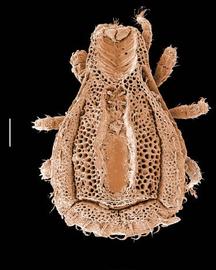
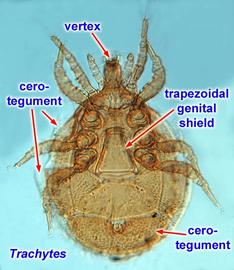
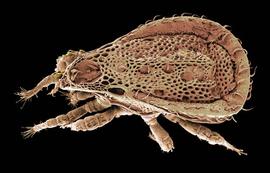
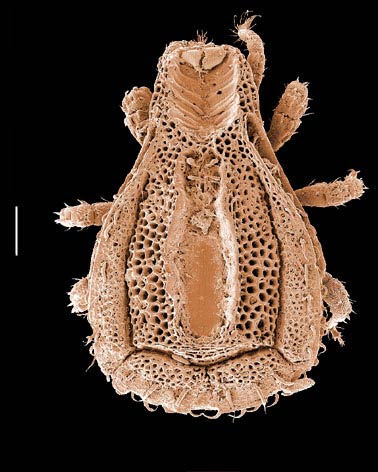
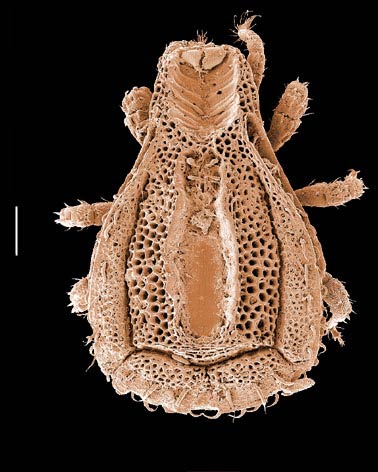
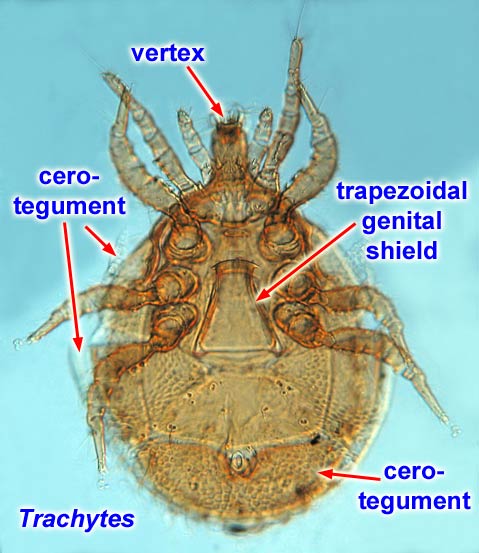
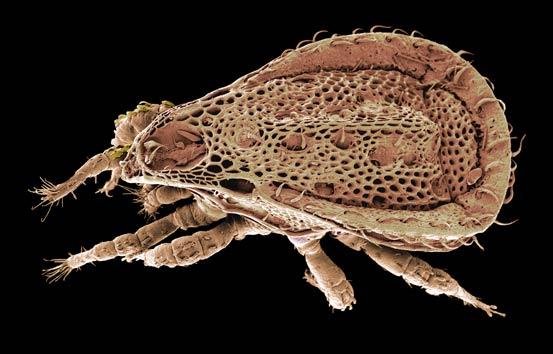
- Slow moving, rough surfaced wedge-shaped mites with a dense coating of cerotegument; podonotal, marginal, and pygidial shields under cerotegument
- <100 dorsal idiosomal setae
- Scabellum and pedofossae absent
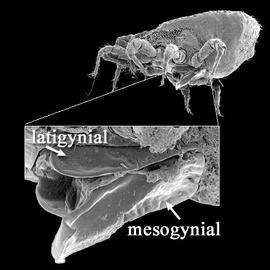
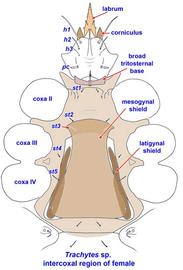
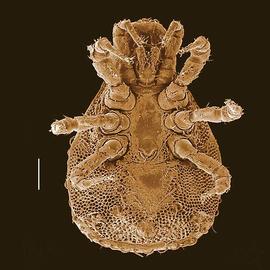
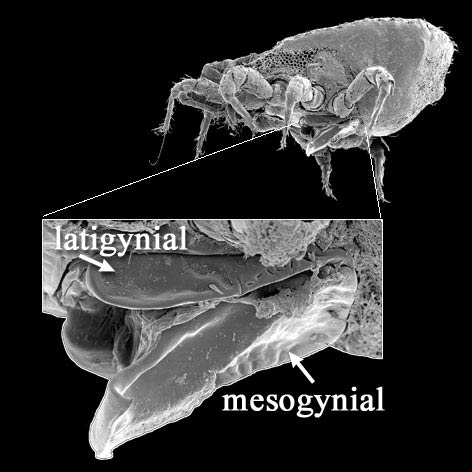
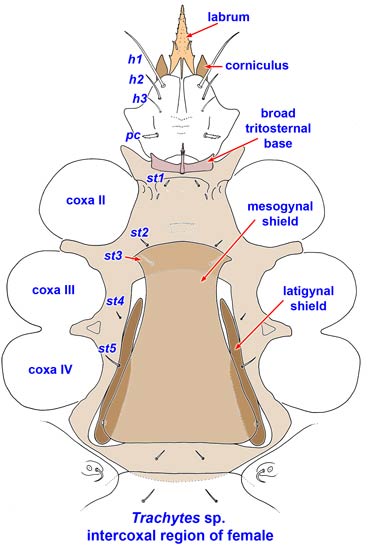
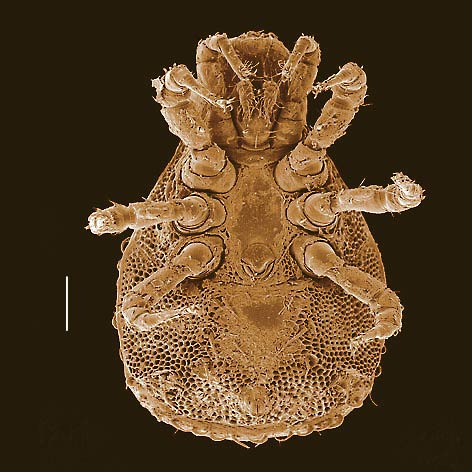
- Sternal setae (st1–4) + JV1 on ventral shield that encompasses the genital opening; st5 on narrow latigynal shields
- Mesogynal shield nude, shaped like an elongate trapezoid
- Anal opening on ventrianal shield.
- Legs I without ambulacra, coxae I enlarged, but subcylindrical and widely separated; trochanter I with 4 setae; tibia I with 4 dorsal and 2 ventral setae; all genua with 4 dorsal setae; genu II with 4 lateral setae.
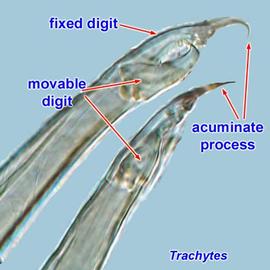
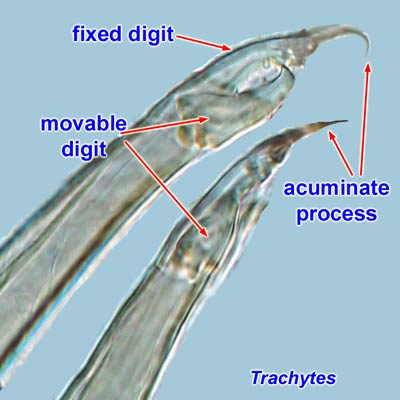
- Chelicerae slender, elongate; fixed digit ending in tapering, acuminate process; corniculi horn-like.
- Tectum with strong, tapering median process; hypostomal denticles in broad median rows.
- Palp apotele 2-tined; palp genu with 5 setae, palp femur with 5 setae.
- Tritosternal laciniae fused basally and subdivided distally; tritosternum wider than long, rectangular.
- Male genital opening intercoxal, valves with or without setae; chelicerae not obviously modified for sperm transfer.
Similar taxa
Key to adult females of common genera of Polyaspidoidea
-
Idiosoma and mesogynal shield oval to subrectangular; marginal shield fragmented.............................. 2
- Idiosoma pyriform, mesogynal shield trapezoidal; marginal shield entire.............................. Trachytes
-
Genu IV with two ventral setae.............................. 3
- Genu IV with one ventral seta.............................. Polyaspinus (+Uroseius)
-
Chelicerae and corniculi elongate, the latter reaching distal end of palpgenu.............................. Polyaspis (+Dyscritaspis)
- Chelicerae and corniculi not elongate.............................. Dipolyaspis
Ecology and distribution
Species of Polyaspis are ambush predators, but the ecology of other Polyaspidoidea is poorly known. Many species are present in forest litter or associated with rotting wood.
References
- Ainscough 1981Ainscough 1981:
Ainscough BD. 1981. Uropodine studies. I. Suprageneric classification in the cohort Uropodina Kramer, 1882 (Acari: Mesostigmata). International Journal of Acarology 7: 47–56.
- Bloszyk and Halliday 2000Bloszyk and Halliday 2000:
Bloszyk J, Halliday RB. 2000. Observations on the genus Polyaspinus Berlese 1916 (Acari: Trachytidae). Systematic and Applied Acarology 5: 47–64.
- Camin 1954bCamin 1954b:
Camin JH. 1954b. Polyaspis berlesei, a new species of trachytoid mite (Mesostigmata: Polyaspidae). Bulletin of the Chicago Academy of Sciences 10: 25–33.
- Evans and Till 1979Evans and Till 1979:
Evans EO, Till WM. 1979. Mesostigmatic mites of Britain and Ireland (Chelicerata: Acari-Parasitiformes): An introduction to their external morphology and classification. Transactions of the Zoological Society of London 35 (2): 145–270.
- Gilyarov and Bregatova 1977Gilyarov and Bregatova 1977:
Gilyarov MS, Bregatova NG, eds. 1977. Handbook for the identification of soil-inhabiting mites, Mesostigmata. Zoological Institute of the Academy of Sciences, Petrograd.
- Karg 1989aKarg 1989a:
Karg W. 1989a. Acari (Acarina), Milben Unterordnung Parasitiformes (Anactinotrichaeta) Uropodina Kramer, Schildkrötenmilben. Die Tierwelt Deutschlands 67: 1–203.
- Krantz and Ainscough 1990Krantz and Ainscough 1990:
Krantz GW, Ainscough B. 1990. Mesostigmata. pp. 583–665. In: Dindal DL, ed. Soil biology guide. John Wiley & Sons, Brisbane.
- Wisniewski and Hirschmann 1993Wisniewski and Hirschmann 1993:
Wisniewski J, Hirschmann W. 1993. Gangsystematik der Parasitiformes. Teil 548. Katalog der Ganggattungen, Untergattungen, Gruppen und Arten die Uropodiden der Erde. Acarologie, Schriftenreihe für Vergleichende Milbenkunde 40: 1–220.
- Womersley 1961Womersley 1961:
Womersley H. 1961. Studies of the Acarina fauna of leaf-litter and moss from Australia. No. 2. A new trachytid mite, Polyaspinus tuberculatus, from Queensland (Acarina, Trachytina). Records of the South Australian Museum 14: 115–123.