Weed
Canada thistle
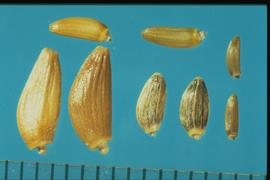
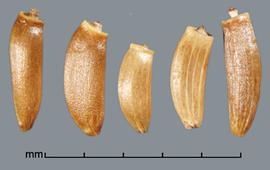
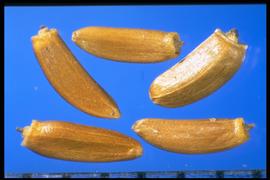
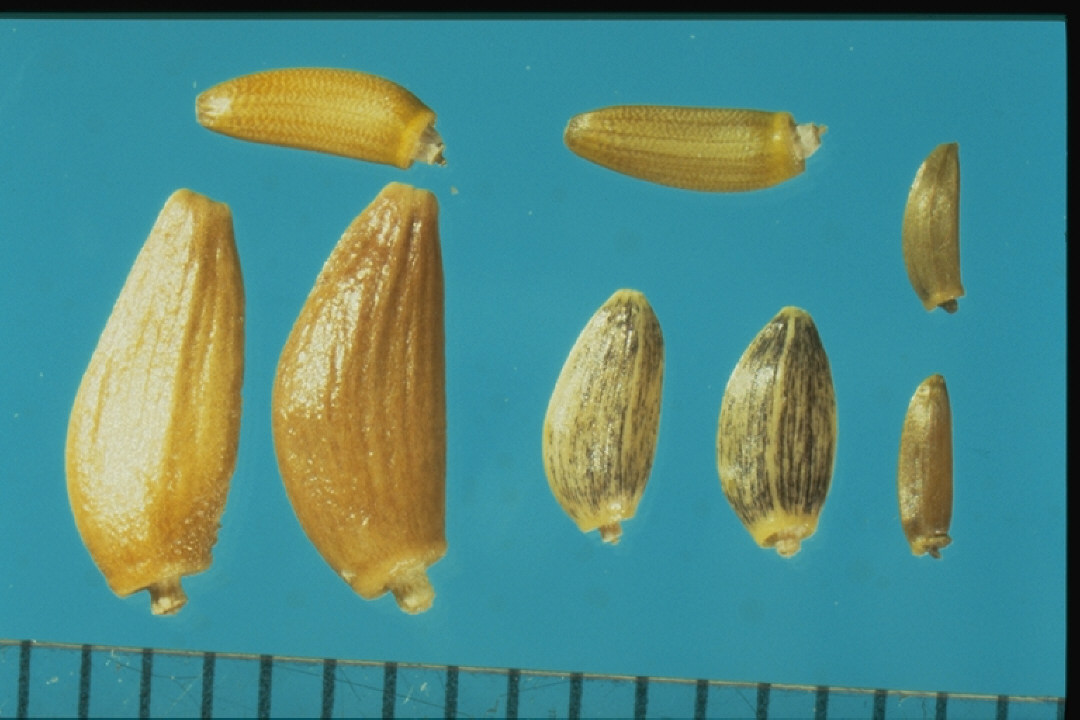
AcheneAchene:
A dry, hard, one-chambered, one-seeded indehiscent fruit, as in buckwheat (Fagopyrum) or sunflower (Helianthus). The fruit wall is not united with the seed coat.
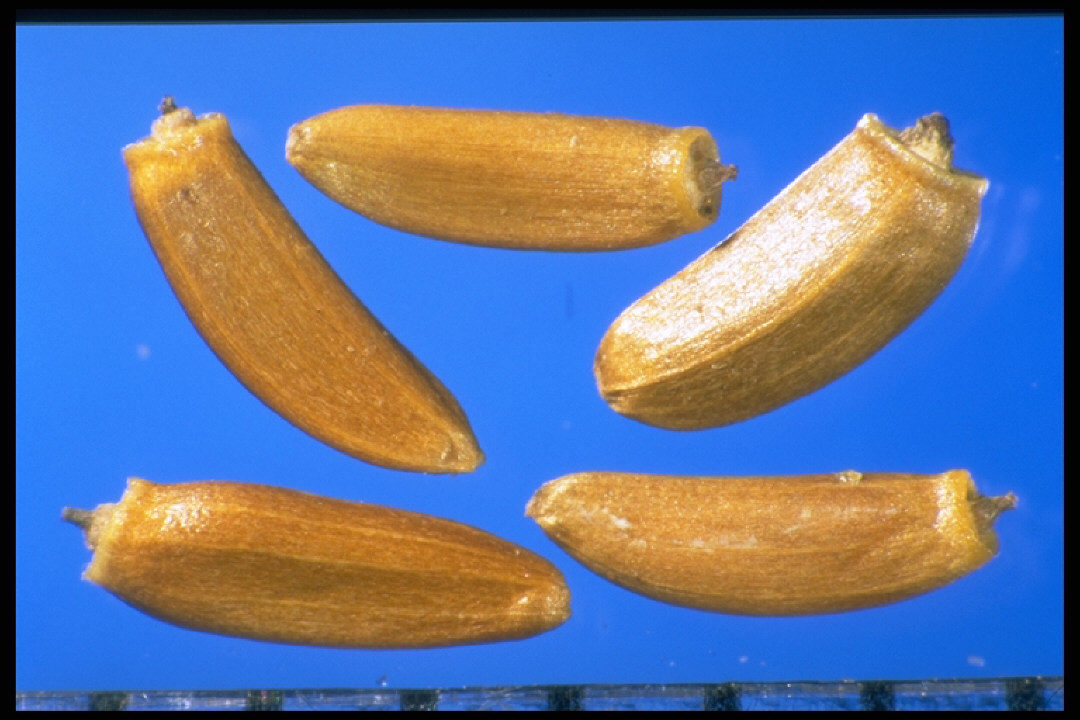
Curved and obovateObovate:
Inverted egg shaped with apical end the broadest.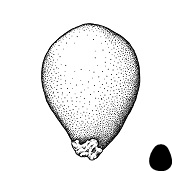
Brown usually with a yellow collar, some yellow longitudinal lines.
Smooth
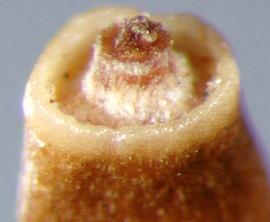
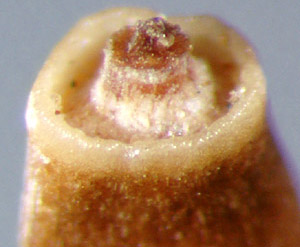
StylarStylar:
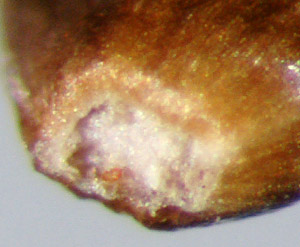
The end of the fruit or seed that contains the style or the apical end.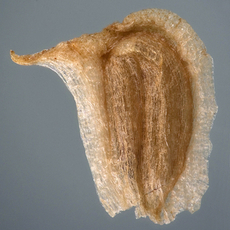 knob is small.
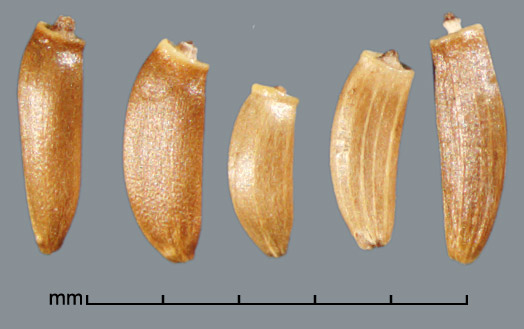
AchenesAchene:
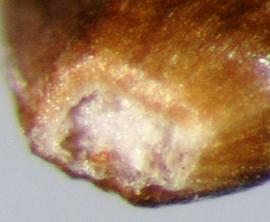
A dry, hard, one-chambered, one-seeded indehiscent fruit, as in buckwheat (Fagopyrum) or sunflower (Helianthus). The fruit wall is not united with the seed coat. are oblong, sometimes curved, with a small stylarStylar:
The end of the fruit or seed that contains the style or the apical end. knob and a basalBasal:
The base of the fruit or seed opposite the apical end.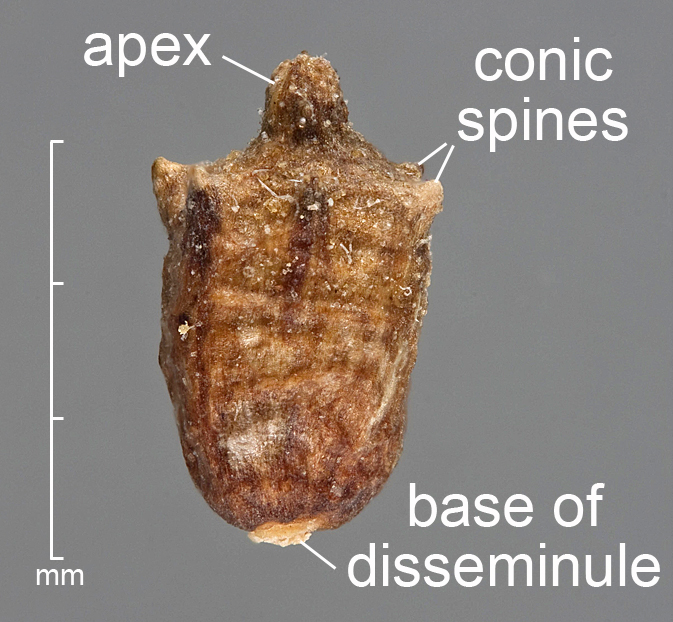 scar. Color uniformly brown with apicalApical:
The distal end of the fruit or seed away from the point of attachment or attachment scar.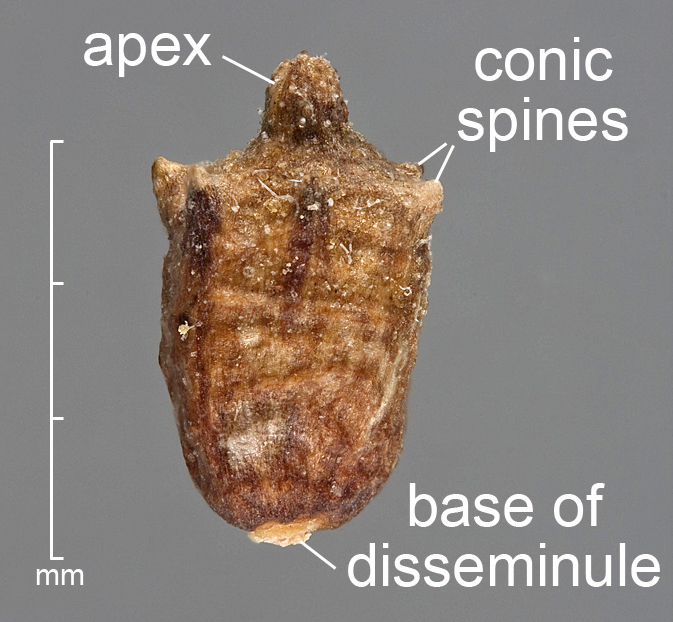 rim slightly lighter. AchenesAchene:
A dry, hard, one-chambered, one-seeded indehiscent fruit, as in buckwheat (Fagopyrum) or sunflower (Helianthus). The fruit wall is not united with the seed coat. seldom retain their pappusPappus:
Modified calyx in Asteraceae, composed of hairs, bristles, awns, or scales. The pappus-like structure attached to milkweed seeds is termed a coma. 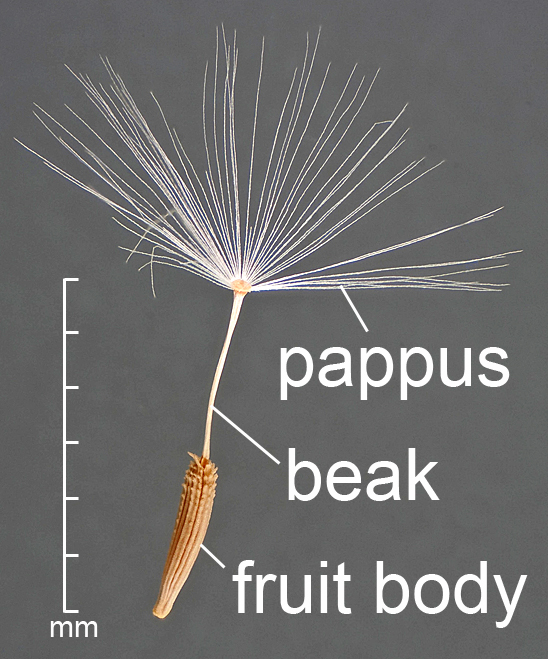 in conditioned seed lots.
State Noxious Weed: Alabama, Alaska, Arizona, Arkansas, California, Colorado, Connecticut, Delaware, DC., Florida, Georgia, Hawaii, Idaho, Illinois, Indiana, Iowa, Kentucky, Louisiana, Maine, Maryland Massachusetts Michigan Minnesota Mississippi, Missouri, Montana, Nebraska, Nevada, New Hampshire, New Jersey, New Mexico, North Carolina, North Dakota, Ohio, Oklahoma, Oregon, Pennsylvania, Rhode Island, South Carolina, South Dakota, Tennessee, Utah, Vermont, Virginia, Washington, West Virginia Wisconsin, Wyoming
Federal: This species is actionable only when found in field or vegetable seed for planting; toleranceTolerance:
The amount by which a second test may differ from a first test without being attributed to an actual difference in seed quality. Tolerances are usually based on normal random variation, or sampling error.
applies, see (7 CFR 361.6(a)(2)).
Learn more on ITP's Federal Noxious Weed Disseminules tool.
Included
For more information, see ISMA fact sheet.
Asteraceae
Cirsium arvense (L.) Scop.
Breea arvensis (L.) Less.
Breea incana (S.G. Gmel.) W.A. Weber, ined.
Carduus arvensis (L.) Robson
Cirsium arvense (L.) Scop. var. argenteum (Vest) Fiori
Cirsium arvense (L.) Scop. var. horridum Wimm. & Grab.
Cirsium arvense (L.) Scop. var. integrifolium Wimm. & Grab.
Cirsium arvense (L.) Scop. var. mite Wimm. & Grab.
Cirsium arvense (L.) Scop. var. vestitum Wimm. & Grab.
Cirsium incanum (S.G. Gmel.) Fisch. ex M. Bieb.
Cirsium setosum (Willd.) Besser ex M. Bieb.
Serratula arvensis L.