The pretarsi of the Tetranychinae often reflex their use, especially modifications for walking on silksilk:
fine threads spun by acariform mites to form a molting chamber (cocoon), protect or attach eggs, or a loosely defined to finely woven web.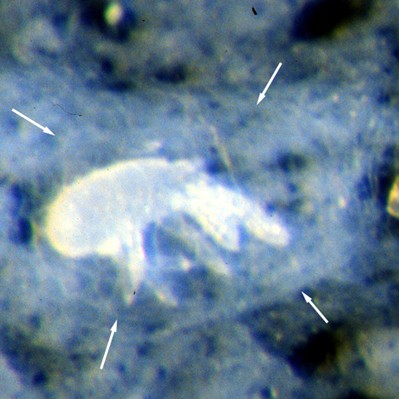 . Economically important genera in the two tribes of Tetranychinae with agricultural pests can be separated partially on the structure of the empodial clawclaw:
like - having a distal hook; resembling a claw.
and proximoventral hairsproximoventral hairs:
the hair-like processes on the empodia of some spider mites; apparently represents a finely divided empodium, and not tenent hairs.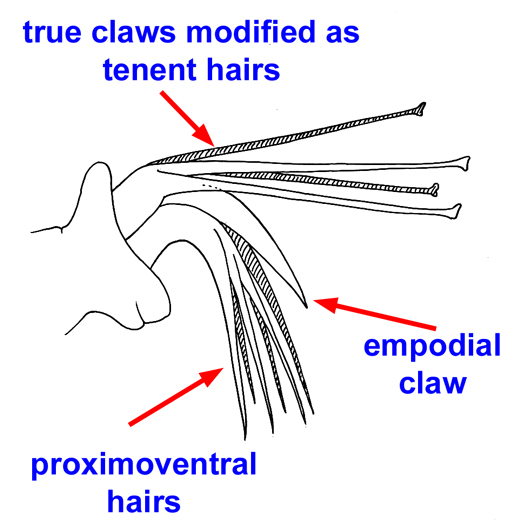 :
:
The empodiaempodium:
(pl. empodia) an unpaired structure arising between the tarsal claws, ranging from pad-like to claw-like and often bearing structures such as tenent hairs, dense setulae, or taking the form of a featherclaw (Eriophyoidea)..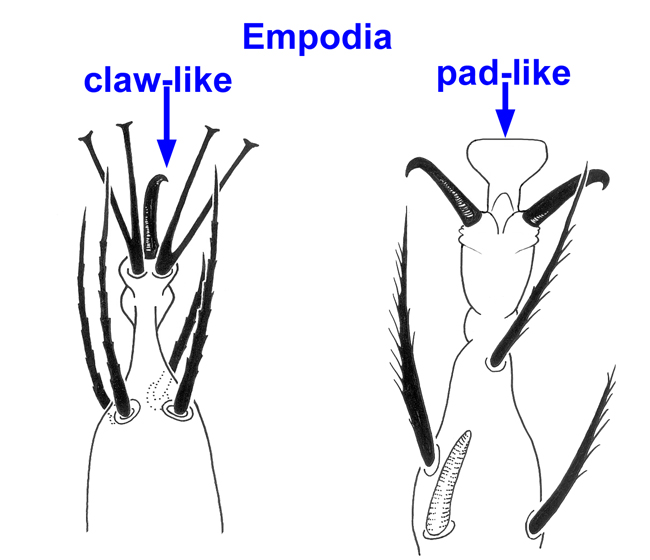 has a clawclaw:
like - having a distal hook; resembling a claw.
-like hookhook:
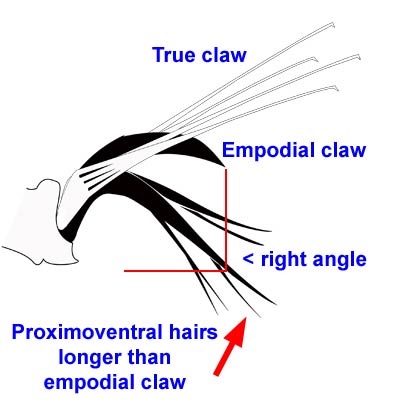
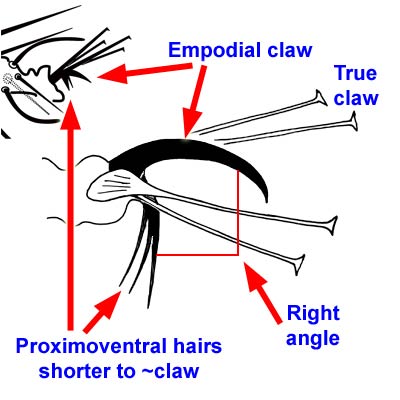
(as in cheliceral hook) the distal hook-like tips of chelicerae in the Mesostigmata, as opposed to cheliceral teeth.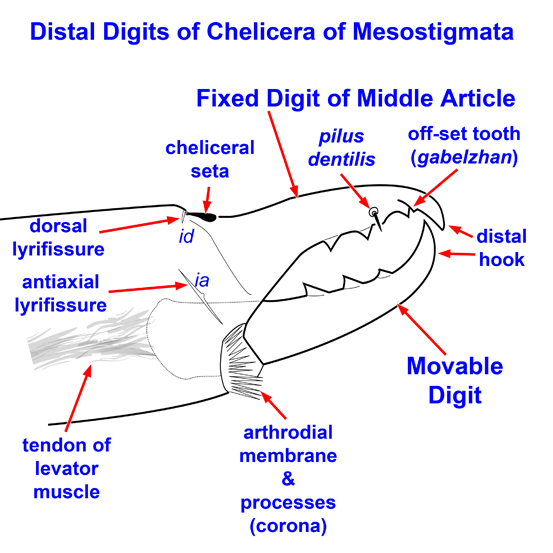 in Oligonychus, Panonychus, and Allonychus. In the latter, the proximoventral hairsproximoventral hairs:
the hair-like processes on the empodia of some spider mites; apparently represents a finely divided empodium, and not tenent hairs. are longer than the clawclaw:
like - having a distal hook; resembling a claw.
, but in the two former genera the proximoventral hairsproximoventral hairs:
the hair-like processes on the empodia of some spider mites; apparently represents a finely divided empodium, and not tenent hairs. are only as long or shorter than the clawclaw:
like - having a distal hook; resembling a claw.
.
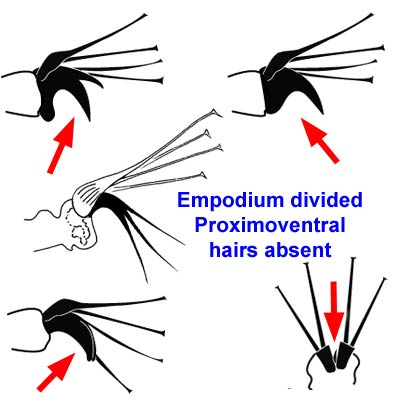
In Eotetranychus, Amphitetranychus, and most Tetranychus the empodial clawclaw:
like - having a distal hook; resembling a claw.
is split distally into 2–3 pairs of 'proximoventral hairs' but usually an empodial clawclaw:
like - having a distal hook; resembling a claw.
is not present. Just to keep things confusing, some Tetranychus have a dorsal spurspur:
a projection, usually tooth- or spine-like, from the body or limbs.
that may look like an empodial clawclaw:
like - having a distal hook; resembling a claw.
.
In Schizotetranychus and the Eurytetranychini proximoventral hairsproximoventral hairs:
the hair-like processes on the empodia of some spider mites; apparently represents a finely divided empodium, and not tenent hairs. are not present.
Author: David E. Walter
Content last updated Sept. 2006, unless indicated otherwise
Lucid key player updated Sept. 2025
idtools.org