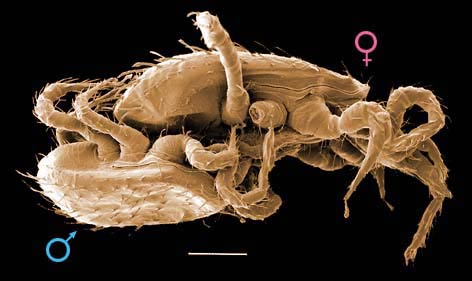
This is a key to mesostigmatic mites likely to be found in quarantine intercepts compiled by Dr. David Evans Walter of Colorado State University and the University of Alberta (dew@ualberta.ca).
About one-quarter of all mite species belong to the monogynaspidmonogynaspine:
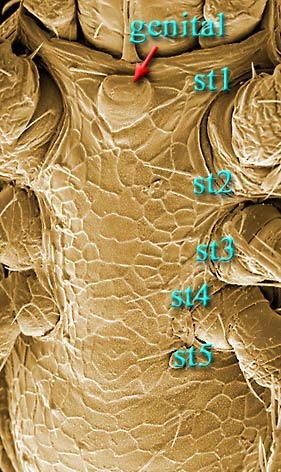
(monogynaspid) representative of the mesostigmatan suborder Monogynaspida, characterized by having a single genital shield in the adult female that usually bears one pair of setae (st5) or may be nude.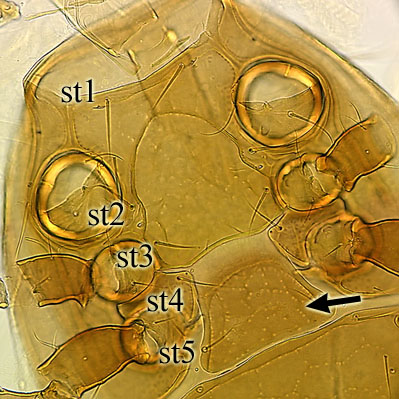 Mesostigmata, including many economically important pests (e.g., varroa mite of bees, fowl mites, rat mites) and even more economically useful biocontrol agents (especially in the families Phytoseiidae, Laelapidae and Macrochelidae). Because of their pervasiveness, mesostigmatans are commonly found in quarantine inspections, but primarily because few are plant parasites, there are few taxonomic specialists to help in their identification. This key is designed to support the identification of members of the largest suborder of Mesostigmata, the Monogynaspida (See the key Major mite taxa to identify Mesostigmata to suborder). Monogynaspids are the mesostigmatans most likely to be found in a quarantine intercept and the Monogynaspida contains all of the economically important species.
In most cases, identification of Mesostigmata to family or lower can be accomplished only if the specimen is an adult female. The easiest way to determine the stagestage:
a distinct developmental form, e.g., the egg, larval, nymphal and adult stages. Since mite instars are usually morphologically distinct, they are also stages (and see stase). Some authors, however, insist that instar should be apolysis to apolysis and stage ecdysis to ecdysis. Since apolysis can be a discontinuous process and, in any case, is difficult to determine, in practice the difference between a stage and an instar is abstract and of importance only if you have a contentious referee.
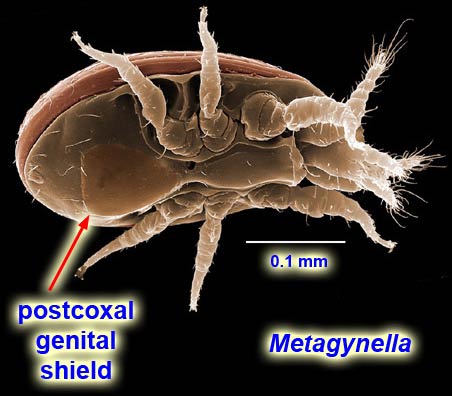
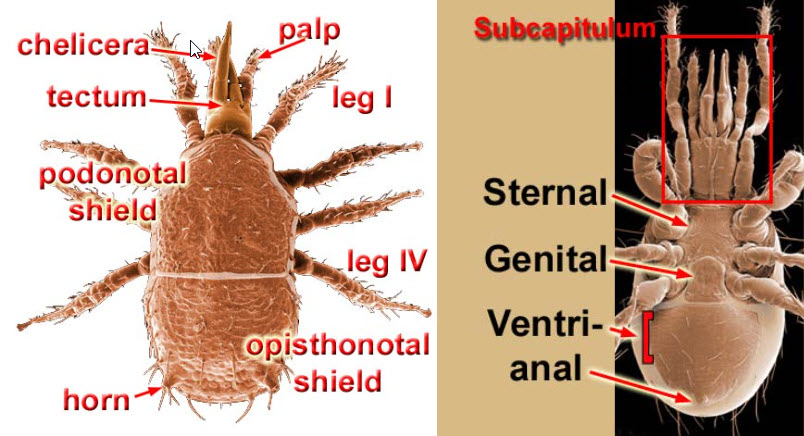
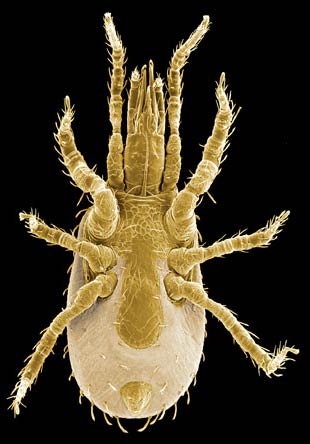
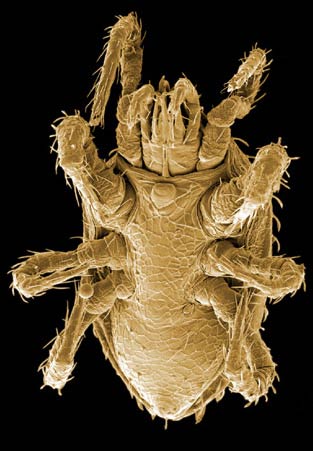
and sex of your specimen is to look at the intercoxal region. Adult females have a genital opening that is almost invariably in the intercoxal region (species of Metagynella (Fig. 1) are exceptions) and covered by a sclerotized shield which may be truncate posteriorly or continue onto the ventral regionventral region:
in Mesostigmata, the area between the genital and anal regions.
. Adult males and immature stages of both sexes have a continuous intercoxal shield that may be truncate or continue onto the ventral regionventral region:
in Mesostigmata, the area between the genital and anal regions.
or even incorporate the entire ventral regionventral region:
in Mesostigmata, the area between the genital and anal regions.
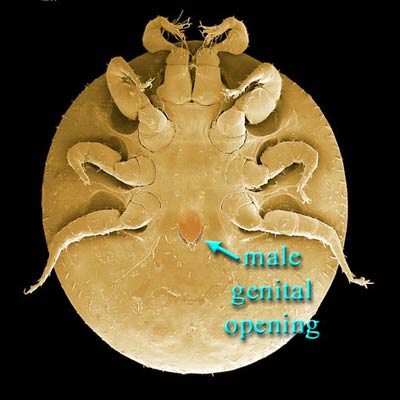
. Adult males have a subcircular opening in the intercoxal shield (sometimes called a sternogenital or sternitogenital shieldsternogenitalshield:
(also sternitogenital, sternitigenital) in male Mesostigmata, a shield covering the intercoxal region and bearing the genital opening.
) somewhere between the posteriorposterior:
the back part of the body or towards that region in comparison, e.g., 'posterior to'.
margins of coxae IV (Fig. 2) and the basebase:
the usually columnar basal part of the tritosternum; sometimes expanded and rectangular or otherwise modified; the most basal part of any structure.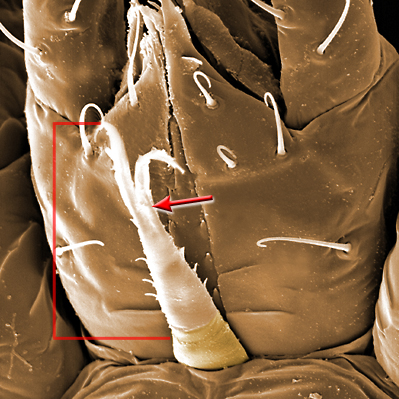 of the tritosternumtritosternum:
the sternum of the 3rd body segment (between legs I); produced as a biflagellate structure in Mesostigmata, although sometimes the flagellae (laciniae) are partially or completely fused. 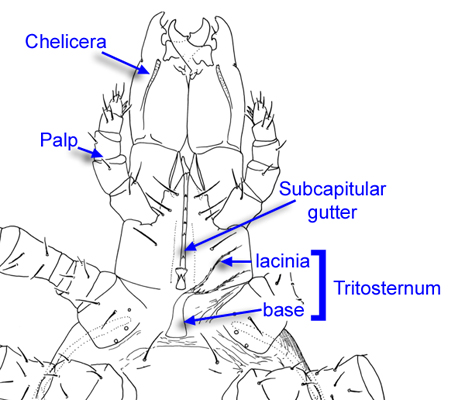 (Fig. 3). Immature stages (larva, protonymphprotonymph:
the first nymphal stage or instar, usually octopod.
, deutonymphdeutonymph:
(also deuteronymph) the second nymphal stage or instar.
) of Mesostigmata have no genital opening.
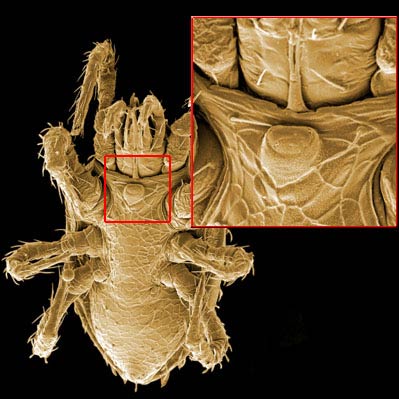
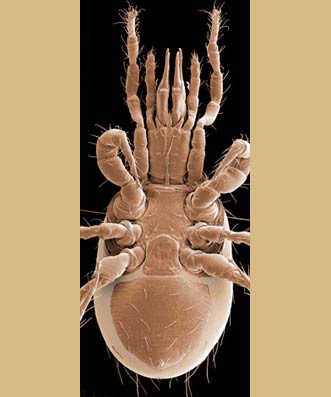
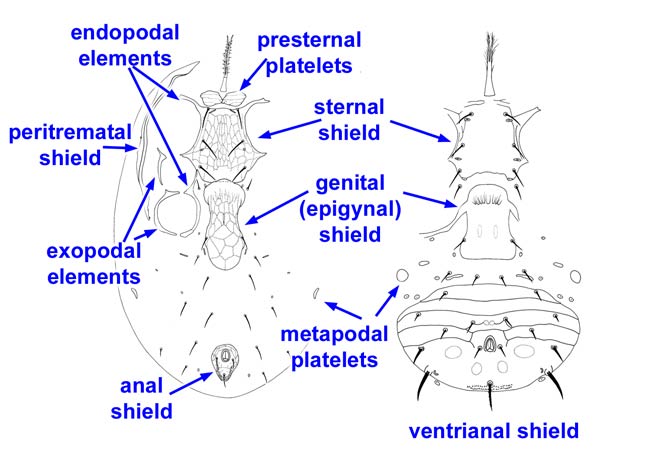
Female mesostigmatans are easily recognized by their genital opening, usually found between coxacoxa:
the basal segment of the leg, articulating with (Parasitiformes) or fused to (Acariformes) the body wall.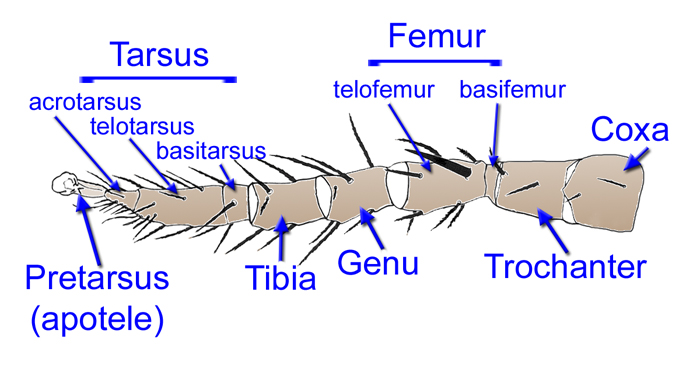 IV and covered by one or more genital shields (Fig. 4). Although called "genital" (or epigynialepigynal:
(also epigynial) of or relating to the female genital opening or a shield protecting it.
, epigynalepigynal:
(also epigynial) of or relating to the female genital opening or a shield protecting it.
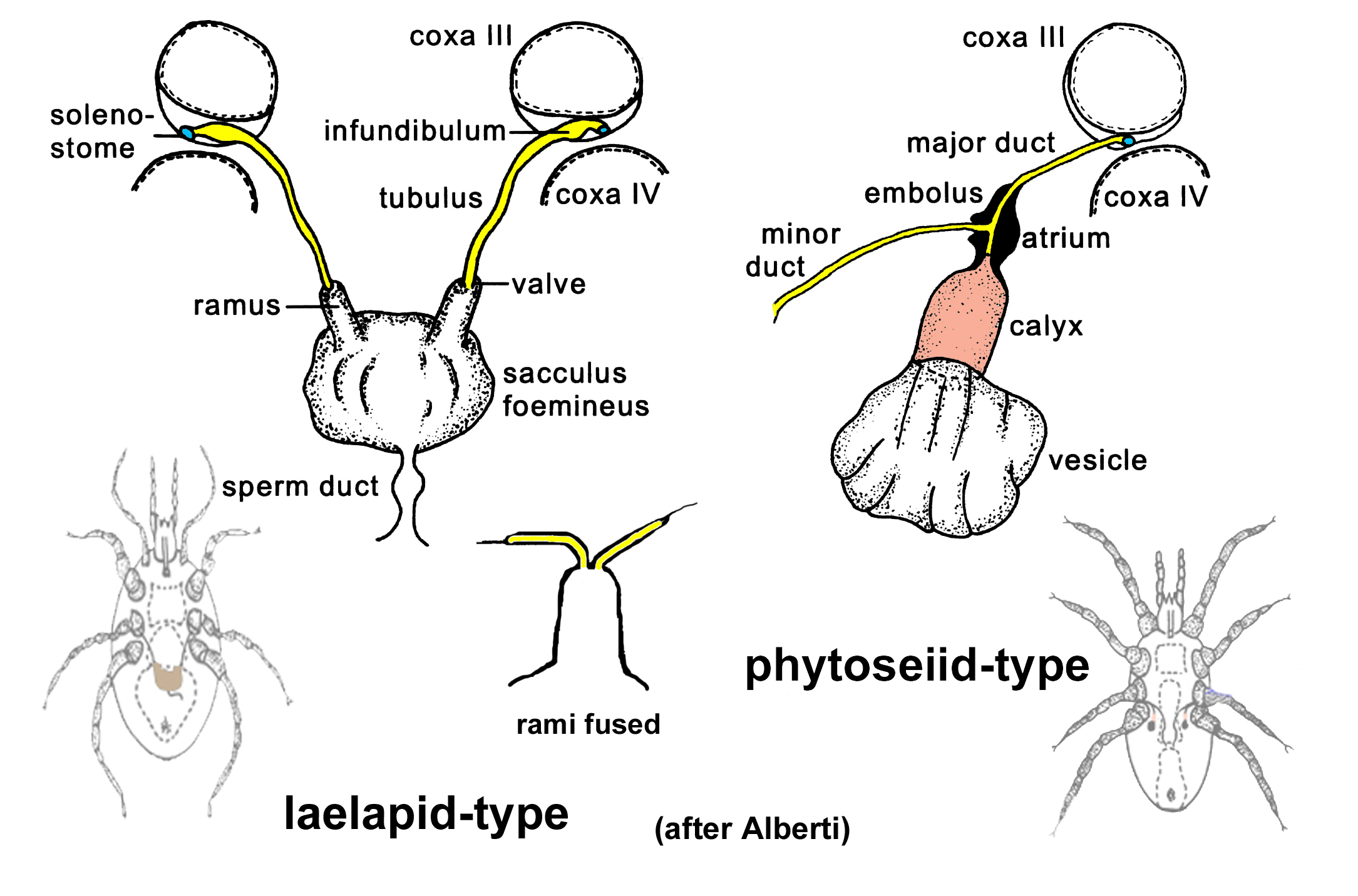
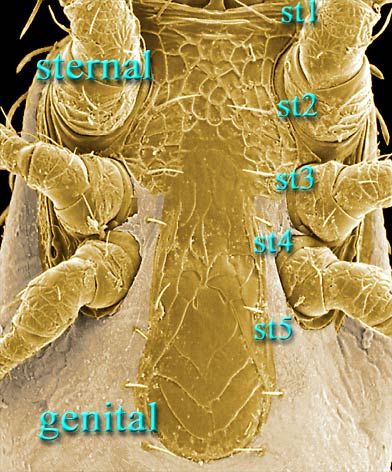
), the shield protects only the ovipore in mesostigmatans with a secondary sperm transfer system (Dermanyssiae; Fig. 5). Females lay eggs relatively large in comparison to their bodybody:
the idiosoma of mites.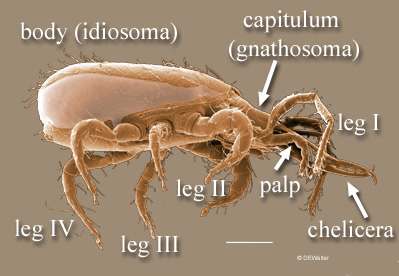 size, so the genital opening and its shield are relatively large, and may be extended posteriorly to incorporate ventralventral:
relating to the lower or under side; opposed to dorsal.
or ventrianal elements.
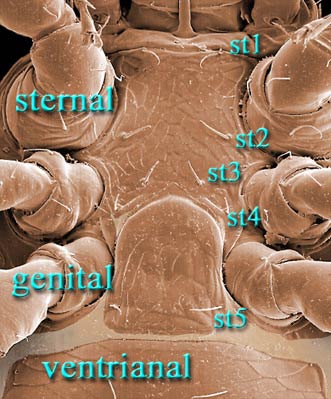
The genital shieldgenital shield:
a shield or shields covering the genital opening; in female mongynaspine Mesostigmata this shield is usually called the epigynal (epigynial) shield.
often bears the 5th pair of sternal setaesternal setae:
in Mesostigmata, the five pairs of setae in the intercoxal region designated st1-5; st1-3 are present in the larva and usually are borne on a sternal shield in the adult female; st4, the metasternal setae, are added in the deutonymph, often are borne on metasternal platelets, and sometimes on the sternal shield; st5, the genital setae, are added in the protonymph and usually borne on or are inserted laterad the epigynal shield in the adult female.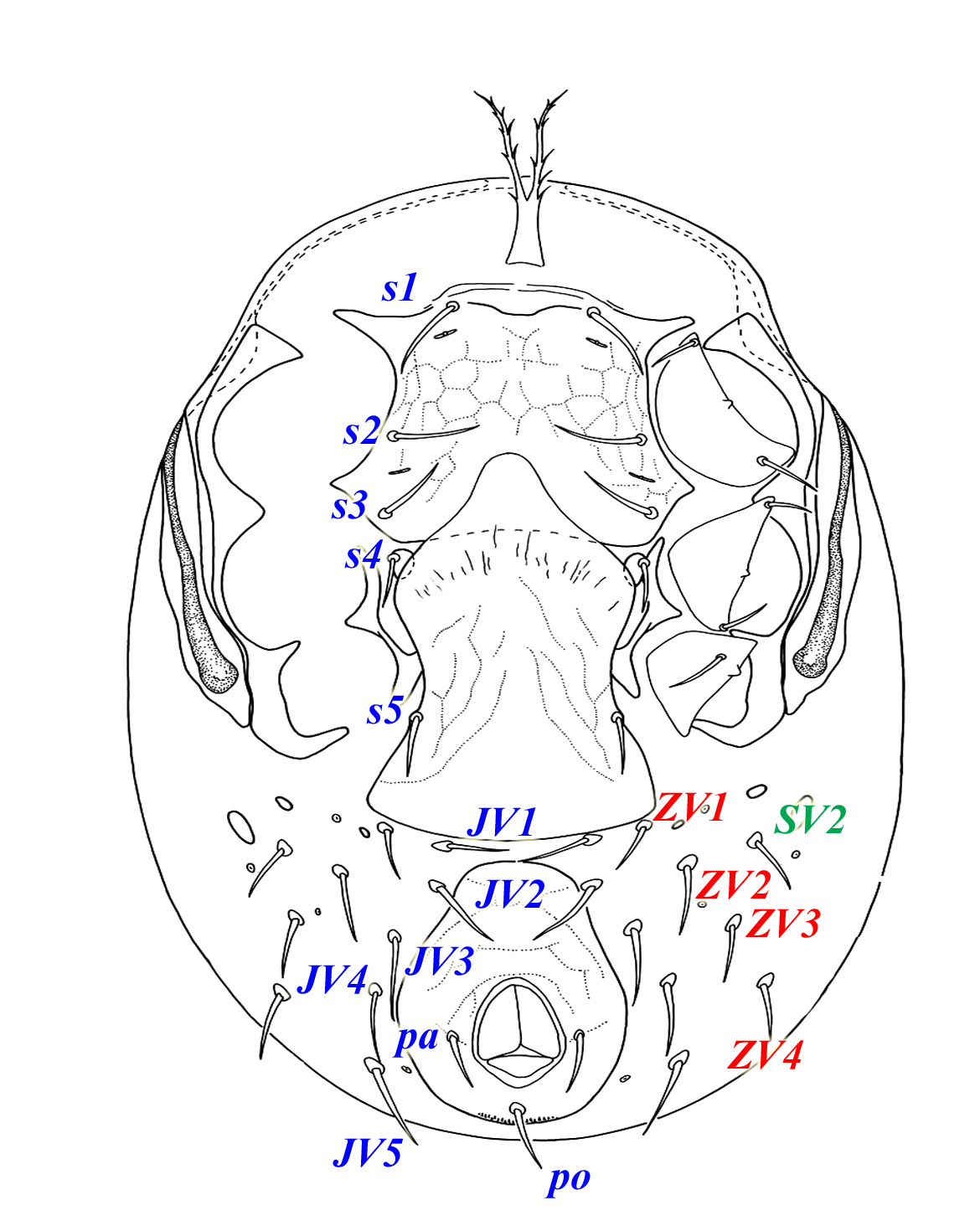 (st5), but may be nude and variously formed. Adult females also usually have one or more shields anterior to the genital shield(s) called sternal shields, and these usually sport one or more of sternal setaesternal setae:
in Mesostigmata, the five pairs of setae in the intercoxal region designated st1-5; st1-3 are present in the larva and usually are borne on a sternal shield in the adult female; st4, the metasternal setae, are added in the deutonymph, often are borne on metasternal platelets, and sometimes on the sternal shield; st5, the genital setae, are added in the protonymph and usually borne on or are inserted laterad the epigynal shield in the adult female. st1–4. Other shields cover the ventralventral:
relating to the lower or under side; opposed to dorsal.
and anal regions. The female ologamasid mite in Figures 6 and 7 has a large ventrianal shieldventrianal shield:
in Mesostigmata, a ventral shield bearing the anal opening, circum anal setae, and one or more pairs of ventral setae or pores (lyrifissures) [see anal shield]; maybe rather narrow or very broad and covering most of the gaster.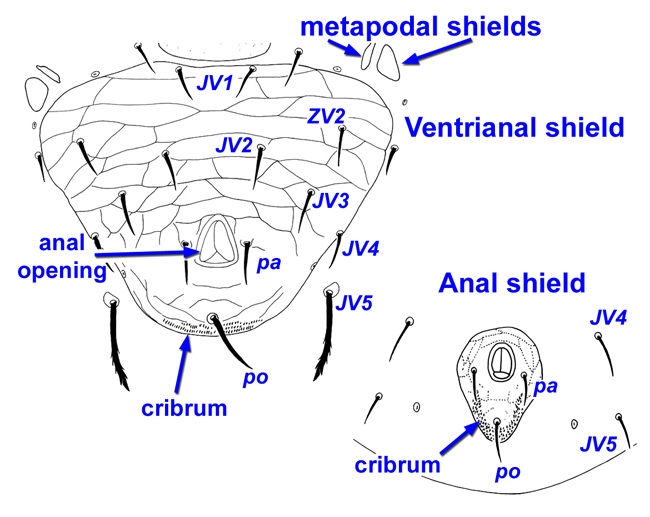 , while the female laelapid mite in Figures 8 and 9 has a small anal shield.
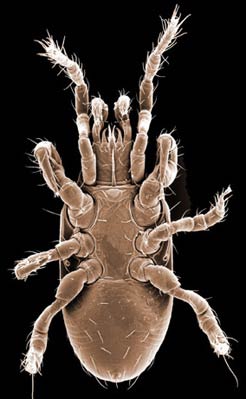
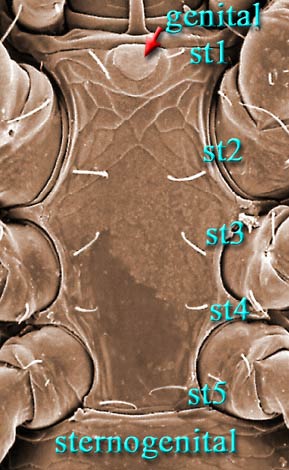
Males, however, produce relatively small sperm packets (spermatophores) and have much smaller genital openings. Although these openings also may lie between coxae IV, they are more typically towards the anterior end of the intercoxal region and often at the basebase:
the usually columnar basal part of the tritosternum; sometimes expanded and rectangular or otherwise modified; the most basal part of any structure. of the tritosternumtritosternum:
the sternum of the 3rd body segment (between legs I); produced as a biflagellate structure in Mesostigmata, although sometimes the flagellae (laciniae) are partially or completely fused. (see details in Figs. 10–13). In the male ologamasid mite (Figs. 10, 11), the genital opening is in a sternogenital (also sternitogenital) shield that bears 5 pairs of setae (st1–5). In the male laelapid mite (Figs. 12, 13), however, the sternogenital shield is fused to the ventrianal shieldventrianal shield:
in Mesostigmata, a ventral shield bearing the anal opening, circum anal setae, and one or more pairs of ventral setae or pores (lyrifissures) [see anal shield]; maybe rather narrow or very broad and covering most of the gaster. and other elements to form a ventral shieldventral shield:
in Mesostigmata, any shield or shields in the ventral region; often fused with the anal shield to form a ventrianal shield. [Back to Top]
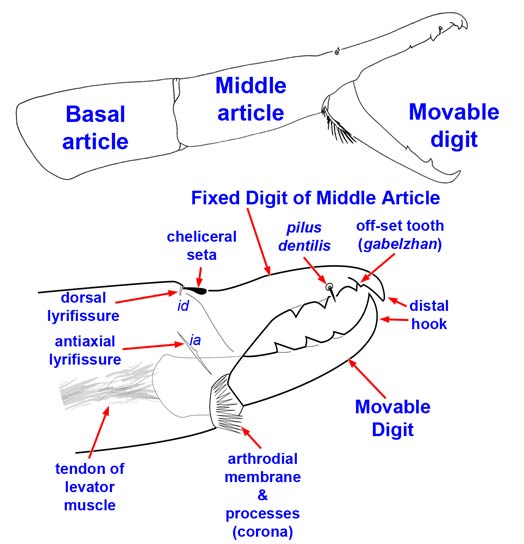
or plate. Males also often, but not always, have modifications to their chelicerae for transferring sperm, e.g., spermatodactyls or spermatotremes.
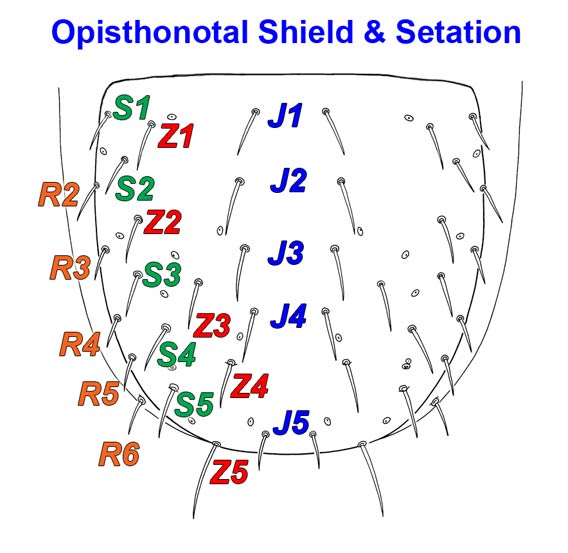
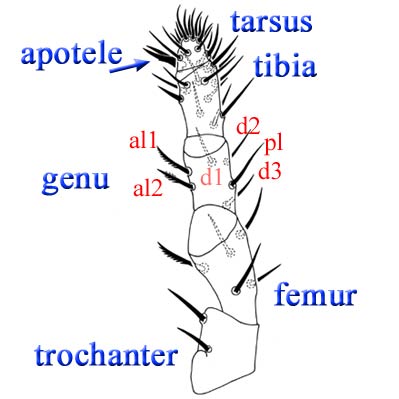
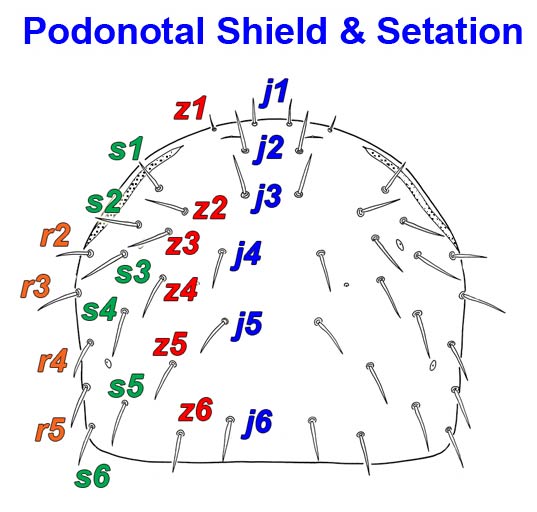
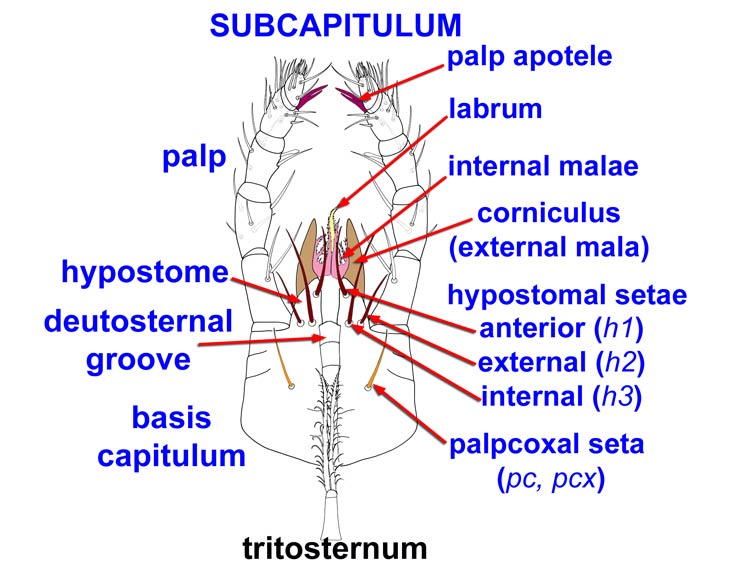
Click on an anatomical part below for a detailed illustration
Author: David E. Walter
Content last updated Sept. 2006, unless indicated otherwise
Lucid key player updated Sept. 2025
idtools.org