Mites are mostly minute (0.080 to 16 mm long as adults) cheliceratechelicerate:
a member of the arthropod lineage Chelicerata that includes the horseshoe crabs, scorpions, spiders, mites and their relatives.
arthropods. Their closest relatives appear to be the Ricinulei and the Acari
Factsheet for:Acari
Glossary:Opilioacariformes:
an obsolescent supraordinal term used for the Opilioacarida.
+ Ricinulei comprise the Acarinomorpha, a subdivision of the Arachnida. Shared derived characters supporting this taxon include a hexapodhexapod:
with three pairs of legs (i.e. 6 legs), as in the larvae of mites or the larviform stages of others.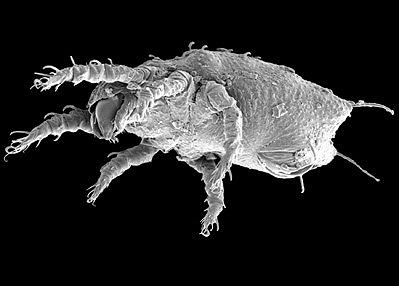 larval stagestage:
a distinct developmental form, e.g., the egg, larval, nymphal and adult stages. Since mite instars are usually morphologically distinct, they are also stages (and see stase). Some authors, however, insist that instar should be apolysis to apolysis and stage ecdysis to ecdysis. Since apolysis can be a discontinuous process and, in any case, is difficult to determine, in practice the difference between a stage and an instar is abstract and of importance only if you have a contentious referee.
and a distinct capitulumgnathosoma:
(= capitulum) the anteriormost part of a mite or ricinuleid, composed of the cheliceral and pedipalpal segments and separated from the body (idiosoma) by a ring of soft cuticle.
or gnathosomagnathosoma:
(= capitulum) the anteriormost part of a mite or ricinuleid, composed of the cheliceral and pedipalpal segments and separated from the body (idiosoma) by a ring of soft cuticle.
(see Glossary for definition of unfamiliar terms).
Mites have been traditionally treated as a Subclass (Acari
Factsheet for:Acari
Glossary:Opilioacariformes:
an obsolescent supraordinal term used for the Opilioacarida.
or Acarina) of the Class Arachnida composed of 2–3 orders. However, the recognition of the Acarinomorpha requires the demotion of the Acari
Factsheet for:Acari
Glossary:Opilioacariformes:
an obsolescent supraordinal term used for the Opilioacarida.
or the invention of a new rank. Rather than coin new term for intermediate taxa, and since the analysis of relationships is still in flux, it seems best to leave the Acari
Factsheet for:Acari
Glossary:Opilioacariformes:
an obsolescent supraordinal term used for the Opilioacarida.
rankless or to use the old "subclass" for convenience.
The high diversity of the Acari
Factsheet for:Acari
Glossary:Opilioacariformes:
an obsolescent supraordinal term used for the Opilioacarida.
and the large number of subdivisions necessary to accommodate all the taxa make for a complicated set of taxonomic ranks. At the present time, two superorders are recognized: the Acariformes and the Parasitiformes (including the once separate Opilioacarida).
The Parasitiformes has about 15,000 described species in four distinct orders: Opilioacarida (=Tetrasigmata, NotostigmataNotostigmata:
an obsolete term for the Opilioacarida (also Opilioacariformes) referring to their possession of dorsolateral stigmatal openings.
), Ixodida (=Metastigmata, ticks), Holothyrida (=Holothyrina), and Mesostigmata (=Gamasida). Only the latter has more than one suborder. The Mesostigmata is divided into three suborders: Sejida, Trigynaspida, and Monogynaspida. Sejida contains a single supercohort, but Trigynaspida is divided into two supercohorts (Cercomegistina, Antennophorina) and Monogynaspida into five supercohorts (Microgyniina, Uropodina, Heterozerconina, and Gamasina). Cohorts and families especially important in quarantine are in red.
The Acariformes contains about 40,000 described species of mites arranged in two orders: Trombidiformes and Sarcoptiformes. The Trombidiformes includes the suborders Sphaerolichida and Prostigmata (=Actinedida). the Sarcoptiformes includes the suborders Endeostigmata and Oribatida (=Cryptostigmata, OribateiOribatei:
an obsolete name for the paraphyletic concept of Oribatida.
). The latter includes the very important cohort Astigmatina (=Astigmata, Acaridida).
Author: David E. Walter
Content last updated Sept. 2006, unless indicated otherwise
Lucid key player updated Sept. 2025
idtools.org