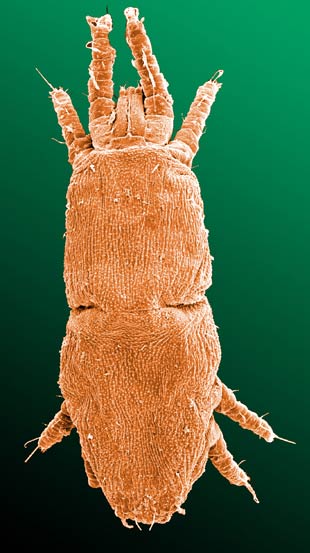
Exotic mite families
t
Taxonomy
updated 2025
Name
Tenuipalpidae Berlese, 1913
Classification
Superorder Acariformes » Order Trombidiformes » Suborder Prostigmata » Infraorder EleutherengonaEleutherengona:
(also Eleutherengonida, Eleutherengonina, Eleutherengonides) an infraorderwithin the Prostigmata consisting of the two hyporders Raphignathina and Heterostigmata. Eleutherengona includes many of the most important plant-parasitic mites, e.g., spider mites, broad mite, cyclamen mite.
» Hyporder Raphignathina » Superfamily Tetranychoidea » Family Tenuipalpidae
Common names
flat mites, false spider mites, bunch mites, red tea mite
Probability of encounter
very high
Quarantine importance
High. About 30 genera and over 600 species of Tenuipalpidae have been described, primarily in the most economically important genera: Brevipalpus (>300 spp.) and Tenuipalpus (>200 spp.). Tenuipalpids feed on stems, fruit, flowers, and leaves (often on the lower surface); some species form galls (e.g., Larvacarus transitans (Ewing) produces twig galls on jujube trees in India and Obdulia tamaricis Pritchard on Tamarix trees in the Mideast). Serious damage is caused to many crops (e.g., citrus, tea, grapes, fruit trees, ornamentals, orchids, grasses, pineapple). Additionally, several tenuipalpids are confirmed vectors of virus or virus-like diseases of plants, e.g., Brevipalpus phoenicis vectors coffee ringspot and passion fruit green spot viruses in Brazil and Costa Rica and B. californicus vectors orchid fleck virus in many parts of the world; tenuipalpids also are associated with citrus necrosis.
Diagnosis
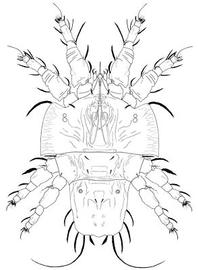
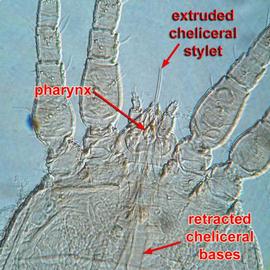
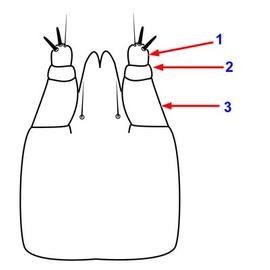
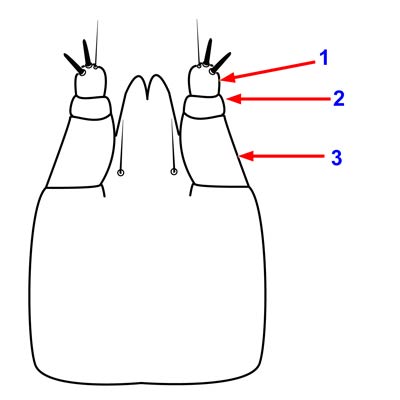
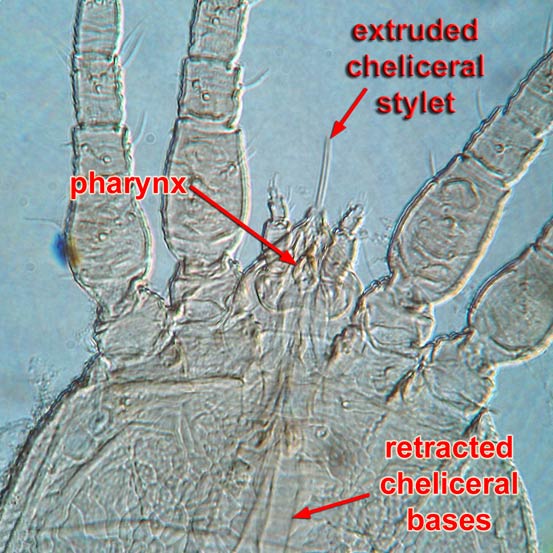
- Cheliceralcheliceral:
of or pertaining to the chelicera.
bases adnate, fused mesally into a stylophorestylophore:
chelicerae formed of fused cheliceral bases bearing stylet-like movable digits as in Raphignathae (Prostigmata), e.g., the plant parasitic spider mites and their relatives (Tetranychoidea). In predatory and parasitic Cheyletoidea and parasitic Myobiidae, the stylophore and subcapitulum are fused into a gnathosomal capsule.
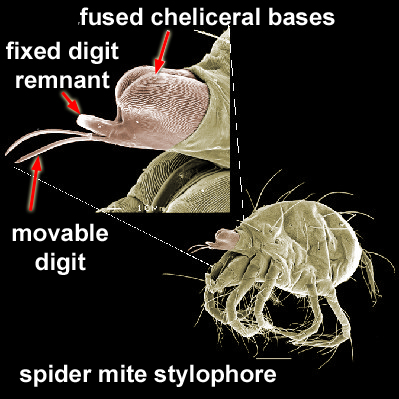 (sometimes withdrawn into the bodybody:
the idiosoma of mites.
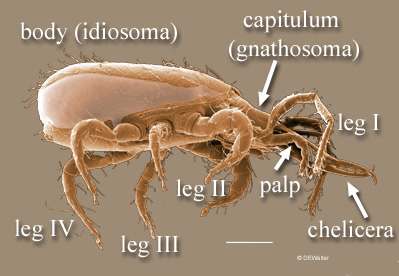 ); chelicerae with fixed digitfixed digit:
the distal extension of the middle article of the chelicera; usually bearing teeth and a distal hook and opposed to the movable digit in chelate-dentate forms, but often regressed; in Mesostigmata the fixed digit may bear the pilus dentilis.
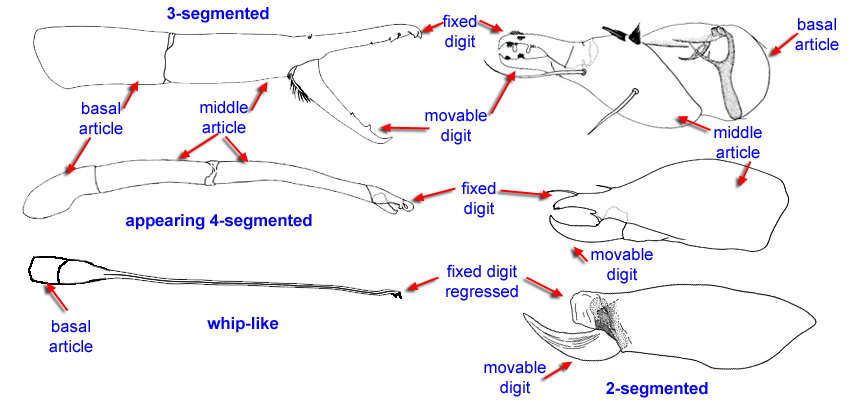 reduced and movable digit whiplike.
- Palptibial clawpalptibial claw:
a claw-like seta on the palptibia of some Prostigmata that forms a chelate structure with the palp tarsus, the palp thumbclaw complex.
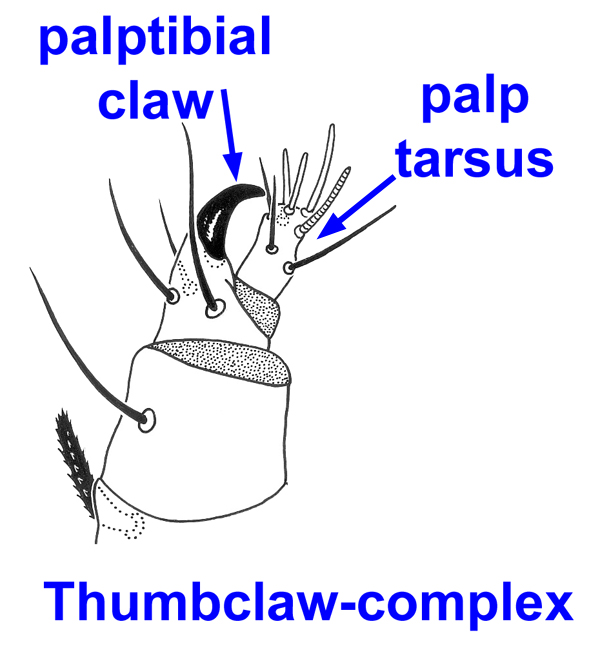 complex absent; palpal segmentationsegmentation:
in mites distinct external segments have been lost but remnants of segmentation may be represented by hysterosomal folds or transverse arrays of setae and other cuticular sense organs. In theory, all chelicerates have a prosoma composed of 6 segments (cheliceral, pedipalpal, and four leg-bearing segments = body segments I-VI). Ventrally the positions of the prosomal segments can be identified by the insertions of their appendages, but dorsally they are obscured. The opisthosoma is thought to comprise an additional 12-13 segments (body segments VII-XVIII or XIX), but appears to be somewhat to much reduced in most mites, except possibly Opilioacarida. In early derivative Acariformes (e.g., many Endeostigmata), hysterosomal folds are thought to represent segmentation and in the Grandjean system are designated (from the sejugal furrow to the anus): C, D, E, F, H, PS AD, AN, PA. There is disagreement in the literature over the origin of 'segments' C and D. Adherents of Grandjean consider them to be opisthosomatic (with C probably representing a fusion of the pregenital [body segment VII] and genital [VIII] segments). Others believe that C and D are the dorsal regions of the last two prosomal segments that bear leggs III and IV (i.e., body segments V & VI).
often reduced (see last image) (5–1 free segments).
- Bodybody:
the idiosoma of mites.
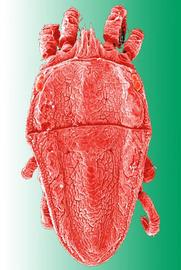
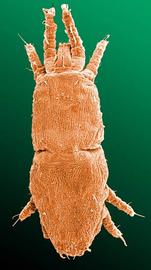
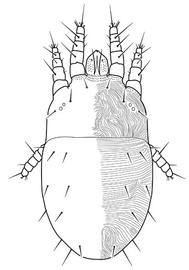
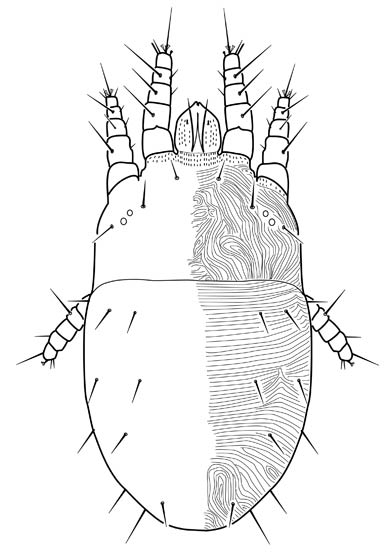
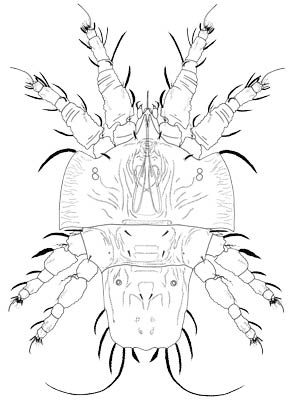
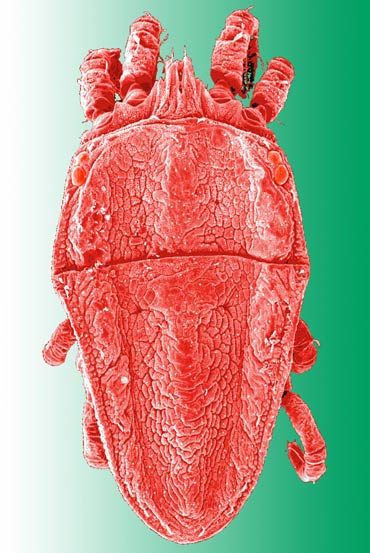
often flattened, with or without well developed plates.
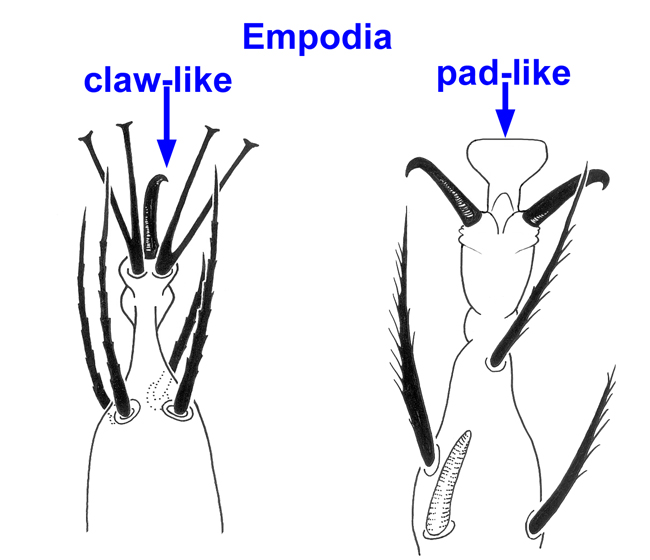
- Adults with 3 or 4 pairs of legs; tarsal claws usually with tenent hairs on both claws and empodiumempodium:
(pl. empodia) an unpaired structure arising between the tarsal claws, ranging from pad-like to claw-like and often bearing structures such as tenent hairs, dense setulae, or taking the form of a featherclaw (Eriophyoidea)..
 .
.
- 2 pairs of eyes usually present, some species blind.
- Naso absent; 3–4 pairs of prodorsal setaeprodorsal setae:
the setae on the prodorsum of acariform mites. Two competing chaetotactic systems are used for designations: the Rostral-lamellar and Vertical-scapular systems.
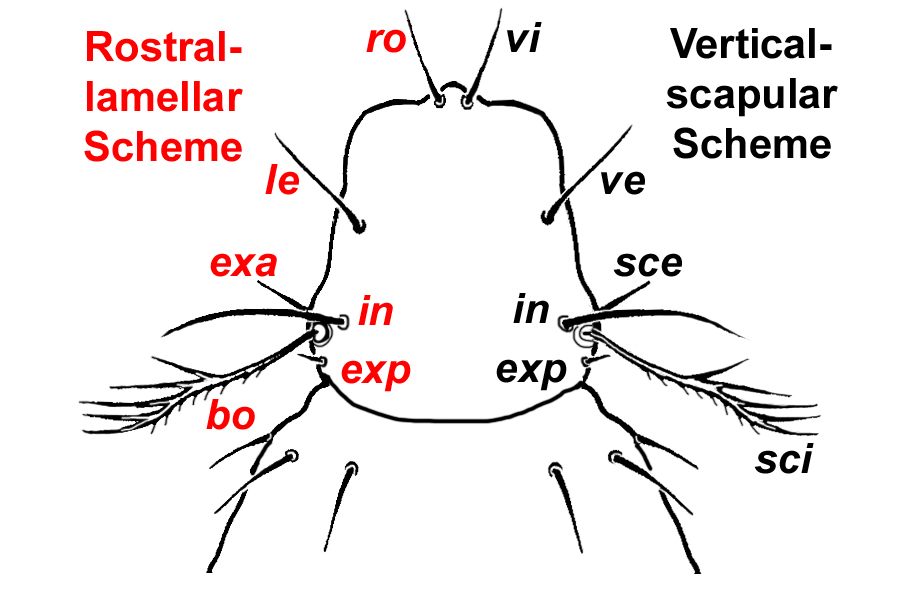 present; trichobothriatrichobothrium:
(pl. trichobothria) (= bothridial sensillum) an often elaborately modified seta set in a cup-like base; forms include filiform, ciliate, pectinate or variously thickened or clubbed (bat-like to globose or capitate).
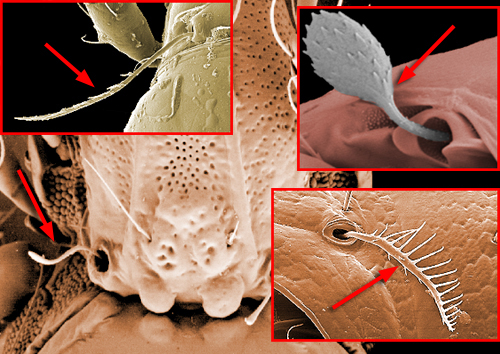 absent.
- Peritremes, when present, typically chamberedchambered:
a structure with discrete compartments, e.g., the peritremes of some ologamasids (Mesostigmata) and prostigmatans.
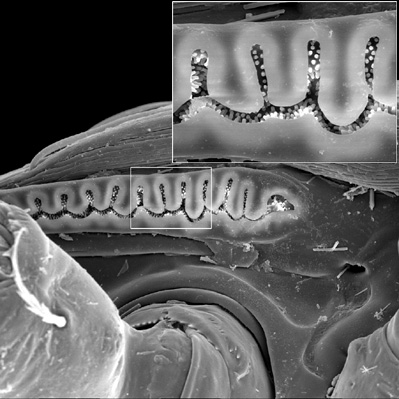 structures on the dorso-lateral surface of the prodorsumprodorsum:
the dorsal surface of the propodosoma.
- Genital papillaegenital papillae:
1-3 pairs of extrusible finger-like to button-like projections, usually retracted into in the genital vestibule of acariform mites; sometimes formed as sessile disks around the genital opening; thought to be osmoregulatory structures; modified or multiplied and dispersed over the body in many freshwater mites. Genital papillae are absent in the larva, but may be added ontogenetically: protonymphs have one pair, deutonymphs two pairs, and tritonymphs (and adults) three pairs. The tritonymphal pair of papillae is often lost. The serially homologous Claparède's organ is usually present in the larvae (and prelarvae) of mites exhibiting genital papillae in nymphs and adults (Oudeman's Rule).
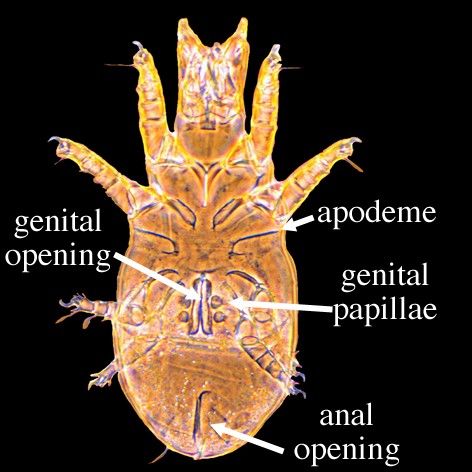 absent; males with an intromittent aedeagus.
Similar taxa
Other members of the Tetranychoidea are the mites most likely to be confused with Tenuipalpidae. Although these mites all share the distinctive tetranychoid mouthparts, tenuipalpids are the only tetranychoids that consistently lack a palptibial claw complex (except for one known species of Linotetranidae). Also, many tenuipalpids have highly reduced palps. Several tenuipalpid lineages appear to have convergently suppressed leg IV in the adult and resemble larval mites, e.g., Larvacarus transitans (Ewing) on jujube in India, Raoiellana allium Baker and Tuttle on Allium bulbs from Turkey, species of Phytoptipalpus on Acacia and Albizzia in Africa and India, and an undescribed genus in Australia that forms galls on the leaves of shrubby composites.
Ecology and distribution
As with all Tetranychoidea, all known species of Tenuipalpidae are obligate parasites on higher plants.
References
- Bajwa et al. 2001Bajwa et al. 2001:
Bajwa WI, Krantz GW, Kogan M. 2001. Discovery of Cenopalpus pulcher (C.& F.) (Acari: Tenuipalpidae) in the New World. Proceedings of the Entomological Society of Washington 103: 754–756.
- Baker 1979Baker 1979:
Baker EW. 1979. A note on paedogenesis in Brevipalpus sp. (Acari: Tenuipalpidae), the first such record for a mite. International Journal of Acarology 5: 355-356.
- Baker and Pritchard 1960Baker and Pritchard 1960:
Baker EW, Pritchard AE. 1960. The tetranychoid mites of Africa. Hilgardia 29 (11): 455–574.
- Baker and Tuttle 1972Baker and Tuttle 1972:
Baker EW, Tuttle DM. 1972. New species and further notes on the Tetranychoidea mostly from the southwestern United States (Acarina: Tetranychidae and Tenuipalpidae). Smithsonian Contributions to Zoology 116: 1–37.
- Baker and Tuttle 1975Baker and Tuttle 1975:
Baker EW, Tuttle DM. 1975. A new genus of Tenuipalpidae (Acarina) from India. USDA Cooperative Economic Institute Report 25 (22): 453–455.
- Baker and Tuttle 1987Baker and Tuttle 1987:
Baker EW, Tuttle DM. 1987. The false spider mites of Mexico (Tenuipalpidae: Acari). United States Department of Agriculture, Agricultural Research Services, Technical Bulletin No. 1706: 237 pp.
- Chagas et al. 2003Chagas et al. 2003:
Chagas CM, Kitajima EW, Rodrigues JCV. 2003. Coffee ringspot virus vectored by Brevipalpus phoenicis (Acari: Tenuipalpidae) in coffee. Experimental and Applied Acarology 30: 203–213.
- Childers et al. 2003aChilders et al. 2003a:
Childers CC, French JV, Rodrigues JCV. 2003a. Brevipalpus californicus, B. obovatus, B. phoenicis, and B. lewisi (Acari: Tenuipalpidae): A review of their biology, feeding injury and economic importance. Experimental and Applied Acarology 30: 5–28.
- Childers et al. 2003bChilders et al. 2003b:
Childers CC, Rodrigues JCV, Welbourn WC. 2003b. Host plants of Brevipalpus californicus, B. obovatus, and B. phoenicis (Acari: Tenuipalpidae). Experimental and Applied Acarology 30: 29–105.
- Collyer 1973aCollyer 1973a:
Collyer E. 1973a. A new species of the genus Dolichotetranychus (Acari: Tenuipalpidae) from New Zealand. New Zealand Journal of Science 16: 747–749.
- Collyer 1973bCollyer 1973b:
Collyer E. 1973b. New species of the genus Tenuipalpus (Acari: Tenuipalpidae) from New Zealand, with a key to the world fauna. New Zealand Journal of Science 16: 915–955.
- Evans et al. 1993Evans et al. 1993:
Evans GA, Cromroy HL, and Ochoa R. 1993. The Tenuipalpidae of Honduras (Tenuipalpidae: Acari). Florida Entomologist 76: 126-155.
- Jeppson et al. 1975Jeppson et al. 1975:
Jeppson LR, Keifer HH, and Baker EW. 1975. Mites injurious to economic plants. University of California Press, Berkeley.
- Meyer 1979Meyer 1979:
Meyer MKPS. 1979. The Tenuipalpidae (Acari) of Africa with keys to the world fauna. Republic of South Africa, Department of Agricultural Technical Services, Entomology Memoir No. 50: 135 pp.
- Ochoa et al. 1994Ochoa et al. 1994:
Ochoa R, Aguilar H, and Vargas C. 1994. Phytophagous mites of Central America: An illustrated guide. CATIE, Turrialba, Costa Rica.
- Weeks et al. 2001Weeks et al. 2001:
Weeks AR, Marec F, and Breeuwer JAJ. 2001. A mite species that consists entirely of haploid females. Science 292: 2479-2482.
- Welbourn et al. 2003Welbourn et al. 2003:
Welbourn WC, Ochoa R, Kane EC, and Erbe EF. 2003. Morphological observations on Brevipalpus phoenicis (Acari: Tenuipalpidae) including comparisons with B. californicus and B. obovatus. Experimental & Applied Acarology 30: 107-133.
- Zhang 2003Zhang 2003:
Zhang Z-Q. 2003. Mites of greenhouses: Identification, biology and control. CABI Publishing, Wallingford. 244 pp.
Videos
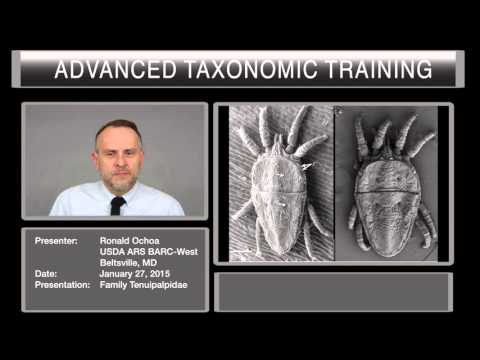
Introduction to Tenuipalpidae
General overview of the mite family Tenuipalpidae