Exotic mite families
t
Taxonomy
updated 2025
Name
Tuckerellidae Baker and Pritchard, 1953Baker and Pritchard, 1953:
Baker EW, Pritchard AE. 1953. The family categories of tetranychoid mites, with a review of the new families Linotetranidae and Tuckerellidae. Annals of the Entomological Society of America 46: 243–258.
Classification
Superorder Acariformes » Order Trombidiformes » Suborder Prostigmata » Infraorder EleutherengonaEleutherengona:
(also Eleutherengonida, Eleutherengonina, Eleutherengonides) an infraorderwithin the Prostigmata consisting of the two hyporders Raphignathina and Heterostigmata. Eleutherengona includes many of the most important plant-parasitic mites, e.g., spider mites, broad mite, cyclamen mite.
» Hyporder Raphignathina » Superfamily Tetranychoidea » Family Tuckerellidae
Common names
peacock mites, ornamental false spider mites
Probability of encounter
medium
Quarantine importance
Medium. The Tuckerellidae consists of a single genus, Tuckerella, and about two dozen species. A few of these are sometimes pests of crops and one species has been associated with citrus necrosis.
Diagnosis
- Empodiumempodium:
(pl. empodia) an unpaired structure arising between the tarsal claws, ranging from pad-like to claw-like and often bearing structures such as tenent hairs, dense setulae, or taking the form of a featherclaw (Eriophyoidea)..
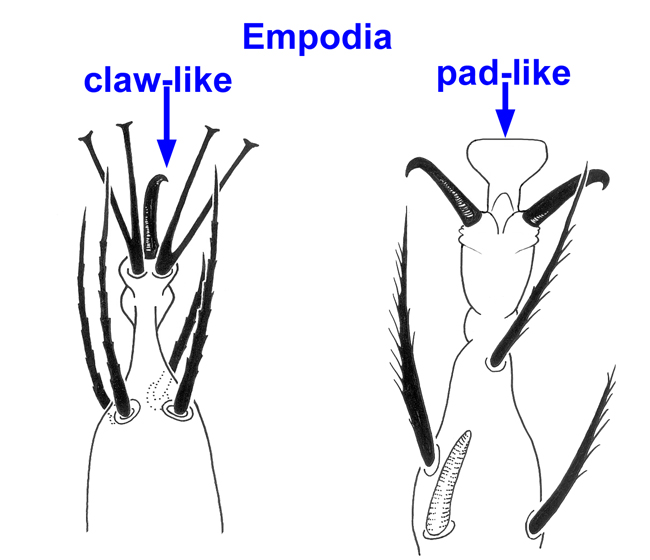 with tenent hairs
- Prodorsumprodorsum:
the dorsal surface of the propodosoma.
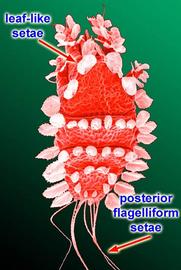
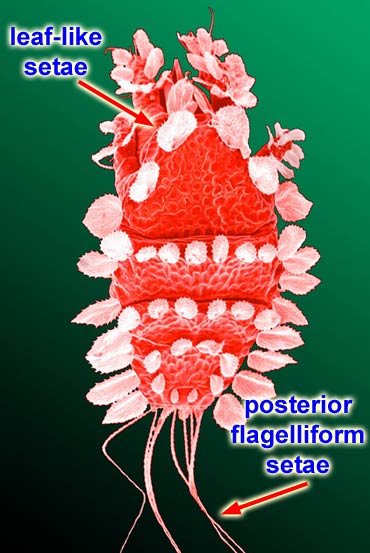
with 4 pairs of setae (vi, ve, sci, sce)
- Most dorsaldorsal:
relating to the upper or back side; opposed to ventral.
setae expanded, leaf-like; posteriorposterior:
the back part of the body or towards that region in comparison, e.g., 'posterior to'.
margin with row of flagelliform setae.
- Adult female with 3 pairs of anal setae (males with 5 pairs of ano-genital setae)
- Cheliceralcheliceral:
of or pertaining to the chelicera.
bases adnate, fused mesally into a stylophorestylophore:
chelicerae formed of fused cheliceral bases bearing stylet-like movable digits as in Raphignathae (Prostigmata), e.g., the plant parasitic spider mites and their relatives (Tetranychoidea). In predatory and parasitic Cheyletoidea and parasitic Myobiidae, the stylophore and subcapitulum are fused into a gnathosomal capsule.
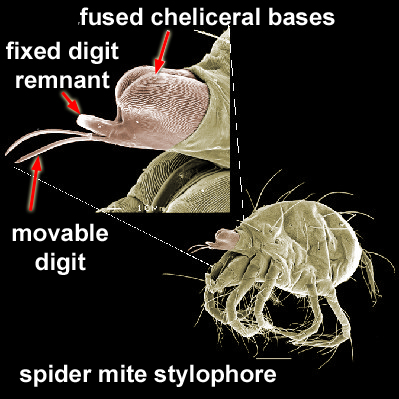 (sometimes withdrawn into the bodybody:
the idiosoma of mites.
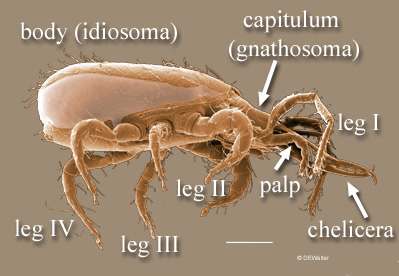 ); chelicerae with fixed digitfixed digit:
the distal extension of the middle article of the chelicera; usually bearing teeth and a distal hook and opposed to the movable digit in chelate-dentate forms, but often regressed; in Mesostigmata the fixed digit may bear the pilus dentilis.
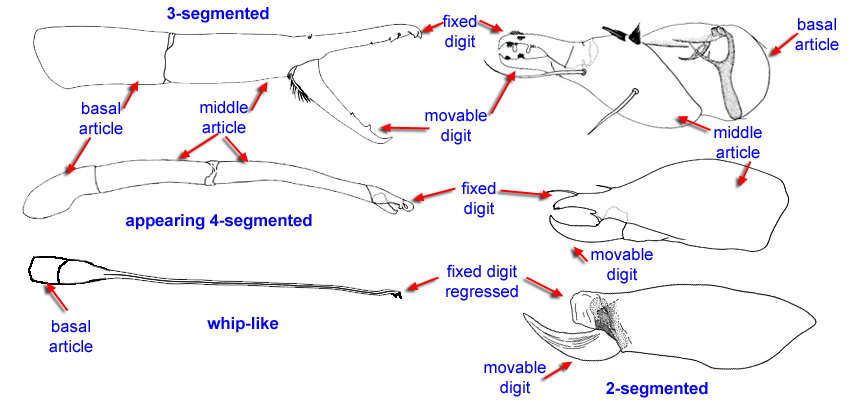 reduced and movable digit whiplike.
- Peritremes typically chamberedchambered:
a structure with discrete compartments, e.g., the peritremes of some ologamasids (Mesostigmata) and prostigmatans.
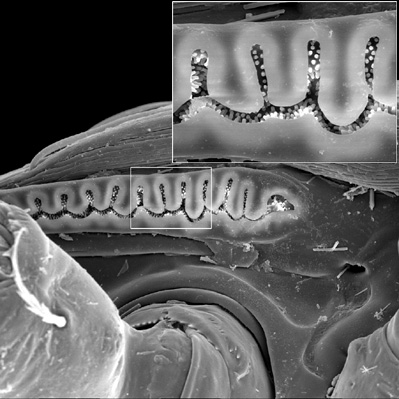 structures on the dorso-lateral surface of the prodorsumprodorsum:
the dorsal surface of the propodosoma.
; naso absent; prodorsal trichobothriatrichobothrium:
(pl. trichobothria) (= bothridial sensillum) an often elaborately modified seta set in a cup-like base; forms include filiform, ciliate, pectinate or variously thickened or clubbed (bat-like to globose or capitate).
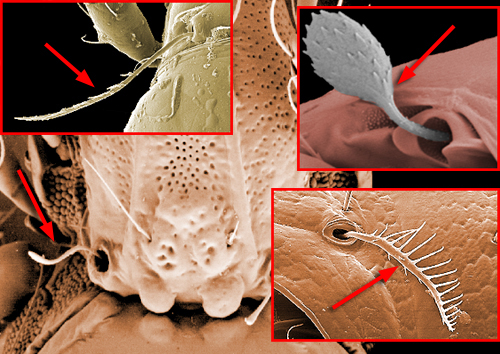 absent; 2 pairs of eye lenses usually present. Palps 5 segmented; with thumbclaw process (claw-like seta on the palp tibiatibia:
(pl. tibiae) the leg segment between the genu and the tarsus.
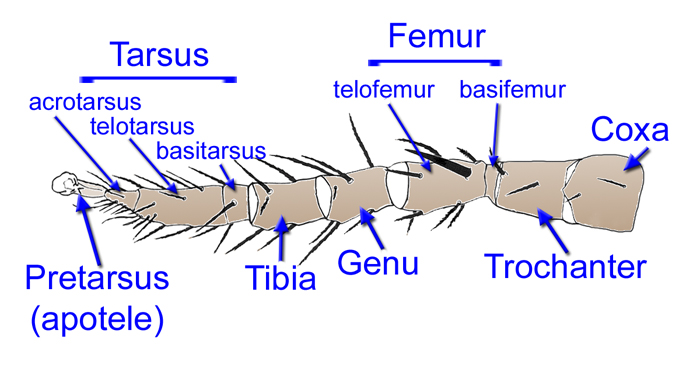 and a thumb- or button-like subterminal palp tarsustarsus:
(pl. tarsi) the subdistal leg segment between the tibia and the pretarsus (apotele).
). Leg tarsitarsus:
(pl. tarsi) the subdistal leg segment between the tibia and the pretarsus (apotele).
usually with tenent hairs on claws or empodiumempodium:
(pl. empodia) an unpaired structure arising between the tarsal claws, ranging from pad-like to claw-like and often bearing structures such as tenent hairs, dense setulae, or taking the form of a featherclaw (Eriophyoidea)..
. Genital papillaegenital papillae:
1-3 pairs of extrusible finger-like to button-like projections, usually retracted into in the genital vestibule of acariform mites; sometimes formed as sessile disks around the genital opening; thought to be osmoregulatory structures; modified or multiplied and dispersed over the body in many freshwater mites. Genital papillae are absent in the larva, but may be added ontogenetically: protonymphs have one pair, deutonymphs two pairs, and tritonymphs (and adults) three pairs. The tritonymphal pair of papillae is often lost. The serially homologous Claparède's organ is usually present in the larvae (and prelarvae) of mites exhibiting genital papillae in nymphs and adults (Oudeman's Rule).
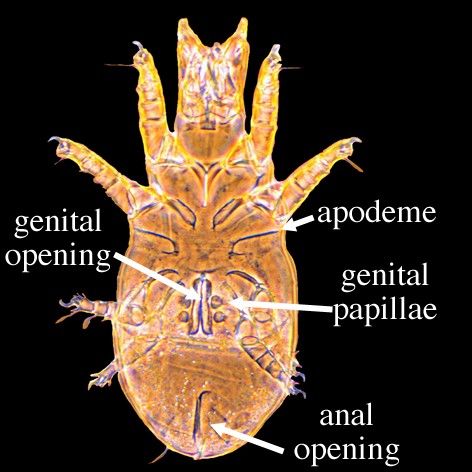 absent; males with an intromittent aedeagus.
Similar taxa
The Stigmaeidae are sometimes confused with spider mites, but these predatory mites lack the whip-like movable digits. Cryptognathidae are capable of retracting their gnathosoma, but their cheliceral bases are free and the movable digit is hook-like.
Ecology and distribution
The Tetranychoidea are plant-associated mites, and includes the infamous spider mites (Tetranychidae). Tetranychoid species that feed on grasses or pasture legumes may occasionally appear in soil samples.
References
- Baker and Pritchard 1953Baker and Pritchard 1953:
Baker EW, Pritchard AE. 1953. The family categories of tetranychoid mites, with a review of the new families Linotetranidae and Tuckerellidae. Annals of the Entomological Society of America 46: 243–258.
- Beard and Walter 2005Beard and Walter 2005:
Beard JJ, Walter DE. 2005. A new species of Tuckerella (Prostigmata: Tetranychoidea: Tuckerellidae) from Australia with descriptions of all stages and a discussion of the tritonymphal stage. Acarologia 45: 4–-60.
- Chaudhri 1971Chaudhri 1971:
Chaudhri WM. 1971. Four new species of the genus Tuckerella from Pakistan. Pakistan Journal of Zoology 3: 79–85.
- Corpuz-Raros 2001Corpuz-Raros 2001:
Corpuz-Raros LA. 2001. Tuckerella filipina, a new species of Tuckerellidae (Acari) from the Philippines. International Journal of Acarology 27: 71–74.
- Collyer 1969Collyer 1969:
Collyer E. 1969. Two species of Tuckerella (Acarina: Tuckerellidae) from New Zealand. New Zealand Journal of Science 12: 811–814.
- Ewing 1922Ewing 1922:
Ewing HE. 1922. Three new species of peculiar and injurious spider mites. Proceedings of the Entomological Society of Washington 24 (4): 104–108.
- Krantz 1978Krantz 1978:
Krantz GW. 1978. A manual of acarology [2nd ed.]. Oregon State University Book Stores, Corvallis.
- Lin and Fu 1997Lin and Fu 1997:
Lin Y-M, Fu Y-G. 1997. Two new species of the genus Tuckerella from Hainan Island, China (Acariformes: Tuckerellidae). Acta Zootaxonomica Sinica 22 (2): 150–153.
- Lin and Fu 2000Lin and Fu 2000:
Lin Y-M, Fu Y-G. 2000. A new species of the genus Tuckerella from China (Acariformes: Tuckerellidae). Acta Entomologica Sinica 40 (3): 311–313.
- Meyer and Ueckermann 1997Meyer and Ueckermann 1997:
Meyer MKPS, Ueckermann EA. 1997. A review of some species of the families Allochaetophoridae, Linotetranidae and Tuckerellidae (Acari: Tetranychoidea). International Journal of Acarology 23: 67–92.
- Miller 1964Miller 1964:
Miller LW. 1964. A new species of Tuckerella (Acarina, Tetranychoidea, Tuckerellidae) from Tasmania. Papers and Proceedings of the Royal Society of Tasmania 98: 79–84.
- Ochoa 1989aOchoa 1989a:
Ochoa R. 1989a. The genus Tuckerella in Costa Rica (Acari: Tuckerellidae). International Journal of Acarology 15 (4): 205–207.
- Ochoa 1989bOchoa 1989b:
Ochoa R. 1989b. A note on paedogenesis in Tetranychoidea. International Journal of Acarology 15 (2): 117–118.
- Ochoa 1999Ochoa 1999:
Ochoa R. 1999. A “mite” more information. Science 286 (5449): 2449.
- Tucker 1926Tucker 1926:
Tucker RWE. 1926. Some South African mites, mainly Tetranychidae and Eriophyidae. Union of South Africa Department of Agriculture, Division of Entomology Memoir No. 5: 15 pp.
- Womersley 1940Womersley 1940:
Womersley H. 1940. Studies on Australian Acarina, Tetranychidae and Trichadenidae. Transactions of the Royal Society of South Australia 64: 233–265.
- Womersley 1957Womersley 1957:
Womersley H. 1957. A new species of Tuckerella (Acarina, Tetranychoidea, Tuckerellidae) from South Australia. Transactions of the Royal Society of South Australia 80: 73–75.