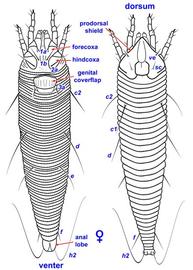
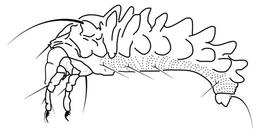
Exotic mite families
t
Taxonomy
updated 2025
Name
Phytoptidae Murray, 1877 (including former Sierraphytoptidae, Nalepellidae, Trisetacidae and Pentasetacidae)
Common names
gall mites, rust mites, erinose mites, eriophyids
Probability of encounter
very high
Quarantine importance
Medium. 21 genera, ~150 described species. Most are leaf vagrants or cause galls on woody parts of plants or big bud deformities, mostly on conifers or monocots (e.g., palms). Phytoptus avellanae Nalepa cause big bud in filberts; P. hedericola Keifer cause leaf stunting and deformation of English ivy. Nalepella species cause needle chlorosis and browning of conifer needles. Retracrus species cause discoloration of fronds of palms, e.g., R. elaeis Keifer causes speckling and black and yellow leaves on African oil palm. Currently, no phytoptids are known to transmit plant viruses or form erineaerineum:
(pl. erinea) the open, fleece-like galls produced by some eriophyoid mites (Prostigmata: Eriophyoidea)
.
Diagnosis
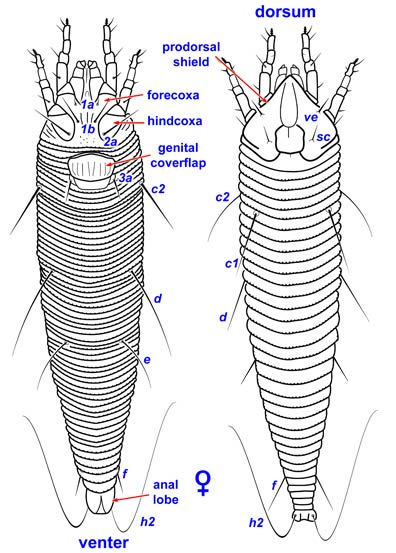
- Prodorsal shieldprodorsal shield:
a shield on the anterior dorsal surface of acariform mites.
always with 1 vi (unpaired median) or 2 ve setae: 1, 3, 4 or 5 setae in total
- Gnathosomagnathosoma:
(= capitulum) the anteriormost part of a mite or ricinuleid, composed of the cheliceral and pedipalpal segments and separated from the body (idiosoma) by a ring of soft cuticle.
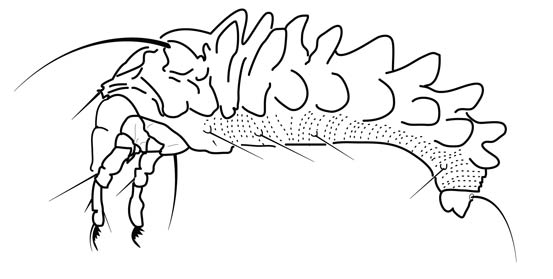
large or small, chelicerae straight or slightly curled
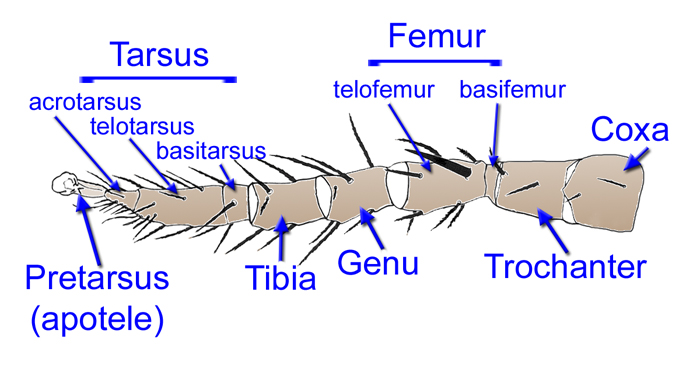
- Tibiatibia:
(pl. tibiae) the leg segment between the genu and the tarsus.
 I solenidionsolenidion:
(pl. solenidia) a hollow, optically inactive chemosensory seta on the limbs of acariform mites appearing to have transverse rows of minute pores (actually pore canals) under light microscopy, (the transverse pattern is often not apparent in SEM); often bulbous or otherwise modified; sometimes associated with a companion seta. Solenidia are designated with Greek letters by leg segment: Ω (omega) on the tarsus, Φ (phi) on the tibia, and Σ (sigma) on the genu.
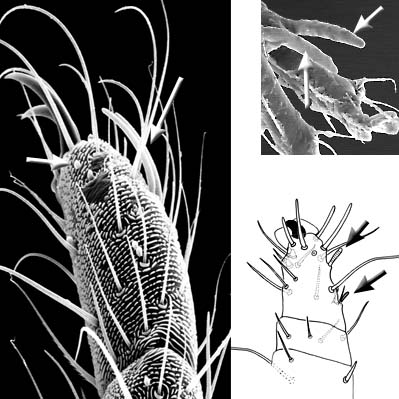 present or absent
- Subdorsal setasubdorsal seta:
in the Eriophyoidea, opisthosomal seta c1.
c1 present or absent
- Featherclaws not divided
- Spermathecal tubes usually long
Similar taxa
Immature Tarsonemidae have 3 pairs of legs and a gnathosomal capsule. Eriophyidae and Diptilomiopidae lack prodorsal shield setae vi and ve and have short spermathecal tubes.
References
- Amrine 1996aAmrine 1996a:
Amrine JW, Jr. 1996a. Keys to the world genera of the Eriophyoidea. Indira Publishing House, West Bloomfield, Michigan.
- Amrine 1996bAmrine 1996b:
Amrine JW, Jr. 1996b. Phyllocoptes fructiphilus and biological control of multiflora rose. pp. 741–749. In: Lindquist EE, Sabelis MW, and Bruin J, eds. Eriophyid mites: Their biology, natural enemies and control. World Crop Pests, Vol. 6. Elsevier, Amsterdam.
- Amrine and Stasny 1994Amrine and Stasny 1994:
Amrine JW, Jr., Stasny TA. 1994. Catalog of the Eriophyoidea (Acarina: Prostigmata) of the world. Indira Publishing House, West Boomfield, Michigan.
- Kethley 1982aKethley 1982a:
Kethley JB. 1982a. Acariformes. pp. 120-123. In: Parker SP, ed. Synopsis and classification of living organisms, Vol. 2. McGraw-Hill, New York.
- Krantz 1978Krantz 1978:
Krantz GW. 1978. A manual of acarology [2nd ed.]. Oregon State University Book Stores, Corvallis.
- Lindquist et al. 1996Lindquist et al. 1996:
Lindquist EE, Sabelis MW, and Bruin J, eds. 1996. Eriophyid Mites: Their biology, natural enemies and control. World Crop Pests, Vol. 6. Elsevier, Amsterdam.