Exotic mite families
t
Taxonomy
updated 2025
Name
Penthaleidae Oudemans, 1931
Classification
Superorder Acariformes » Order Trombidiformes » Suborder Prostigmata » Infraorder Eupodina » Superfamily Eupodoidea » Family Penthaleidae
Common names
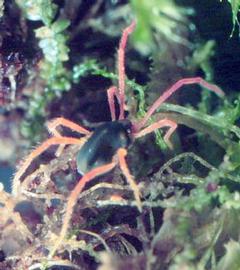
red-legged earth mites, black sand mites, pea mites, oat mites, winter grain mites.
Probability of encounter
high
Quarantine importance
Very high. The red-legged earth mites, winter grain mites, and their relatives are major pests of pasture, lawns, and vegetable and grain crops in many areas of the world.
Diagnosis
- Bodies sac-like with long legs. In life, bodybody:
the idiosoma of mites.
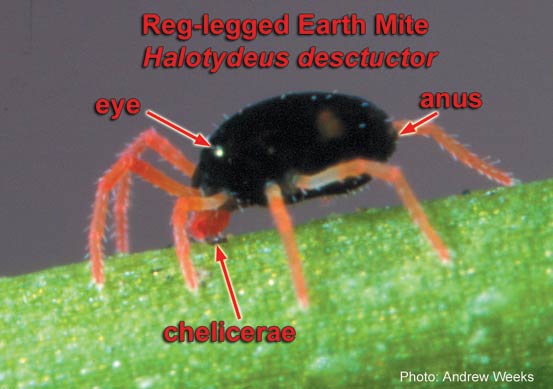
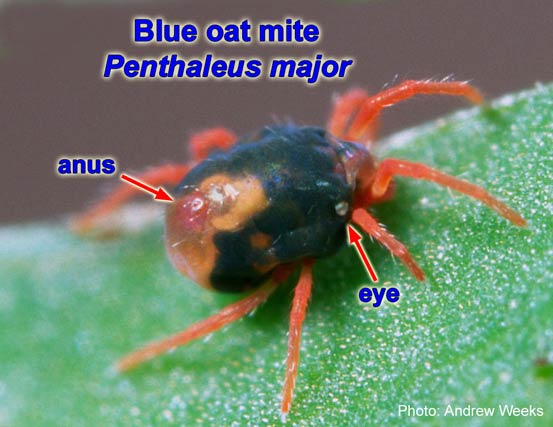
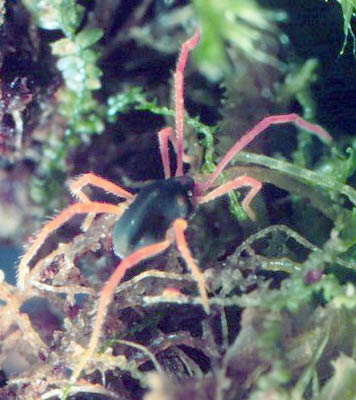
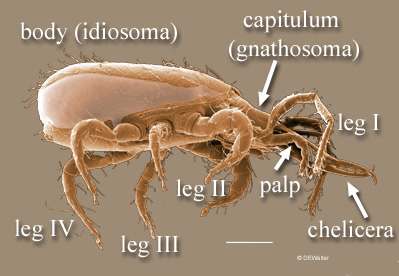 dark (black to dark green) and legs red
- Idiosoma, especially ventrally, and legs hypertrichous
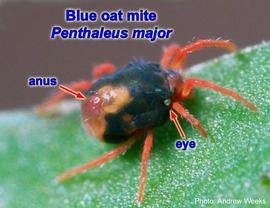
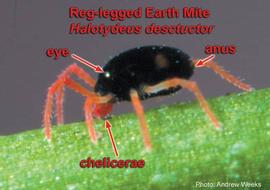
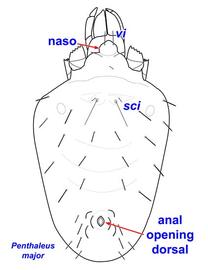
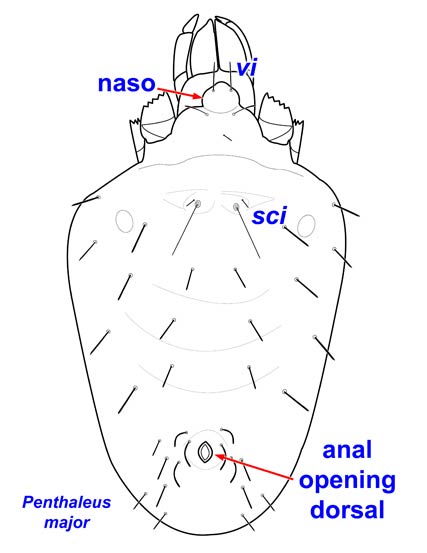
- Anal opening terminal (Halotydeus), dorso-terminal (Chromotydeus) or dorsaldorsal:
relating to the upper or back side; opposed to ventral.
(Penthaleus)
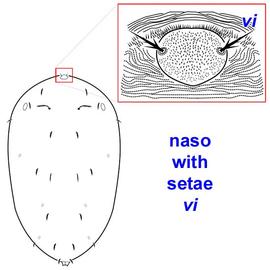
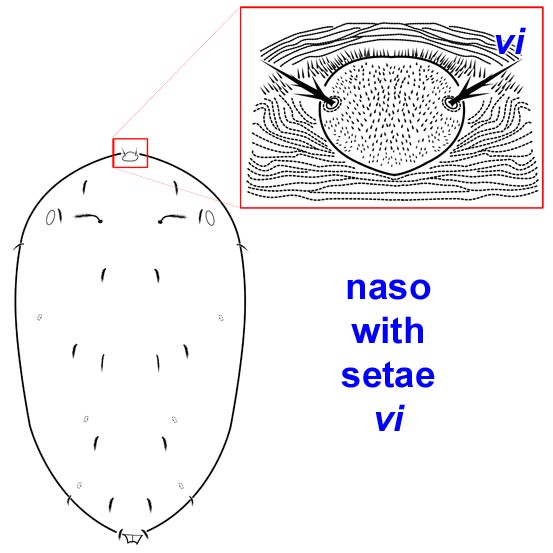
- Naso present and bearing setae vi; prodorsal setaeprodorsal setae:
the setae on the prodorsum of acariform mites. Two competing chaetotactic systems are used for designations: the Rostral-lamellar and Vertical-scapular systems.
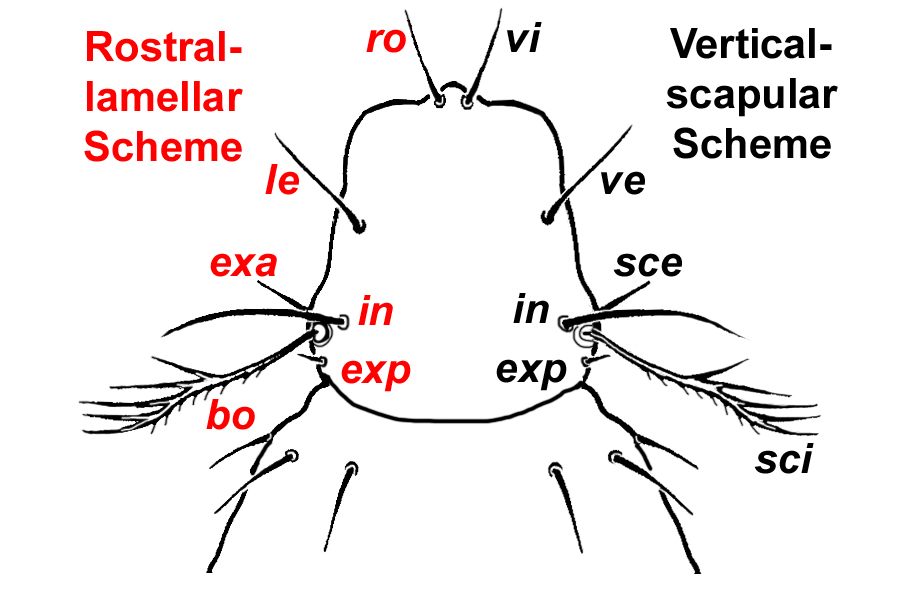 sci present and trichobothrial (filiformfiliform:
thread-like; long and narrow.
).
- 2 pairs of genital papillaegenital papillae:
1-3 pairs of extrusible finger-like to button-like projections, usually retracted into in the genital vestibule of acariform mites; sometimes formed as sessile disks around the genital opening; thought to be osmoregulatory structures; modified or multiplied and dispersed over the body in many freshwater mites. Genital papillae are absent in the larva, but may be added ontogenetically: protonymphs have one pair, deutonymphs two pairs, and tritonymphs (and adults) three pairs. The tritonymphal pair of papillae is often lost. The serially homologous Claparède's organ is usually present in the larvae (and prelarvae) of mites exhibiting genital papillae in nymphs and adults (Oudeman's Rule).
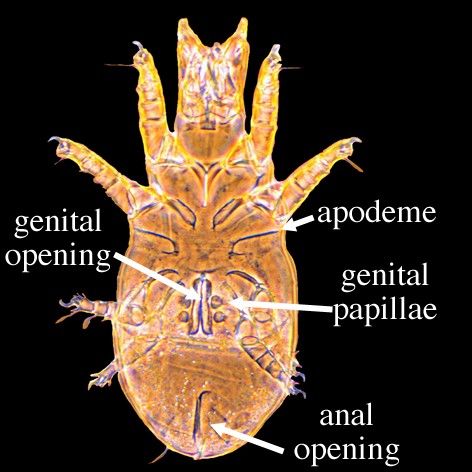 in adult
- Chelicerae separate, fixed digitfixed digit:
the distal extension of the middle article of the chelicera; usually bearing teeth and a distal hook and opposed to the movable digit in chelate-dentate forms, but often regressed; in Mesostigmata the fixed digit may bear the pilus dentilis.
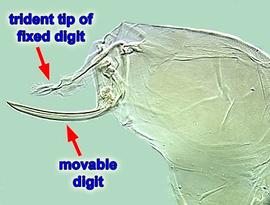
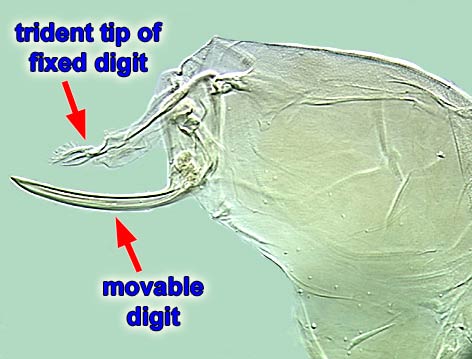
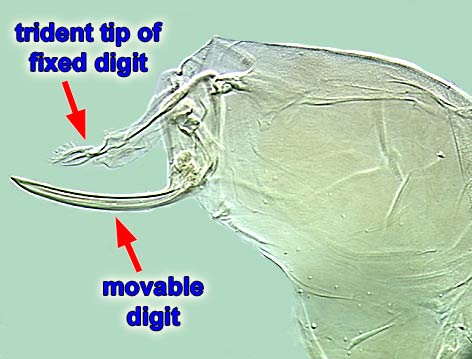
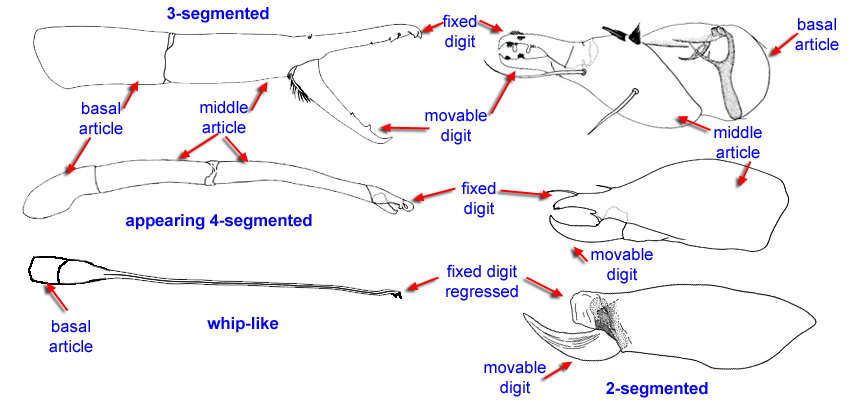 regressed, movable digit sickle-like to prong-like
- Rhagidial organsrhagidial organs:
recumbent solenidia in shallow depressions on the distal segments of legs I-II in Eupodoidea (Prostigmata).
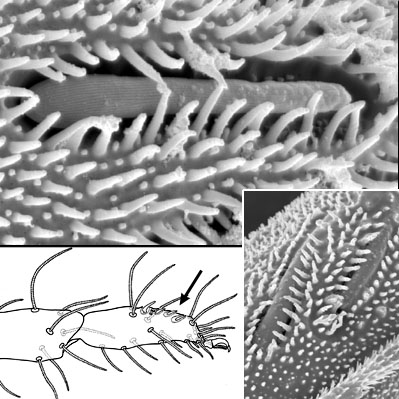 on tarsitarsus:
(pl. tarsi) the subdistal leg segment between the tibia and the pretarsus (apotele).
I–II only (Halotydeus, Penthaleus) or on tarsitarsus:
(pl. tarsi) the subdistal leg segment between the tibia and the pretarsus (apotele).
I–III (Chromotydeus)
Ecology and distribution
Penthaleus major (Dugès) is the best known species in a complex called winter grain, blue oat, or pea mites. They attack a variety of economically important plants including clover, peas, cotton, peanuts, ornamentals, wheat and other grains. These mites are parthenogenetic and males are unknown. In Australia the complex includes P. minor (Canestrini) and P. falcatus Qin & Halliday which can be separated from P. major by differences in setation and cheliceralcheliceral:
of or pertaining to the chelicera.
structure (see Qin and Halliday 1996aQin and Halliday 1996a:
Qin TK, Halliday RB. 1996a. The Australian species of Chromotydaeus Berlese and Penthaleus C.L. Koch (Acarina: Penthaleidae). Journal of Natural History 30 (12): 1833–1848.). Other described species of Penthaleus are known, but not currently considered major pests.
Halotydeus destructor (Tucker), the red-legged earth miteearth mite:
a member of the Penthaleidae (Prostigmata: Eupodoidea), including major plant pests in the redlegged earth mite (Halotydeus) and the blue pea-winter grain mite (Penthaleus) genera, or related families with red legs and black to dark green bodies. In reality, the entire cuticle is reddish, but the dark body contents obscure the body color.
or black sand mite feeds in groups (usually on the upper leaf surface) on vegetable and legume crops, tobacco, and pasture grasses and is a major pest in Australia, New Zealand, and Africa. Other species of Halotydeus include: H. anthroopus Qin & Halliday from clover, grass and cape weed in South Africa; H. bakerae Qin & Halliday from moss, grasses, and saltbush in Australia; H. catrellus Qin & Halliday from undergrowth in forested areas in Australia; H. spectatus Qin & Halliday from grasses in wooded areas in Australia; H. hydrodromus Berlese & Trouessart from littoral and intertidal rocks in France, Italy and Ireland; H. signiensis Strandtmann & Tilbrook from moss in the South Orkney Islands; and H. mollis Luxton from a mangrove beach in Hong Kong.
Chromotydaeus Berlese can be distinguished from other penthaleids by the presence of rhagidial organsrhagidial organs:
recumbent solenidia in shallow depressions on the distal segments of legs I-II in Eupodoidea (Prostigmata).
on tarsitarsus:
(pl. tarsi) the subdistal leg segment between the tibia and the pretarsus (apotele).
III. Chromotydeus egregius (Berlese) is known from dry areas in Italy, and C. quartus Qin & Halliday from native shrub and pasture habitats in Australia. Neither are considered pests.
Linopenthaloides novaezealandicus Strandtmann lives in caves in New Zealand.
References
- Baker 1995Baker 1995:
Baker AS. 1995. A redescription of Halotydeus destructor (Tucker) (Prostigmata: Penthaleidae), with a survey of ontogenetic setal development in the superfamily Eupodoidea. International Journal of Acarology 21 (4): 261–282.
- Qin and Halliday 1996aQin and Halliday 1996a:
Qin TK, Halliday RB. 1996a. The Australian species of Chromotydaeus Berlese and Penthaleus C.L. Koch (Acarina: Penthaleidae). Journal of Natural History 30 (12): 1833–1848.
- Qin and Halliday 1996bQin and Halliday 1996b:
Qin TK, Halliday RB. 1996b. Revision of the Australian and South African species of Halotydeus (Acarina: Penthaleidae). Bulletin of Entomological Research 86: 441–450.
- Ridsdill-Smith 1997Ridsdill-Smith 1997:
Ridsdill-Smith TJ. 1997. Biology and control of Halotydeus destructor (Tucker) (Acarina: Penthaleidae): A review. Experimental and Applied Acarology 21: 195–224.
- Ridsdill-Smith et al. 1996Ridsdill-Smith et al. 1996:
Ridsdill-Smith TJ, Craig S, Beaton CD. 1996. Microsopic examination of feeding damage to subterranean clover cotyledons caused by Halotydeus destructor (Tucker) (Penthaleidae). pp. 55–57. In: Mitchell R, Horn DJ, Needham GR, and Welbourn WC, eds. Acarology IX, Vol. 1. Ohio Biological Survey, Columbus.
- Ridsdill-Smith and Pavri 2000Ridsdill-Smith and Pavri 2000:
Ridsdill-Smith TJ, Pavri C. 2000. Feeding life style of redlegged earth mite, Halotydeus destructor (Acari: Penthaleidae), in pastures and the role of broad-leafed weeds. Experimental and Applied Acarology 24: 397–414.
- Weeks and Hoffmann 1998Weeks and Hoffmann 1998:
Weeks AR, Hoffmann AA. 1998. Intense selection of mite clones in a heterogenous environment. Evolution 32: 1325–1333.
- Weeks and Hoffmann 1999Weeks and Hoffmann 1999:
Weeks AR, Hoffmann AA. 1999. The biology of Penthaleus species in southeastern Australia. Entomologia Experimentalis et Applicata 92: 179–189.
- Weeks and Hoffmann 2000Weeks and Hoffmann 2000:
Weeks AR, Hoffmann AA. 2000. Competitive interactions between two pest species of earth mite, Halotydeus destructor and Penthaleus major (Acarina: Penthaleidae) in pastures and crops. Journal of Economic Entomology 93: 1183–91.
- Weeks et al. 2000Weeks et al. 2000:
Weeks AR, Turelli M, Hoffmann AA. 2000. Dispersal patterns of pest earth mites (Acari: Penthaleidae) in pastures and crops. Journal of Economic Entomology 93: 1415–1423.
Videos
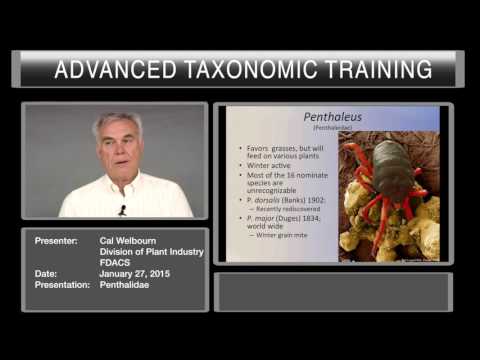
Introduction to the family Penthaleidae
General overview of the mite family Penthaleidae
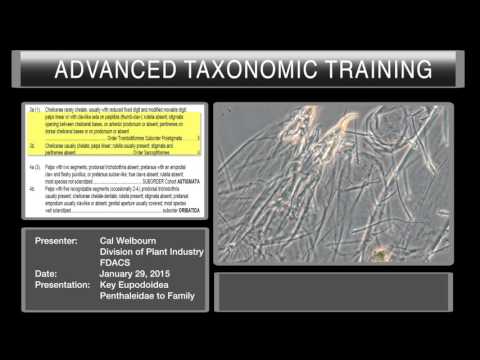
Keying Penthaleidae (Eupodoidea) to family
Using a dichotomous key to get a Penthaleidae specimen to family