t
water fleas, daphnia
High if intercept has standing water and from some soils if appropriate extraction techniques used (i.e., wet funnel, flotation).
Unknown. Most species are suspension feeders on detritus and microbes.
Small size, lack of clear segmentationsegmentation:
in mites distinct external segments have been lost but remnants of segmentation may be represented by hysterosomal folds or transverse arrays of setae and other cuticular sense organs. In theory, all chelicerates have a prosoma composed of 6 segments (cheliceral, pedipalpal, and four leg-bearing segments = body segments I-VI). Ventrally the positions of the prosomal segments can be identified by the insertions of their appendages, but dorsally they are obscured. The opisthosoma is thought to comprise an additional 12-13 segments (body segments VII-XVIII or XIX), but appears to be somewhat to much reduced in most mites, except possibly Opilioacarida. In early derivative Acariformes (e.g., many Endeostigmata), hysterosomal folds are thought to represent segmentation and in the Grandjean system are designated (from the sejugal furrow to the anus): C, D, E, F, H, PS AD, AN, PA. There is disagreement in the literature over the origin of 'segments' C and D. Adherents of Grandjean consider them to be opisthosomatic (with C probably representing a fusion of the pregenital [body segment VII] and genital [VIII] segments). Others believe that C and D are the dorsal regions of the last two prosomal segments that bear leggs III and IV (i.e., body segments V & VI).
.
Normal adult length: mostly 0.25–2 mm
Bodybody:
the idiosoma of mites.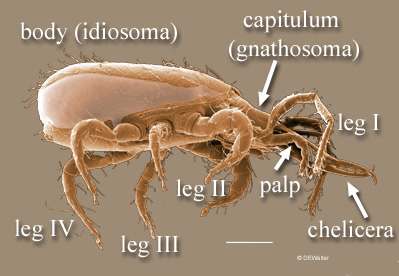 tagmata: head (1 pair of antennae), trunk, postabdomen
Eyes: median fused compound eye, naupliar eye
Antennae: biramous, swimming
Mouthparts: mandibles without palps; one pair of maxillae
Legs: 5–6 pairs of swimming/ grasping/ filtering legs
Respiration: cutaneous and coxal epipodites of trunk limbs
Gonopore: various on trunk
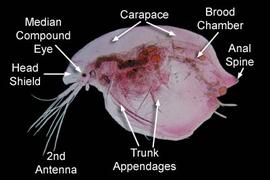
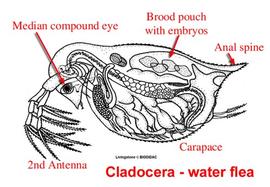
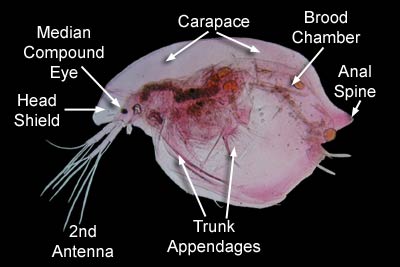
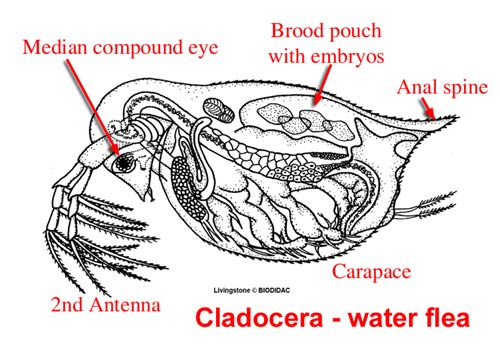
Distinguishing features: Minute swimming crustaceans with head shield and shell-like carapacecarapace:
the shield covering the dorsal prosoma of arachnids; in some European literature, the mesostigmatan podonotal shield.
, swimming 2nd antennae, dorsaldorsal:
relating to the upper or back side; opposed to ventral.
brood chamber
Comments: Water fleas are normally considered aquatic organisms and would be expected primarily in moist intercepts (e.g., bromeliads); however, they also can be extracted with wet funnels from some soils. Eggs are brooded under the carapacecarapace:
the shield covering the dorsal prosoma of arachnids; in some European literature, the mesostigmatan podonotal shield.
which sometimes forms a protective capsulecapsule:
as in gnathosomal capsule, the fused chelicerae and subcapitulum characteristic of Tarsonemina and some other Prostigmata (e.g., Cheyletoidea, Myobioidea) (also tegmen, rostral shield).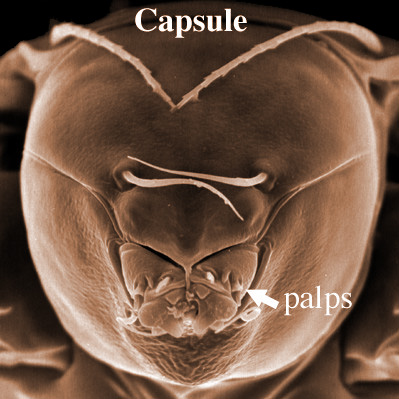 (ephippium) that allows aerial dispersal by wind.
4 suborders, 11 families, 80+ genera, >400 species
Author: David E. Walter
Content last updated Sept. 2006, unless indicated otherwise
Lucid key player updated Sept. 2025
idtools.org