t
Superorder Parasitiformes » Order Mesostigmata » Suborder Monogynaspida » Infraorder Gamasina » Hyporder Dermanyssiae » Superfamily Rhodacaroidea » Family Rhodacaridae
Children: Afrogamasellus Loots and Ryke, Afrodacarellus Hurlbutt, Rhodacarus, Minirhodacarellus, Rhodacarellus, Rhodacaropsis, Protogamasellopsis; selected genera not in this tool: Dendrolobatus Shcherbak, Podalogamasellus Karg, Rhodacarella Moraza
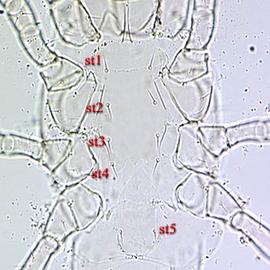
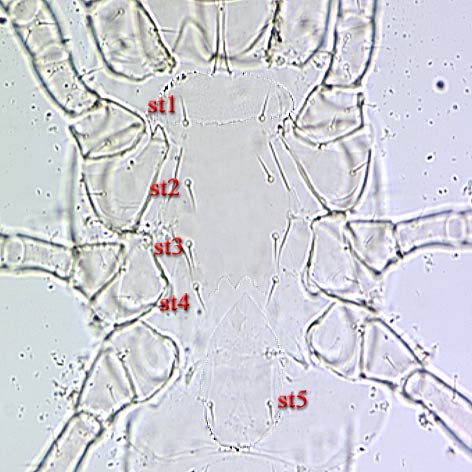
 on the sternal shieldsternal shield: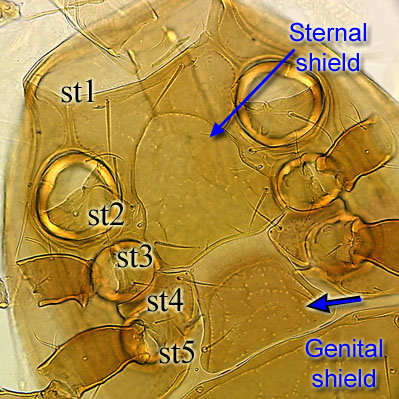
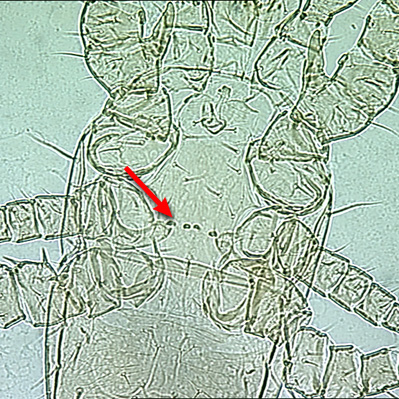 on pododnotal shield
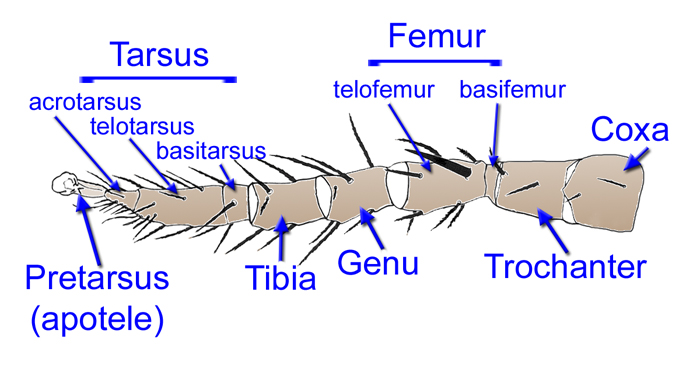 I with 6/4 and genugenu:; genugenu:, 5/2 dorsal/ventral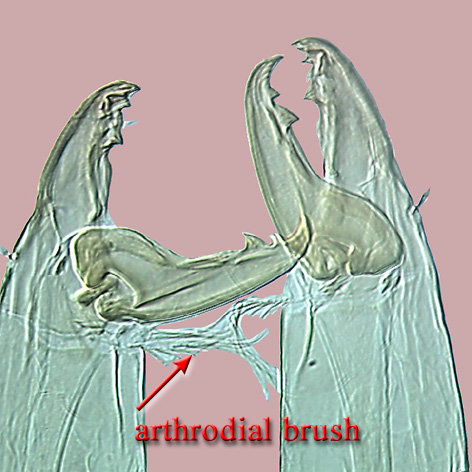
Arthrodial process simplesimple:
unadorned; simple setae are needle-like and without hairs or pectins.
.............................. 4
- Arthrodial process produced as a brush.............................. 2
Basitarsusbasitarsus:
a basal subdivision of the tarsus.
IV with 4 setae (pl4 present).............................. Pararhodacarus
- Basitarsusbasitarsus:
a basal subdivision of the tarsus.
IV with 3 setae (pl4 absent).............................. 3
Tectumgnathotectum:
(= epistome, tectum) an often membranous dorsal projection of the anterior margin of the basis capitulum in Mesostigmata; often diagnostic at family-, genus- or species-levels; also often difficult to see without high magnification and good optics.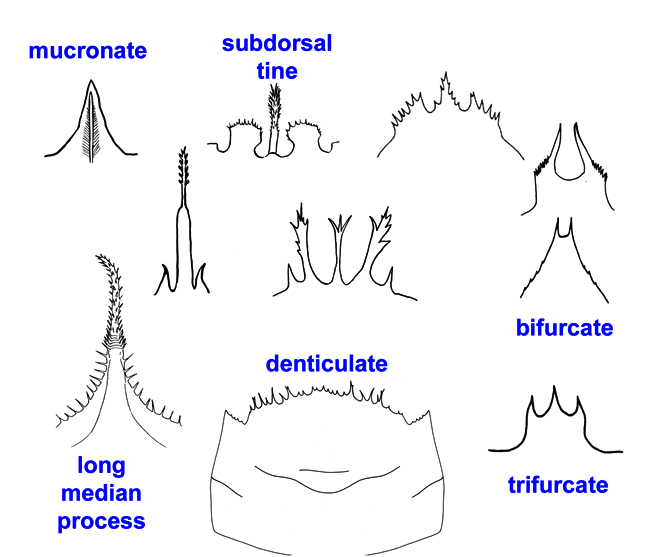 with single median process or dentate.............................. Afrogamasellus
- Tectumgnathotectum:
(= epistome, tectum) an often membranous dorsal projection of the anterior margin of the basis capitulum in Mesostigmata; often diagnostic at family-, genus- or species-levels; also often difficult to see without high magnification and good optics. with median stalk y-shaped, usually with lateral tines.............................. Afrodacarellus
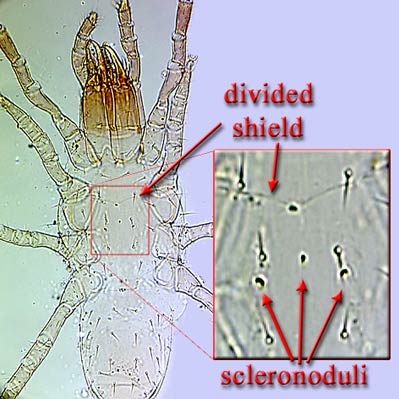
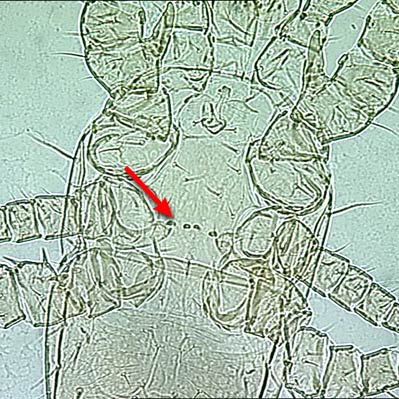
Scleronoduli present.............................. 5
- Scleronoduliscleronoduli:
3-4 light refractile structures, sometimes comma-shaped, in the podonotal region of many Rhodacaroidea and the genus Protogamasellus (Ascidae) in the Mesostigmata. absent.............................. 10
Tibiatibia:
(pl. tibiae) the leg segment between the genu and the tarsus. I with 4 ventral setaeventral setae:
in the Lindquist-Evans system used in the Mesostigmata, the ventral region has up to three longitudinal rows (Jv, Zv, Lv) with 1-5 transverse row designations.
; palp apotelepalptarsal apotele:
(= palp apotele, palptarsal claw) the most distal segment of the palp; absent in Acariformes, claw-like in Opilioacarida, and a subdistal, tined structure in the Mesostigmata.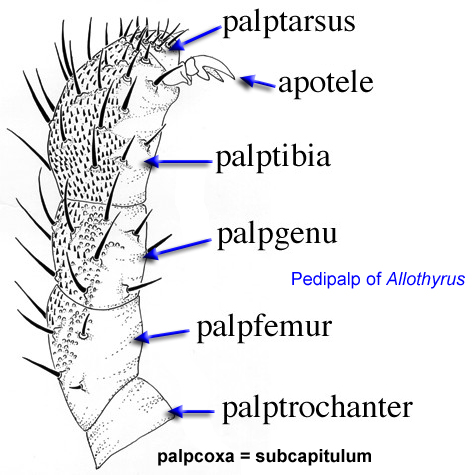 3-tined.............................. 6
- Tibiatibia:
(pl. tibiae) the leg segment between the genu and the tarsus. I with 3 ventral setaeventral setae:
in the Lindquist-Evans system used in the Mesostigmata, the ventral region has up to three longitudinal rows (Jv, Zv, Lv) with 1-5 transverse row designations.
; palp apotelepalptarsal apotele:
(= palp apotele, palptarsal claw) the most distal segment of the palp; absent in Acariformes, claw-like in Opilioacarida, and a subdistal, tined structure in the Mesostigmata. 2-tined.............................. 9
3 scleronoduli (median unpaired); j1–2, z1, and s1 on anterior margin of podonotal shieldpodonotal shield:
the anterior shield in mesostigmatans with divided dorsal shields. 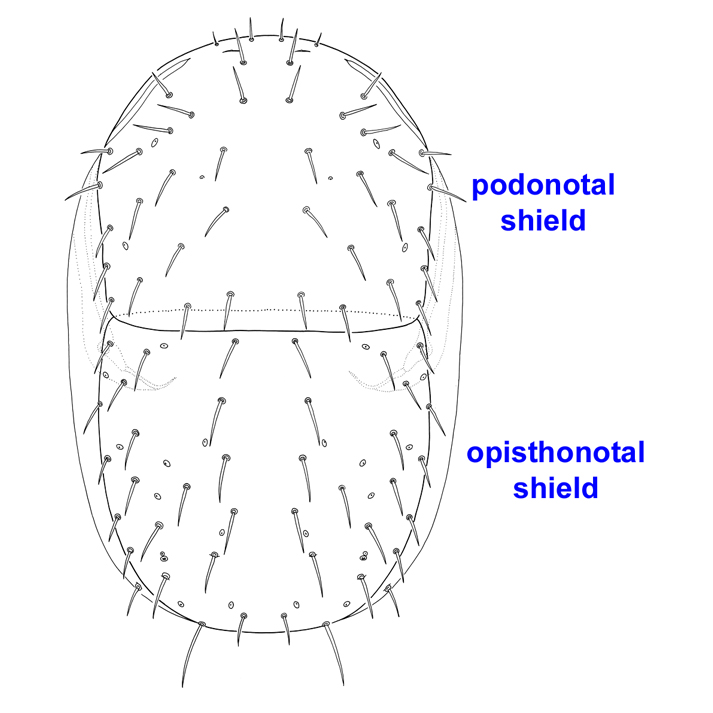 .............................. 7
- 4 scleronoduli (median pair +/- fused); j1 (but not j2), z1 and s1 on anterior margin of shield.............................. 8
Pretarsustarsal apotele:
(also pretarsus) the most distal segments of legs and palps bearing the claws and empodium I absent; without presternal plateletspresternal platelets:
small sclerotized plates anterior to the sternal shield and laterad or posteriad the base of the tritosternum in some Mesostigmata.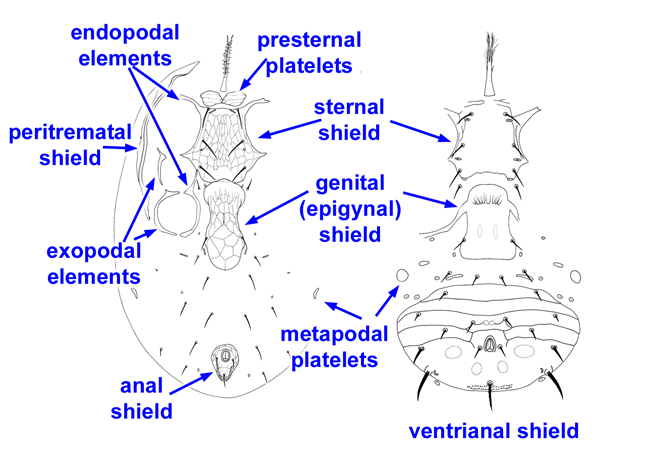 .............................. Rhodacarus (+Mediorhodacarus)
- Pretarsustarsal apotele:
(also pretarsus) the most distal segments of legs and palps bearing the claws and empodium I present; with 2 pairs of presternal plateletspresternal platelets:
small sclerotized plates anterior to the sternal shield and laterad or posteriad the base of the tritosternum in some Mesostigmata............................... Rhodacaropsis
Podonotal shieldpodonotal shield:
the anterior shield in mesostigmatans with divided dorsal shields. entire.............................. Rhodacarellus
- Podonotal shieldpodonotal shield:
the anterior shield in mesostigmatans with divided dorsal shields. divided between setae j3–j4; tectumgnathotectum:
(= epistome, tectum) an often membranous dorsal projection of the anterior margin of the basis capitulum in Mesostigmata; often diagnostic at family-, genus- or species-levels; also often difficult to see without high magnification and good optics. denticulate-trifurcate.............................. Minirhodacarellus
Tibiatibia:
(pl. tibiae) the leg segment between the genu and the tarsus. I with 5 (rarely 4) dorsaldorsal:
relating to the upper or back side; opposed to ventral.
setae; 2 pairs of scleronoduliscleronoduli:
3-4 light refractile structures, sometimes comma-shaped, in the podonotal region of many Rhodacaroidea and the genus Protogamasellus (Ascidae) in the Mesostigmata. ; sternal shieldsternal shield:
a shield in the anterior intercoxal region of parasitiform mites that bears one or more pairs of sternal setae. with 4 pairs of setae; anal opening normal.............................. Dendrolaelaps (Digamasellidae)
- Tibiatibia:
(pl. tibiae) the leg segment between the genu and the tarsus. I with 6 dorsaldorsal:
relating to the upper or back side; opposed to ventral.
setae; 3 scleronoduliscleronoduli:
3-4 light refractile structures, sometimes comma-shaped, in the podonotal region of many Rhodacaroidea and the genus Protogamasellus (Ascidae) in the Mesostigmata. ; sternal shieldsternal shield:
a shield in the anterior intercoxal region of parasitiform mites that bears one or more pairs of sternal setae. with 3 pairs of setae (st4 in soft cuticle); anal opening enlarged.............................. Protogamasellus mica Group (Ascidae)
Sternal seta st4 on sternal shieldsternal shield:
a shield in the anterior intercoxal region of parasitiform mites that bears one or more pairs of sternal setae............................... 11
- Sternal seta st4 in soft cuticle.............................. 15
Anal opening large; tibiatibia:
(pl. tibiae) the leg segment between the genu and the tarsus. I with 5 dorsaldorsal:
relating to the upper or back side; opposed to ventral.
setae.............................. Digamasellus (Digamasellidae)
- Anal opening normal; tibiatibia:
(pl. tibiae) the leg segment between the genu and the tarsus. I with 6 dorsaldorsal:
relating to the upper or back side; opposed to ventral.
setae.............................. 12
Sternal shieldsternal shield:
a shield in the anterior intercoxal region of parasitiform mites that bears one or more pairs of sternal setae. strongly sclerotized throughout; tibiatibia:
(pl. tibiae) the leg segment between the genu and the tarsus. I with 4 ventral setaeventral setae:
in the Lindquist-Evans system used in the Mesostigmata, the ventral region has up to three longitudinal rows (Jv, Zv, Lv) with 1-5 transverse row designations.
.............................. Geogamasus (Ologamasidae)
- Anterior region of sternal shieldsternal shield:
a shield in the anterior intercoxal region of parasitiform mites that bears one or more pairs of sternal setae. poorly sclerotized, setae st1 in soft or granulate cuticle; tibiatibia:
(pl. tibiae) the leg segment between the genu and the tarsus. I with 3 ventral setaeventral setae:
in the Lindquist-Evans system used in the Mesostigmata, the ventral region has up to three longitudinal rows (Jv, Zv, Lv) with 1-5 transverse row designations.
.............................. 13
Palp apotelepalptarsal apotele:
(= palp apotele, palptarsal claw) the most distal segment of the palp; absent in Acariformes, claw-like in Opilioacarida, and a subdistal, tined structure in the Mesostigmata. 2-tined; coxacoxa:
the basal segment of the leg, articulating with (Parasitiformes) or fused to (Acariformes) the body wall. I without dorsaldorsal:
relating to the upper or back side; opposed to ventral.
spine .............................. 15
- Palpapotele 3-tined: coxacoxa:
the basal segment of the leg, articulating with (Parasitiformes) or fused to (Acariformes) the body wall. I with dorsaldorsal:
relating to the upper or back side; opposed to ventral.
spine.............................. 14
Presternal area granulate.............................. Protogamasellopsis
- Presternal area with paired stacks of 4 presternal plateletspresternal platelets:
small sclerotized plates anterior to the sternal shield and laterad or posteriad the base of the tritosternum in some Mesostigmata............................... Rhodacarella
Posteriorposterior:
the back part of the body or towards that region in comparison, e.g., 'posterior to'.
margin of podonotalpodonotal:
relating to the dorsal podosoma, the region of the idiosoma over the legs.
(at j6) and anterior margin of opisthonotalopisthonotal:
dorsal opisthosoma.
(at J1) shields with transverse lines; genugenu:
(pl. genua) (= patella) the 4th leg segment, between the femur and tibia.
IV with 8 setae, tibiatibia:
(pl. tibiae) the leg segment between the genu and the tarsus. IV with 9 setae.............................. Protogamasellus hibernicus Group (Ascidae)
- Podonotalpodonotal:
relating to the dorsal podosoma, the region of the idiosoma over the legs.
and opisthonotalopisthonotal:
dorsal opisthosoma.
shields without transverse lines; genugenu:
(pl. genua) (= patella) the 4th leg segment, between the femur and tibia.
IV with 9 setae, tibiatibia:
(pl. tibiae) the leg segment between the genu and the tarsus. IV with 10 setae.............................. Gamasellodes (Ascidae)
Author: David E. Walter
Content last updated Sept. 2006, unless indicated otherwise
Lucid key player updated Sept. 2025
idtools.org