t
Arctacarus Evans, 1955: 299
Arctacarus rostratus Evans, 1955
Superorder Parasitiformes » Order Mesostigmata » Suborder Monogynaspida » Infraorder Gamasina » Hyporder Arctacariae » Superfamily Arctacaroidea » Family Arctacaridae » Genus Arctacarus
Arctacarus beringianus Bregetova, 1977; Arctacarus dzungaricus Bregetova, 1977
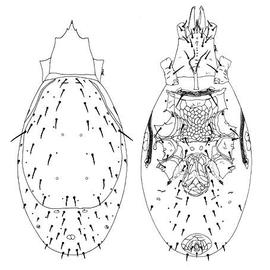
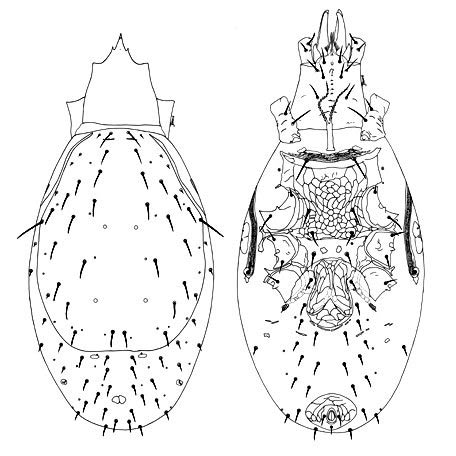
Brown and white, with truncate dorsaldorsal:
relating to the upper or back side; opposed to ventral.
shield exposing much of opisthosomaopisthosoma:
(= abdomen) the posterior body division in arachnids; usually not distinct in mites because of the fusion of the opisthosoma with part of the prosoma to form the idiosoma.
of female; opisthonotalopisthonotal:
dorsal opisthosoma.
region with pairs of small mesonotal scutellascutella:
(pl scutellae) small shields or platelets.
and a minute, lazy-8 shaped pygidial scleritepygidial shield:
(pygidial sclerite) in Mesostigmata, a shield at the back end of the idiosoma.
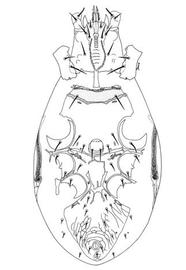
. Sternal shield large, with 3 pairs of setaeseta:
(pl. setae, from L. = bristle) cuticular process composed of a hollow shaft (sometimes filled with a refractive material) produced from a membranous socket (the alveolus); the hair-like, spine-like, branched or variously expanded structures on the surfaces of the legs and body. Most setae function as mechanoreceptors, but others (e.g., solenidia) are chemoreceptors or have unknown or ambiguous functions.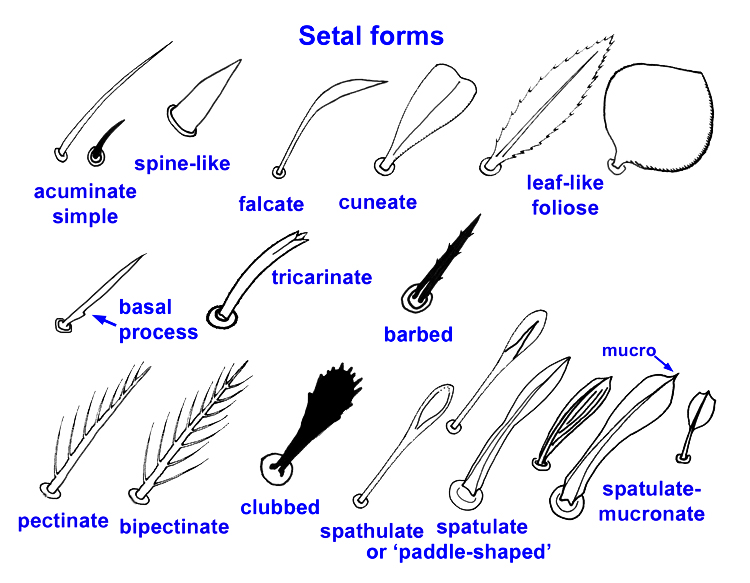 (st1–3), 3 pairs of lyrifissures (stp1–3), and fused endopodal elements I-II; st4 in soft cuticle; genital shieldgenital shield:
a shield or shields covering the genital opening; in female mongynaspine Mesostigmata this shield is usually called the epigynal (epigynial) shield.
axe-shape, nude, flanked by 2 pairs of setaeseta:
(pl. setae, from L. = bristle) cuticular process composed of a hollow shaft (sometimes filled with a refractive material) produced from a membranous socket (the alveolus); the hair-like, spine-like, branched or variously expanded structures on the surfaces of the legs and body. Most setae function as mechanoreceptors, but others (e.g., solenidia) are chemoreceptors or have unknown or ambiguous functions. in soft cuticle; inguinal glands on small platelets behind coxae IV; anal opening with 2 valves in small anal shieldanal shield:
in Mesostigmata, a ventral shield bearing the anal opening and circumanal setae (po, pa), but without any ventral setae or pores (lyrifissures) [see ventrianal shield].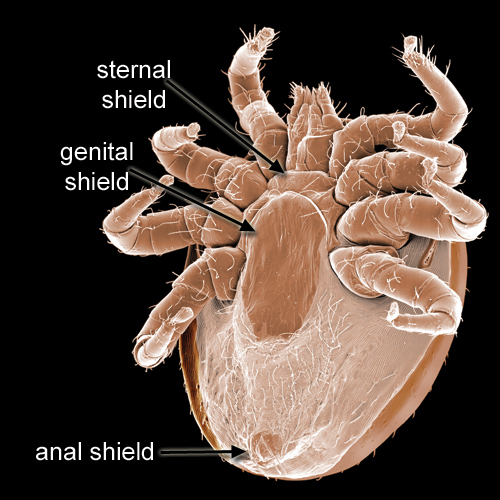 . Peritremes relatively short, reaching anterioranterior:
the front part of the body or towards that region in comparison, e.g., 'anterior to'.
margin of coxacoxa:
the basal segment of the leg, articulating with (Parasitiformes) or fused to (Acariformes) the body wall.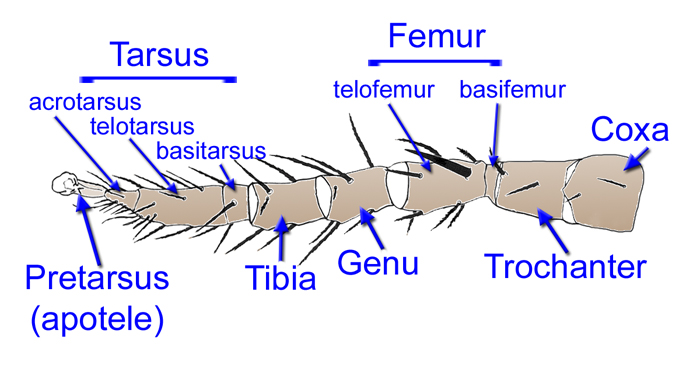 II, peritrematalperitrematal:
(peritrematic) of or referring to the peritreme; adjectival form of peritreme.
shield poorly developed and fused to dorsaldorsal:
relating to the upper or back side; opposed to ventral.
shield anteriorly. Tarsustarsus:
(pl. tarsi) the subdistal leg segment between the tibia and the pretarsus (apotele).
I with or without claws. Palppalp:
(= pedipalp) the second pair of limbs in arachnids, used in feeding and originating on either side of the chelicerae. In mites, the palps may be vestigial, with only a few segments, or have a maximum of 5 freely articulating segments (rarely the femur is subdivided) and a distal or subdistal apotele.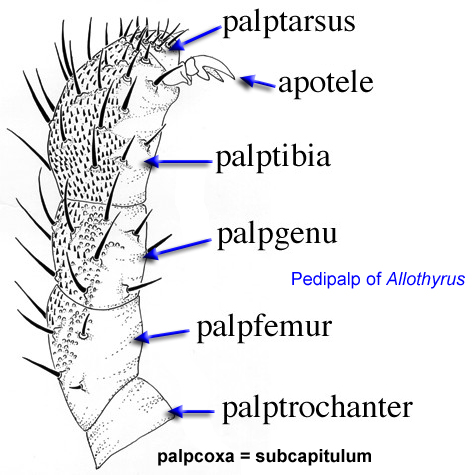 genu with 6 setaeseta:
(pl. setae, from L. = bristle) cuticular process composed of a hollow shaft (sometimes filled with a refractive material) produced from a membranous socket (the alveolus); the hair-like, spine-like, branched or variously expanded structures on the surfaces of the legs and body. Most setae function as mechanoreceptors, but others (e.g., solenidia) are chemoreceptors or have unknown or ambiguous functions.; palp apotelepalptarsal apotele:
(= palp apotele, palptarsal claw) the most distal segment of the palp; absent in Acariformes, claw-like in Opilioacarida, and a subdistal, tined structure in the Mesostigmata. with 3 tines. Tectumgnathotectum:
(= epistome, tectum) an often membranous dorsal projection of the anterior margin of the basis capitulum in Mesostigmata; often diagnostic at family-, genus- or species-levels; also often difficult to see without high magnification and good optics.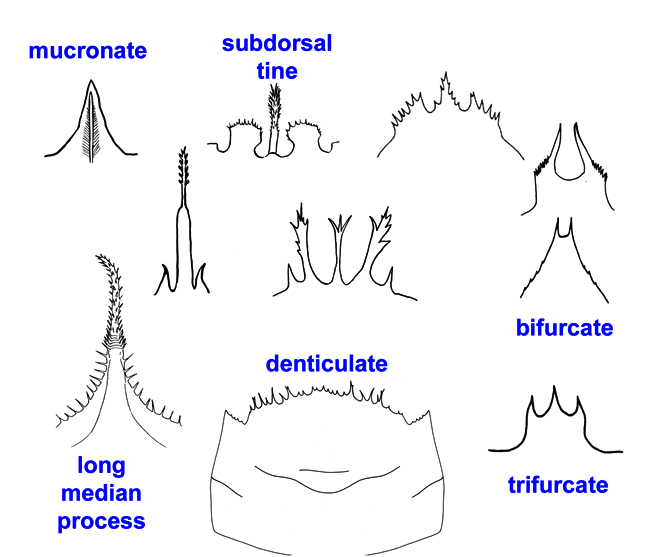 mucronate and coarsely denticulatedenticulate:
bearing small, sharp processes, e.g., the hypostome of ticks.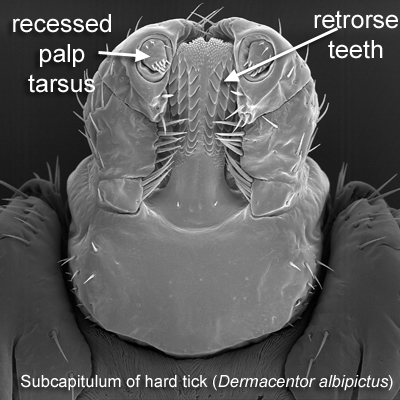 ; hypostomal setaeseta:
(pl. setae, from L. = bristle) cuticular process composed of a hollow shaft (sometimes filled with a refractive material) produced from a membranous socket (the alveolus); the hair-like, spine-like, branched or variously expanded structures on the surfaces of the legs and body. Most setae function as mechanoreceptors, but others (e.g., solenidia) are chemoreceptors or have unknown or ambiguous functions. in triangular array; subcapitular gutter broad, with denticlesdenticles:
small tooth-like processes, e.g., on the subcapitula of ticks and many mesostigmatans.
; corniculicorniculus:
(pl. corniculi) (also, external malae) a usually horn-like process (sometimes toothed, bifurcate, trifurcate, spine-like, spatulate, or membranous) on the subcapitulum of parasitiform mites that usually supports the salivary styli. A toothed corniculus could be confused with a rutellum, a possibly homologous structure in Acariformes and Opilioacarida. Phytoseiid image is spatulate corniculus.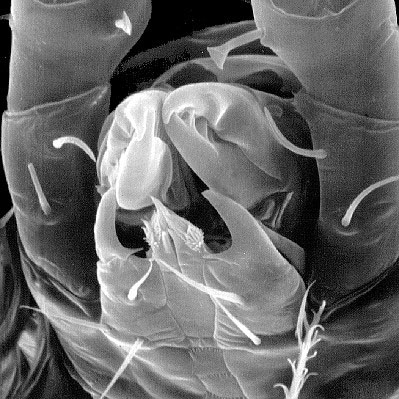 horn-like. Chelicerae chelate-dentatechelate-dentate:
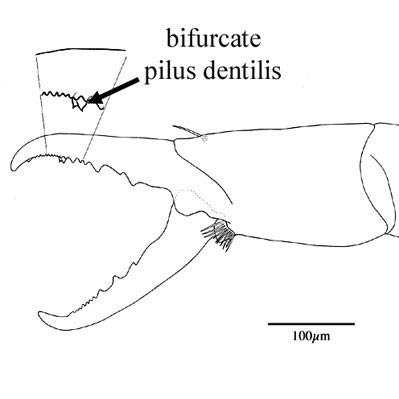
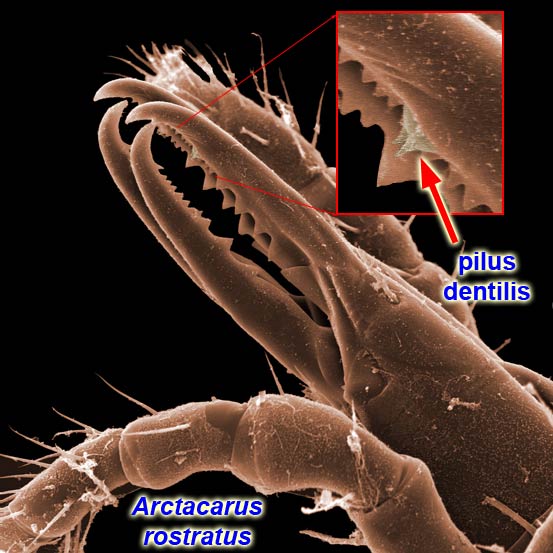
pincer-like chelicerae with teeth.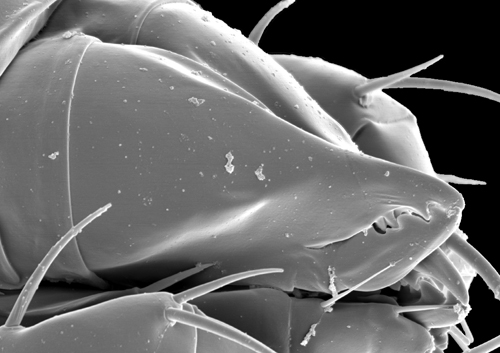 to chelate serrateserrate:
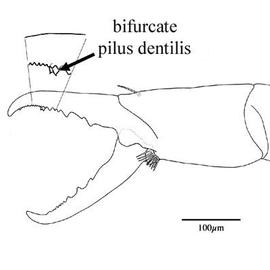
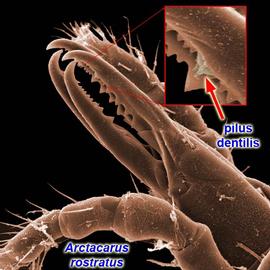
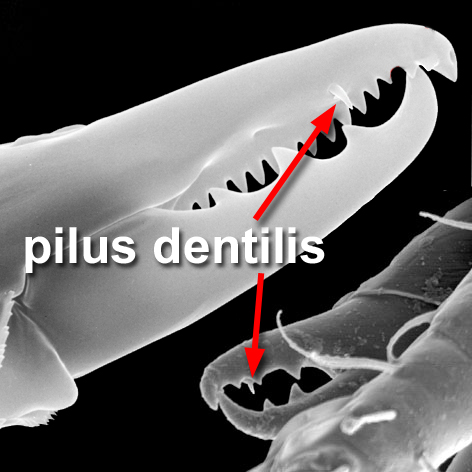
with closely set teeth that resemble the cutting edge of a saw.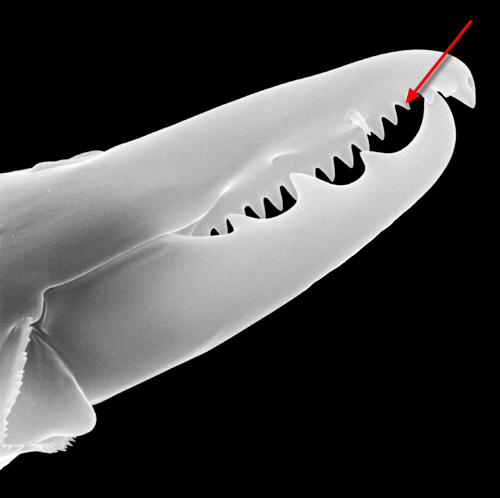 ; pilus dentilispilus dentilis:
(pl. pili dentilis) a seta-like or membranous sensory organ inserted ventrolaterally on the fixed digit of the chelicera of many Mesostigmata. short, broad and bifurcatebifurcate:
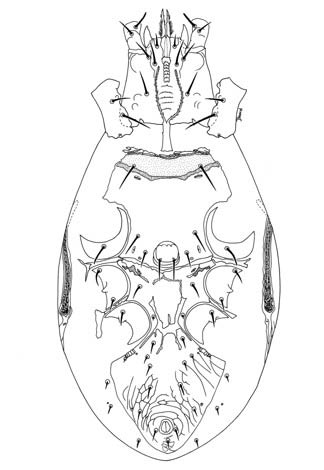
split into two distally or with two projections. 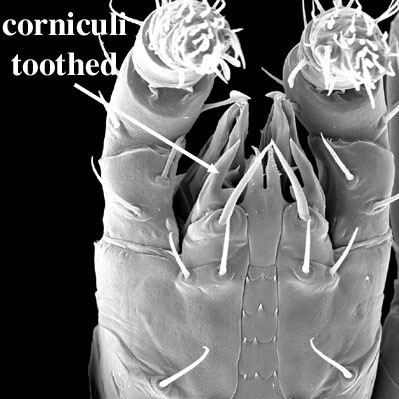 . Male with holodorsal shieldholodorsal shield:
a shield that covers all of the dorsum. In Mesostigmata, the holodorsal shield is often interpreted as resulting from the fusion of podonotal and opisthonotal shields and a suture between these regions is often visible (see recurved and procurved).
; genital opening on intercoxal shield, valve with a pair of setaeseta:
(pl. setae, from L. = bristle) cuticular process composed of a hollow shaft (sometimes filled with a refractive material) produced from a membranous socket (the alveolus); the hair-like, spine-like, branched or variously expanded structures on the surfaces of the legs and body. Most setae function as mechanoreceptors, but others (e.g., solenidia) are chemoreceptors or have unknown or ambiguous functions.; chelicerae not obviously modified for sperm transfer, but legs II and IV with spurs.
Species of Proarctacarus have a very short podonotal shield and a series of small mesonotal platelets. Laelapidae (Hypoaspis, Gaeolaelaps), Parasitidae, Veigaiidae all are somewhat similar in form to Arctacarus, but none have the posteriorly truncate dorsal shield, lazy-8 pygidium, and bifurcate pilus dentilis, nor males with a mid-coxal genital opening.
Author: David E. Walter
Content last updated Sept. 2006, unless indicated otherwise
Lucid key player updated Sept. 2025
idtools.org