t
Zerconidae Berlese
Superorder Parasitiformes » Order Mesostigmata » Suborder Monogynaspida » Infraorder Gamasina » Hyporder Epicriiae » Superfamily Zerconoidea » Family Zerconidae
Acoesejus Sellnick, Aleksozercon Petrova, Allozercon Blaszak, Amerozercon Halaskova, Aquilonozercon Halaskova, Aspar Halaskova, Bakeras Blaszak, Bledas Halaskova, Carpathozercon Balan, Caurozercon Halaskova, Cosmozercon Blaszak, Echinozercon Blaszak, Eurozercon Halaskova, Hypozercon Blaszak, Icozercon Blaszak, Indozercon Blaszak, Kaikiozercon Halaskova, Koreozercon Halaskova, Krantzas Blaszak, Lindquistas Blaszak, Macrozercon Blaszak, Mesozercon Blaszak, Metazercon Blaszak, Microzercon Blaszak, Mixozercon Halaskova, Monozercon Blaszak, Neozercon Petrova, Paleozercon Blaszak, Cokendolpher & Polyak, Parazercon Trägårdh, Parhozercon Blaszak, Polonozercon Blaszak, Prozercon Sellnick, Rafas Blaszak, Skeironozercon Halaskova, Syskenozercon Athias-Henriot, Triangulazercon Jacot, Trizerconoides Jacot, Xenozercon Blaszak, Zercon Koch
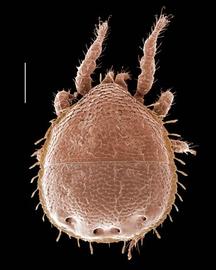
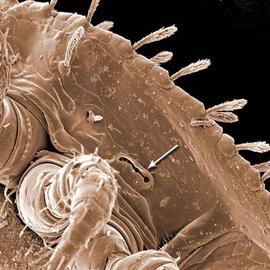
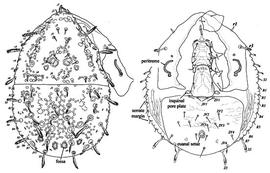
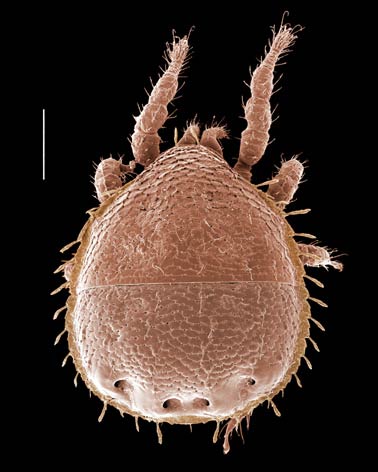
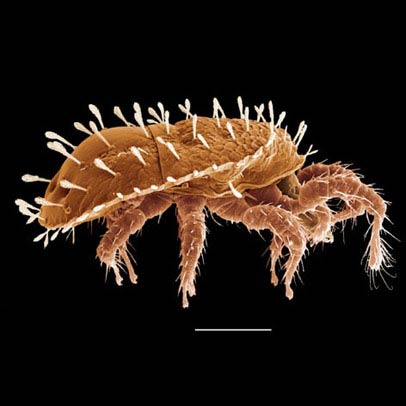
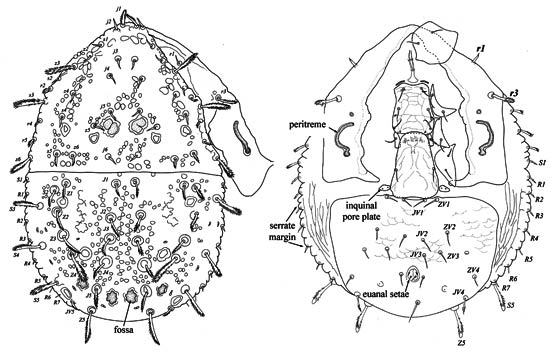
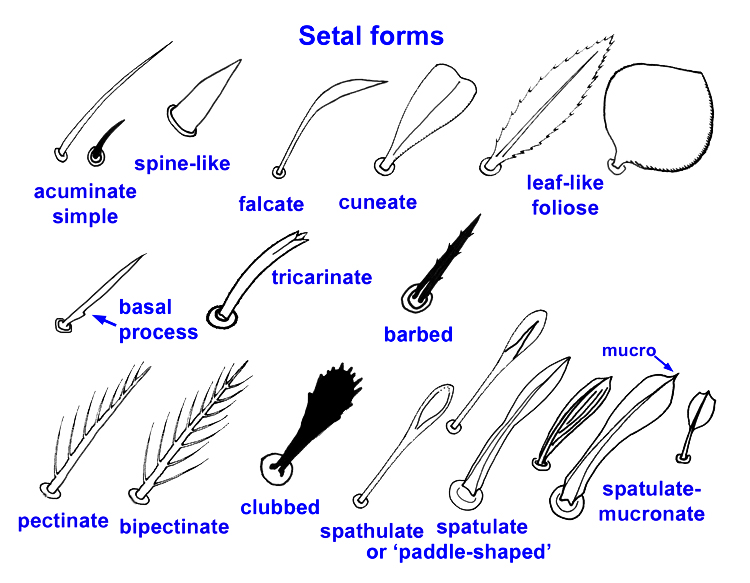
 to crenulate margins with interspersed marginal setaeseta:
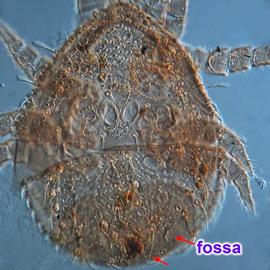
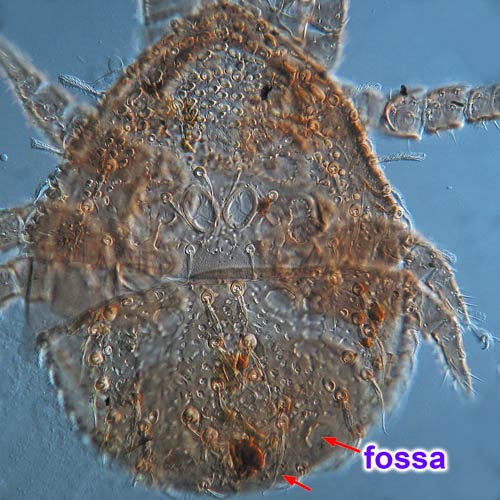
 and usually with 4 deep semi-circular depressions (fossaefossa:
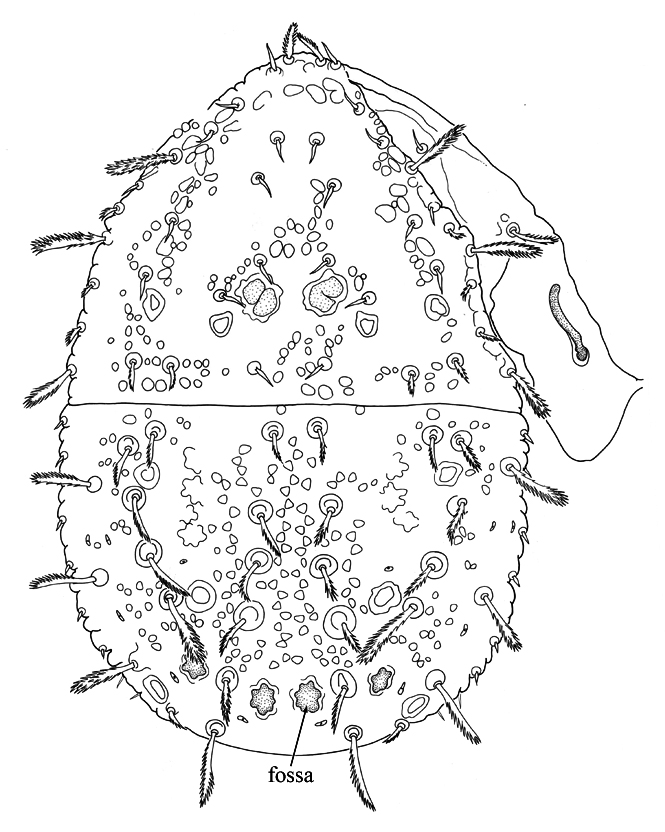 ) on the posteriorposterior: may be present
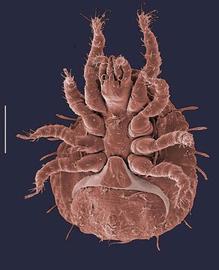
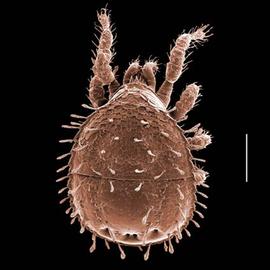
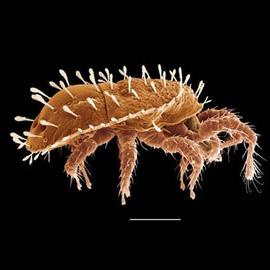
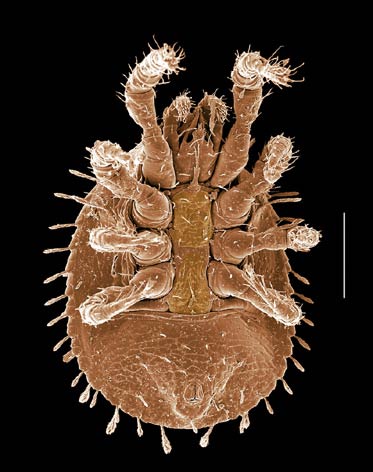
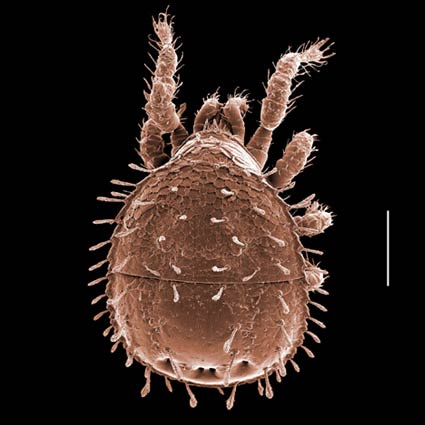
Brown, yellow or pinkish, oval to subrectangular mites with separate podonotalpodonotal:
relating to the dorsal podosoma, the region of the idiosoma over the legs.
and opisthosomalopisthosomal:
(opisthosomatic) adjectival form of opisthosoma.
shields usually bearing r-R series and often with serrateserrate:
with closely set teeth that resemble the cutting edge of a saw. margins; often somewhat hypertrichous; podonotal shieldpodonotal shield:
the anterior shield in mesostigmatans with divided dorsal shields. 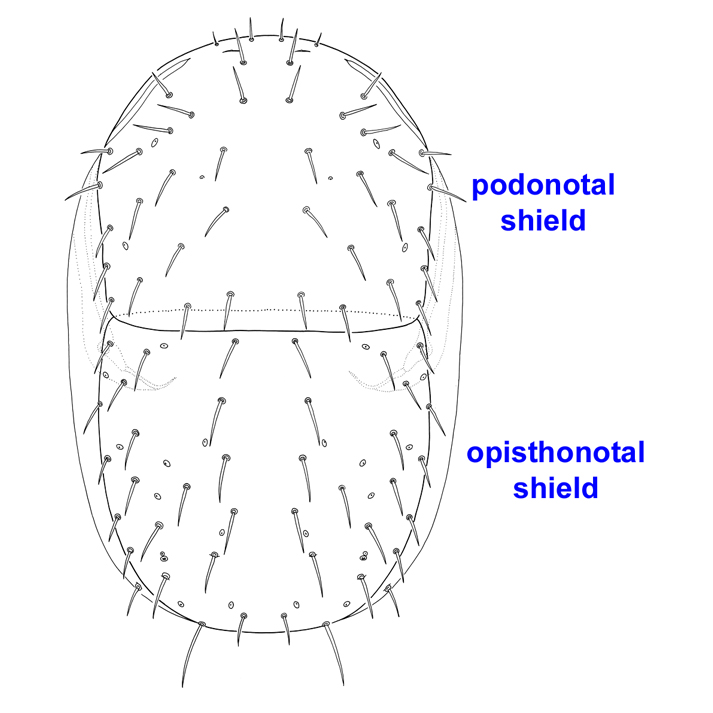 usually with 4 deep depressions near its posteriorposterior:
the back part of the body or towards that region in comparison, e.g., 'posterior to'.
margin at the insertion of major dorso-ventralventral:
relating to the lower or under side; opposed to dorsal.
muscles, and bearing ventralventral:
relating to the lower or under side; opposed to dorsal.
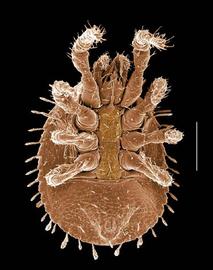
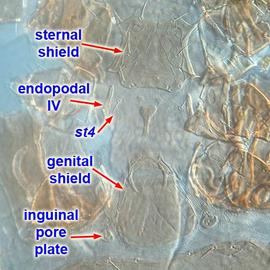
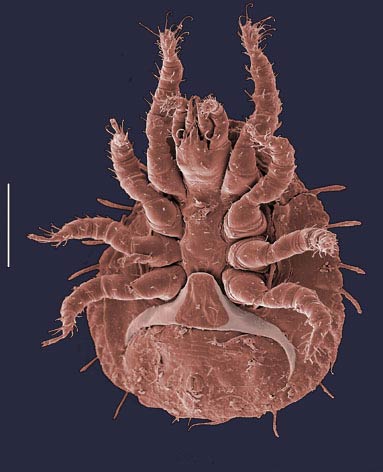
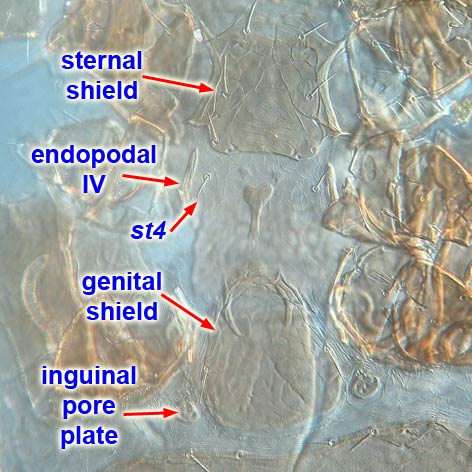
seta JV5. Female sternal shieldsternal shield:
a shield in the anterior intercoxal region of parasitiform mites that bears one or more pairs of sternal setae.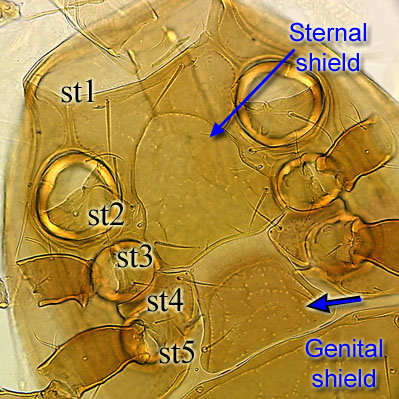 with 3 pairs of setae (st1–3) and 2 pairs of lyrifissures (stp1–2); st4 and stp3 usually on small metasternal platelets; epigynialepigynal:
(also epigynial) of or relating to the female genital opening or a shield protecting it.
shield axe-shape, with 1 pair of setae; inguinal glands on small platelets between basebase:
the usually columnar basal part of the tritosternum; sometimes expanded and rectangular or otherwise modified; the most basal part of any structure.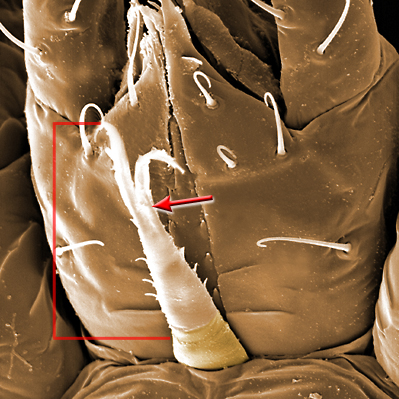 of epigynialepigynal:
(also epigynial) of or relating to the female genital opening or a shield protecting it.
shield and coxae IV or in soft cuticle; anal opening with 2 valves (often with a pair of euanal setaeeuanal setae:
setae borne on the anal valve (Parasitiformes).
) in large ventrianal shieldventrianal shield:
in Mesostigmata, a ventral shield bearing the anal opening, circum anal setae, and one or more pairs of ventral setae or pores (lyrifissures) [see anal shield]; maybe rather narrow or very broad and covering most of the gaster.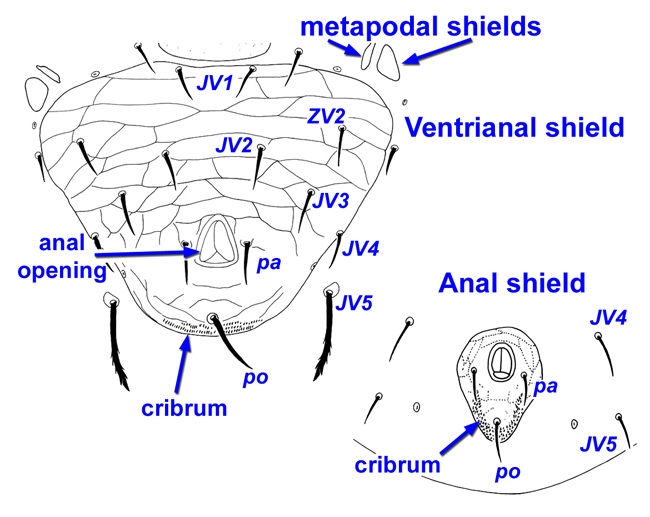 , free from truncate peritrematalperitrematal:
(peritrematic) of or referring to the peritreme; adjectival form of peritreme.
shield or fused to peritrematalperitrematal:
(peritrematic) of or referring to the peritreme; adjectival form of peritreme.
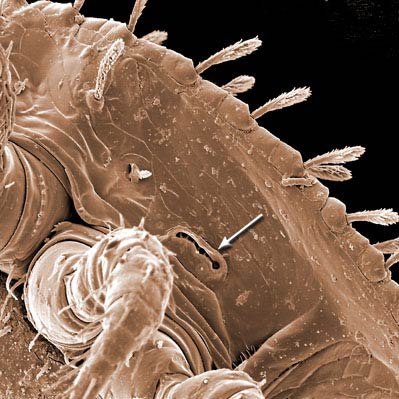
-metapodal shields. Peritremes usually short in adults (less than anterior margin of coxacoxa:
the basal segment of the leg, articulating with (Parasitiformes) or fused to (Acariformes) the body wall.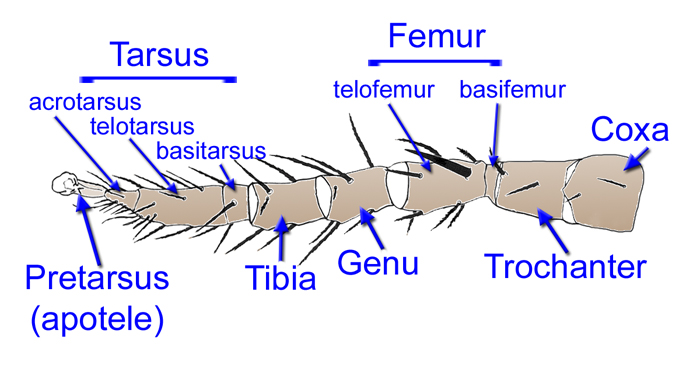 II), but longer in deutonymphs, on broad shields bearing 1–3 pairs of setae. Tarsustarsus:
(pl. tarsi) the subdistal leg segment between the tibia and the pretarsus (apotele).
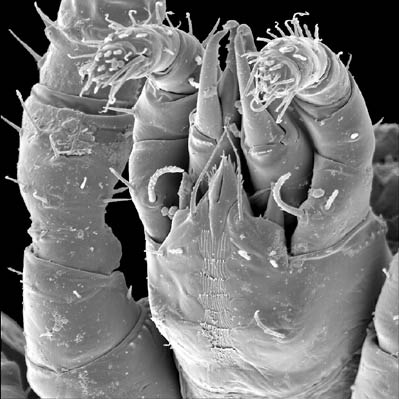
I with claws. Palppalp:
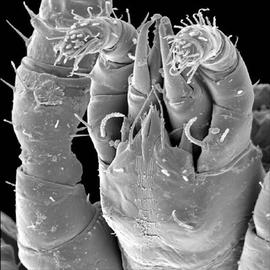
(= pedipalp) the second pair of limbs in arachnids, used in feeding and originating on either side of the chelicerae. In mites, the palps may be vestigial, with only a few segments, or have a maximum of 5 freely articulating segments (rarely the femur is subdivided) and a distal or subdistal apotele.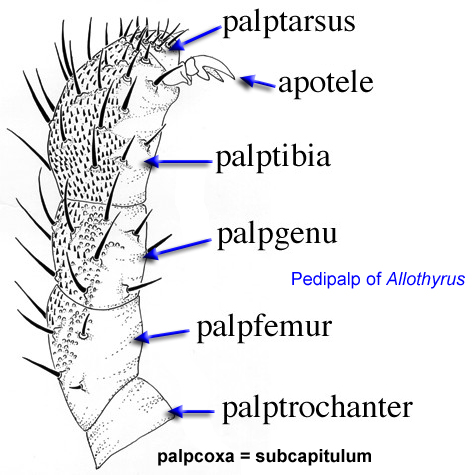 genu with 6 setae; palp apotelepalptarsal apotele:
(= palp apotele, palptarsal claw) the most distal segment of the palp; absent in Acariformes, claw-like in Opilioacarida, and a subdistal, tined structure in the Mesostigmata. with 2 tines. Tectumgnathotectum:
(= epistome, tectum) an often membranous dorsal projection of the anterior margin of the basis capitulum in Mesostigmata; often diagnostic at family-, genus- or species-levels; also often difficult to see without high magnification and good optics.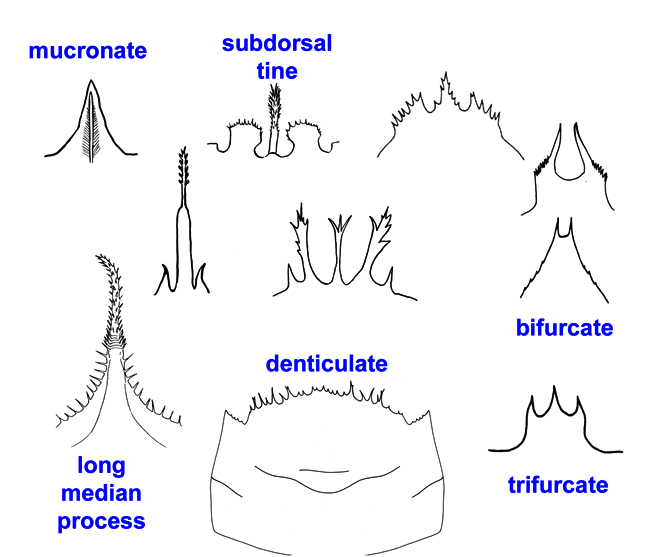 denticulate to spinose; subcapitular gutter often with pencil-like rows of ridges; corniculicorniculus:
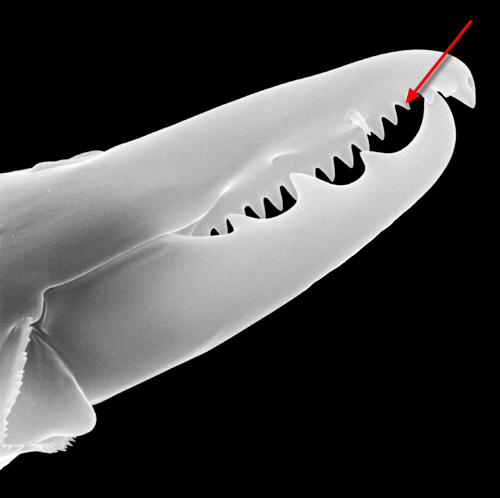
(pl. corniculi) (also, external malae) a usually horn-like process (sometimes toothed, bifurcate, trifurcate, spine-like, spatulate, or membranous) on the subcapitulum of parasitiform mites that usually supports the salivary styli. A toothed corniculus could be confused with a rutellum, a possibly homologous structure in Acariformes and Opilioacarida. Phytoseiid image is spatulate corniculus.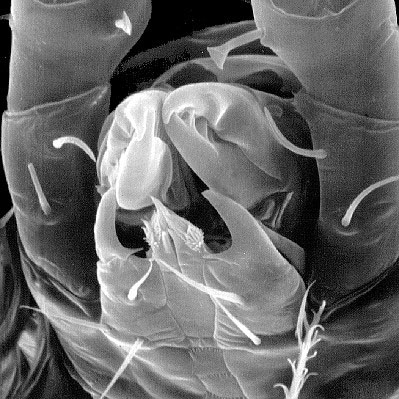 horn-like; hypostomal setae in triangular array; hypostomal groove broad, with denticlesdenticles:
small tooth-like processes, e.g., on the subcapitula of ticks and many mesostigmatans.
. Chelicerae chelate-dentatechelate-dentate:
pincer-like chelicerae with teeth.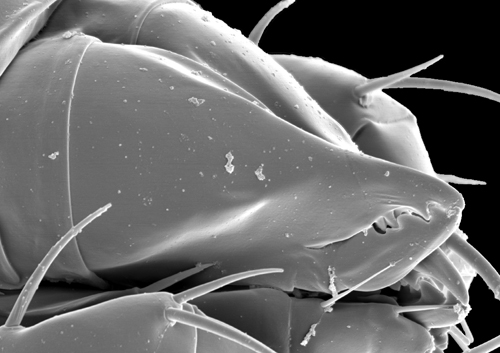 ; pilus dentilispilus dentilis:
(pl. pili dentilis) a seta-like or membranous sensory organ inserted ventrolaterally on the fixed digit of the chelicera of many Mesostigmata.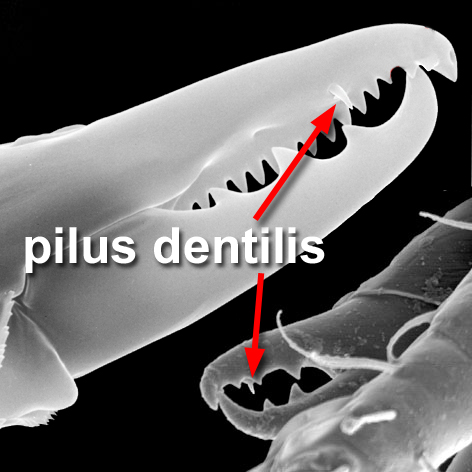 setiform. Male genital opening on intercoxal shield, valve with a pair of setae; neither chelicerae nor legs obviously modified for sperm transfer.
Heatherellidae have elaborate setae on the margins of the their shields, but also have large, spout-like gland openings and subdivided opisthonotal shielding. Some ascids (Ascinae) may seem superficially similar to zerconids, but lack deep pits and serrate margins on the dorsal shield, as well as having a reduced chaetotaxy, seta JV5 fully ventral, and a dermanyssine reproductive system. Adult female Coprozercon (Coprozerconidae) lack a opisthonotal shield.
Author: David E. Walter
Content last updated Sept. 2006, unless indicated otherwise
Lucid key player updated Sept. 2025
idtools.org