t
Veigaia Oudemans
Superorder Parasitiformes » Order Mesostigmata » Suborder Monogynaspida » Infraorder Gamasina » Hyporder Dermanyssiae » Superfamily Veigaioidea » Family Veigaiidae » Genus Veigaia
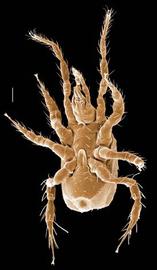
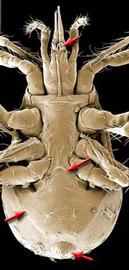
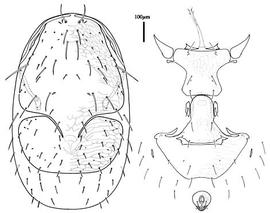
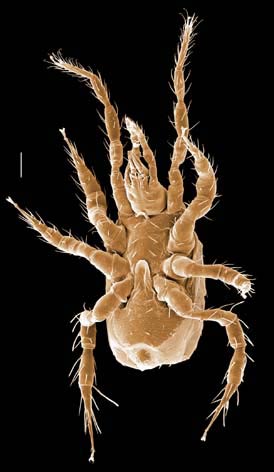
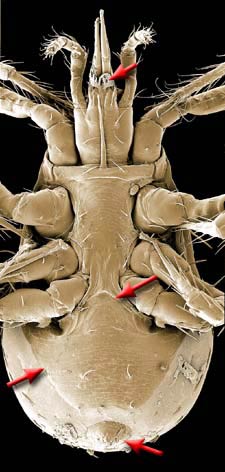
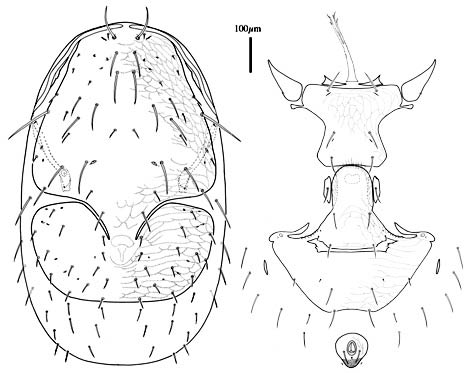
Yellow to orange-brown dermanyssine mesostigmatans. Females with separate podonotalpodonotal:
relating to the dorsal podosoma, the region of the idiosoma over the legs.
and opisthonotalopisthonotal:
dorsal opisthosoma.
shields or with deeply incised schizodorsal shieldschizodorsal shield:
in Mesostigmata, a holodorsal shield that incised laterally at about the midpoint or podonotal and opisthonotal shields that are fused only medially.
; opisthonotalopisthonotal:
dorsal opisthosoma.
region reduced, hypotrichous to slightly hypertrichous; males with holodorsal shieldholodorsal shield:
a shield that covers all of the dorsum. In Mesostigmata, the holodorsal shield is often interpreted as resulting from the fusion of podonotal and opisthonotal shields and a suture between these regions is often visible (see recurved and procurved).
. Peritremes typical running past coxacoxa:
the basal segment of the leg, articulating with (Parasitiformes) or fused to (Acariformes) the body wall.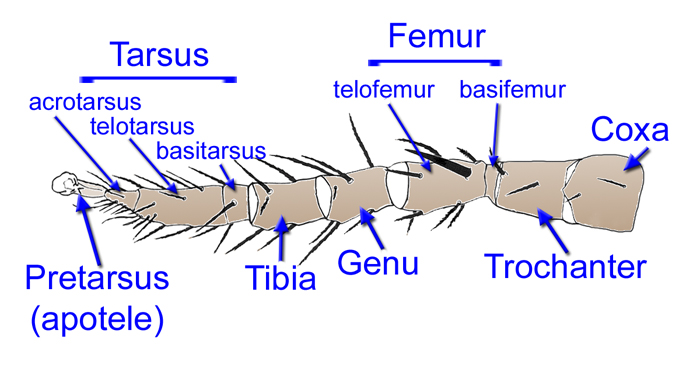 I; peritrematalperitrematal:
(peritrematic) of or referring to the peritreme; adjectival form of peritreme.
shield usually narrow, joining podonotal shieldpodonotal shield:
the anterior shield in mesostigmatans with divided dorsal shields. 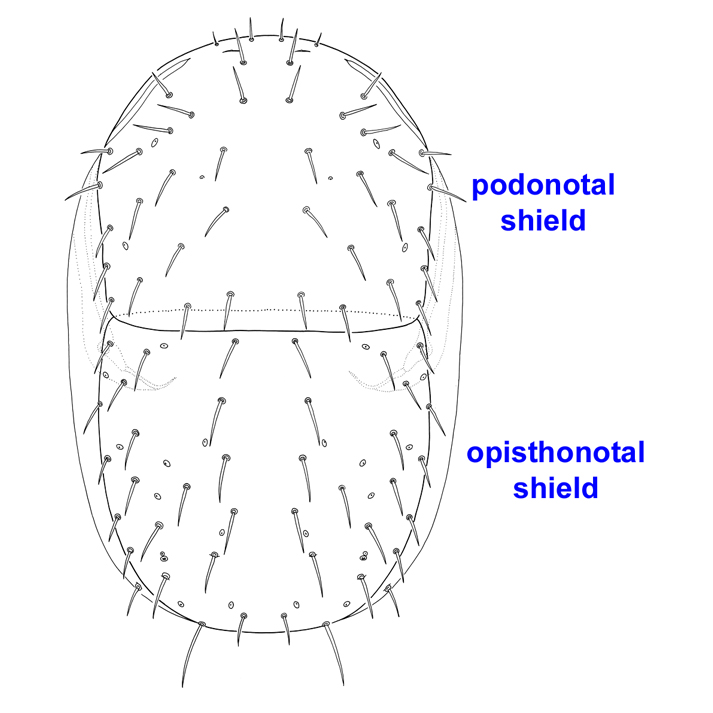 anteriorly, sometimes fused to ventral shieldventral shield:
in Mesostigmata, any shield or shields in the ventral region; often fused with the anal shield to form a ventrianal shield. [Back to Top]
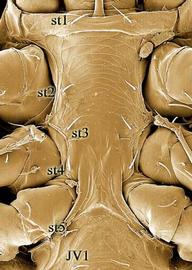
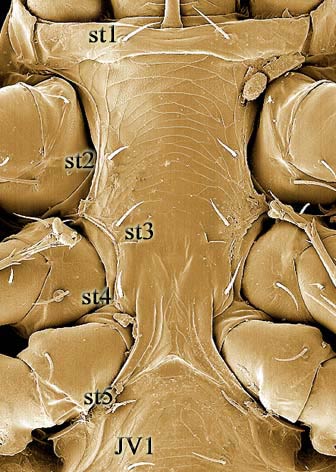
. Female with large sternal shieldsternal shield:
a shield in the anterior intercoxal region of parasitiform mites that bears one or more pairs of sternal setae.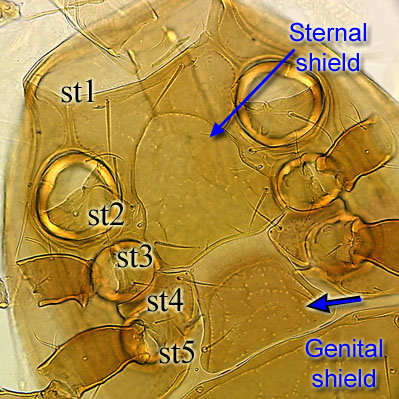 bearing 3 pairs of setae (st1–3) and 2 pairs of lyrifissures (stp1–2); metasternal shields strap-like to subtriangularsubtriangular:
more or less triangular.
and bearing st4, stp3; genital shieldgenital shield:
a shield or shields covering the genital opening; in female mongynaspine Mesostigmata this shield is usually called the epigynal (epigynial) shield.
usually trapezoid and bearing 1 pair of setae, free from, partially fused to (at posteriorposterior:
the back part of the body or towards that region in comparison, e.g., 'posterior to'.
corners), or completely fused to ventral shieldventral shield:
in Mesostigmata, any shield or shields in the ventral region; often fused with the anal shield to form a ventrianal shield. [Back to Top]
; rarely absent (Gamasolaelaps); ventral shieldventral shield:
in Mesostigmata, any shield or shields in the ventral region; often fused with the anal shield to form a ventrianal shield. [Back to Top]
well developed, free from or fused to peritrematalperitrematal:
(peritrematic) of or referring to the peritreme; adjectival form of peritreme.
or genital shields; anal shield free and bearing 3 circumanal setaecircumanal setae:
in Mesostigmata, the three setae (postanal and pair of peranal) setae surrounding the anal opening.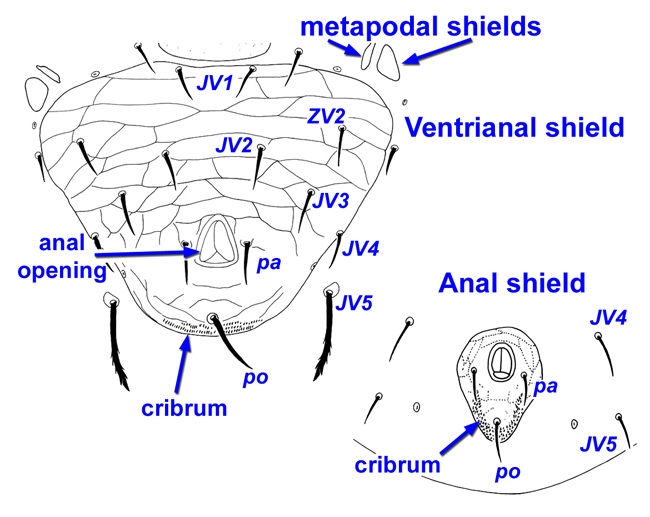 , rarely with 1 pair of ventral setaeventral setae:
in the Lindquist-Evans system used in the Mesostigmata, the ventral region has up to three longitudinal rows (Jv, Zv, Lv) with 1-5 transverse row designations.
. Tarsustarsus:
(pl. tarsi) the subdistal leg segment between the tibia and the pretarsus (apotele).
I slender, elongate, with claws; trochantertrochanter:
the leg segment between the coxa and the femur. I with 6 setae; tibiatibia:
(pl. tibiae) the leg segment between the genu and the tarsus. I with 6 dorsaldorsal:
relating to the upper or back side; opposed to ventral.
and 4 (rarely 3) ventral setaeventral setae:
in the Lindquist-Evans system used in the Mesostigmata, the ventral region has up to three longitudinal rows (Jv, Zv, Lv) with 1-5 transverse row designations.
; genugenu:
(pl. genua) (= patella) the 4th leg segment, between the femur and tibia.
IV with 5 dorsaldorsal:
relating to the upper or back side; opposed to ventral.
and 2 ventral setaeventral setae:
in the Lindquist-Evans system used in the Mesostigmata, the ventral region has up to three longitudinal rows (Jv, Zv, Lv) with 1-5 transverse row designations.
; trochantertrochanter:
the leg segment between the coxa and the femur. and femurfemur:
(pl. femora) major leg segment between trochanter and genu; often subdivided into a basifemur and a telofemur. IV of female sometimes with ventralventral:
relating to the lower or under side; opposed to dorsal.
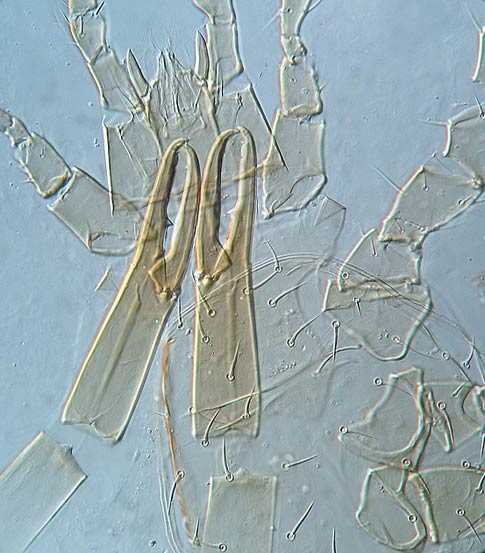
spurs. Chelicerae typically elongate, snapping, with teeth and blade-like regions, less commonly chelate-dentatechelate-dentate:
pincer-like chelicerae with teeth.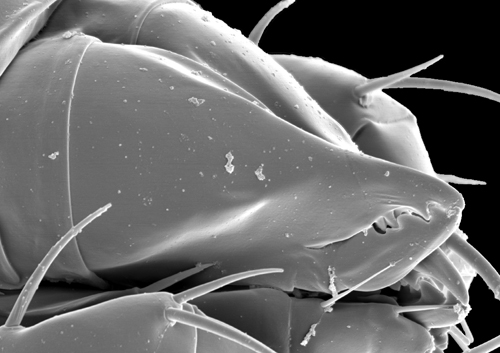 ; movable digit without excrescences. Palp genugenu:
(pl. genua) (= patella) the 4th leg segment, between the femur and tibia.
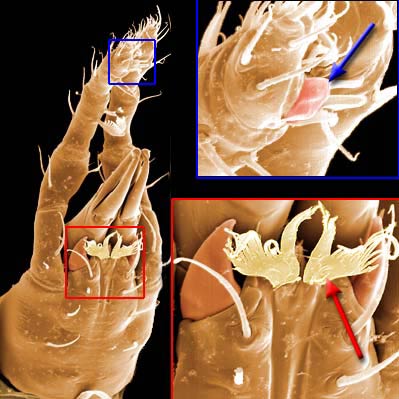
with 6 setae, palp apotelepalptarsal apotele:
(= palp apotele, palptarsal claw) the most distal segment of the palp; absent in Acariformes, claw-like in Opilioacarida, and a subdistal, tined structure in the Mesostigmata.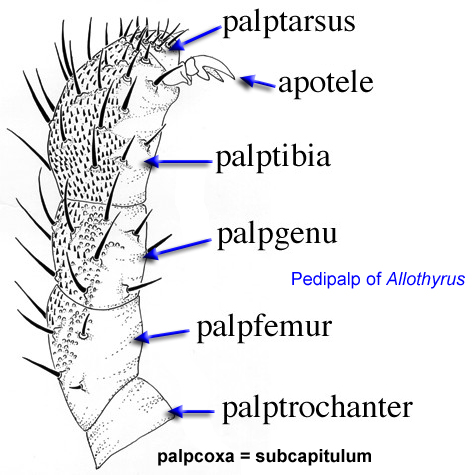 3–4 tined and with dorsaldorsal:
relating to the upper or back side; opposed to ventral.
hyaline scale-like process; corniculicorniculus:
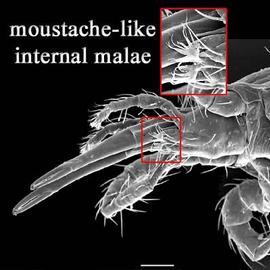
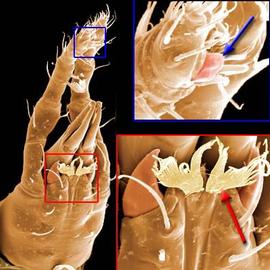
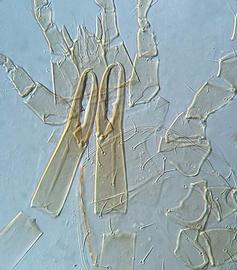
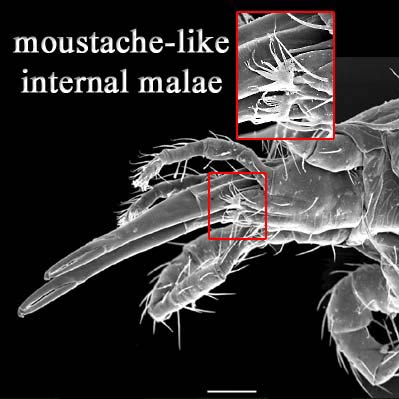
(pl. corniculi) (also, external malae) a usually horn-like process (sometimes toothed, bifurcate, trifurcate, spine-like, spatulate, or membranous) on the subcapitulum of parasitiform mites that usually supports the salivary styli. A toothed corniculus could be confused with a rutellum, a possibly homologous structure in Acariformes and Opilioacarida. Phytoseiid image is spatulate corniculus.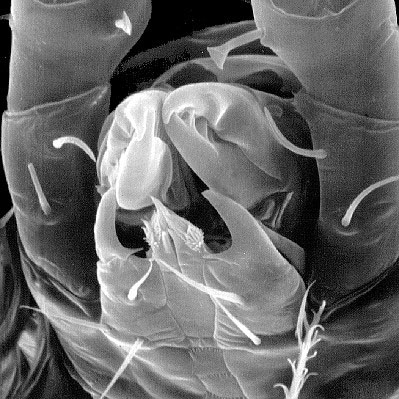 horn-like; internal malae highly divided, often bilobed and moustache-likemoustache-like:
having the appearance of a well developed handlebar moustache, as in the internal malae of most species of Veigaia (Mesostigmata). 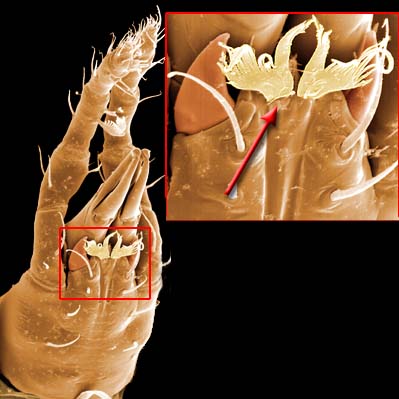 . Tritosternumtritosternum:
the sternum of the 3rd body segment (between legs I); produced as a biflagellate structure in Mesostigmata, although sometimes the flagellae (laciniae) are partially or completely fused. 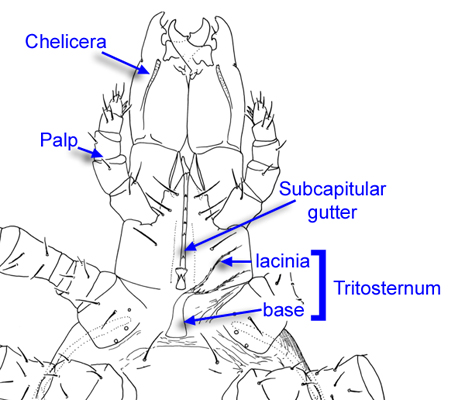 biflagellate, with columnar basebase:
the usually columnar basal part of the tritosternum; sometimes expanded and rectangular or otherwise modified; the most basal part of any structure.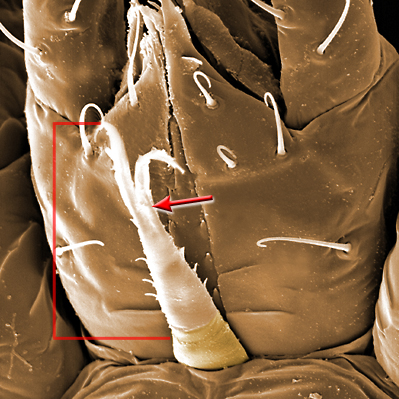 . Tectumgnathotectum:
(= epistome, tectum) an often membranous dorsal projection of the anterior margin of the basis capitulum in Mesostigmata; often diagnostic at family-, genus- or species-levels; also often difficult to see without high magnification and good optics.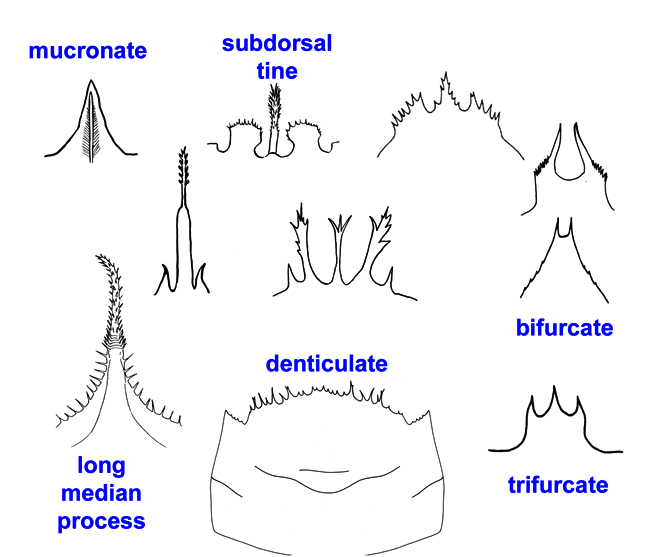 bifurcate, and often with an elongate, subdorsal median process; subcapitular gutter usually broad, with 10 rows of denticlesdenticles:
small tooth-like processes, e.g., on the subcapitula of ticks and many mesostigmatans.
. Female sperm induction pores typically near basebase:
the usually columnar basal part of the tritosternum; sometimes expanded and rectangular or otherwise modified; the most basal part of any structure. of coxae IV; sperm ducts lead to unpaired, central spermathecal sack (laelapid type). Males with genital opening at basebase:
the usually columnar basal part of the tritosternum; sometimes expanded and rectangular or otherwise modified; the most basal part of any structure. of tritosternumtritosternum:
the sternum of the 3rd body segment (between legs I); produced as a biflagellate structure in Mesostigmata, although sometimes the flagellae (laciniae) are partially or completely fused. in sternogenital shield or holoventral plate; spermatodactylspermatodactyl:
(also spermadactyl) the 'sperm finger' on the chelicerae of male dermanyssine Mesostigmata used to transfer sperm to the secondary sperm system in the female; spermatodactyls take various forms, from simple finger-like processes to very long, contorted structures. 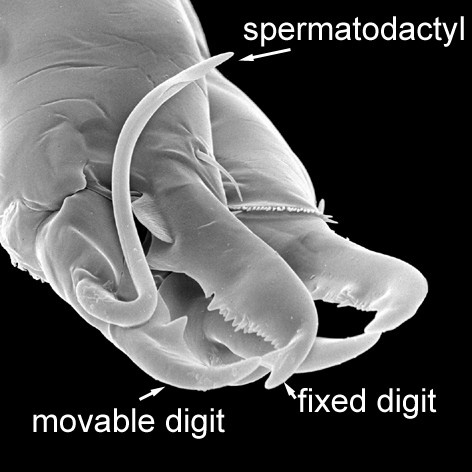 simple and finger-like to extremely elongate; legs II with spurs on femorafemur:
(pl. femora) major leg segment between trochanter and genu; often subdivided into a basifemur and a telofemur., genuagenu:
(pl. genua) (= patella) the 4th leg segment, between the femur and tibia.
, tibiaetibia:
(pl. tibiae) the leg segment between the genu and the tarsus. and tarsitarsus:
(pl. tarsi) the subdistal leg segment between the tibia and the pretarsus (apotele).
.
Parasitidae are superficially similar, but have ventrianal shields and lack characters such as the scale-like process above the palp apotelepalptarsal apotele:
(= palp apotele, palptarsal claw) the most distal segment of the palp; absent in Acariformes, claw-like in Opilioacarida, and a subdistal, tined structure in the Mesostigmata. and moustache-likemoustache-like:
having the appearance of a well developed handlebar moustache, as in the internal malae of most species of Veigaia (Mesostigmata). internal malae.
Tarsitarsus:
(pl. tarsi) the subdistal leg segment between the tibia and the pretarsus (apotele).
II–IV with 1–2 broad ambulacral pads.............................. 2
Tarsi II–IV with 2 narrow, acuminate ambulacra.............................. Cyrthydrolaelaps Berlese
Ambulacral pad entireentire:
a shield or sclerite with a continuous margin without incisions.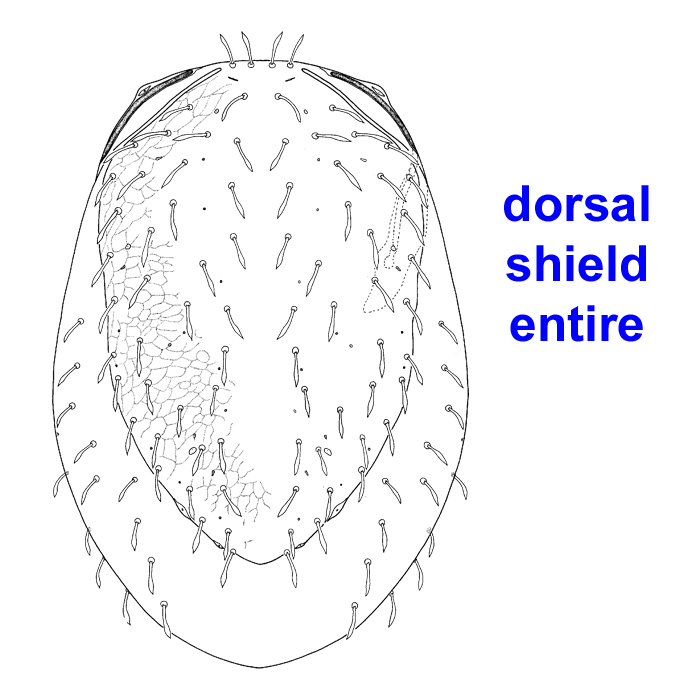 .............................. Gamasolaelaps Berlese
Ambulacra divided into 2 lobes .............................. Veigaia Oudemans
Author: David E. Walter
Content last updated Sept. 2006, unless indicated otherwise
Lucid key player updated Sept. 2025
idtools.org