Mesostigmata
t
Taxonomy
updated 2025
Name
Panteniphis Willmann
Synonyms
Lindquistoseius Genis, Loots & Ryke
Diagnostic characters
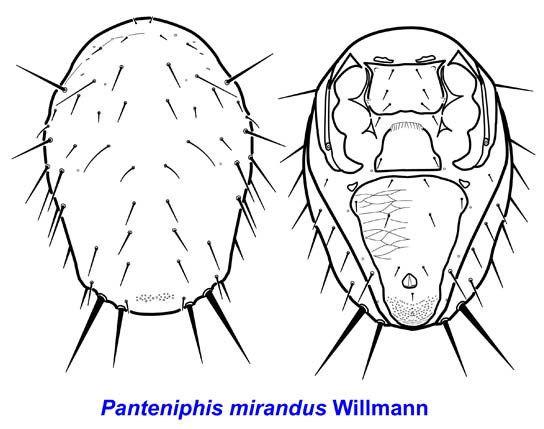
- Female with 3–4 pairs of setae on the sternal shieldsternal shield:
a shield in the anterior intercoxal region of parasitiform mites that bears one or more pairs of sternal setae.
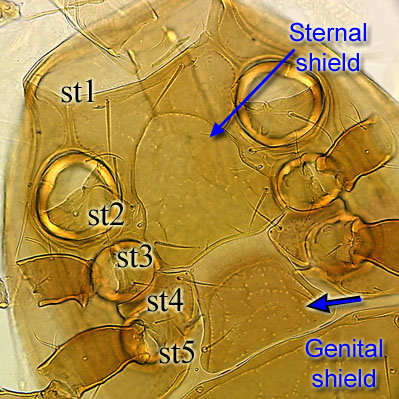 (st1 in membranous or st4 off shield)
- Dorsaldorsal:
relating to the upper or back side; opposed to ventral.
shield entireentire:
a shield or sclerite with a continuous margin without incisions.
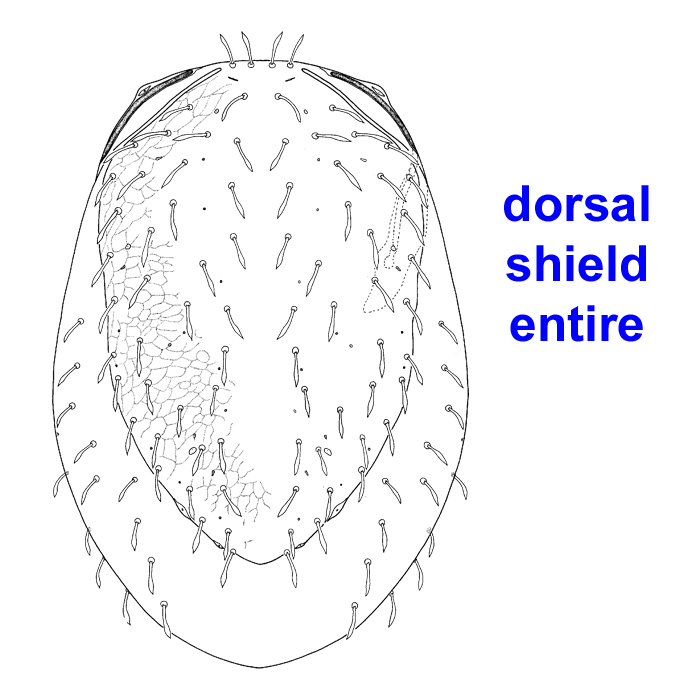 in female (entireentire:
a shield or sclerite with a continuous margin without incisions.
or divided in male; divided in deutonymphdeutonymph:
(also deuteronymph) the second nymphal stage or instar.
); setae j1, z1 and j2 minute; scleronoduliscleronoduli:
3-4 light refractile structures, sometimes comma-shaped, in the podonotal region of many Rhodacaroidea and the genus Protogamasellus (Ascidae) in the Mesostigmata.
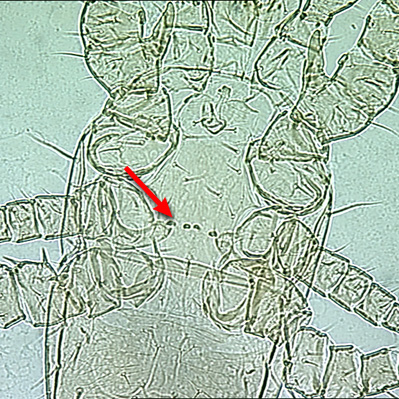 absent.
- Tibiatibia:
(pl. tibiae) the leg segment between the genu and the tarsus.
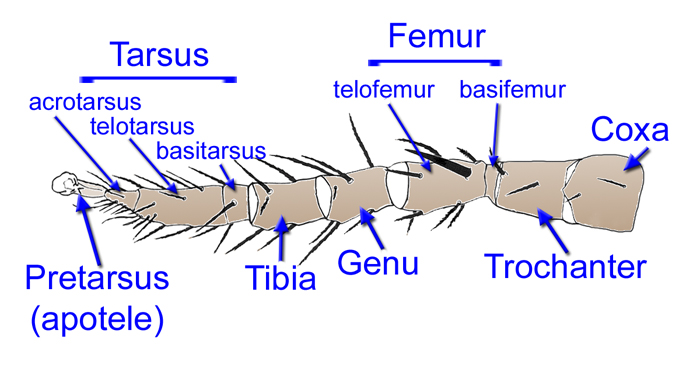 I and genugenu:
(pl. genua) (= patella) the 4th leg segment, between the femur and tibia.
I each with 5/3 or 5/2 dorsal/ventral setae 12 or 11 setae total); genugenu:
(pl. genua) (= patella) the 4th leg segment, between the femur and tibia.
IV with 6 setae.
- Sperm induction porepore:
a pore-like opening or structure in the cuticle. In Mesostigmata, lyrifissures and true pore openings are often difficult to separate and both tend to be called 'pores', e.g., the sternal pores stp1-3.
usually on leg III
- Tectumgnathotectum:
(= epistome, tectum) an often membranous dorsal projection of the anterior margin of the basis capitulum in Mesostigmata; often diagnostic at family-, genus- or species-levels; also often difficult to see without high magnification and good optics.
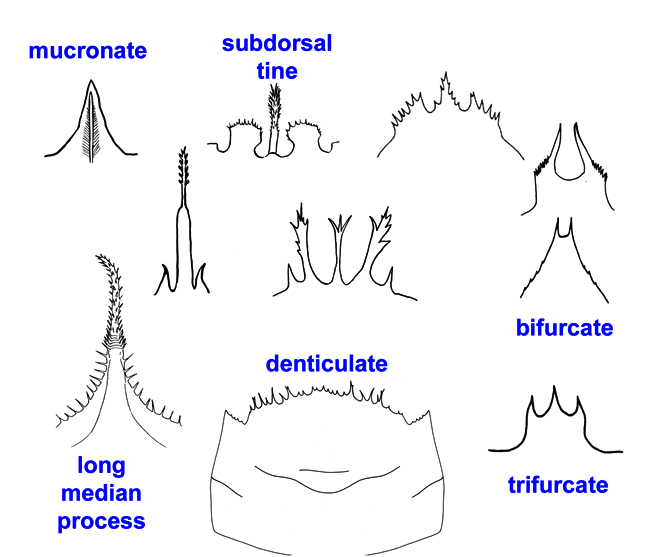 with or with median subdorsal process and a pair of lateral tines
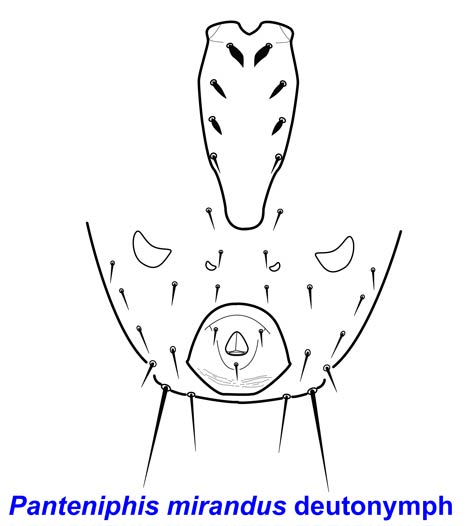
- Deutonymphs phoretic on insects
Similar taxa
Species of Panteniphis appear to be aberrant Rhodacaroidea referable to Digamasellidae because of their reduced leg setation and sperm induction pore on leg III. Adults are strongly hemispherical in shape, but unlike somewhat similar Dendrolaelaspis species, lack posterior horn-like processes and have an entire dorsal shield.
Ecology and distribution
Deutonymphs are phoretic on carabid beetles. Adults are free-living in soil. Known distribution: Europe, North America, and Africa.
References
- Gwaiazdowicz 2000Gwaiazdowicz 2000:
Gwiazdowicz DJ. 2000. Description of deutonymph of Panteniphis mirandus (Acari: Rhodacaridae) from Poland. Biologia (Bratislava) 55: 465-470.
- Hurlbutt 1975Hurlbutt 1975:
Hurlbutt HW. 1975. The systematic position of Panteniphis africanus (Acarina: Mesostigmata). Acarologia 14: 36-42.
- Kethley 1983aKethley 1983a:
Kethley J. 1983a. The deutonymph of Epiphis rarior Berlese, 1916 (Epiphidinae n. subfam., Rhodacaridae, Rhodacaroidea). Canadian Journal of Zoology 61: 2598-2611.
- Willmann 1949Willmann 1949:
Willmann C. 1949. Über eine Milbenausbeute aus dem Naturschutzgebiet Verlorenes Wasser bei Panten (Kr. Liegnitz). Abhandlungen Naturwissenschaftlichen Verein zu Bremen 32: 339-358.