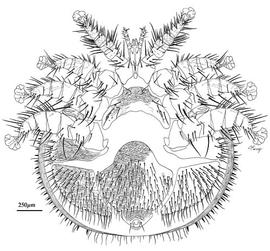
Mesostigmata
t
Taxonomy
updated 2025
Classification
Superorder Parasitiformes » Order Mesostigmata » Suborder Monogynaspida » Infraorder Gamasina » Hyporder Dermanyssiae » Superfamily Dermanyssoidea » Family Varroidae » Genus Varroa
Diagnostic characters
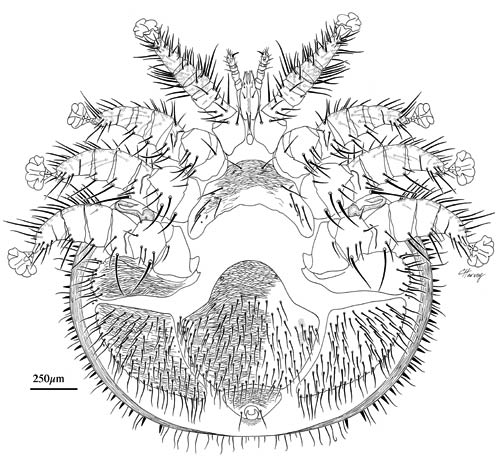
- Peritremes short, sinuous
- Sternal shieldsternal shield:
a shield in the anterior intercoxal region of parasitiform mites that bears one or more pairs of sternal setae.
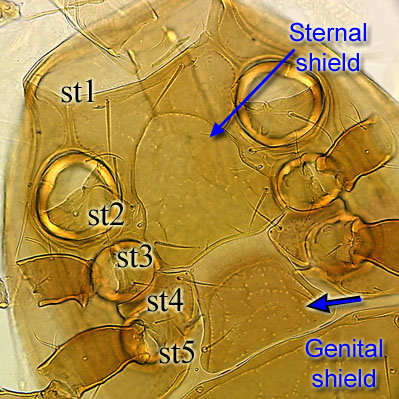 horseshoe-shaped and bearing 5 pairs of setaeseta:
(pl. setae, from L. = bristle) cuticular process composed of a hollow shaft (sometimes filled with a refractive material) produced from a membranous socket (the alveolus); the hair-like, spine-like, branched or variously expanded structures on the surfaces of the legs and body. Most setae function as mechanoreceptors, but others (e.g., solenidia) are chemoreceptors or have unknown or ambiguous functions.
- Metapodal shieldsmetapodal shields:
(also metapodal plates, metapodal platelets, metapodal sclerites) in Mesostigmata, a pair (sometimes fused) of small sclerites posteriad coxae IV in the ventral region that probably reflect muscle attachments.
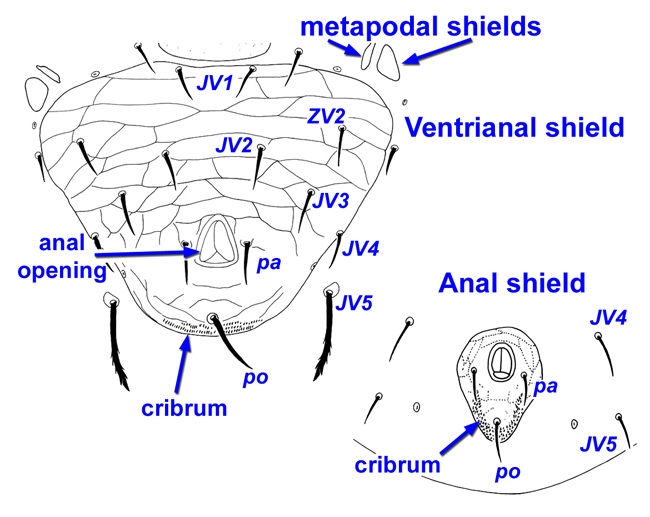 very large and covered with numerous small setaeseta:
(pl. setae, from L. = bristle) cuticular process composed of a hollow shaft (sometimes filled with a refractive material) produced from a membranous socket (the alveolus); the hair-like, spine-like, branched or variously expanded structures on the surfaces of the legs and body. Most setae function as mechanoreceptors, but others (e.g., solenidia) are chemoreceptors or have unknown or ambiguous functions.
- Opisthogenital shield with numerous small setaeseta:
(pl. setae, from L. = bristle) cuticular process composed of a hollow shaft (sometimes filled with a refractive material) produced from a membranous socket (the alveolus); the hair-like, spine-like, branched or variously expanded structures on the surfaces of the legs and body. Most setae function as mechanoreceptors, but others (e.g., solenidia) are chemoreceptors or have unknown or ambiguous functions.
, expanded laterally and reaching metapodal and anal shields; bodybody:
the idiosoma of mites.
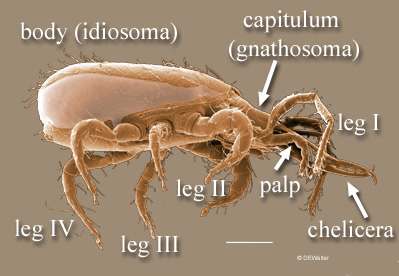 broader than long
More about Varroa on Bee Mite ID
Similar taxa
Euvarroa mites are longer than broad and have a ventrianal shield and small metapodal shields. Tropilaelaps are longer than wide and have narrow genital shields. Melittiphis have a well developed sternal keel.
Ecology and distribution
Parasites of honeybees.
References
- Casanueva 1993Casanueva 1993:
Casanueva ME. 1993. Phylogenetic studies of the free-living arthropod associated Laelapidae (Acari: Mesostigmata). Gayana Zoologica 57: 21–46.
- Delfinado and Baker 1974Delfinado and Baker 1974:
Delfinado MD and Baker EW. 1974. Varroidae, a new family of mites on honey bees (Mesostigmata: Acarina). Journal of the Washington Academy of Science 64: 4-10.
- Delfinado-Baker and Houck 1989Delfinado-Baker and Houck 1989:
Delfinado-Baker M and Houck MA. 1989. Geographic variation in Varroa jacobsoni (Acari, Varroidae): Application of multivariate morphometric techniques. Apidologie 20: 345-358.