Mesostigmata
t
Taxonomy
updated 2025
Name
Euvarroa Delfinado & Baker
Classification
Superorder Parasitiformes » Order Mesostigmata » Suborder Monogynaspida » Infraorder Gamasina » Hyporder Dermanyssiae » Superfamily Dermanyssoidea » Family Varroidae » Genus Euvarroa
Diagnostic characters
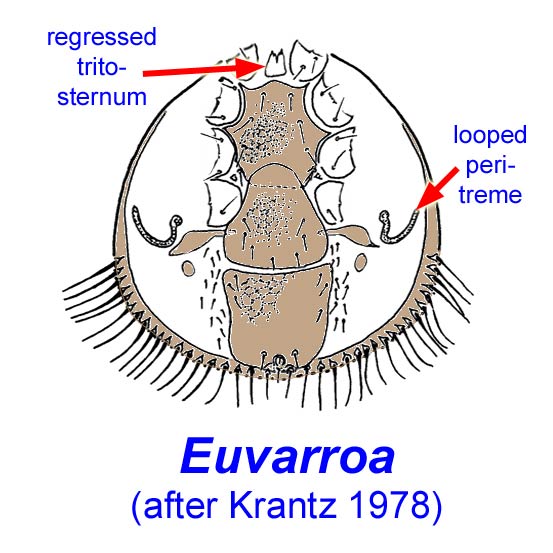
- Peritremes short, sinuous
- Sternal shieldsternal shield:
a shield in the anterior intercoxal region of parasitiform mites that bears one or more pairs of sternal setae.
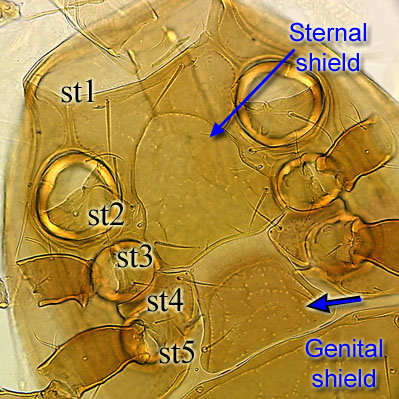 bearing 4 pairs of setaeseta:
(pl. setae, from L. = bristle) cuticular process composed of a hollow shaft (sometimes filled with a refractive material) produced from a membranous socket (the alveolus); the hair-like, spine-like, branched or variously expanded structures on the surfaces of the legs and body. Most setae function as mechanoreceptors, but others (e.g., solenidia) are chemoreceptors or have unknown or ambiguous functions.
- Metapodal shieldsmetapodal shields:
(also metapodal plates, metapodal platelets, metapodal sclerites) in Mesostigmata, a pair (sometimes fused) of small sclerites posteriad coxae IV in the ventral region that probably reflect muscle attachments.
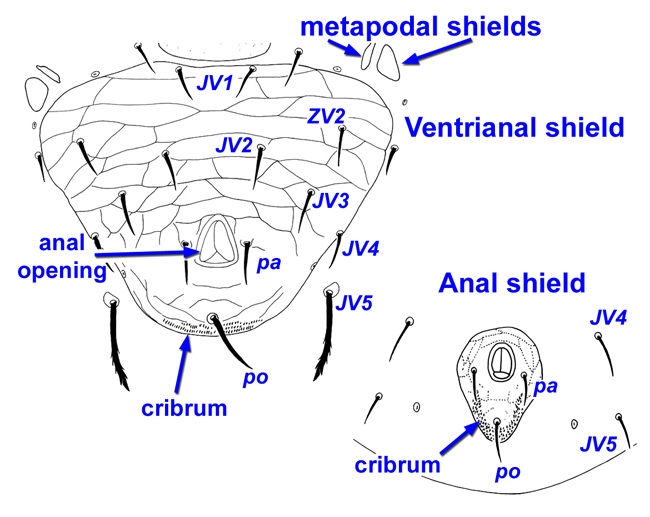 small, nude
- Opisthogenital shield with 3–4 pairs of setaeseta:
(pl. setae, from L. = bristle) cuticular process composed of a hollow shaft (sometimes filled with a refractive material) produced from a membranous socket (the alveolus); the hair-like, spine-like, branched or variously expanded structures on the surfaces of the legs and body. Most setae function as mechanoreceptors, but others (e.g., solenidia) are chemoreceptors or have unknown or ambiguous functions.
, abutting large ventrianal shieldventrianal shield:
in Mesostigmata, a ventral shield bearing the anal opening, circum anal setae, and one or more pairs of ventral setae or pores (lyrifissures) [see anal shield]; maybe rather narrow or very broad and covering most of the gaster.
- Bodybody:
the idiosoma of mites.
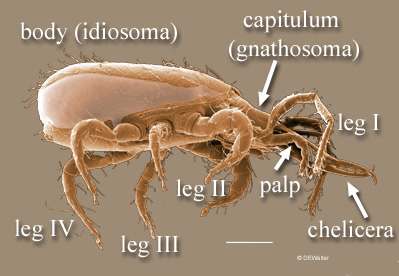 longer than broad
More about Euvarroa on Bee Mite ID
Similar taxa
Varroa mites are broader than long and have a separate anal shield and very large metapodal shields. Tropilaelaps are longer than wide and have narrow genital shields. Melittiphis have a well developed sternal keel.
Ecology and distribution
Parasites of honeybees (Apis spp.).
References
- Casanueva 1993Casanueva 1993:
Casanueva ME. 1993. Phylogenetic studies of the free-living arthropod associated Laelapidae (Acari: Mesostigmata). Gayana Zoologica 57: 21–46.
- Delfinado and Baker 1974Delfinado and Baker 1974:
Delfinado MD and Baker EW. 1974. Varroidae, a new family of mites on honey bees (Mesostigmata: Acarina). Journal of the Washington Academy of Science 64: 4-10.
- Koeniger et al. 1993Koeniger et al. 1993:
Koeniger K, Koeniger G, de Guzman LI, and Lekprayoon C. 1993. Survival of Euvarroa sinhai Delfinado and Baker (Acari, Varroidae) on workers of Apis cerana Fabr., Apis florea Fabr. and Apis mellifera L. in cages. Apidologie 24 (4): 403-410.
- Lekprayoon and Tangkanasing 1991Lekprayoon and Tangkanasing 1991:
Lekprayoon C and Tangkanasing P. 1991. Euvarroa wongririi, a new species of bee mite from Thailand. International Journal of Acarology 17 (4): 255-258.
- Lekprayoon and Tangkanasing 1993Lekprayoon and Tangkanasing 1993:
Lekprayoon C and Tangkanasing P. 1993. Comparative morphology of Euvarroa sinhai and Euvarroa wongsirii: Parasites of Apis florea and Apis andreniformis. p. 427-433. In: Connor LJ, Rinderer T, Sylvester HA, and Wongsiri S, eds. Asian Apiculture: Proceedings of the first international conference on the Asian honey bees and bee mites. Wicwas, Cheshire.