t
Schizosthetus Athias-Henriot
Superorder Parasitiformes » Order Mesostigmata » Suborder Monogynaspida » Infraorder Gamasina » Hyporder Parasitiae » Superfamily Parasitoidea » Family Parasitidae » Subfamily Parasitinae » Genus Schizostethus
Some Laelapidae parasitic on millipedes have split sternal shields but lack parasitineparasitine:
representative of the Parasitidae (Mesostigmata: Monogynaspida: Parasitiae)
genital regions and enlarged metasternal shields.
Lateral setae of palppalp:
(= pedipalp) the second pair of limbs in arachnids, used in feeding and originating on either side of the chelicerae. In mites, the palps may be vestigial, with only a few segments, or have a maximum of 5 freely articulating segments (rarely the femur is subdivided) and a distal or subdistal apotele.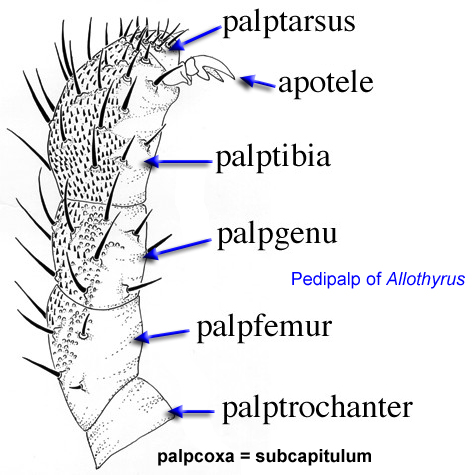 genu (al1–2) entireentire:
a shield or sclerite with a continuous margin without incisions.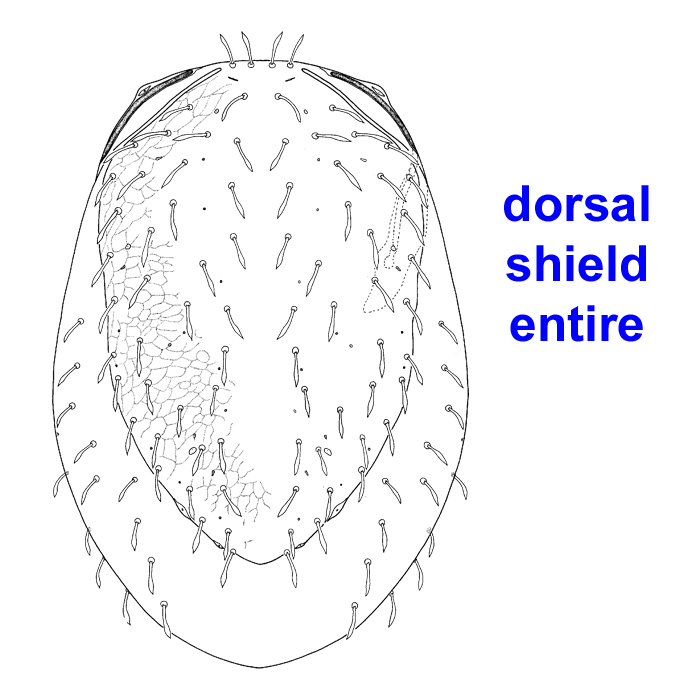 , either setiform or spatulatespatulate:
(Latin spatula = spoon) spatula-shaped; variously interpreted, but usually referring to setae that are flattened and somewhat expanded distally.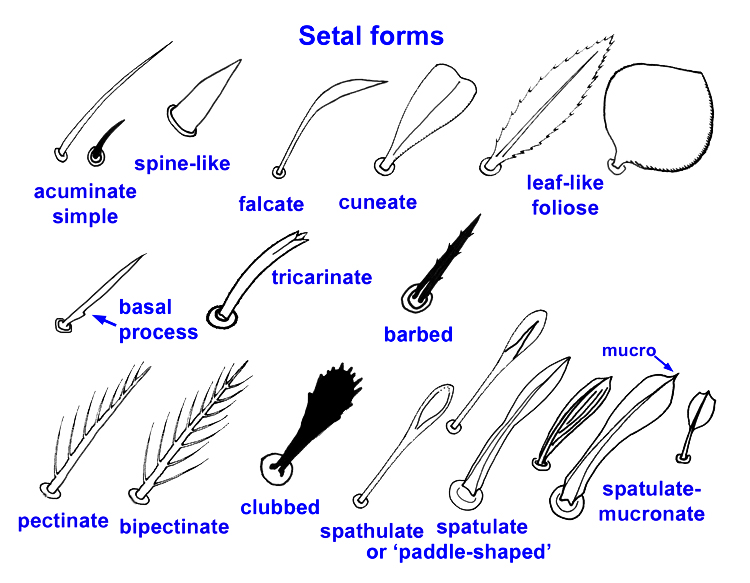 .............................. 2
- Lateral setae of palppalp:
(= pedipalp) the second pair of limbs in arachnids, used in feeding and originating on either side of the chelicerae. In mites, the palps may be vestigial, with only a few segments, or have a maximum of 5 freely articulating segments (rarely the femur is subdivided) and a distal or subdistal apotele. genu (al1–2) bifid.............................. Eugamasus
Posterior ventral regionventral region:
in Mesostigmata, the area between the genital and anal regions.
(opisthogaster) with 30 or fewer pairs of setae; associated with a variety of insects, but usually not bumblebees (Bombus).............................. 3
- Opisthogaster with extensive hypertrichy (>40 pairs of setae); associated with bumblebees (Bombus) or their nests.............................. Parasitellus
Corniculicorniculus:
(pl. corniculi) (also, external malae) a usually horn-like process (sometimes toothed, bifurcate, trifurcate, spine-like, spatulate, or membranous) on the subcapitulum of parasitiform mites that usually supports the salivary styli. A toothed corniculus could be confused with a rutellum, a possibly homologous structure in Acariformes and Opilioacarida. Phytoseiid image is spatulate corniculus.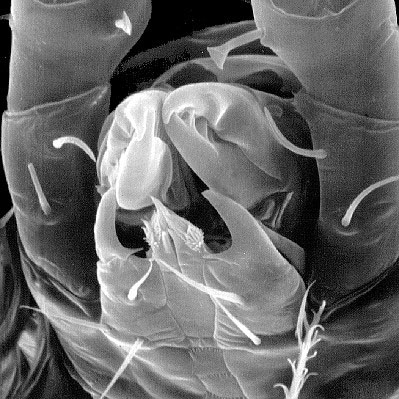 of normal length, not reaching the anterior margin of the palppalp:
(= pedipalp) the second pair of limbs in arachnids, used in feeding and originating on either side of the chelicerae. In mites, the palps may be vestigial, with only a few segments, or have a maximum of 5 freely articulating segments (rarely the femur is subdivided) and a distal or subdistal apotele. femur; anterior margin of anterior dorsaldorsal:
relating to the upper or back side; opposed to ventral.
shield convex.............................. 4
- Corniculicorniculus:
(pl. corniculi) (also, external malae) a usually horn-like process (sometimes toothed, bifurcate, trifurcate, spine-like, spatulate, or membranous) on the subcapitulum of parasitiform mites that usually supports the salivary styli. A toothed corniculus could be confused with a rutellum, a possibly homologous structure in Acariformes and Opilioacarida. Phytoseiid image is spatulate corniculus. elongate, extending beyond palppalp:
(= pedipalp) the second pair of limbs in arachnids, used in feeding and originating on either side of the chelicerae. In mites, the palps may be vestigial, with only a few segments, or have a maximum of 5 freely articulating segments (rarely the femur is subdivided) and a distal or subdistal apotele. femur-genugenu:
(pl. genua) (= patella) the 4th leg segment, between the femur and tibia.
articulation; margin of anterior dorsaldorsal:
relating to the upper or back side; opposed to ventral.
shield concave.............................. Cornigamasus
Genital shieldgenital shield:
a shield or shields covering the genital opening; in female mongynaspine Mesostigmata this shield is usually called the epigynal (epigynial) shield.
(or genital region of hologastric shieldhologastric shield:
in Mesostigmata, a shield that covers the genital, ventral and anal regions; a ventrianal shield that incorporates the metapodal elements and is fused to the epigynal shield. 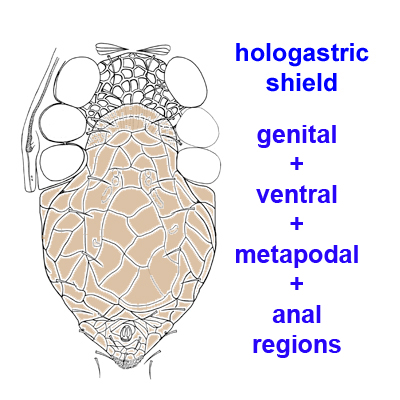 ) subtriangularsubtriangular:
more or less triangular.
, acuminate.............................. 5
- Genital region of hologastric shieldhologastric shield:
in Mesostigmata, a shield that covers the genital, ventral and anal regions; a ventrianal shield that incorporates the metapodal elements and is fused to the epigynal shield. distally tricuspidtricuspid:
having three points or cusps, e.g., the gnathotectum of some Mesostigmata.
.............................. Porrhostaspis
Lateral seta of palppalp:
(= pedipalp) the second pair of limbs in arachnids, used in feeding and originating on either side of the chelicerae. In mites, the palps may be vestigial, with only a few segments, or have a maximum of 5 freely articulating segments (rarely the femur is subdivided) and a distal or subdistal apotele. femur (al) entireentire:
a shield or sclerite with a continuous margin without incisions., usually spatulatespatulate:
(Latin spatula = spoon) spatula-shaped; variously interpreted, but usually referring to setae that are flattened and somewhat expanded distally...............................8
- Lateral seta of palppalp:
(= pedipalp) the second pair of limbs in arachnids, used in feeding and originating on either side of the chelicerae. In mites, the palps may be vestigial, with only a few segments, or have a maximum of 5 freely articulating segments (rarely the femur is subdivided) and a distal or subdistal apotele. femur bifid, serrateserrate:
with closely set teeth that resemble the cutting edge of a saw.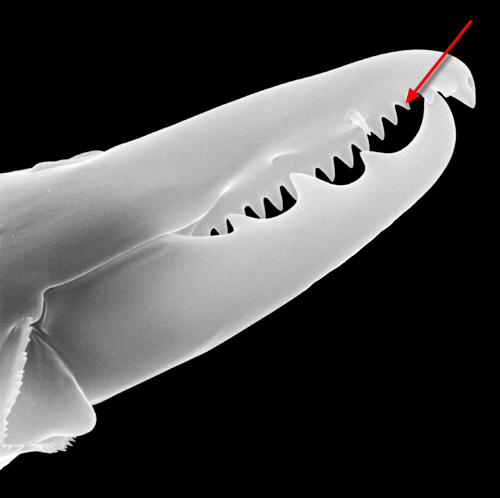 , or serrateserrate:
with closely set teeth that resemble the cutting edge of a saw.-spatulate.............................. 6
Setae of dorsal hexagondorsal hexagon:
a fancied hexagonal area staked out by setal pairs j5, z5 and j6 in the podonotal region of many mesostigmatans; useful for orienting to setae to determine designations (see Lindquist-Evans system); setae j3-5 may also form a hexagonal array.
dissimilar, seta z5 longer and usually thicker than j5 and j6............................... 7
- Setae of dorsal hexagondorsal hexagon:
a fancied hexagonal area staked out by setal pairs j5, z5 and j6 in the podonotal region of many mesostigmatans; useful for orienting to setae to determine designations (see Lindquist-Evans system); setae j3-5 may also form a hexagonal array.
similar in size and ornamentation.............................. Vulgarogamasus
Sternal shieldsternal shield:
a shield in the anterior intercoxal region of parasitiform mites that bears one or more pairs of sternal setae.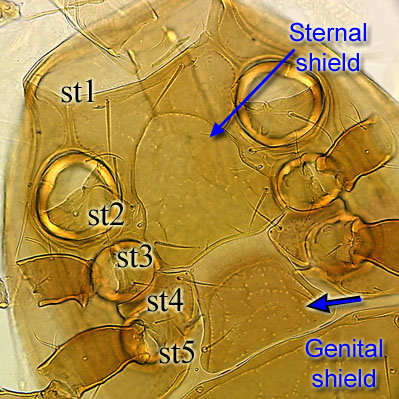 entire; seta z5 usually thicker than j5 and j6 and distally pilosepilose:
with a covering of hairs or hair-like processes. associated with dung (and dung beetles), compost, etc.............................. Parasitus
- Sternal shieldsternal shield:
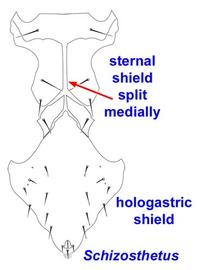
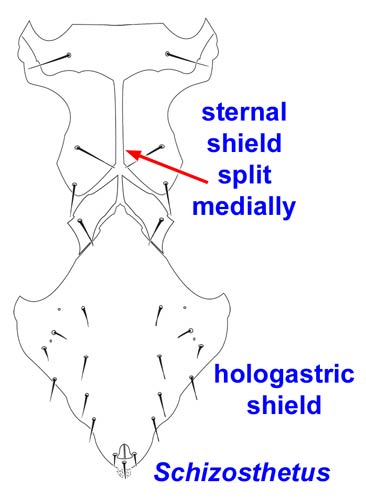
a shield in the anterior intercoxal region of parasitiform mites that bears one or more pairs of sternal setae. split medially; seta z5 usually longer than j5 and j6 but similar in form; associated with bark beetles.............................. Schizosthetus
Dorsaldorsal:
relating to the upper or back side; opposed to ventral.
shield completely divided.............................. 9
- Schizodorsal shieldschizodorsal shield:
in Mesostigmata, a holodorsal shield that incised laterally at about the midpoint or podonotal and opisthonotal shields that are fused only medially.
.............................. Gamasodes bispinosus group
Seta z5 of dorsal hexagondorsal hexagon:
a fancied hexagonal area staked out by setal pairs j5, z5 and j6 in the podonotal region of many mesostigmatans; useful for orienting to setae to determine designations (see Lindquist-Evans system); setae j3-5 may also form a hexagonal array.
thickened and distally pilosepilose:
with a covering of hairs or hair-like processes.; associated with various insects.............................. 10
- Seta z5 simplesimple:
unadorned; simple setae are needle-like and without hairs or pectins.
; associated with carrion beetles (Silphidae).............................. Poecilochirus
Articulationarticulation:
a region of differentiated cuticle joining two parts of an exoskeleton; a joint, scissure or furrow.
between sternal and metasternal shields oblique; ambulacra of legs II–IV simplesimple:
unadorned; simple setae are needle-like and without hairs or pectins.
, rounded.............................. Gamasodes
- Articulationarticulation:
a region of differentiated cuticle joining two parts of an exoskeleton; a joint, scissure or furrow.
(or suturesuture:
an inflexible juncture between two body parts; line of fusion between two formerly separate body parts or regions. This term is often misused for flexible articulations.
) between sternal and metasternal shields transverse; ambulacra of legs II–IV long and acuminate.............................. Trachygamasus
Predators found in bark beetle galleries; deutonymphs phoretic on bark beetles.
Author: David E. Walter
Content last updated Sept. 2006, unless indicated otherwise
Lucid key player updated Sept. 2025
idtools.org