Mesostigmata
t
Taxonomy
updated 2025
Name
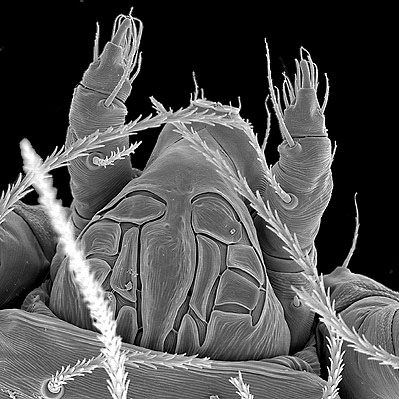
Dinychidae Berlese, 1916Berlese, 1916:
Berlese A. 1916. Centuria seconda di Acari nuovi. Redia 12: 125–177.
Children
Dinychus Kramer
Diagnostic characters
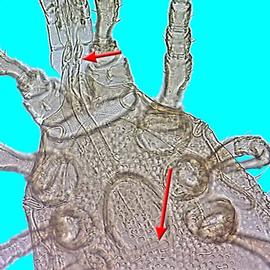
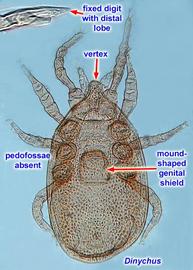
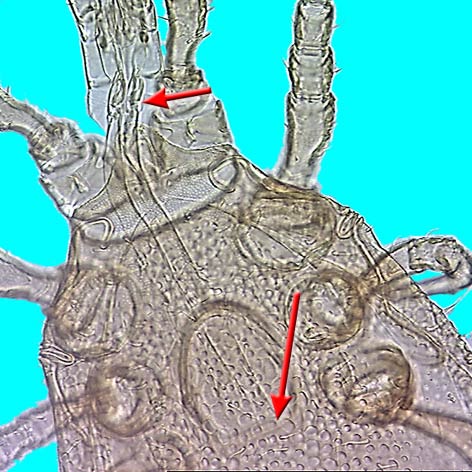
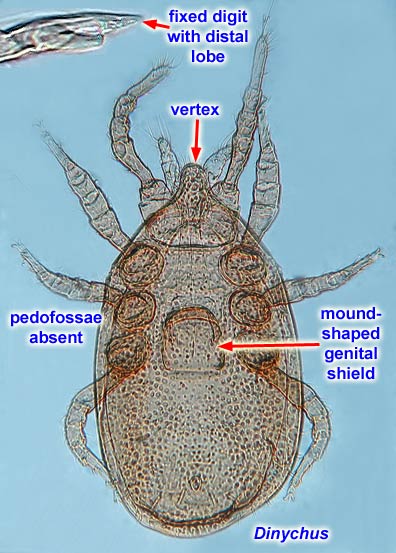
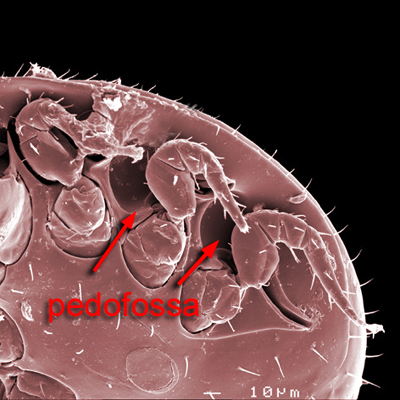
- Uropodoids with flattened, adjacent coxae I but without pedofossaepedofossa:
(pl. pedofossae) (= fossae pedales, fovae pedales) recesses into which the legs can be withdrawn.
- Tarsustarsus:
(pl. tarsi) the subdistal leg segment between the tibia and the pretarsus (apotele).
I with claws
- Cheliceralcheliceral:
of or pertaining to the chelicera.
node present
- Genital shieldgenital shield:
a shield or shields covering the genital opening; in female mongynaspine Mesostigmata this shield is usually called the epigynal (epigynial) shield.
as wide as long
- Hypostomal setaeseta:
(pl. setae, from L. = bristle) cuticular process composed of a hollow shaft (sometimes filled with a refractive material) produced from a membranous socket (the alveolus); the hair-like, spine-like, branched or variously expanded structures on the surfaces of the legs and body. Most setae function as mechanoreceptors, but others (e.g., solenidia) are chemoreceptors or have unknown or ambiguous functions.
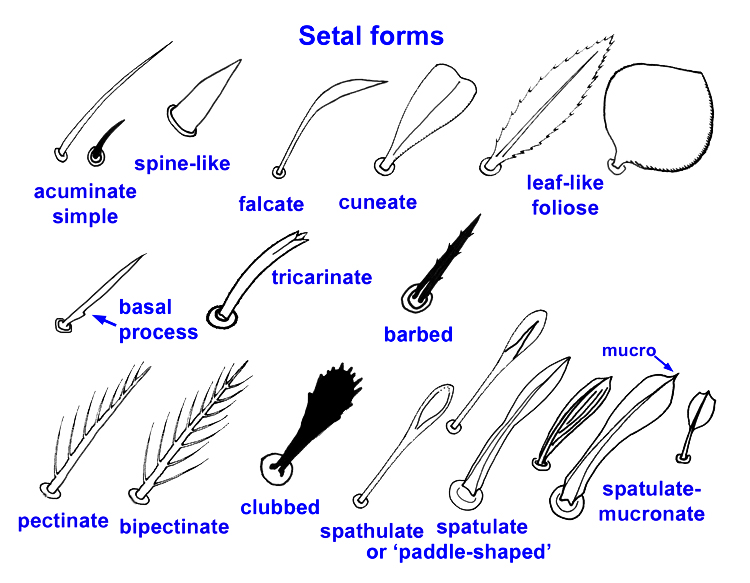 h1–3 smooth, acicular; pc short and barbed.
- Peritremeperitreme:
a groove or gutter on the surface connecting to a stigmatal opening. In Mesostigmata the peritremes are lateral and run above the coxae of the legs and usually run to near the anterior margin of the idiosoma, but they may be very short or vestigial. In Prostigmata peritremes are usually found on the anterior margin of the idiosoma, as short processes to either side of the capitulum (emergent peritremes), or as simple to complex lines or reticulations of short, connected chambers on the dorsal surface of the chelicerae or stylophore.
 usually with post-stigmatic extension
- Dorsaldorsal:
relating to the upper or back side; opposed to ventral.
shield typically strongly reticulatereticulate:
foveate - having a net-like ornamentation composed of irregular, rounded cells. Also having a net-like structure; usually referring to ornamentation on shields composed of irregular, angular cells.
or punctatepunctate:
usually referring to ornamentation on shields resembling a dense array of needle punctures; with a granular appearance.
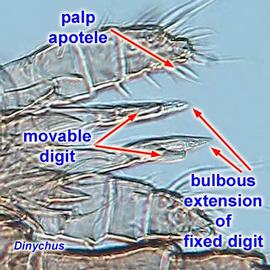
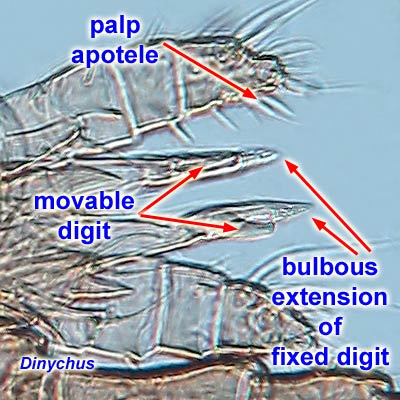
- Fixed digitfixed digit:
the distal extension of the middle article of the chelicera; usually bearing teeth and a distal hook and opposed to the movable digit in chelate-dentate forms, but often regressed; in Mesostigmata the fixed digit may bear the pilus dentilis.
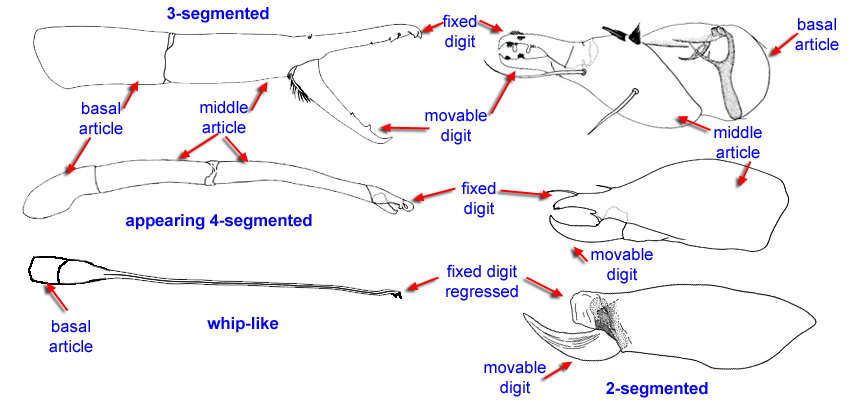 of chelicerae with well developed anterior extension
Similar taxa
Lower uropodines typically have well separated coxae I and large, rectangular tritosternal bases; most higher uropodines have well developed pedofossae (fovae pedales).
References
- Ainscough 1981Ainscough 1981:
Ainscough BD. 1981. Uropodine studies. I. Suprageneric classification in the cohort Uropodina Kramer, 1882 (Acari: Mesostigmata). International Journal of Acarology 7: 47–56.
- Athias 1976Athias 1976:
Athias F. 1976. Observations morphologiques sur Polyaspis patavinus Berlese 1881 (Acariens: Uropodides). 2. Morphologie et chètotaxie des appendices au cours du dèveloppement postembryonnaire. Acarologia 18: 194–216.
- Athias-Binche and Bloszyk 1988Athias-Binche and Bloszyk 1988:
Athias-Binche F, Bloszyk J. 1988. Australian Uropodina (Acari: Anactinotrichida). I. Australocilliba gen. n. (Cillibidae). Journal of the Australian Entomological Society 27: 1–8.
- Athias-Binche and Evans 1981Athias-Binche and Evans 1981:
Athias-Binche F, Evans GO. 1981. Observations on the genus Protodinychus Evans, 1957 (Acari: Mesostigmata) with descriptions of the male and phoretic deuteronymph. Proceedings of the Royal Irish Academy (Section B) 81B: 25–36.
- Bloszyk and Halliday 1995Bloszyk and Halliday 1995:
Bloszyk J, Halliday RB. 1995. A new species of Dinychus Kramer from Tasmania (Acarina: Dinychidae). Journal of the Australian Entomological Society 34: 187–191.
- Evans and Till 1979Evans and Till 1979:
Evans EO and Till WM. 1979. Mesostigmatic mites of Britain and Ireland (Chelicerata: Acari-Parasitiformes): An introduction to their external morphology and classification. Transactions of the Zoological Society of London 35 (2): 145-270.
- Gilyarov and Bregatova 1977Gilyarov and Bregatova 1977:
Gilyarov MS and Bregatova NG, eds. 1977. Handbook for the identification of soil-inhabiting mites, Mesostigmata. Zoological Institute of the Academy of Sciences, Petrograd.
- Johnston 1961Johnston 1961:
Johnston DE. 1961. A review of the lower uropodid mites (former Thinozerconoidea, Protodinychoidea and Trachytoidea) with notes on the classification of the Uropodina (Acarina). Acarologia 3: 522-545.
- Karg 1989aKarg 1989a:
Karg W. 1989a. Acari (Acarina), Milben Unterordnung Parasitiformes (Anactinotrichaeta) Uropodina Kramer, Schildkrötenmilben. Die Tierwelt Deutschlands 67: 1-203.
- Krantz and Ainscough 1990Krantz and Ainscough 1990:
Krantz GW and Ainscough B. 1990. Mesostigmata. pp. 583-665. In: Dindal DL, ed. Soil biology guide. John Wiley & Sons, Brisbane.
- Wisniewski and Hirschmann 1993Wisniewski and Hirschmann 1993:
Wisniewski J and Hirschmann W. 1993. Gangsystematik der Parasitiformes. Teil 548. Katalog der Ganggattungen, Untergattungen, Gruppen und Arten die Uropodiden der Erde. Acarologie, Schriftenreihe für Vergleichende Milbenkunde 40: 1-220.
- Womersley 1959bWomersley 1959b:
Womersley H. 1959b. A new species of Urodiscella (Acarina, Uropodidae) from Australia. Records of the South Australian Museum 13: 349-353.