Mesostigmata
t
Taxonomy
updated 2025
Name
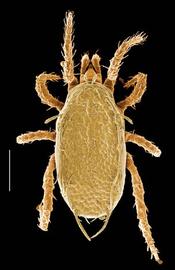
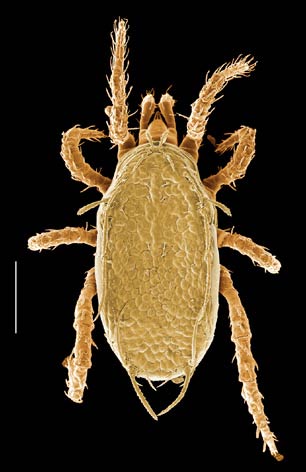
Phytoseius Ribaga, 1902
Classification
Superorder Parasitiformes » Order Mesostigmata » Suborder Monogynaspida » Infraorder Gamasina » Hyporder Dermanyssiae » Superfamily Phytoseioidea » Family Phytoseiidae » Subfamily Phytoseiinae » Genus Phytoseius
Diagnostic characters
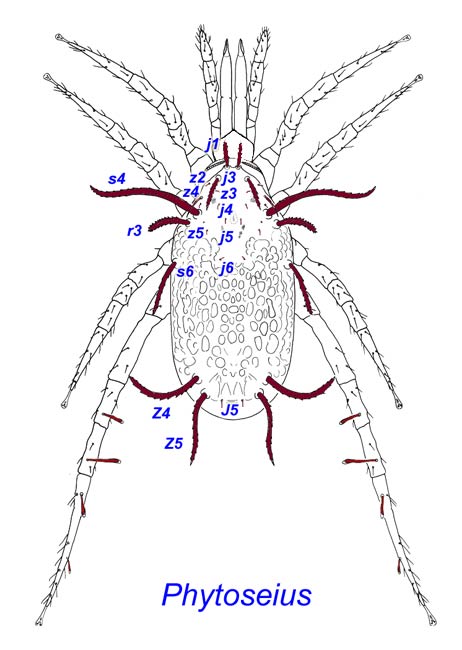
- Phytoseiidae with all setaeseta:
(pl. setae, from L. = bristle) cuticular process composed of a hollow shaft (sometimes filled with a refractive material) produced from a membranous socket (the alveolus); the hair-like, spine-like, branched or variously expanded structures on the surfaces of the legs and body. Most setae function as mechanoreceptors, but others (e.g., solenidia) are chemoreceptors or have unknown or ambiguous functions.
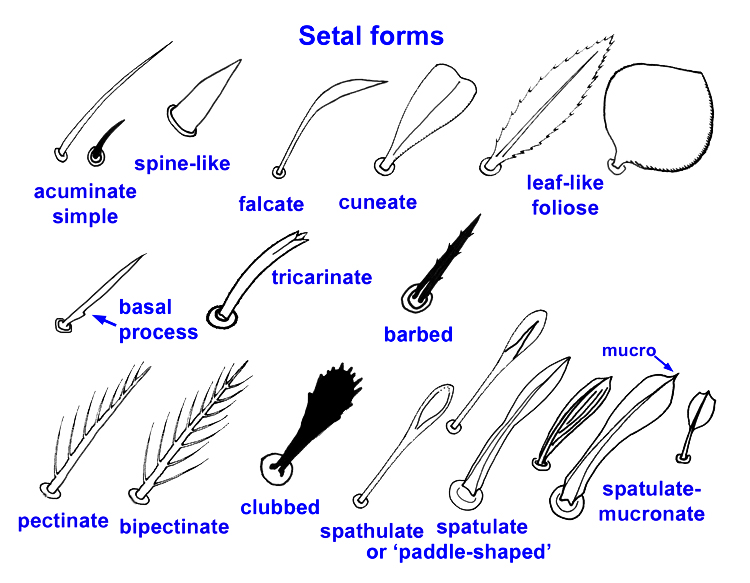 in the S-series and Z1 suppressed
- Setaseta:
(pl. setae, from L. = bristle) cuticular process composed of a hollow shaft (sometimes filled with a refractive material) produced from a membranous socket (the alveolus); the hair-like, spine-like, branched or variously expanded structures on the surfaces of the legs and body. Most setae function as mechanoreceptors, but others (e.g., solenidia) are chemoreceptors or have unknown or ambiguous functions.
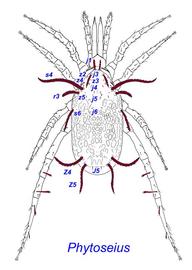
s6 present, z3 present but often minute; Z4–5 usually enlarged, barbed and with insertions usually contiguous.
- Genugenu:
(pl. genua) (= patella) the 4th leg segment, between the femur and tibia.
II with 7 setaeseta:
(pl. setae, from L. = bristle) cuticular process composed of a hollow shaft (sometimes filled with a refractive material) produced from a membranous socket (the alveolus); the hair-like, spine-like, branched or variously expanded structures on the surfaces of the legs and body. Most setae function as mechanoreceptors, but others (e.g., solenidia) are chemoreceptors or have unknown or ambiguous functions.
; genugenu:
(pl. genua) (= patella) the 4th leg segment, between the femur and tibia.
III with 6 setaeseta:
(pl. setae, from L. = bristle) cuticular process composed of a hollow shaft (sometimes filled with a refractive material) produced from a membranous socket (the alveolus); the hair-like, spine-like, branched or variously expanded structures on the surfaces of the legs and body. Most setae function as mechanoreceptors, but others (e.g., solenidia) are chemoreceptors or have unknown or ambiguous functions.
. ~150 described species.
Similar taxa
Species of Paraphytoseius (Amblyseiinae) strongly resemble species of Phytoseius but have serrateserrate:
with closely set teeth that resemble the cutting edge of a saw.
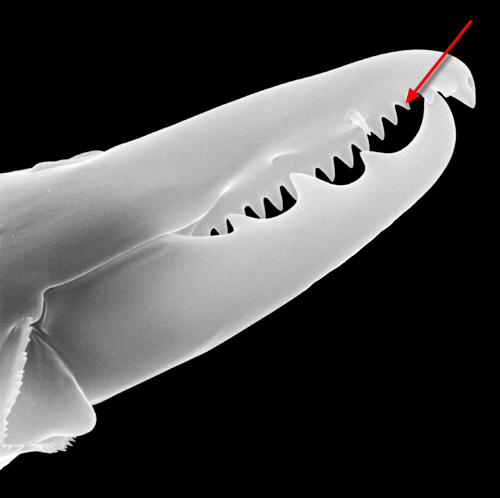 -chelate chelicerae and lack setae z3 and s6. Species of Platyseiella lack setae z3.
Key to genera of Phytoseiinae
-
Seta z3 absent, s6 present.............................. Platyseiella Muma
- Seta z3 present, s6 present or absent............................... 2
-
Seta z6 absent, s6 present; dorsaldorsal:
relating to the upper or back side; opposed to ventral.
shield setae barbed, usually acicular, fine to thickened.............................. Phytoseius Ribaga
- Seta z6 present, s6 absent; dorsaldorsal:
relating to the upper or back side; opposed to ventral.
shield setae spatulate/paddle-shaped.............................. Chantia Pritchard & BakerPritchard & Baker:
A system of setal designations of spider mites in Pritchard & Baker 1955 (A revision of the spider mite family Tetranychidae. Mem. Pac. Coast Entomol. Soc. 2: 1-472.). Dorsocentrals: D1 = c1; D2 = d1; D3 = e1; D4 = f1; D5 = h1; Dorsolaterals: L1 = c2; L2 = d2; L3 = e2; L4 = f2; Sublaterals: 1st sublaterals = c3; 2nd sublaterals = d3; 3rd sublaterals = e3; Humerals: H = c3; also Inner sacrals (or DC4) = f1; Outer sacrals (or L4) = f2; Clunals (or DC5) = h1 or f3; Postanals (or posterior para-anals) = h2; Anterior para-anals = h3; Anals = ps1-3; 1st genitals (or anteromedial genitals) = g1; 2nd genitals (or posterolateral genitals)= g2; Pregenitals = ag in the Grandjean system.
Ecology and distribution
Species of Phytoseius are found worldwide and some have proven useful as biocontrol agents of eriophyoid mites.
References
- Beard and Walter 1996Beard and Walter 1996:
Beard JJ, Walter DE. 1996. Australian mites of the genera Paraphytoseius and Paraamblyseius (Acarina: Phytoseiidae). Australian Journal of Entomology 35: 235–241.
- Chant and McMurtry 1994Chant and McMurtry 1994:
Chant DA, McMurtry JA. 1994. A review of the subfamilies Phytoseiinae and Typhlodrominae (Acari: Phytoseiidae). International Journal of Acarology 20: 223–310.
- Denmark and Schicha 1983Denmark and Schicha 1983:
Denmark HA and Schicha E. 1983. Revision of the genus Phytoseiulus Evans (Acarina: Phytoseiidae). International Journal of Acarology 9: 27-35.
- Krantz and Ainscough 1990Krantz and Ainscough 1990:
Krantz GW and Ainscough B. 1990. Mesostigmata. pp. 583-665. In: Dindal DL, ed. Soil biology guide. John Wiley & Sons, Brisbane.
- Schicha 1987Schicha 1987:
Schicha E. 1987. Phytoseiidae of Australia and neighbouring areas. Indira Publishing House, Oak Park, Michigan.
- Schuster and Pritchard 1963Schuster and Pritchard 1963:
Schuster RO and Pritchard EA. 1963. Phytoseiid mites of California. Hilgardia 43 (7): 191-285.
- Tseng 1976Tseng 1976:
Tseng YH. 1976. Systematics of the mite family Phytoseiidae from Taiwan, with a revised key to the genera of the world (II). Journal of the Agricultural Association of China 94: 86-128.
- Walter 1997bWalter 1997b:
Walter DE. 1997b. Notes on Australian Typhlodrominae (Acari: Mesostigmata: Phytoseiidae) with descriptions of two new species of Neoseiulella Muma from tropical rainforests in Far North Queensland. Australian Journal of Entomology 36: 333-338.
- Walter 1999Walter 1999:
Walter DE. 1999. A review of Australian Asperoseius Chant, Euseius Wainstein, Okiseius Ehara and Phytoscutus Muma (Acari: Mesostigmata: Phytoseiidae) with a key to the genera of Australian Amblyseiinae and descriptions of three new species. Australian Journal of Entomology 38: 85-95.
- Walter and Beard 1997Walter and Beard 1997:
Walter DE and Beard JJ. 1997. A review of the Australian Phytoseiinae (Acari: Mesostigmata: Phytoseiidae). Invertebrate Taxonomy 11: 823-860.
- Walter et al. 1998Walter et al. 1998:
Walter DE, Azam G, Waite G, and Hargreaves J. 1998. Risk assessment of an exotic biocontrol agent: Phytoseiulus persimilis (Acari: Phytoseiidae) does not establish in rainforest in south-east Queensland. Australian Journal of Ecology 23: 587-592.
- Walter and Proctor 1998bWalter and Proctor 1998b:
Walter DE and Proctor HC. 1998b. Predatory mites in tropical Australia: Local species richness and complementarity. Biotropica 30: 72-81.
- Womersley 1954aWomersley 1954a:
Womersley H. 1954a. Species of the subfamily Phytoseiinae (Acarina: Laelaptidae) from Australia. Australian Journal of Zoology 2: 169-191.