t
Chantia Pritchard and Baker, 1962
Superorder Parasitiformes » Order Mesostigmata » Suborder Monogynaspida » Infraorder Gamasina » Hyporder Dermanyssiae » Superfamily Phytoseioidea » Family Phytoseiidae » Subfamily Phytoseiinae » Genus Chantia
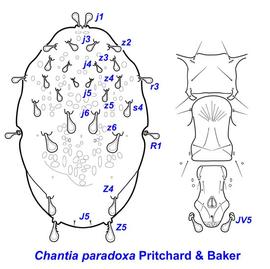
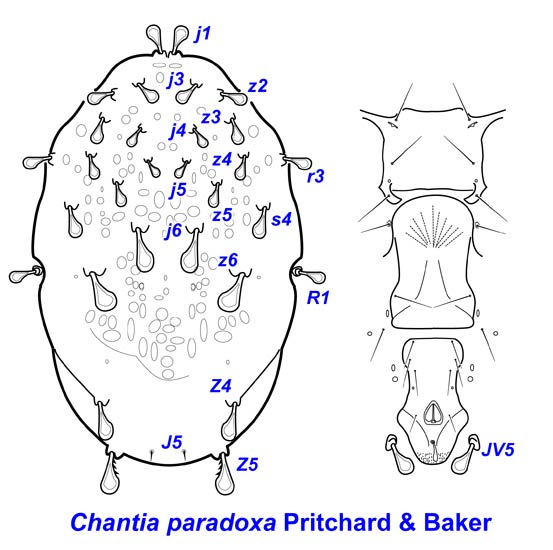
 except R1, J5, Z4–5 suppressed except J5 paddle-shaped s6 absent but z6 present, z3 present.; genugenu:; no marcosetae on legs.
Dorsaldorsal:
relating to the upper or back side; opposed to ventral.
chaetomes composed of spatulate setaeseta:
(pl. setae, from L. = bristle) cuticular process composed of a hollow shaft (sometimes filled with a refractive material) produced from a membranous socket (the alveolus); the hair-like, spine-like, branched or variously expanded structures on the surfaces of the legs and body. Most setae function as mechanoreceptors, but others (e.g., solenidia) are chemoreceptors or have unknown or ambiguous functions. occur sporadically in other groups, but only Chantia paradoxa has such a highly reduced chaetomechaetome:
a complement of setae; the setal array present on a stage or body part.
with only 4 pairs of opisthonotal setaeseta:
(pl. setae, from L. = bristle) cuticular process composed of a hollow shaft (sometimes filled with a refractive material) produced from a membranous socket (the alveolus); the hair-like, spine-like, branched or variously expanded structures on the surfaces of the legs and body. Most setae function as mechanoreceptors, but others (e.g., solenidia) are chemoreceptors or have unknown or ambiguous functions..
Setaseta:
(pl. setae, from L. = bristle) cuticular process composed of a hollow shaft (sometimes filled with a refractive material) produced from a membranous socket (the alveolus); the hair-like, spine-like, branched or variously expanded structures on the surfaces of the legs and body. Most setae function as mechanoreceptors, but others (e.g., solenidia) are chemoreceptors or have unknown or ambiguous functions. z3 absent, s6 present.............................. Platyseiella Muma
- Setaseta:
(pl. setae, from L. = bristle) cuticular process composed of a hollow shaft (sometimes filled with a refractive material) produced from a membranous socket (the alveolus); the hair-like, spine-like, branched or variously expanded structures on the surfaces of the legs and body. Most setae function as mechanoreceptors, but others (e.g., solenidia) are chemoreceptors or have unknown or ambiguous functions. z3 present, s6 present or absent............................... 2
Setaseta:
(pl. setae, from L. = bristle) cuticular process composed of a hollow shaft (sometimes filled with a refractive material) produced from a membranous socket (the alveolus); the hair-like, spine-like, branched or variously expanded structures on the surfaces of the legs and body. Most setae function as mechanoreceptors, but others (e.g., solenidia) are chemoreceptors or have unknown or ambiguous functions. z6 absent, s6 present; dorsaldorsal:
relating to the upper or back side; opposed to ventral.
shield setaeseta:
(pl. setae, from L. = bristle) cuticular process composed of a hollow shaft (sometimes filled with a refractive material) produced from a membranous socket (the alveolus); the hair-like, spine-like, branched or variously expanded structures on the surfaces of the legs and body. Most setae function as mechanoreceptors, but others (e.g., solenidia) are chemoreceptors or have unknown or ambiguous functions. barbed, usually acicular, fine to thickened.............................. Phytoseius Ribaga
- Setaseta:
(pl. setae, from L. = bristle) cuticular process composed of a hollow shaft (sometimes filled with a refractive material) produced from a membranous socket (the alveolus); the hair-like, spine-like, branched or variously expanded structures on the surfaces of the legs and body. Most setae function as mechanoreceptors, but others (e.g., solenidia) are chemoreceptors or have unknown or ambiguous functions. z6 present, s6 absent; dorsaldorsal:
relating to the upper or back side; opposed to ventral.
shield setaeseta:
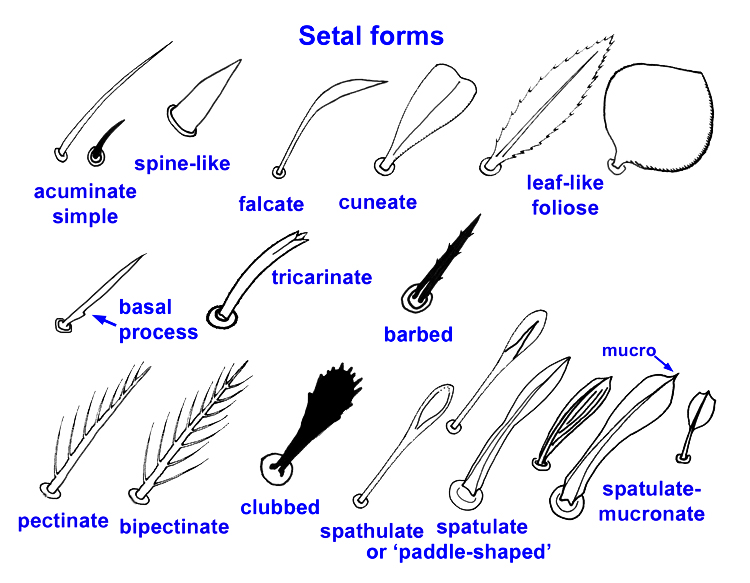
(pl. setae, from L. = bristle) cuticular process composed of a hollow shaft (sometimes filled with a refractive material) produced from a membranous socket (the alveolus); the hair-like, spine-like, branched or variously expanded structures on the surfaces of the legs and body. Most setae function as mechanoreceptors, but others (e.g., solenidia) are chemoreceptors or have unknown or ambiguous functions. spatulate/paddle-shaped.............................. Chantia Pritchard & BakerPritchard & Baker:
A system of setal designations of spider mites in Pritchard & Baker 1955 (A revision of the spider mite family Tetranychidae. Mem. Pac. Coast Entomol. Soc. 2: 1-472.). Dorsocentrals: D1 = c1; D2 = d1; D3 = e1; D4 = f1; D5 = h1; Dorsolaterals: L1 = c2; L2 = d2; L3 = e2; L4 = f2; Sublaterals: 1st sublaterals = c3; 2nd sublaterals = d3; 3rd sublaterals = e3; Humerals: H = c3; also Inner sacrals (or DC4) = f1; Outer sacrals (or L4) = f2; Clunals (or DC5) = h1 or f3; Postanals (or posterior para-anals) = h2; Anterior para-anals = h3; Anals = ps1-3; 1st genitals (or anteromedial genitals) = g1; 2nd genitals (or posterolateral genitals)= g2; Pregenitals = ag in the Grandjean system.
Only one specimen is known from a collection in central Africa.
Author: David E. Walter
Content last updated Sept. 2006, unless indicated otherwise
Lucid key player updated Sept. 2025
idtools.org