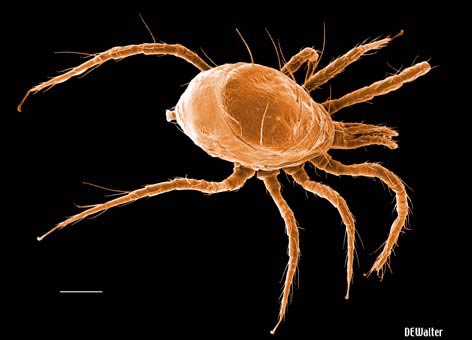
Mesostigmata
t
Taxonomy
updated 2025
Classification
Superorder Parasitiformes » Order Mesostigmata » Suborder Monogynaspida » Infraorder Gamasina » Hyporder Dermanyssiae » Superfamily Phytoseioidea » Family Phytoseiidae » Subfamily Amblyseiinae » Genus Phytoseiulus
Diagnostic characters
- Dorsaldorsal:
relating to the upper or back side; opposed to ventral.
shield entireentire:
a shield or sclerite with a continuous margin without incisions.
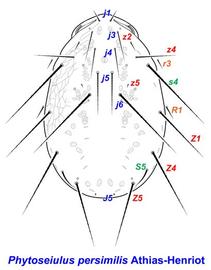
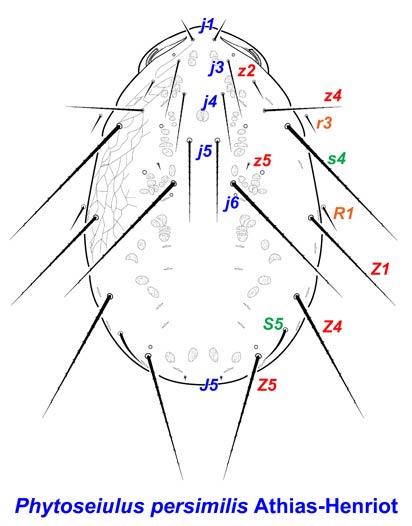
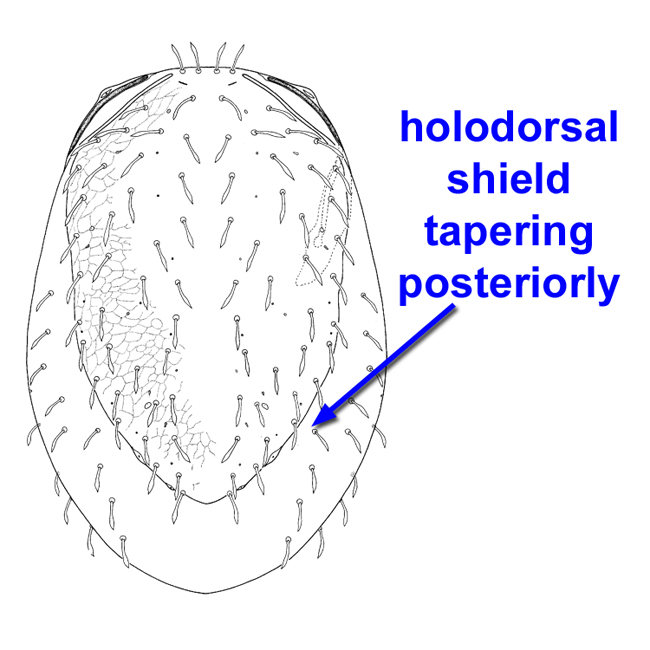
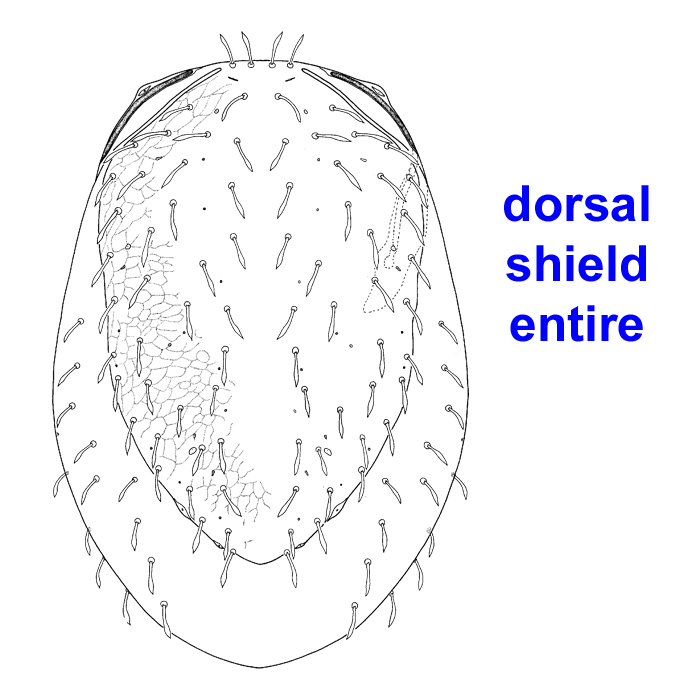 with 12–14 pairs of setae; present = (j1, 3, 4, 5, 6; J5; z2, 4, 5; Z1, 4, 5; s4); j5, S5 present or absent (j1 absent on some individuals in cultures).
- Setae r3 and R1 present in the soft cuticle
- Setae Z1, Z4, Z5 and s4 along margin of dorsaldorsal:
relating to the upper or back side; opposed to ventral.
shield very long and barbed
- Sternal shieldsternal shield:
a shield in the anterior intercoxal region of parasitiform mites that bears one or more pairs of sternal setae.
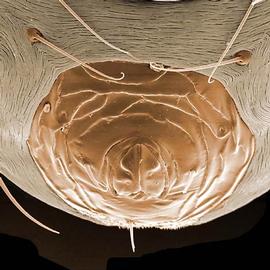
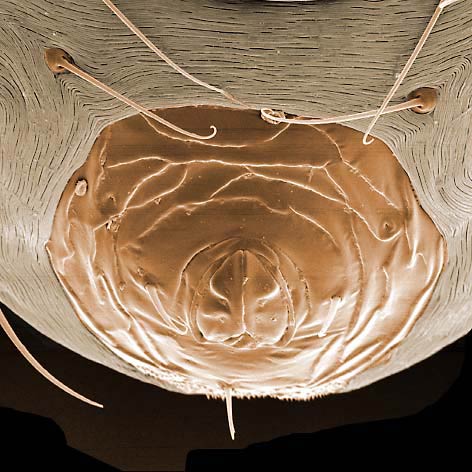
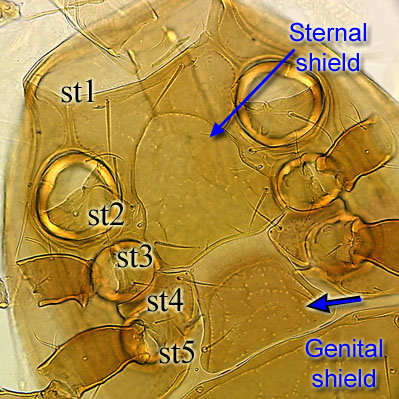 with 2–3 pairs of setae, st4 +/- st3 on small plates
- Anal opening small, on anal (3 setae) or small ventrianal shieldventrianal shield:
in Mesostigmata, a ventral shield bearing the anal opening, circum anal setae, and one or more pairs of ventral setae or pores (lyrifissures) [see anal shield]; maybe rather narrow or very broad and covering most of the gaster.
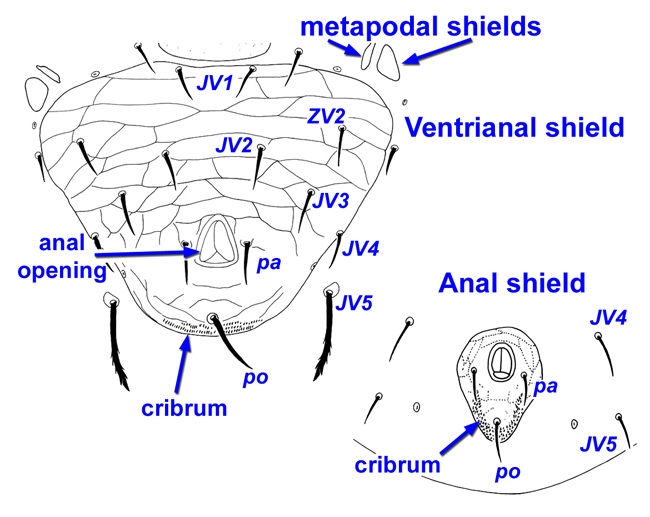 (4–5 setae)
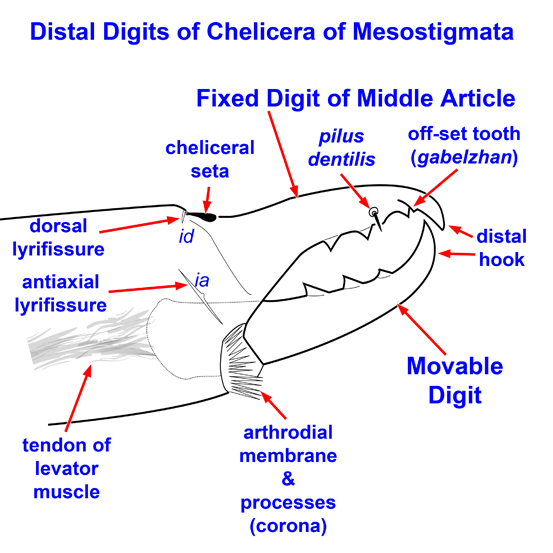
- Movable digit of chelicerae with 3 teeth, fixed digitfixed digit:
the distal extension of the middle article of the chelicera; usually bearing teeth and a distal hook and opposed to the movable digit in chelate-dentate forms, but often regressed; in Mesostigmata the fixed digit may bear the pilus dentilis.
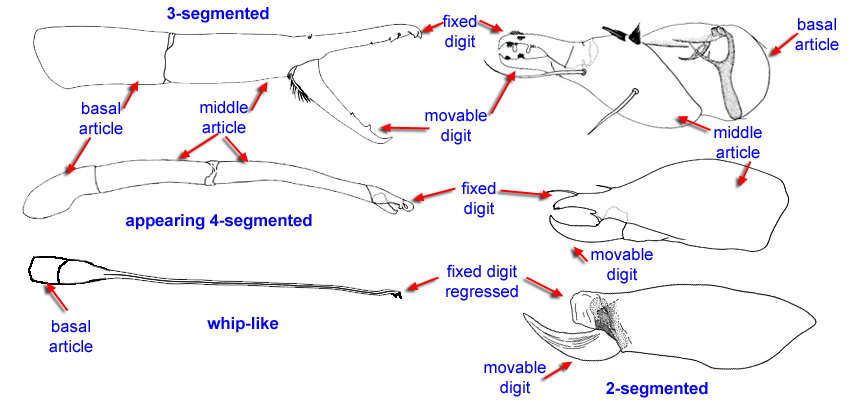 chelate-serrateserrate:
with closely set teeth that resemble the cutting edge of a saw.
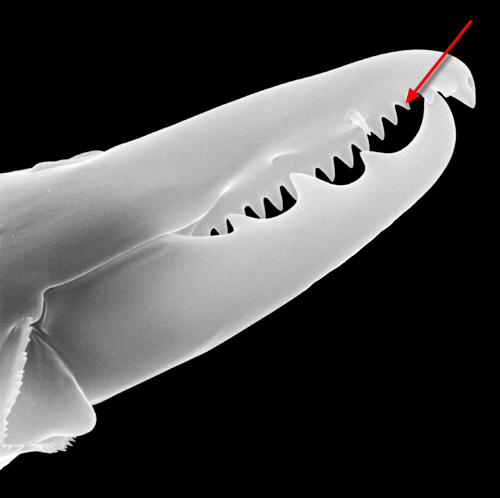 with 7–9 teeth or more stubby and chelate-dentatechelate-dentate:
pincer-like chelicerae with teeth.
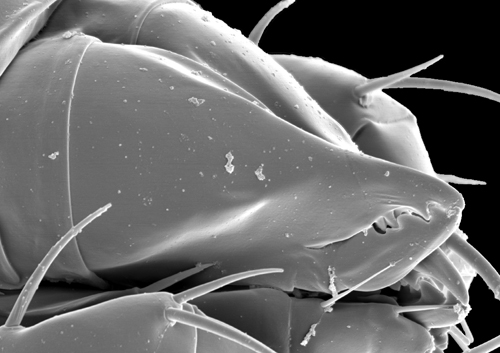 with only 3 teeth and terminal hookhook:
(as in cheliceral hook) the distal hook-like tips of chelicerae in the Mesostigmata, as opposed to cheliceral teeth.
- Spermathecaspermatheca:
a structure in the female for storing sperm, typically sac-like.
funnel-like, either broadly taperingtapering:
drawn out or with margins converging.
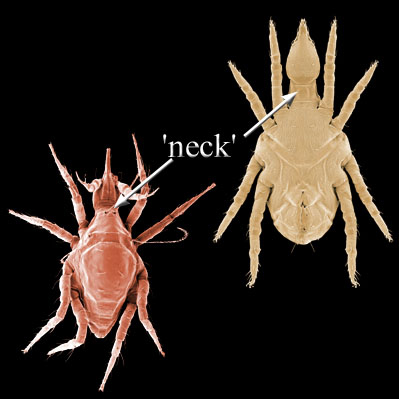
 or with narrow neckneck:
(neck-like) a narrow constricted region joining the capitulum to the idiosoma.
 and basalbasal:
towards the base of a structure; on a limb, towards the insertion on the body.
swelling
- Tibiatibia:
(pl. tibiae) the leg segment between the genu and the tarsus.
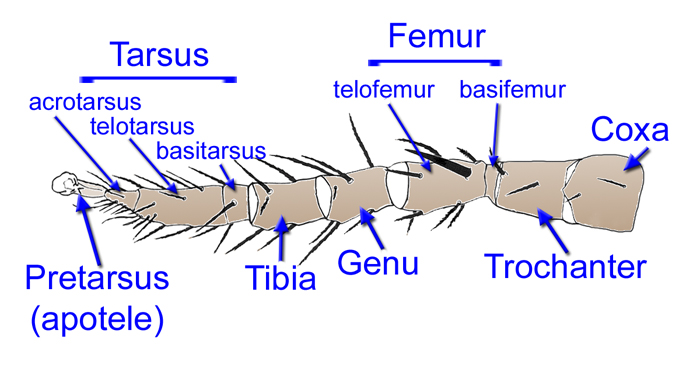 I setation: 2–2/2, 2/1–2
Open Phytoseiulus key
Similar taxa
Ascidae mites usually have dorsaldorsal:
relating to the upper or back side; opposed to ventral.
shields with 22 or more pairs of setae. Blattisociidae may have have phytoseioid-like corniculicorniculus:
(pl. corniculi) (also, external malae) a usually horn-like process (sometimes toothed, bifurcate, trifurcate, spine-like, spatulate, or membranous) on the subcapitulum of parasitiform mites that usually supports the salivary styli. A toothed corniculus could be confused with a rutellum, a possibly homologous structure in Acariformes and Opilioacarida. Phytoseiid image is spatulate corniculus.
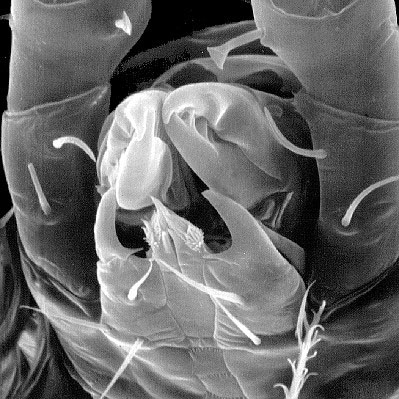 (e.g., Blattisocius), but usually have much fuller dorsaldorsal:
relating to the upper or back side; opposed to ventral.
shield setation (Lasioseius phytoseioides group excepted). Most other species of Amblyseiinae have ventrianal shields.
Ecology and distribution
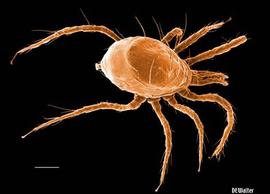
Species of Phytoseiulus are widely established around the world because of their use as biological control agents. They are specialist predators of spider mites that produce dense webbing, especially species of Tetranychus.
References
- Evans and Till 1966Evans and Till 1966:
Evans GO and Till WM. 1966. Studies on the British Dermanyssidae (Acari: Mesostigmata). Part II. Classification. Bulletin of the British Museum (Natural History) Zoology 14: 107-370.
- Gilyarov and Bregatova 1977Gilyarov and Bregatova 1977:
Gilyarov MS and Bregatova NG, eds. 1977. Handbook for the identification of soil-inhabiting mites, Mesostigmata. Zoological Institute of the Academy of Sciences, Petrograd.
- Karg 1993Karg 1993:
Karg W. 1993. Acari (Acarina), Milben Parasitiformes (Anactinochaeta) Cohors Gamasina Leach, Raubmilben. Die Tierwelt Deutschlands 59: 1-523.
- Schicha 1987Schicha 1987:
Schicha E. 1987. Phytoseiidae of Australia and neighbouring areas. Indira Publishing House, Oak Park, Michigan.
- Schuster and Pritchard 1963Schuster and Pritchard 1963:
Schuster RO and Pritchard EA. 1963. Phytoseiid mites of California. Hilgardia 43 (7): 191-285.
- Takahashi and Chant 1993Takahashi and Chant 1993:
Takahashi F and Chant DA. 1993. Phylogenetic relationships in the genus Phytoseiulus Evans (Acari: Phytoseiidae). II. Taxonomic Review. International Journal of Acarology 19: 23-37.
- Tenorio 1982Tenorio 1982:
Tenorio JM. 1982. Hypoaspidinae (Acari: Gamasida: Laelapidae) of the Hawaiian Islands. Pacific Insects 24: 259-274.
- Tseng 1976Tseng 1976:
Tseng YH. 1976. Systematics of the mite family Phytoseiidae from Taiwan, with a revised key to the genera of the world (II). Journal of the Agricultural Association of China 94: 86-128.
- Walter and Campbell 2003Walter and Campbell 2003:
Walter DE and Campbell NJH. 2003. Exotic vs endemic biocontrol agents: Would the real Stratiolaelaps miles (Berlese) (Acari: Mesostigmata: Laelapidae) please stand up? Biological Control 26: 253-269.
- Womersley 1956Womersley 1956:
Womersley H. 1956. On some new Acarina-Mesostigmata from Australia, New Zealand and New Guinea. Journal of the Linnean Society of London, Zoology 42: 505-599.
- Wright and Chambers 1994Wright and Chambers 1994:
Wright EM and Chambers RJ. 1994. The biology of the predatory mite Hypoaspis miles (Acari: Laelapidae), a potential biological control agent of Bradysia paupera (Dipt.: Sciardiae). Entomophaga 39: 225-235.
- Zumpt and Patterson 1951Zumpt and Patterson 1951:
Zumpt F and Patterson PM. 1951. Further notes on laelaptid mites parasitic on vertebrates. A preliminary study to the Ethiopian fauna. Journal of the Entomological Society of Southern Africa 14: 63-93.