Mesostigmata
t
Taxonomy
updated 2025
Name
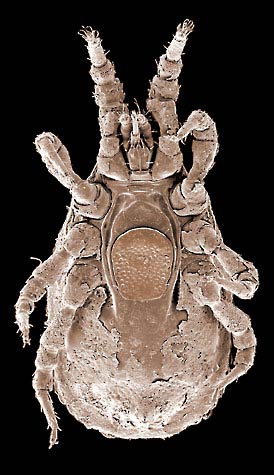
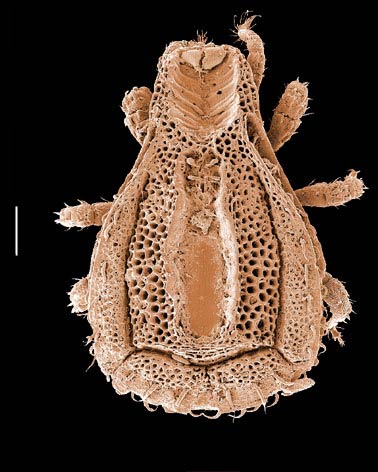
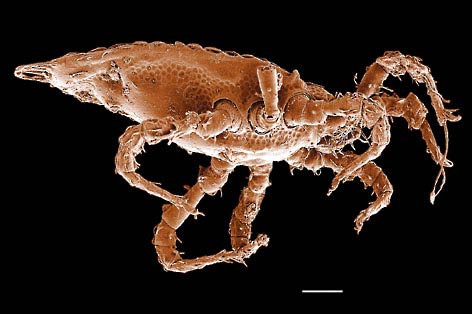
Trachytidae Trägårdh, 1938 (+ Dithinozerconidae Ainscough)
Children
Polyaspinus Berlese, Uroseius Berlese, Trachytes Michael, Indrotrachytes
(+ Dithinozercon Berlese, Apionoseius Berlese, Iphidinychus Berlese, Caminella Krantz and Ainscough)
Diagnostic characters
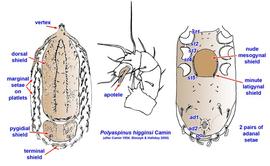
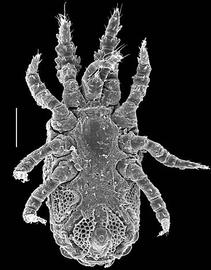
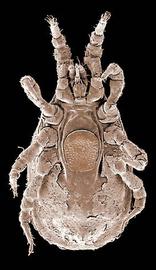
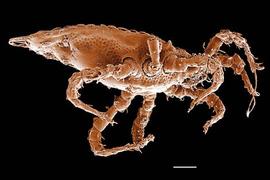
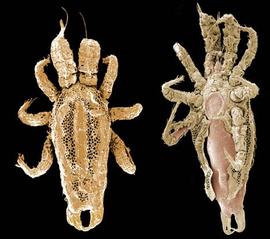
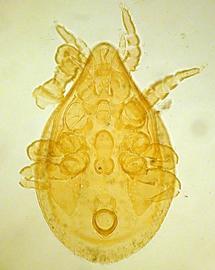
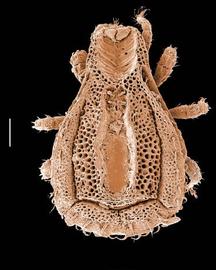
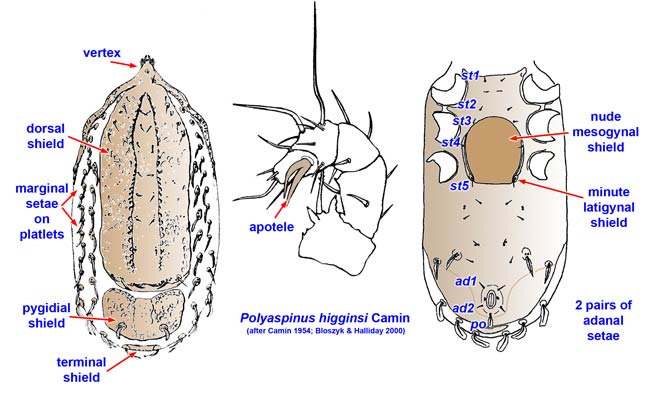
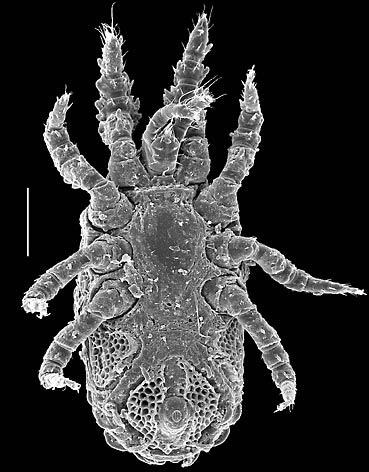
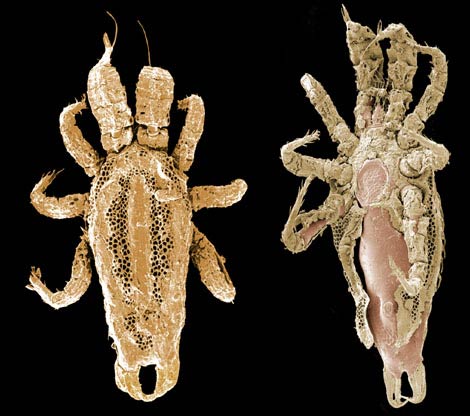
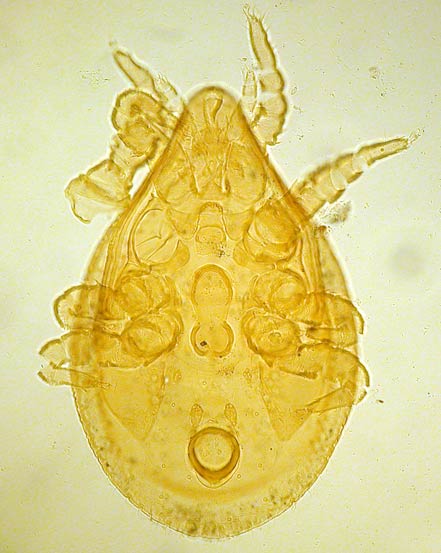
- Slow moving, rough surfaced, subrectangular, wedge-shaped, or tailed mites with a dense coating of cerotegumentcerotegument:
the outer layers of the epicuticle, including the wax and cement layers; often thin and inconspicuous, but sometimes very thick, ornamented, and obscuring the underlying cuticle; thick ceroteguments often can be peeled off to expose a very different-looking mite.
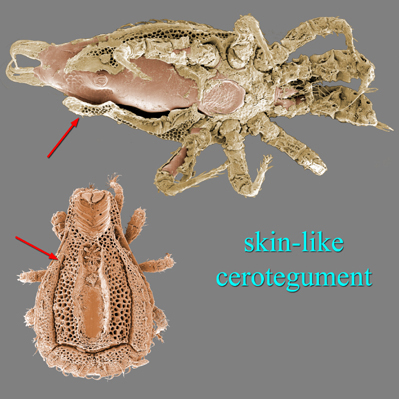 ; podonotal shieldpodonotal shield:
the anterior shield in mesostigmatans with divided dorsal shields.
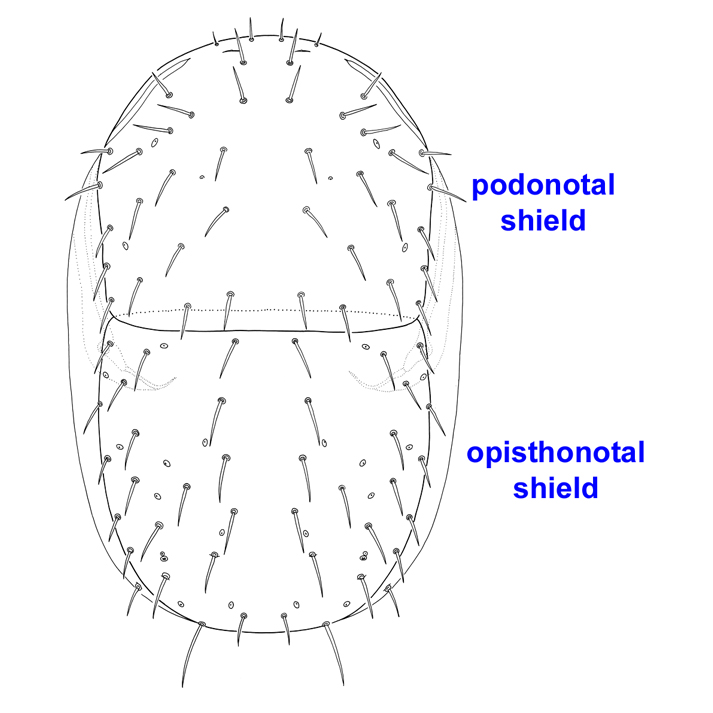 and free marginal seta (or small plates) and pygidial shields under cerotegumentcerotegument:
the outer layers of the epicuticle, including the wax and cement layers; often thin and inconspicuous, but sometimes very thick, ornamented, and obscuring the underlying cuticle; thick ceroteguments often can be peeled off to expose a very different-looking mite.
.
- <100 dorsal idiosomalidiosomal:
(idiosomatic) adjectival form of idiosoma.
setae; scabellumscabellum:
in Uropodina, a platform-like structure on the underside of the vertex that receives the withdrawn legs I.
and pedofossaepedofossa:
(pl. pedofossae) (= fossae pedales, fovae pedales) recesses into which the legs can be withdrawn.
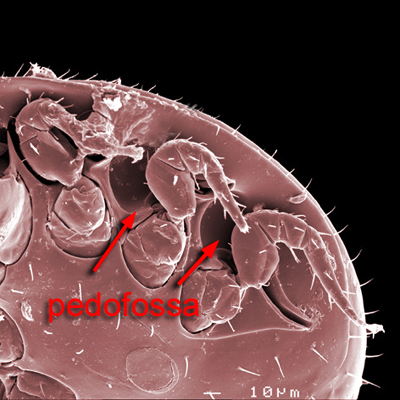 absent
- Sternal setaesternal setae:
in Mesostigmata, the five pairs of setae in the intercoxal region designated st1-5; st1-3 are present in the larva and usually are borne on a sternal shield in the adult female; st4, the metasternal setae, are added in the deutonymph, often are borne on metasternal platelets, and sometimes on the sternal shield; st5, the genital setae, are added in the protonymph and usually borne on or are inserted laterad the epigynal shield in the adult female.
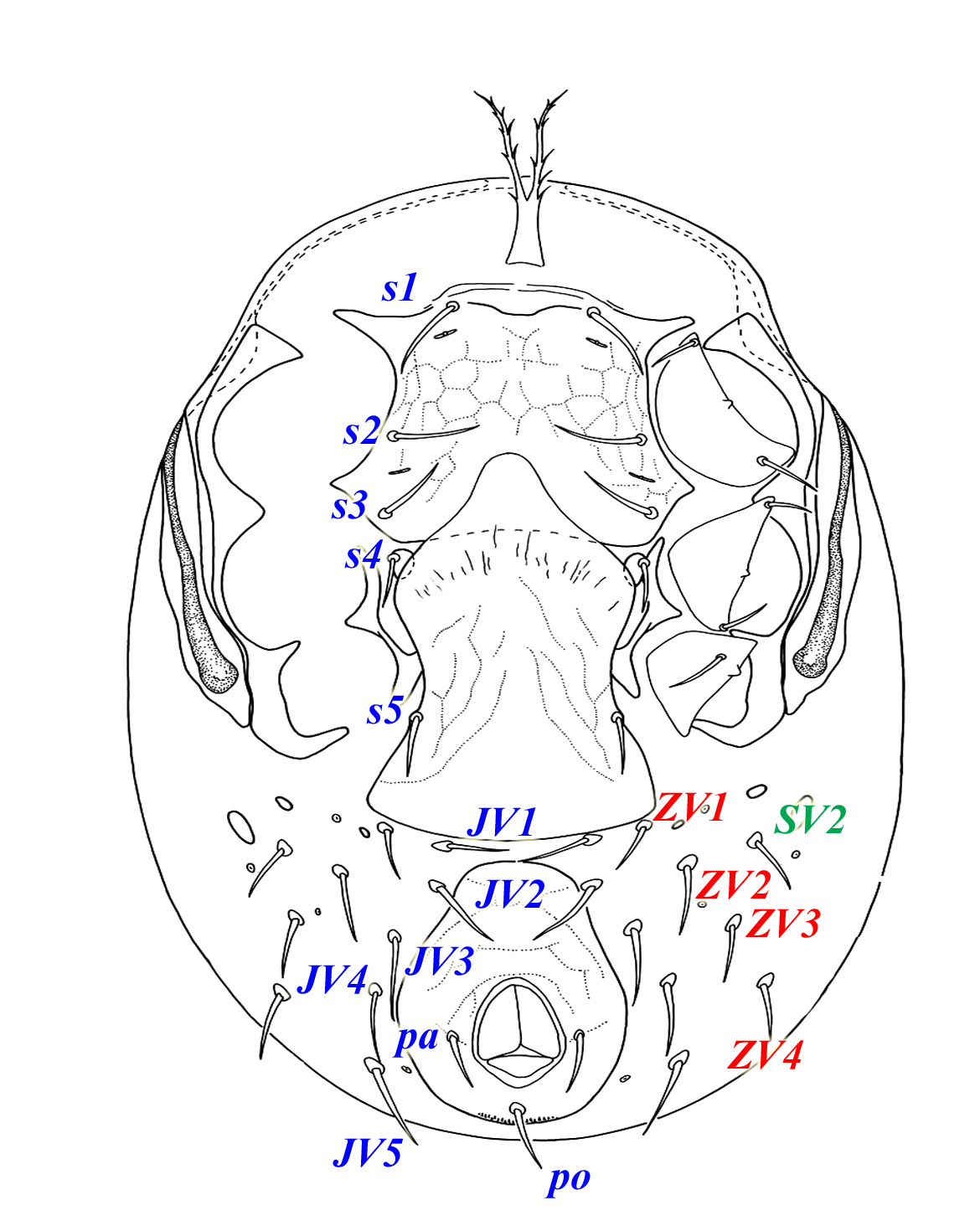 (st1–4) on ventral shieldventral shield:
in Mesostigmata, any shield or shields in the ventral region; often fused with the anal shield to form a ventrianal shield. [Back to Top]
that encompasses the genital opening; st5 on narrow latigynal shields (rarely fused to endopodal shields); anal opening on ventral shieldventral shield:
in Mesostigmata, any shield or shields in the ventral region; often fused with the anal shield to form a ventrianal shield. [Back to Top]
or ventrianal shieldventrianal shield:
in Mesostigmata, a ventral shield bearing the anal opening, circum anal setae, and one or more pairs of ventral setae or pores (lyrifissures) [see anal shield]; maybe rather narrow or very broad and covering most of the gaster.
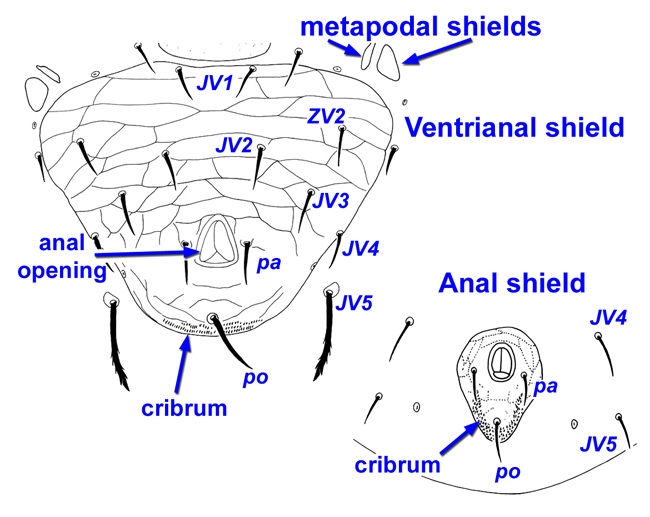 with 3–5 circumanal setaecircumanal setae:
in Mesostigmata, the three setae (postanal and pair of peranal) setae surrounding the anal opening.
.
- Mesogynal shield nude, entirely intercoxal, usually without anterior median process
- Legs I with or without ambulacra, coxae I enlarged, but subcylindrical and widely separated; trochantertrochanter:
the leg segment between the coxa and the femur.
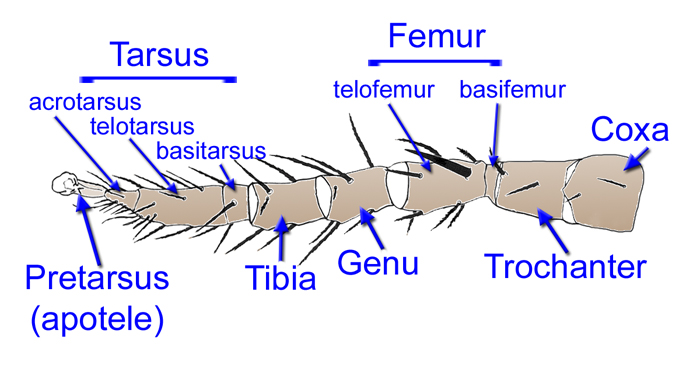 I with 4 setae; tibiatibia:
(pl. tibiae) the leg segment between the genu and the tarsus.
I with 4 (rarely 3) dorsaldorsal:
relating to the upper or back side; opposed to ventral.
and 2 ventral setaeventral setae:
in the Lindquist-Evans system used in the Mesostigmata, the ventral region has up to three longitudinal rows (Jv, Zv, Lv) with 1-5 transverse row designations.
; all genugenu:
(pl. genua) (= patella) the 4th leg segment, between the femur and tibia.
with 4 dorsaldorsal:
relating to the upper or back side; opposed to ventral.
setae; genugenu:
(pl. genua) (= patella) the 4th leg segment, between the femur and tibia.
II with 4 lateral setae.
- Chelicerae typically slender, elongate, with small digits and distaldistal:
towards the free end of an appendage.
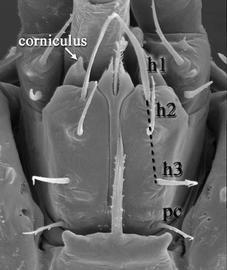
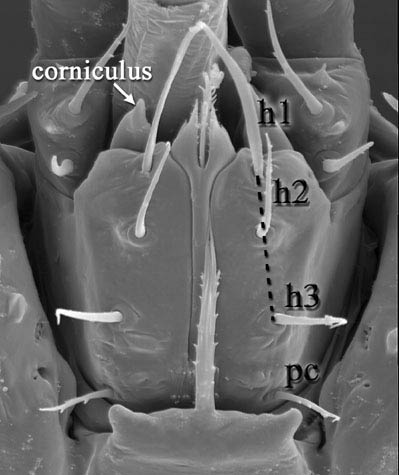
sensory area; corniculicorniculus:
(pl. corniculi) (also, external malae) a usually horn-like process (sometimes toothed, bifurcate, trifurcate, spine-like, spatulate, or membranous) on the subcapitulum of parasitiform mites that usually supports the salivary styli. A toothed corniculus could be confused with a rutellum, a possibly homologous structure in Acariformes and Opilioacarida. Phytoseiid image is spatulate corniculus.
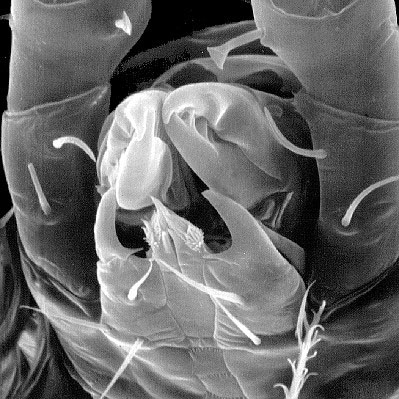 horn-like.
- Tectumgnathotectum:
(= epistome, tectum) an often membranous dorsal projection of the anterior margin of the basis capitulum in Mesostigmata; often diagnostic at family-, genus- or species-levels; also often difficult to see without high magnification and good optics.
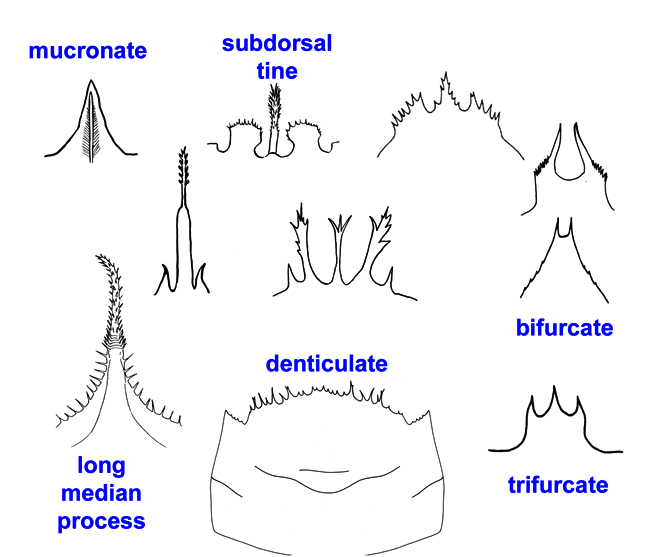 with strong median process; hypostomal denticleshypostomal denticles:
(teeth, retrorse teeth) the backwardly directed tooth-like projections on the elongate hypostome of ticks that are used to anchor the capitulum to skin while feeding.
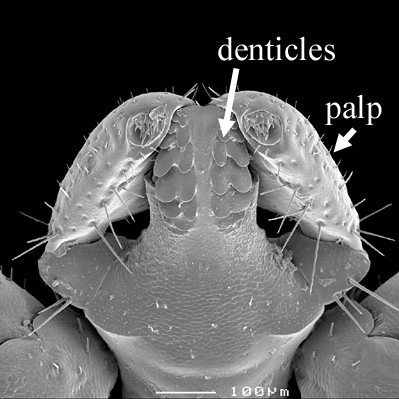 in rows to either side of furrow.
- Palp apotelepalptarsal apotele:
(= palp apotele, palptarsal claw) the most distal segment of the palp; absent in Acariformes, claw-like in Opilioacarida, and a subdistal, tined structure in the Mesostigmata.
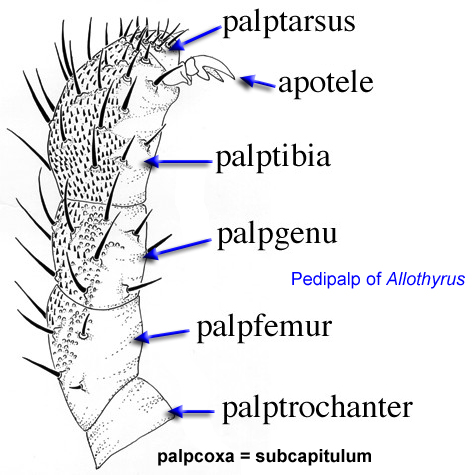 2-tined; palppalp:
(= pedipalp) the second pair of limbs in arachnids, used in feeding and originating on either side of the chelicerae. In mites, the palps may be vestigial, with only a few segments, or have a maximum of 5 freely articulating segments (rarely the femur is subdivided) and a distal or subdistal apotele.
genu with 4–5 setae, palppalp:
(= pedipalp) the second pair of limbs in arachnids, used in feeding and originating on either side of the chelicerae. In mites, the palps may be vestigial, with only a few segments, or have a maximum of 5 freely articulating segments (rarely the femur is subdivided) and a distal or subdistal apotele.
femur with 5 setae.
- Tritosternal laciniae typically fused basally and highly divided; distally tritosternumtritosternum:
the sternum of the 3rd body segment (between legs I); produced as a biflagellate structure in Mesostigmata, although sometimes the flagellae (laciniae) are partially or completely fused.
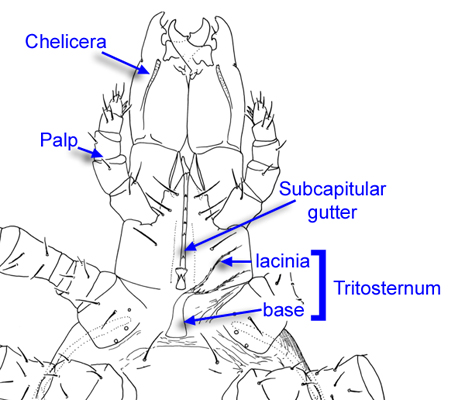 wider than long, usually rectangular.
- Male genital opening intercoxal, valves with or without setae; chelicerae not obviously modified for sperm transfer
Similar taxa
Key to adult females of common genera of Polyaspidoidea
-
Idiosoma and mesogynal shield oval to subrectangular; marginal shield fragmentedfragmented:
broken up, composed of several discrete parts rather than of a single unit.
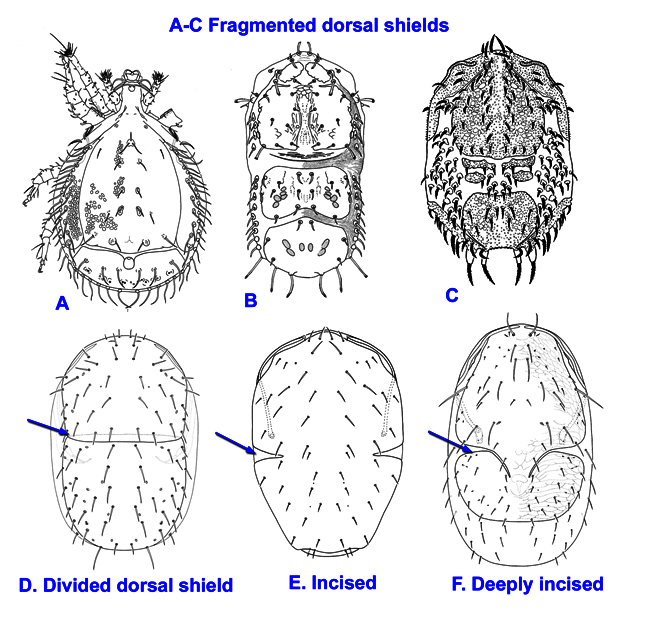 .............................. 2
- Idiosoma pyriform, mesogynal shield trapezoidal; marginal shield entireentire:
a shield or sclerite with a continuous margin without incisions.
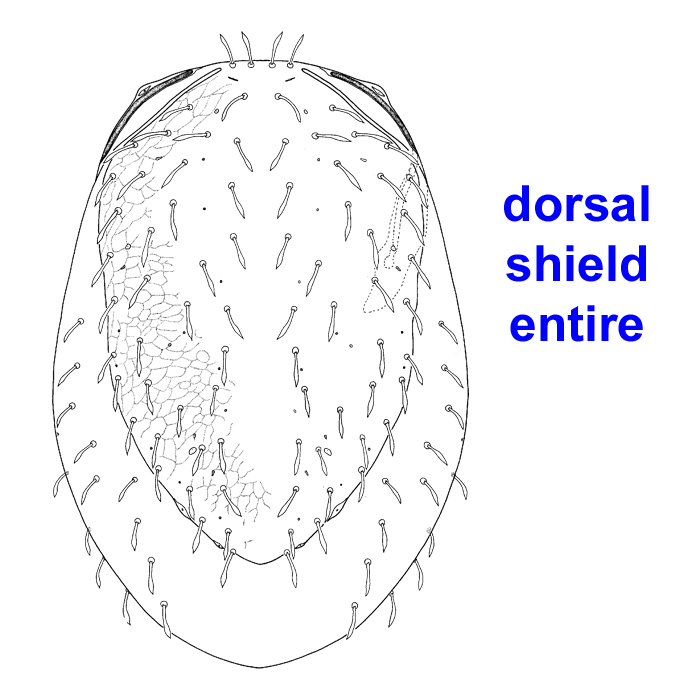 .............................. Trachytes
-
Genugenu:
(pl. genua) (= patella) the 4th leg segment, between the femur and tibia.
IV with two ventral setaeseta:
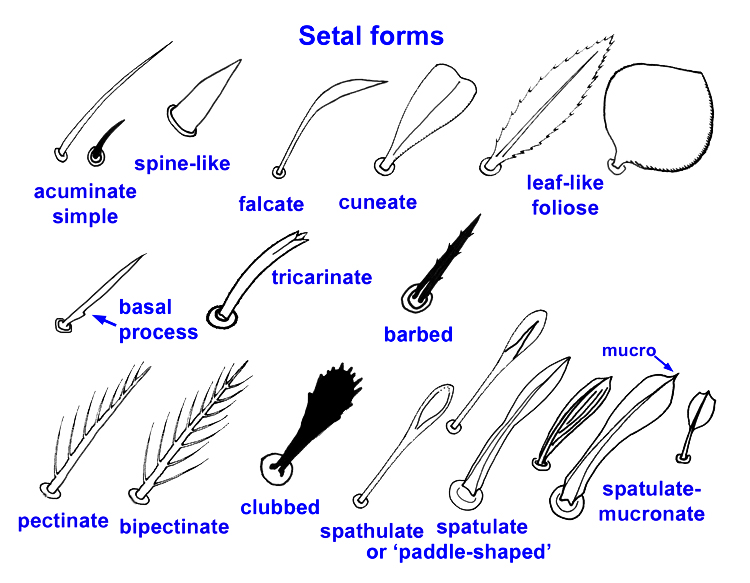
(pl. setae, from L. = bristle) cuticular process composed of a hollow shaft (sometimes filled with a refractive material) produced from a membranous socket (the alveolus); the hair-like, spine-like, branched or variously expanded structures on the surfaces of the legs and body. Most setae function as mechanoreceptors, but others (e.g., solenidia) are chemoreceptors or have unknown or ambiguous functions.
 .............................. 3
- Genugenu:
(pl. genua) (= patella) the 4th leg segment, between the femur and tibia.
IV with one ventralventral:
relating to the lower or under side; opposed to dorsal.
seta.............................. Polyaspinus (+Uroseius)
-
Chelicerae and corniculicorniculus:
(pl. corniculi) (also, external malae) a usually horn-like process (sometimes toothed, bifurcate, trifurcate, spine-like, spatulate, or membranous) on the subcapitulum of parasitiform mites that usually supports the salivary styli. A toothed corniculus could be confused with a rutellum, a possibly homologous structure in Acariformes and Opilioacarida. Phytoseiid image is spatulate corniculus.
elongate, the latter reaching distaldistal:
towards the free end of an appendage.
end of palpgenu.............................. Polyaspis (+Dyscritaspis)
- Chelicerae and corniculicorniculus:
(pl. corniculi) (also, external malae) a usually horn-like process (sometimes toothed, bifurcate, trifurcate, spine-like, spatulate, or membranous) on the subcapitulum of parasitiform mites that usually supports the salivary styli. A toothed corniculus could be confused with a rutellum, a possibly homologous structure in Acariformes and Opilioacarida. Phytoseiid image is spatulate corniculus.
not elongate.............................. Dipolyaspis
Ecology and distribution
Species of Polyaspis are ambush predators, but the ecology of other Polyaspidoidea is poorly known. Many species are present in forest litter or associated with rotting wood.
References
- Ainscough 1981Ainscough 1981:
Ainscough BD. 1981. Uropodine studies. I. Suprageneric classification in the cohort Uropodina Kramer, 1882 (Acari: Mesostigmata). International Journal of Acarology 7: 47–56.
- Bloszyk and Halliday 2000Bloszyk and Halliday 2000:
Bloszyk J and Halliday RB. 2000. Observations on the genus Polyaspinus Berlese 1916 (Acari: Trachytidae). Systematic and Applied Acarology 5: 47-64.
- Camin 1954bCamin 1954b:
Camin JH. 1954b. Polyaspis berlesei, a new species of trachytoid mite (Mesostigmata: Polyaspidae). Bulletin of the Chicago Academy of Sciences 10: 25–33.
- Evans and Till 1979Evans and Till 1979:
Evans EO and Till WM. 1979. Mesostigmatic mites of Britain and Ireland (Chelicerata: Acari-Parasitiformes): An introduction to their external morphology and classification. Transactions of the Zoological Society of London 35 (2): 145-270.
- Gilyarov and Bregatova 1977Gilyarov and Bregatova 1977:
Gilyarov MS and Bregatova NG, eds. 1977. Handbook for the identification of soil-inhabiting mites, Mesostigmata. Zoological Institute of the Academy of Sciences, Petrograd.
- Karg 1989aKarg 1989a:
Karg W. 1989a. Acari (Acarina), Milben Unterordnung Parasitiformes (Anactinotrichaeta) Uropodina Kramer, Schildkrötenmilben. Die Tierwelt Deutschlands 67: 1-203.
- Krantz and Ainscough 1990Krantz and Ainscough 1990:
Krantz GW and Ainscough B. 1990. Mesostigmata. pp. 583-665. In: Dindal DL, ed. Soil biology guide. John Wiley & Sons, Brisbane.
- Wisniewski and Hirschmann 1993Wisniewski and Hirschmann 1993:
Wisniewski J and Hirschmann W. 1993. Gangsystematik der Parasitiformes. Teil 548. Katalog der Ganggattungen, Untergattungen, Gruppen und Arten die Uropodiden der Erde. Acarologie, Schriftenreihe für Vergleichende Milbenkunde 40: 1-220.
- Womersley 1961Womersley 1961:
Womersley H. 1961. Studies of the Acarina fauna of leaf-litter and moss from Australia. No. 2. A new trachytid mite, Polyaspinus tuberculatus, from Queensland (Acarina, Trachytina). Records of the South Australian Museum 14: 115-123.