Mesostigmata
t
Taxonomy
updated 2025
Classification
Superorder Parasitiformes » Order Mesostigmata » Suborder Monogynaspida » Infraorder Uropodina » Superfamily Thinozerconoidea » Family Thinozerconidae » Genus Thinozercon
Diagnostic characters
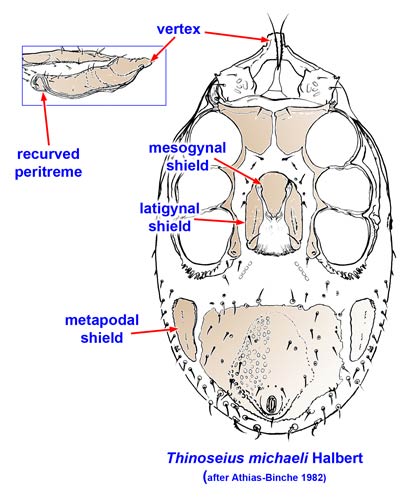
- Uropodine mesostigmatans with peritrematalperitrematal:
(peritrematic) of or referring to the peritreme; adjectival form of peritreme.
shields joined to vertexvertex:
an anterior extension of the idiosoma that covers the capitulum in many uropodid mites.
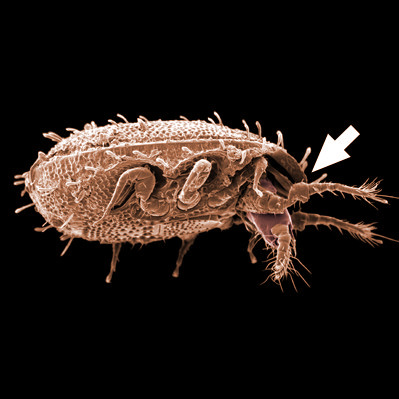 , but separate from large anterioranterior:
the front part of the body or towards that region in comparison, e.g., 'anterior to'
shield, and separate pygidial shieldpygidial shield:
(pygidial sclerite) in Mesostigmata, a shield at the back end of the idiosoma.
- <100 dorsaldorsal:
relating to the upper or back side; opposed to ventral.
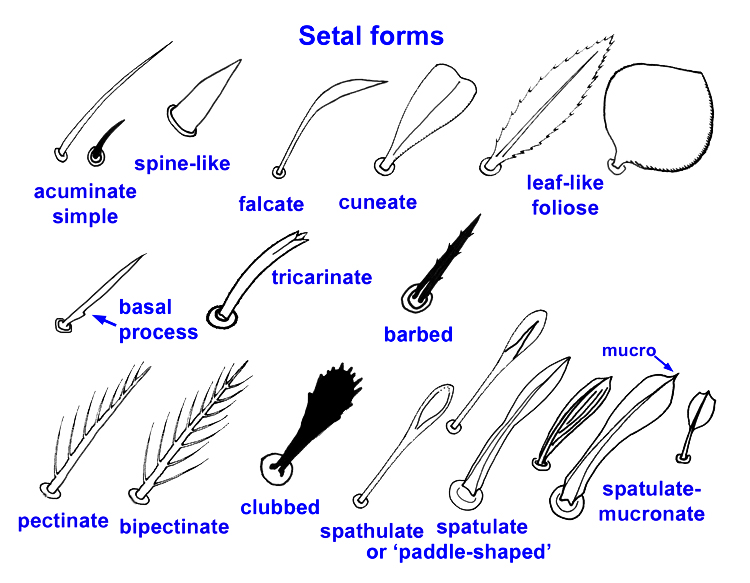
idiosomal setaeseta:
(pl. setae, from L. = bristle) cuticular process composed of a hollow shaft (sometimes filled with a refractive material) produced from a membranous socket (the alveolus); the hair-like, spine-like, branched or variously expanded structures on the surfaces of the legs and body. Most setae function as mechanoreceptors, but others (e.g., solenidia) are chemoreceptors or have unknown or ambiguous functions.
- Scabellumscabellum:
in Uropodina, a platform-like structure on the underside of the vertex that receives the withdrawn legs I.
and pedofossaepedofossa:
(pl. pedofossae) (= fossae pedales, fovae pedales) recesses into which the legs can be withdrawn.
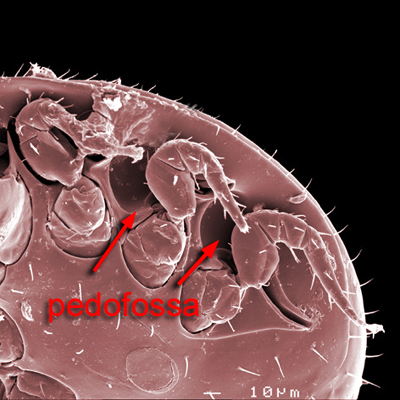 absent
- Peritremes recurvedrecurved:
a curved suture or line of dehiscence that arches posteriorly; opposed to procurved.
basally, extending to vertexvertex:
an anterior extension of the idiosoma that covers the capitulum in many uropodid mites.
- Sternal shieldsternal shield:
a shield in the anterior intercoxal region of parasitiform mites that bears one or more pairs of sternal setae.
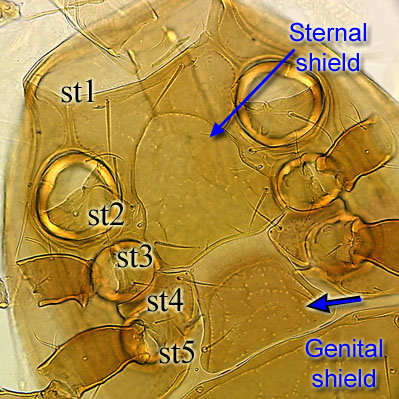 divided medially, bearing st1 and united with endopodal elements
- Mesogynal shield small
- Strap-like latigynal shields bearing st5
- Large ventrianal shieldventrianal shield:
in Mesostigmata, a ventral shield bearing the anal opening, circum anal setae, and one or more pairs of ventral setae or pores (lyrifissures) [see anal shield]; maybe rather narrow or very broad and covering most of the gaster.
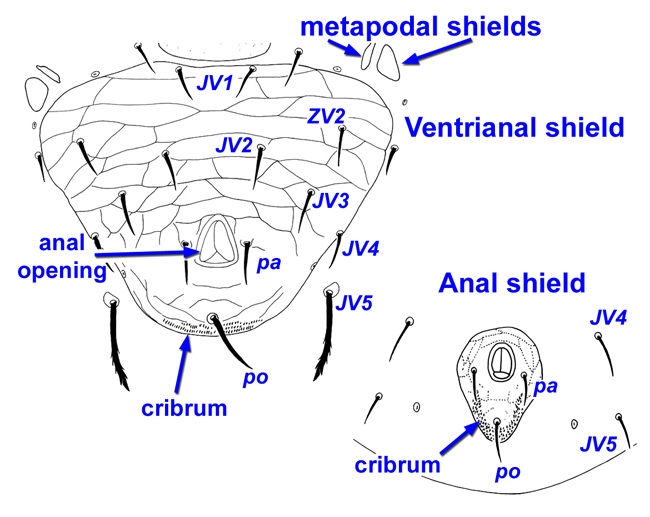 flanked by large, nude metapodal shieldsmetapodal shields:
(also metapodal plates, metapodal platelets, metapodal sclerites) in Mesostigmata, a pair (sometimes fused) of small sclerites posteriad coxae IV in the ventral region that probably reflect muscle attachments.
; 3 circumanal setaeseta:
(pl. setae, from L. = bristle) cuticular process composed of a hollow shaft (sometimes filled with a refractive material) produced from a membranous socket (the alveolus); the hair-like, spine-like, branched or variously expanded structures on the surfaces of the legs and body. Most setae function as mechanoreceptors, but others (e.g., solenidia) are chemoreceptors or have unknown or ambiguous functions.
- Coxae I cylindrical, widely separate
- Chelicerae elongate, apparently raptorialraptorial:
(Latin raptor = robber) modified for capturing prey; predatory. The pedipalps (e.g., many Cunaxidae) or legs I may be raptorial in mites.
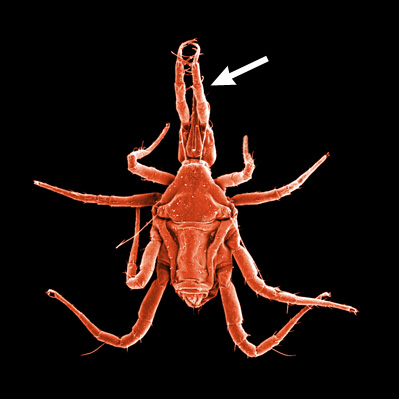 , sometimes snapping, appearing 4-segmented in Thinozercon
- Corniculicorniculus:
(pl. corniculi) (also, external malae) a usually horn-like process (sometimes toothed, bifurcate, trifurcate, spine-like, spatulate, or membranous) on the subcapitulum of parasitiform mites that usually supports the salivary styli. A toothed corniculus could be confused with a rutellum, a possibly homologous structure in Acariformes and Opilioacarida. Phytoseiid image is spatulate corniculus.
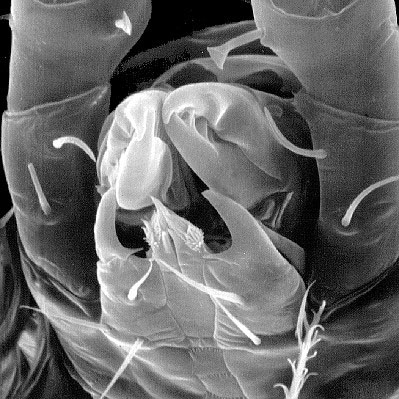 horn-like
Similar taxa
Thinozerconoids are considered the most early derivative of living Uropodina and are distinguished from the other superfamilies primarily on their plesiomorphic chaetotaxy.
Ecology and distribution
The Thinozerconoidea are a small, but intriguing group of mites associated with wet habitats and appear to have originated near the base of the Uropodina. Thinozercon occur in decaying tidal debris.
References
- Ainscough 1981Ainscough 1981:
Ainscough BD. 1981. Uropodine studies. I. Suprageneric classification in the cohort Uropodina Kramer, 1882 (Acari: Mesostigmata). International Journal of Acarology 7: 47–56.
- Athias-Binche 1982Athias-Binche 1982:
Athias-Binche F. 1982. A redescription of Thinozercon michaeli Halbert, 1915 (Uropodina: Thinozerconoidea). Proceedings of the Royal Irish Academy (Section B) 82B: 261–276.
- Evans and Till 1979Evans and Till 1979:
Evans EO and Till WM. 1979. Mesostigmatic mites of Britain and Ireland (Chelicerata: Acari-Parasitiformes): An introduction to their external morphology and classification. Transactions of the Zoological Society of London 35 (2): 145-270.
- Gilyarov and Bregatova 1977Gilyarov and Bregatova 1977:
Gilyarov MS and Bregatova NG, eds. 1977. Handbook for the identification of soil-inhabiting mites, Mesostigmata. Zoological Institute of the Academy of Sciences, Petrograd.
- Johnston 1961Johnston 1961:
Johnston DE. 1961. A review of the lower uropodid mites (former Thinozerconoidea, Protodinychoidea and Trachytoidea) with notes on the classification of the Uropodina (Acarina). Acarologia 3: 522-545.
- Krantz and Ainscough 1990Krantz and Ainscough 1990:
Krantz GW and Ainscough B. 1990. Mesostigmata. pp. 583-665. In: Dindal DL, ed. Soil biology guide. John Wiley & Sons, Brisbane.