Mesostigmata
t
Taxonomy
updated 2025
Classification
Superorder Parasitiformes » Order Mesostigmata » Suborder Monogynaspida » Infraorder Uropodina » Superfamily Thinozerconoidea » Family Protodinychidae » Genus Protodinychus
Diagnostic characters
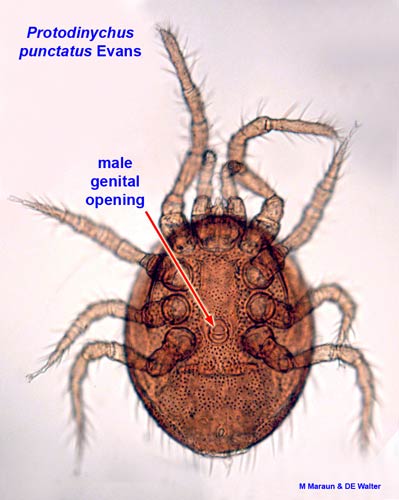
- Uropodine mesostigmatans with a large central dorsaldorsal:
relating to the upper or back side; opposed to ventral.
shield
- Pygidial free or fused to dorsaldorsal:
relating to the upper or back side; opposed to ventral.
shield
- Peritrematalperitrematal:
(peritrematic) of or referring to the peritreme; adjectival form of peritreme.
shields large
- Scabellumscabellum:
in Uropodina, a platform-like structure on the underside of the vertex that receives the withdrawn legs I.
and pedofossaepedofossa:
(pl. pedofossae) (= fossae pedales, fovae pedales) recesses into which the legs can be withdrawn.
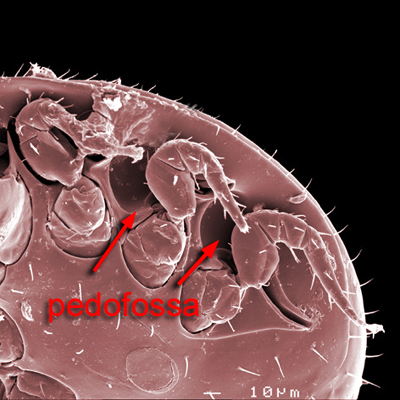 absent
- Peritremes linear, extending to coxacoxa:
the basal segment of the leg, articulating with (Parasitiformes) or fused to (Acariformes) the body wall.
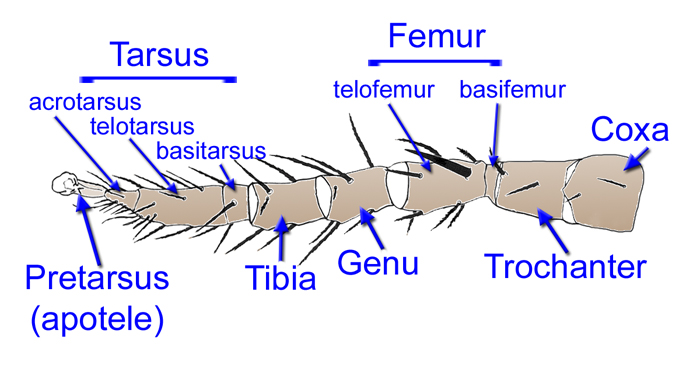 I
I
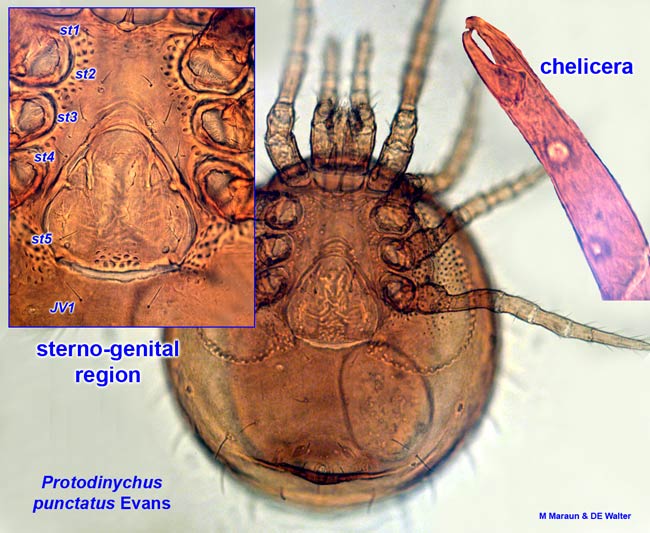
- Mesogynal shield narrow and weakly attached to strap-like latigynial shieldslatigynal shields :
(also latigynial shields) a pair of sclerites laterad the mesogynal shield in some female parasitiform mites that help protect the genital opening; usually bearing one or more pairs of setae and sometimes fused to other genital or ventral elements. The single female genital shield in the Gamasina may represent a fusion of the latigynal and mesogynal shields.
bearing st5
- Metapodal elements incorporated into peritrematalperitrematal:
(peritrematic) of or referring to the peritreme; adjectival form of peritreme.
shields
- Anal opening in small ventrianal shieldventrianal shield:
in Mesostigmata, a ventral shield bearing the anal opening, circum anal setae, and one or more pairs of ventral setae or pores (lyrifissures) [see anal shield]; maybe rather narrow or very broad and covering most of the gaster.
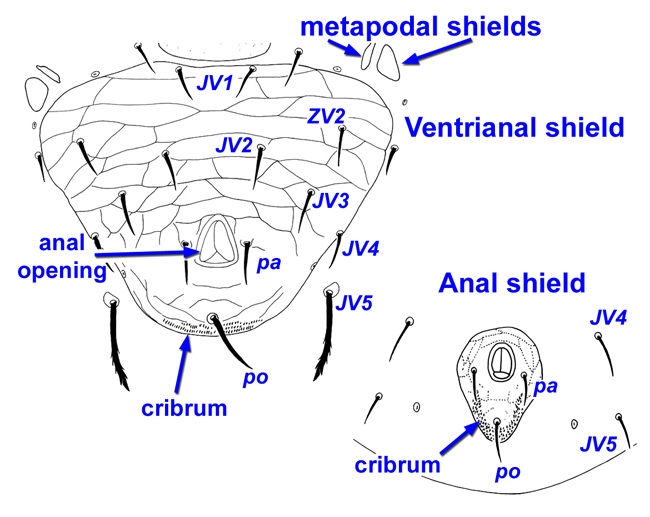 that captures one pair of ventral setaeventral setae:
in the Lindquist-Evans system used in the Mesostigmata, the ventral region has up to three longitudinal rows (Jv, Zv, Lv) with 1-5 transverse row designations.
; 3 circumanal setaecircumanal setae:
in Mesostigmata, the three setae (postanal and pair of peranal) setae surrounding the anal opening.
.
- Legs I with ambulacra, coxae I cylindrical, widely separate; coxae IV with 2 pairs of setae.
- Chelicerae elongate, apparently raptorialraptorial:
(Latin raptor = robber) modified for capturing prey; predatory. The pedipalps (e.g., many Cunaxidae) or legs I may be raptorial in mites.
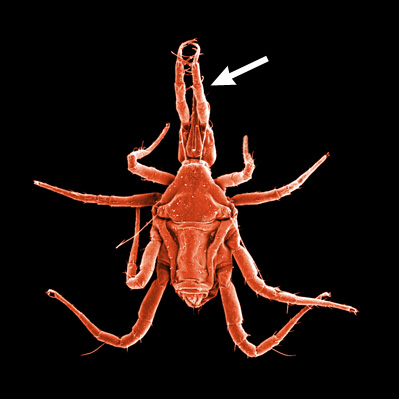 , bearing pilus dentilispilus dentilis:
(pl. pili dentilis) a seta-like or membranous sensory organ inserted ventrolaterally on the fixed digit of the chelicera of many Mesostigmata.
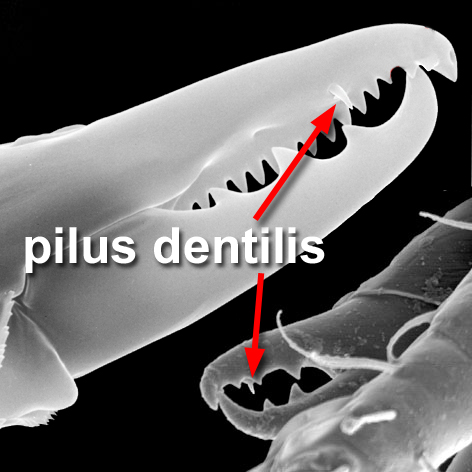 and 3 membranous, mushroom-like structures; deutosternal groovehypognathal groove:
(also hypognathal gutter, subcapitular groove, deutosternal groove or gutter) the median longitudinal gutter running on the subcapitulum of parasitiform mites that receives the tritosternum.
crowded with few denticlesdenticles:
small tooth-like processes, e.g., on the subcapitula of ticks and many mesostigmatans.
per row.
Ecology and distribution
Protodinychus have been collected in lakeside debris, pastures, and in beaver lodges (with deutonymphs phoretic on beaver beetles).
References
- Ainscough 1981Ainscough 1981:
Ainscough BD. 1981. Uropodine studies. I. Suprageneric classification in the cohort Uropodina Kramer, 1882 (Acari: Mesostigmata). International Journal of Acarology 7: 47–56.
- Athias-Binche and Evans 1981Athias-Binche and Evans 1981:
Athias-Binche F, Evans GO. 1981. Observations on the genus Protodinychus Evans, 1957 (Acari: Mesostigmata) with descriptions of the male and phoretic deuteronymph. Proceedings of the Royal Irish Academy (Section B) 81B: 25–36.
- Evans and Till 1979Evans and Till 1979:
Evans EO and Till WM. 1979. Mesostigmatic mites of Britain and Ireland (Chelicerata: Acari-Parasitiformes): An introduction to their external morphology and classification. Transactions of the Zoological Society of London 35 (2): 145-270.
- Gilyarov and Bregatova 1977Gilyarov and Bregatova 1977:
Gilyarov MS and Bregatova NG, eds. 1977. Handbook for the identification of soil-inhabiting mites, Mesostigmata. Zoological Institute of the Academy of Sciences, Petrograd.
- Johnston 1961Johnston 1961:
Johnston DE. 1961. A review of the lower uropodid mites (former Thinozerconoidea, Protodinychoidea and Trachytoidea) with notes on the classification of the Uropodina (Acarina). Acarologia 3: 522-545.
- Krantz and Ainscough 1990Krantz and Ainscough 1990:
Krantz GW and Ainscough B. 1990. Mesostigmata. pp. 583-665. In: Dindal DL, ed. Soil biology guide. John Wiley & Sons, Brisbane.