Mesostigmata
t
Taxonomy
updated 2025
Name
Microgynium Trägårdh
Classification
Superorder Parasitiformes » Order Mesostigmata » Suborder Monogynaspida » Infraorder Uropodina » Superfamily Microgynioidea » Family Microgyniidae » Genus Microgynium
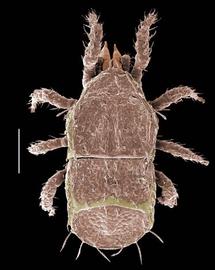
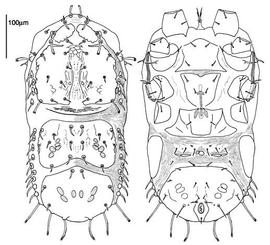
Diagnostic characters
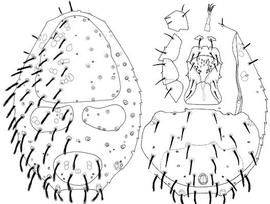
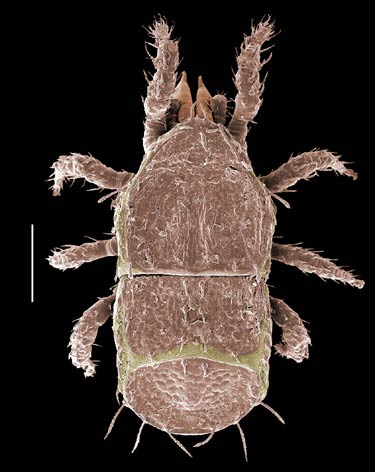
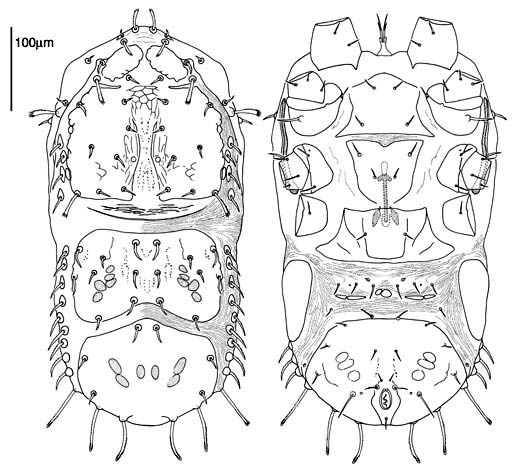
- Brownish, subrectangular mites with podonotalpodonotal:
relating to the dorsal podosoma, the region of the idiosoma over the legs.
, mesonotal and pygidial shields
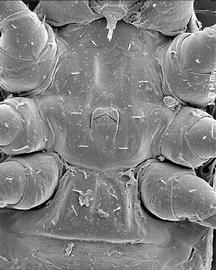
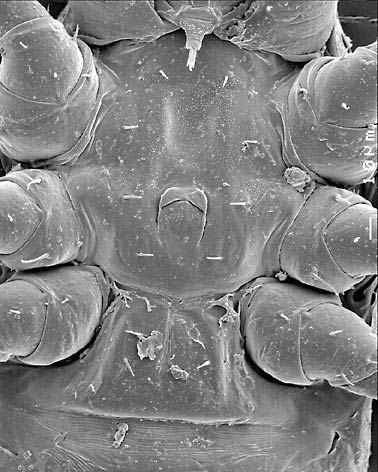
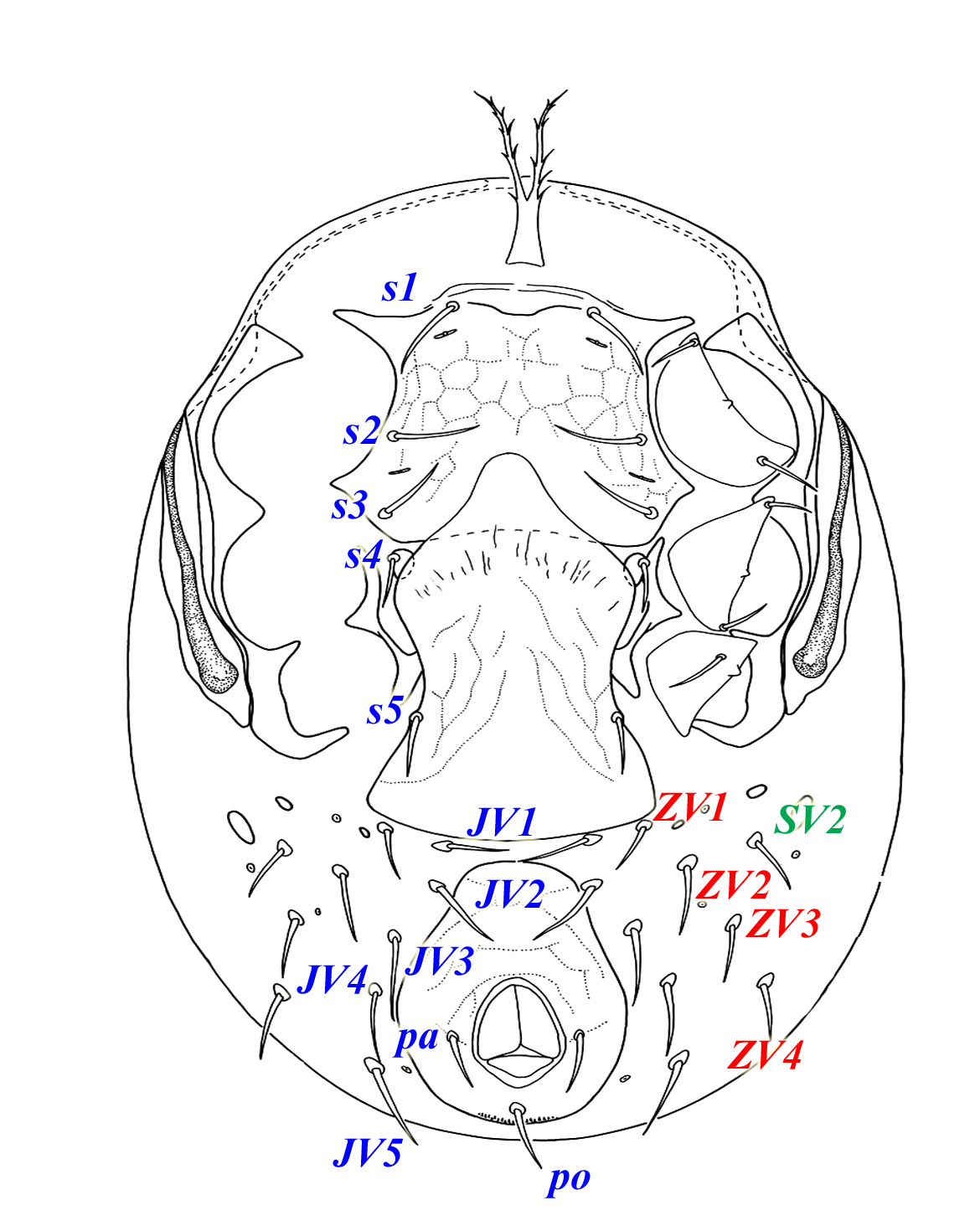
- Sternal shield divided, st1–2 and st3–4 on separate halves
- Genital shieldgenital shield:
a shield or shields covering the genital opening; in female mongynaspine Mesostigmata this shield is usually called the epigynal (epigynial) shield.
with broad wings and a single pair of setae
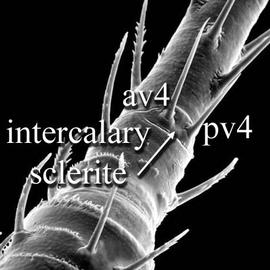
- Intercalary scleritesclerite:
A component section of an exoskeleton; a plate forming the skeleton of an arthropod.
of tarsustarsus:
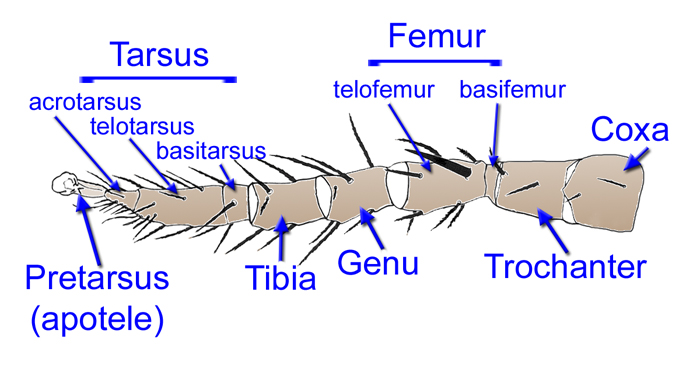
(pl. tarsi) the subdistal leg segment between the tibia and the pretarsus (apotele).
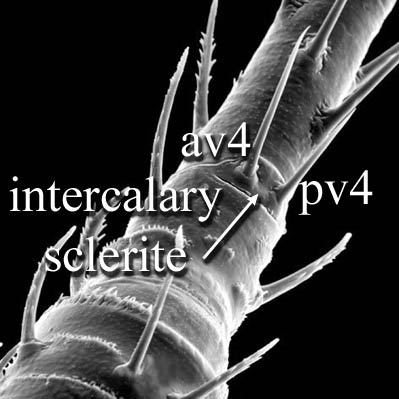
IV reduced to linear remnant; setae av4 and pv4 absent
- Trochantertrochanter:
the leg segment between the coxa and the femur.
 I of adult with larval setalsetal:
of or pertaining to a seta.
complement (4 setae); femorafemur:
(pl. femora) major leg segment between trochanter and genu; often subdivided into a basifemur and a telofemur.
, genuagenu:
(pl. genua) (= patella) the 4th leg segment, between the femur and tibia.
and tibiaetibia:
(pl. tibiae) the leg segment between the genu and the tarsus.
I with 10 setae; tibiaetibia:
(pl. tibiae) the leg segment between the genu and the tarsus.
II–IV with 9 setae (2–1/1,2/1–2).
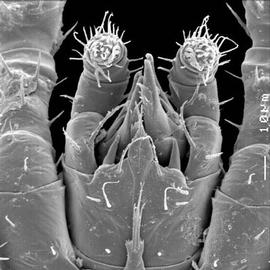
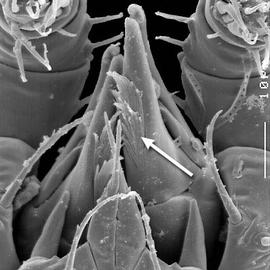
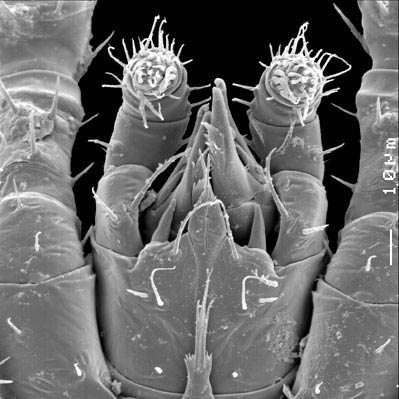
- Hypostomal setae in triangular array; palp apotelepalptarsal apotele:
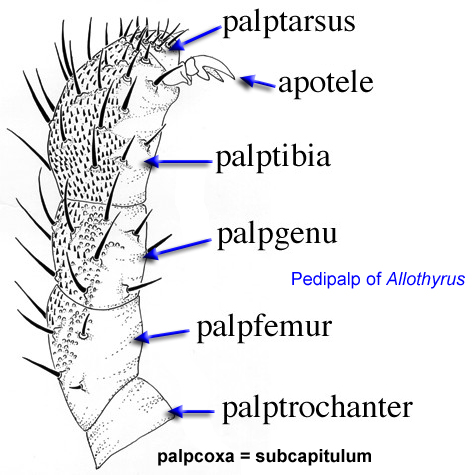
(= palp apotele, palptarsal claw) the most distal segment of the palp; absent in Acariformes, claw-like in Opilioacarida, and a subdistal, tined structure in the Mesostigmata.
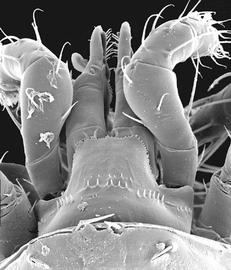
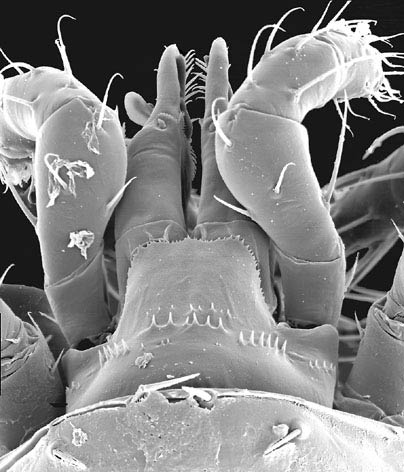
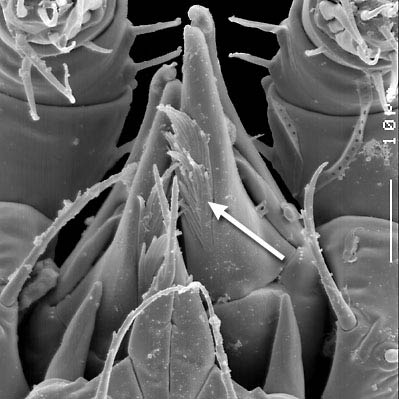
 2-tined; movable digit of chelicerae with excrescences.
- Males with sternal-genital shieldgenital shield:
a shield or shields covering the genital opening; in female mongynaspine Mesostigmata this shield is usually called the epigynal (epigynial) shield.
bearing 4 pairs of setae; genital opening between coxae III; fifth pair of sternal setaesternal setae:
in Mesostigmata, the five pairs of setae in the intercoxal region designated st1-5; st1-3 are present in the larva and usually are borne on a sternal shield in the adult female; st4, the metasternal setae, are added in the deutonymph, often are borne on metasternal platelets, and sometimes on the sternal shield; st5, the genital setae, are added in the protonymph and usually borne on or are inserted laterad the epigynal shield in the adult female.
 on or near a separate plate between coxae IV.
Similar taxa
Microsejus has 5 setae on trochantertrochanter:
the leg segment between the coxa and the femur.
I, 2 mesonotal shields, and lacks cheliceralcheliceral:
of or pertaining to the chelicera.
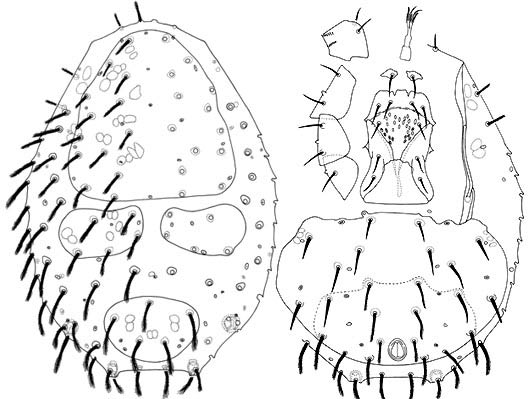
excrescences. Nothogynus have nude mesonotal scutellascutella:
(pl scutellae) small shields or platelets.
and pygidial shields, 4-segmented palps, and lack claws on tarsustarsus:
(pl. tarsi) the subdistal leg segment between the tibia and the pretarsus (apotele).
I. Polyaspidids have a nude genital shieldgenital shield:
a shield or shields covering the genital opening; in female mongynaspine Mesostigmata this shield is usually called the epigynal (epigynial) shield.
. Saprosecans (Halolaelapidae) have posteriorposterior:
the back part of the body or towards that region in comparison, e.g., 'posterior to'.
opisthonotal horn-like processes.
Taxon not in this tool: Davacarids have 3 genital shields, short peritremes, a lobe-like process on the chelicerae, and setae av4/pv4 on tarsitarsus:
(pl. tarsi) the subdistal leg segment between the tibia and the pretarsus (apotele).
IV. Sejids have setae av4/pv4.
Ecology and distribution
Microgyniidae are associated with rotting wood and litter in boreal forests. An undescribed species is known from Tasmania.
References
- Evans and Till 1979Evans and Till 1979:
Evans EO and Till WM. 1979. Mesostigmatic mites of Britain and Ireland (Chelicerata: Acari-Parasitiformes): An introduction to their external morphology and classification. Transactions of the Zoological Society of London 35 (2): 145-270.
- Gilyarov and Bregatova 1977Gilyarov and Bregatova 1977:
Gilyarov MS and Bregatova NG, eds. 1977. Handbook for the identification of soil-inhabiting mites, Mesostigmata. Zoological Institute of the Academy of Sciences, Petrograd.
- Johnston 1982bJohnston 1982b:
Johnston DE. 1982b. Mesostigmata. pp. 112-116. In: Parker SP, ed. Synopsis and classification of living organisms, Vol. 2. McGraw-Hill, New York.
- Krantz 1961Krantz 1961:
Krantz GW. 1961. A re-evaluation of the Microgynioidea, with a description of a new species of Microgynium (Acarina: Mesostigmata). Acarologia 3: 1-10.
- Walter and Krantz 1999Walter and Krantz 1999:
Walter DE and Krantz GW. 1999. New early derivative mesostigmatans from Australia: Nothogynus, n. g., Nothogynidae, n. fam. (Mesostigmata: Microgyniina). International Journal of Acarology 25: 67-76.