test
Prostigmata Kramer, 1877
Superorder Acariformes » Order Trombidiformes » Suborder Prostigmata
infraorders: Labidostommatina, Eupodina, Anystina, EleutherengonaEleutherengona:
(also Eleutherengonida, Eleutherengonina, Eleutherengonides) an infraorderwithin the Prostigmata consisting of the two hyporders Raphignathina and Heterostigmata. Eleutherengona includes many of the most important plant-parasitic mites, e.g., spider mites, broad mite, cyclamen mite.
prostigmatans, prostigmatic mites
very high
Very high, all of the major plant parasitic mites belong to the Prostigmata as well as numerous important parasites of people, livestock, pets, wildlife and insects, including the presumed cause of Isle of Wight Disease in honeybees. Many species are free-living predators or fungivores (including some pests in mushroom cultivation).
Very small (0.08 mm long) to very large (16 mm) mites with a pair of stigmatal openings between the chelicerae or on the anterioranterior:
the front part of the body or towards that region in comparison, e.g., 'anterior to'
margin of the idiosoma, sometimes associated with a chambered peritrematalperitrematal:
(peritrematic) of or referring to the peritreme; adjectival form of peritreme.
system; gnathosomagnathosoma:
(= capitulum) the anteriormost part of a mite or ricinuleid, composed of the cheliceral and pedipalpal segments and separated from the body (idiosoma) by a ring of soft cuticle.
either with the bases of the chelicerae exposed or partially consolidated into a stylophorestylophore:
chelicerae formed of fused cheliceral bases bearing stylet-like movable digits as in Raphignathae (Prostigmata), e.g., the plant parasitic spider mites and their relatives (Tetranychoidea). In predatory and parasitic Cheyletoidea and parasitic Myobiidae, the stylophore and subcapitulum are fused into a gnathosomal capsule.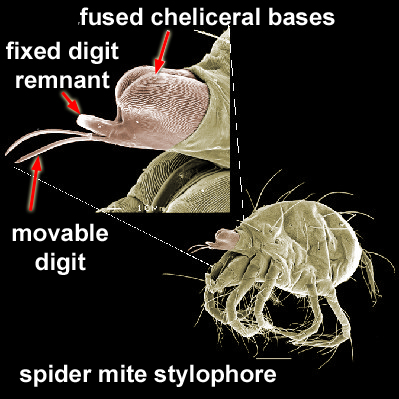 or fully consolidated into a head-like capsulecapsule:
as in gnathosomal capsule, the fused chelicerae and subcapitulum characteristic of Tarsonemina and some other Prostigmata (e.g., Cheyletoidea, Myobioidea) (also tegmen, rostral shield).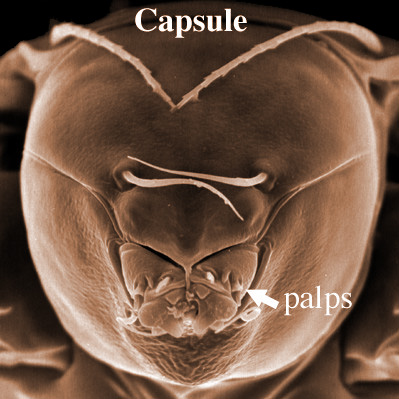 , capitulumgnathosoma:
(= capitulum) the anteriormost part of a mite or ricinuleid, composed of the cheliceral and pedipalpal segments and separated from the body (idiosoma) by a ring of soft cuticle.
sometimes retracted within the bodybody:
the idiosoma of mites.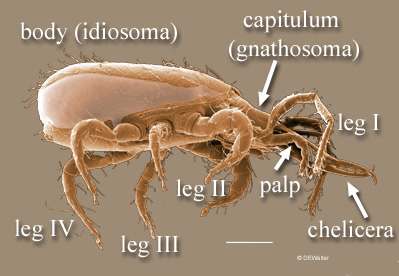 ; palps with 2–5 free segments, without a palp apotelepalptarsal apotele:
(= palp apotele, palptarsal claw) the most distal segment of the palp; absent in Acariformes, claw-like in Opilioacarida, and a subdistal, tined structure in the Mesostigmata.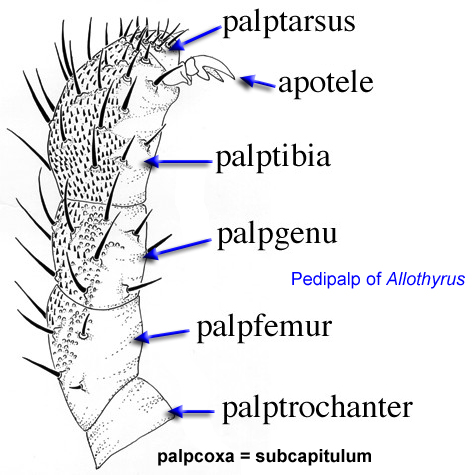 ; subcapitulumsubcapitulum:
(also infracapitulum) the venter of the capitulum; the ventral faces of the fused palpcoxae; apparently formed independently in the two superorders of mites.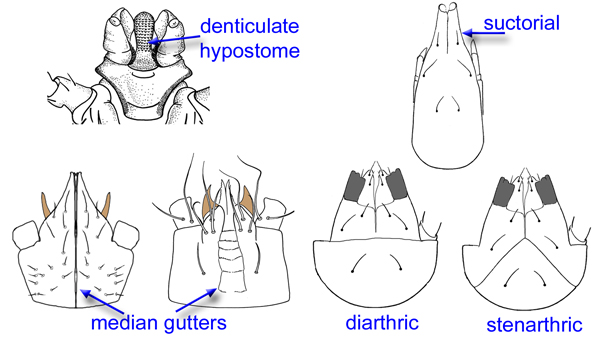 without a median groove or transverse rows of denticlesdenticles:
small tooth-like processes, e.g., on the subcapitula of ticks and many mesostigmatans.
; flagellate tritosternumtritosternum:
the sternum of the 3rd body segment (between legs I); produced as a biflagellate structure in Mesostigmata, although sometimes the flagellae (laciniae) are partially or completely fused. 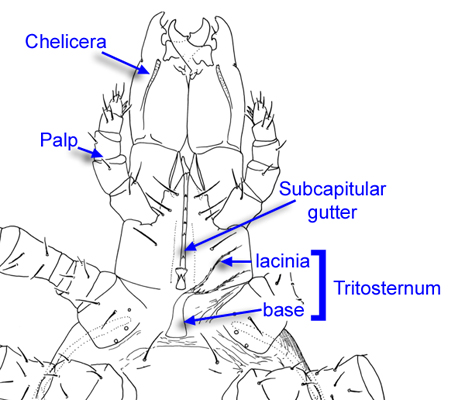 absent; coxae fused to bodybody:
the idiosoma of mites. wall, usually plate-like; chelicerae 2-segmented; prodorsumprodorsum:
the dorsal surface of the propodosoma.
sometimes with 1–2 pairs of trichobothriatrichobothrium:
(pl. trichobothria) (= bothridial sensillum) an often elaborately modified seta set in a cup-like base; forms include filiform, ciliate, pectinate or variously thickened or clubbed (bat-like to globose or capitate).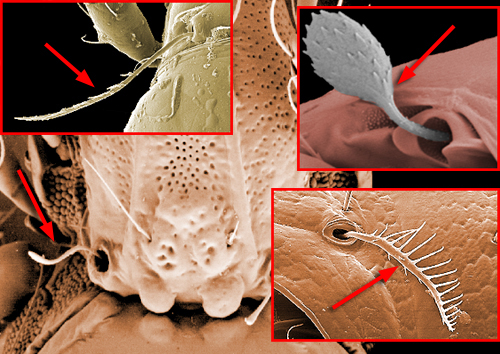 ; intercoxal region without sternal or genital shieldgenital shield:
a shield or shields covering the genital opening; in female mongynaspine Mesostigmata this shield is usually called the epigynal (epigynial) shield.
elements, genital opening postcoxalpostcoxal:
posterior to the coxae. 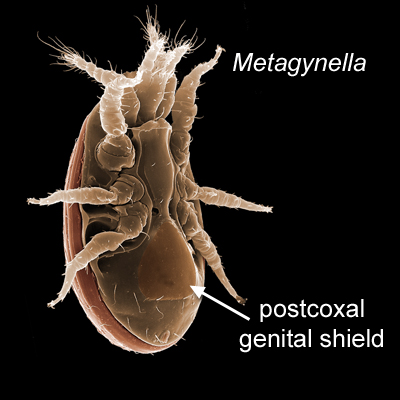 ; development: +/- hexapod prelarvaprelarva:
(also deutovum, prolarva) the first instar in acariform mites having a complete ontogenetic sequence, but absent in derived Prostigmata and Parasitiformes (except Opilioacarida); incompletely formed, without functional mouthparts, often retained within the egg shell or just extruding from it, and usually inactive; hexapod or apodous.
, hexapodhexapod:
with three pairs of legs (i.e. 6 legs), as in the larvae of mites or the larviform stages of others.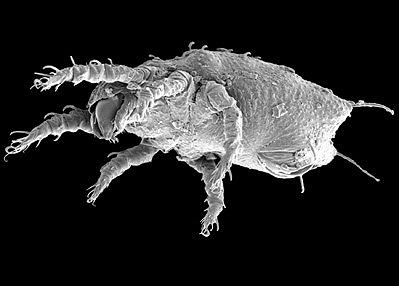 larva and 1–3 usually octopod nymphal stages (protonymphprotonymph:
the first nymphal stage or instar, usually octopod.
, +/- deutonymphdeutonymph:
(also deuteronymph) the second nymphal stage or instar.
, +/- tritonymphtritonymph:
the third, and final, nymphal stage or instar present in Opilioacarida, Holothyrida, Argasidae, and many Acariformes.
), rarely all stages are quadruped; genital opening develops gradually and sometimes associated with 1–2 pairs of genital papillaegenital papillae:
1-3 pairs of extrusible finger-like to button-like projections, usually retracted into in the genital vestibule of acariform mites; sometimes formed as sessile disks around the genital opening; thought to be osmoregulatory structures; modified or multiplied and dispersed over the body in many freshwater mites. Genital papillae are absent in the larva, but may be added ontogenetically: protonymphs have one pair, deutonymphs two pairs, and tritonymphs (and adults) three pairs. The tritonymphal pair of papillae is often lost. The serially homologous Claparède's organ is usually present in the larvae (and prelarvae) of mites exhibiting genital papillae in nymphs and adults (Oudeman's Rule).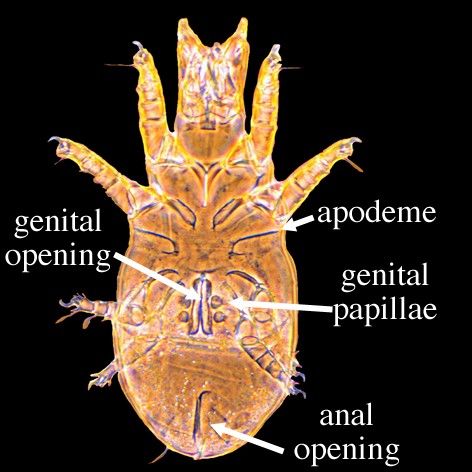 ; larva sometimes with urstigmataurstigma:
(pl. urstigmata) the presumed homologue of the genital papillae found between legs I-II in the prelarvae and larvae of many acariform mites; osmoregulatory organs (= Claparède's organ, also urpores, bruststiele). Tydeid mites may retain the urstigmata beyond the larval stage.
; males sometimes with an aedeagusaedeagus:
a male intromittent organ, especially when sclerotized (e.g., in Tetranycoidea, Raphignathoidea); a penis is a flexible, membranous intromittent organ, although 'penis' is often used for aedeagi (e.g., in Astigmata)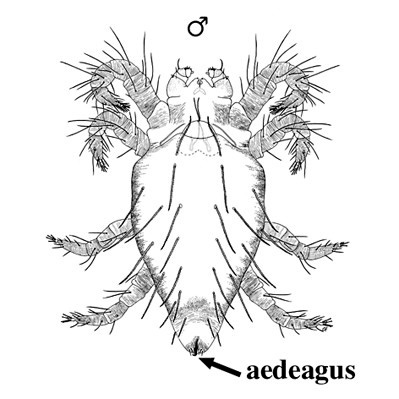 , never with modified chelicerae; female sperm receiving structures primary or secondary.
Immature Mesostigmata may be confused with Prostigmata, but the lateral stigmatal openings should be easy to find except in larvae (which lack them).
Cosmopolitan. Although many species are free-living predators or fungivores, many lineages are parasitic on vertebrates and arthropods. Many are phoretic on insects, often as adults and sometimes as specialized phoretomorphs. As far as is known, all prostigmatans are fluid-feeders.
Author: David E. Walter
Content last updated Sept. 2006, unless indicated otherwise
Lucid key player updated Sept. 2025
idtools.org