test
Oribatida van der Hammen, 1968Hammen, 1968:
Hammen L van der. 1968. Studies on Opilioacarida (Arachnida). II. Redescription of Paracarus hexophthalmus (Redikorzev). Zoölogische Mededelingen 43: 57-76.
Superorder Acariformes » Order Sarcoptiformes » Suborder Oribatida
infraorders: Palaeosomata, Enarthronota, Parhyposomata, Mixonomata, Desmonomata
oribatid mites, moss mites, armored mites, cryptostigmatans, astigmatids, acarids
very high
High, but almost entirely because of the hyporder Astigmata. Most traditional oribatid mites are of little interest to quarantine: most are fungivores or detritivores, only a few are minor pests of plants and none are significant parasites of animals. Some oribatidsoribatidmites:
are a member of the sarcoptiform suborder Oribatida (=Cryptostigmata, Oribatei); some academics consider the use of 'oribatid' as a noun to be low class, but others consider that attitude pedantic.
, however, may disperse fungal spores and other microbial propagules. In contrast, the hyporder Astigmata contains many important parasites of people, livestock, pets, wildlife and insects, as well as many fungivores and scavengers that are pests in stored products and homes.
Small (0.100 mm long) to medium (2.0 mm) mites without typical stigmatal openings (some have secondarily derived brachytracheaebrachytracheae:
thick, elongated and porose tube-like invaginations in the cuticle of some oribatid mites.
), rarely with expansive plastron-likeplastron-like:
peritremes that are flattened and broad and serve as an incompressible plastron in mesostigmatans living in wet habitats. 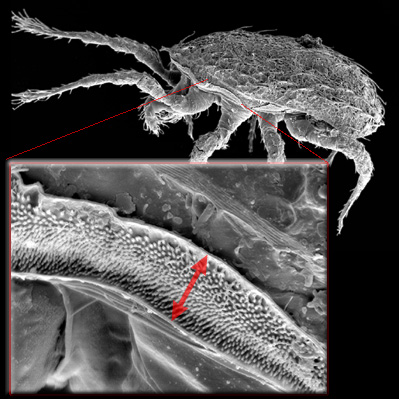 structures in aquatic species; gnathosomagnathosoma:
(= capitulum) the anteriormost part of a mite or ricinuleid, composed of the cheliceral and pedipalpal segments and separated from the body (idiosoma) by a ring of soft cuticle.
with the bases of the chelicerae exposed, but often withdrawn into a camerostomecamerostome:
a recess under the rostral tectum that allows retraction of the chelicerae and palps of oribatid mites and that is sealed by the subcapitulum when retracted; a deep recess containing the gnathosoma in Uropodina.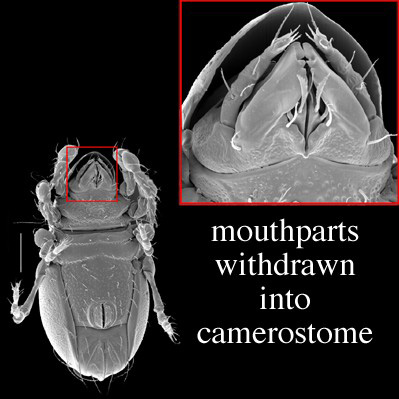 ; palps with 2–5 free segments, without a palp apotelepalptarsal apotele:
(= palp apotele, palptarsal claw) the most distal segment of the palp; absent in Acariformes, claw-like in Opilioacarida, and a subdistal, tined structure in the Mesostigmata.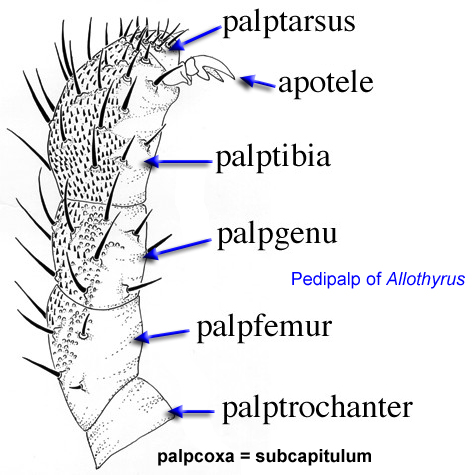 ; subcapitulumsubcapitulum:
(also infracapitulum) the venter of the capitulum; the ventral faces of the fused palpcoxae; apparently formed independently in the two superorders of mites.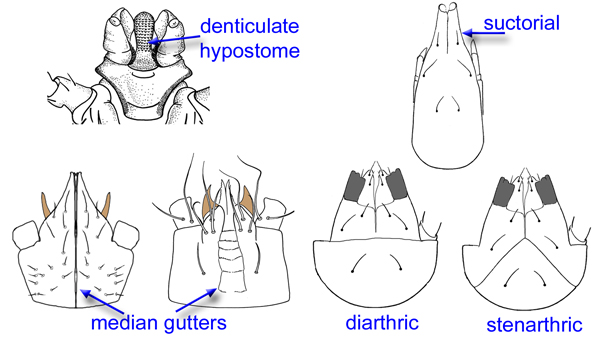 without a median groove or transverse rows of denticlesdenticles:
small tooth-like processes, e.g., on the subcapitula of ticks and many mesostigmatans.
; toothed to quadrate rutellarutellum:
(pl. rutella) In Sarcoptiformes, the hypertrophied setae on the hypostome, often toothed; not to be confused with a corniculus (although possibly a homologue). In Astigmata, the rutellum may be referred to as a pseudorutellum, although it is the same structure. Various forms of rutella are recognized, including the atelebasic and pantelebasic.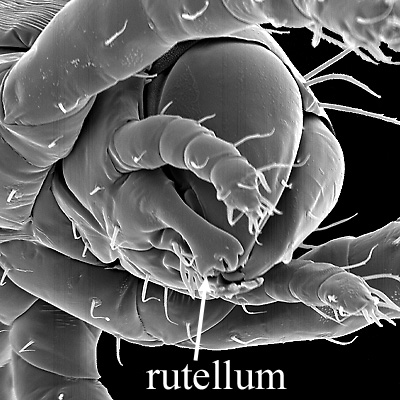 usually present; flagellate tritosternumtritosternum:
the sternum of the 3rd body segment (between legs I); produced as a biflagellate structure in Mesostigmata, although sometimes the flagellae (laciniae) are partially or completely fused. 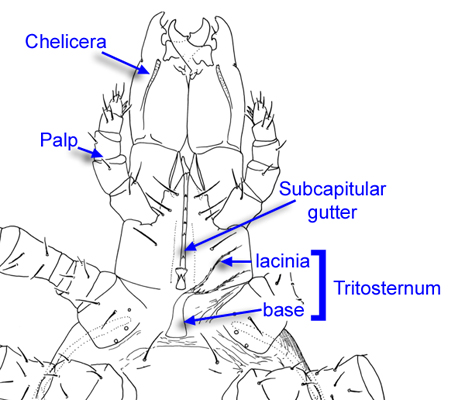 absent; coxae fused to bodybody:
the idiosoma of mites.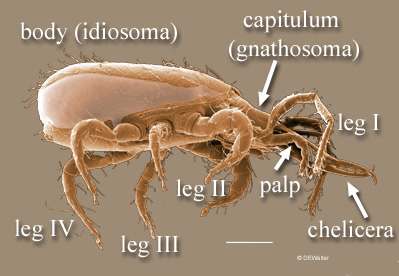 wall, usually plate-like or completely assimilated into the bodybody:
the idiosoma of mites. wall (epimeres); chelicerae 2-segmented (rarely with additional remnant basalbasal:
towards the base of a structure; on a limb, towards the insertion on the body.
segment); prodorsumprodorsum:
the dorsal surface of the propodosoma.
with 0–1 pair of trichobothriatrichobothrium:
(pl. trichobothria) (= bothridial sensillum) an often elaborately modified seta set in a cup-like base; forms include filiform, ciliate, pectinate or variously thickened or clubbed (bat-like to globose or capitate).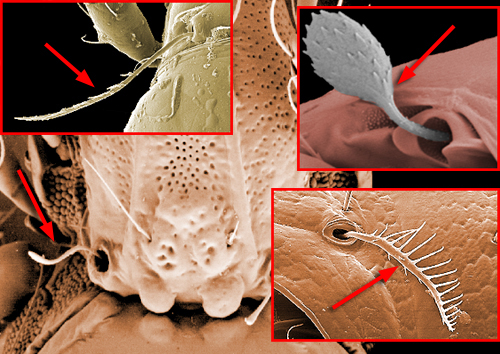 ; intercoxal region without sternal or genital shieldgenital shield:
a shield or shields covering the genital opening; in female mongynaspine Mesostigmata this shield is usually called the epigynal (epigynial) shield.
elements, genital opening postcoxalpostcoxal:
posterior to the coxae. 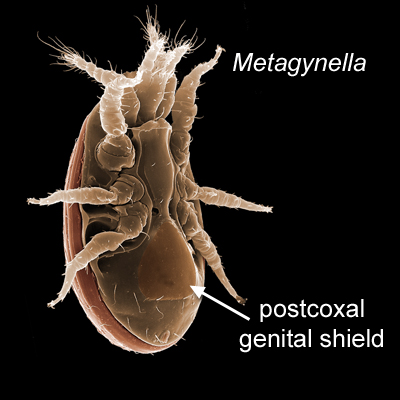 ; development: +/- hexapod prelarvaprelarva:
(also deutovum, prolarva) the first instar in acariform mites having a complete ontogenetic sequence, but absent in derived Prostigmata and Parasitiformes (except Opilioacarida); incompletely formed, without functional mouthparts, often retained within the egg shell or just extruding from it, and usually inactive; hexapod or apodous.
, hexapodhexapod:
with three pairs of legs (i.e. 6 legs), as in the larvae of mites or the larviform stages of others.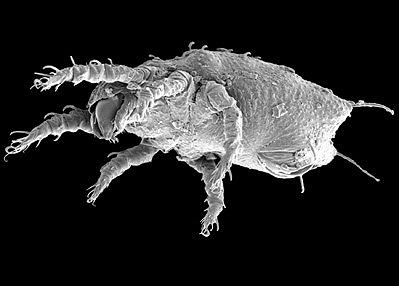 larva and 2–3 octopod nymphal stages (protonymphprotonymph:
the first nymphal stage or instar, usually octopod.
, +/- deutonymphdeutonymph:
(also deuteronymph) the second nymphal stage or instar.
, tritonymphtritonymph:
the third, and final, nymphal stage or instar present in Opilioacarida, Holothyrida, Argasidae, and many Acariformes.
); genital opening develops gradually and usually associated with 1–3 pairs of genital papillaegenital papillae:
1-3 pairs of extrusible finger-like to button-like projections, usually retracted into in the genital vestibule of acariform mites; sometimes formed as sessile disks around the genital opening; thought to be osmoregulatory structures; modified or multiplied and dispersed over the body in many freshwater mites. Genital papillae are absent in the larva, but may be added ontogenetically: protonymphs have one pair, deutonymphs two pairs, and tritonymphs (and adults) three pairs. The tritonymphal pair of papillae is often lost. The serially homologous Claparède's organ is usually present in the larvae (and prelarvae) of mites exhibiting genital papillae in nymphs and adults (Oudeman's Rule).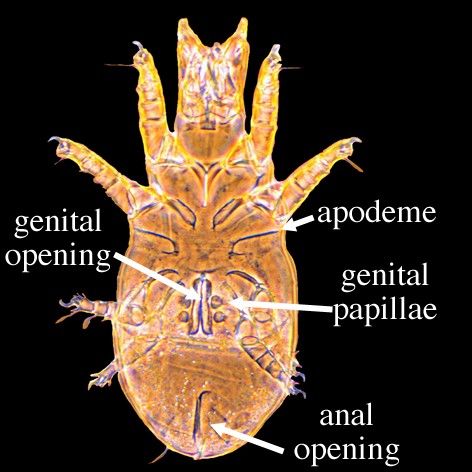 ; larva usually with urstigmataurstigma:
(pl. urstigmata) the presumed homologue of the genital papillae found between legs I-II in the prelarvae and larvae of many acariform mites; osmoregulatory organs (= Claparède's organ, also urpores, bruststiele). Tydeid mites may retain the urstigmata beyond the larval stage.
; males sometimes with an aedeagusaedeagus:
a male intromittent organ, especially when sclerotized (e.g., in Tetranycoidea, Raphignathoidea); a penis is a flexible, membranous intromittent organ, although 'penis' is often used for aedeagi (e.g., in Astigmata).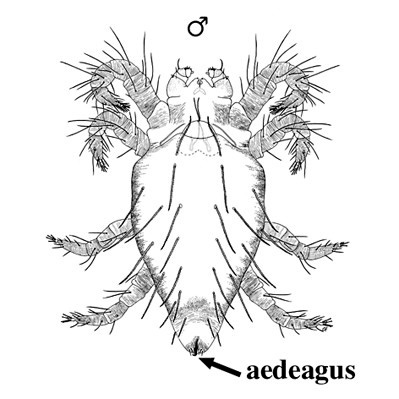 , never with modified chelicerae; female sperm receiving structures primary or secondary.
Immature Oribatida: prodorsum with 1 pair of variously formed trichobothriatrichobothrium:
(pl. trichobothria) (= bothridial sensillum) an often elaborately modified seta set in a cup-like base; forms include filiform, ciliate, pectinate or variously thickened or clubbed (bat-like to globose or capitate). and usually 5 pairs of setaeseta:
(pl. setae, from L. = bristle) cuticular process composed of a hollow shaft (sometimes filled with a refractive material) produced from a membranous socket (the alveolus); the hair-like, spine-like, branched or variously expanded structures on the surfaces of the legs and body. Most setae function as mechanoreceptors, but others (e.g., solenidia) are chemoreceptors or have unknown or ambiguous functions.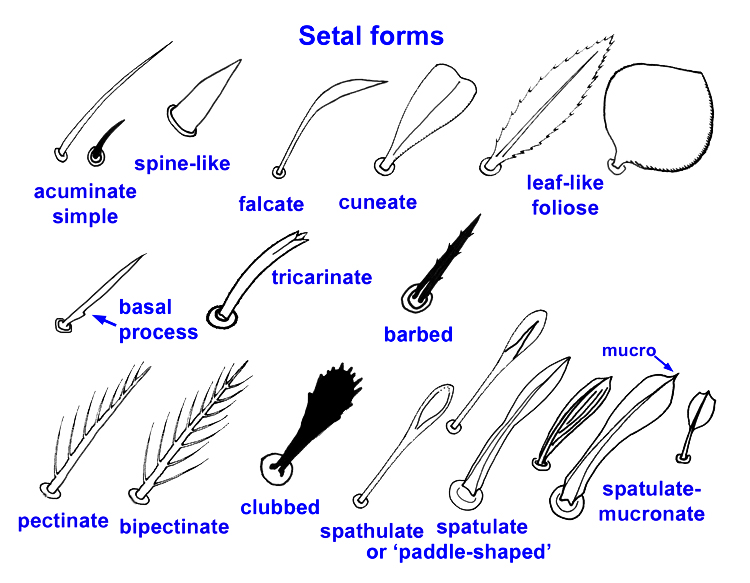 ; naso and/ or eyes rarely present, legs ending in a single clawclaw:
like - having a distal hook; resembling a claw.
without rays, opisthonotalopisthonotal:
dorsal opisthosoma.
gland often present.
Some adult Mesostigmata and Prostigmata are heavily sclerotized and might be confused with oribatid mites. However, heavily sclerotized oribatid mites usually have rutellarutellum:
(pl. rutella) In Sarcoptiformes, the hypertrophied setae on the hypostome, often toothed; not to be confused with a corniculus (although possibly a homologue). In Astigmata, the rutellum may be referred to as a pseudorutellum, although it is the same structure. Various forms of rutella are recognized, including the atelebasic and pantelebasic. and lack stigmatal openings. Additionally, heavily sclerotized Mesostigmata usually have well developed tritosterna and horn-like corniculicorniculus:
(pl. corniculi) (also, external malae) a usually horn-like process (sometimes toothed, bifurcate, trifurcate, spine-like, spatulate, or membranous) on the subcapitulum of parasitiform mites that usually supports the salivary styli. A toothed corniculus could be confused with a rutellum, a possibly homologous structure in Acariformes and Opilioacarida. Phytoseiid image is spatulate corniculus.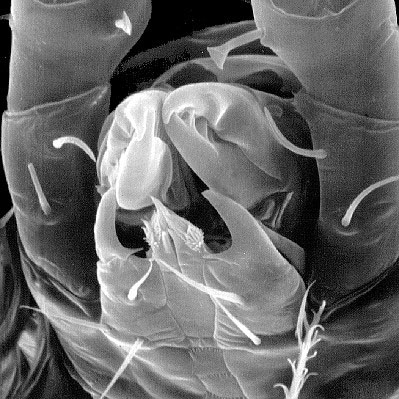 .
.
The immature stages of some oribatid mites may be confused with Endeostigmata.
Cosmopolitan. Although most species are free-living fungivores, many astigmatid lineages are parasitic on vertebrates and arthropods. Many Astigmata are phoretic on insects as heteromorphicheteromorphic:
having different morphological forms; referring either to different forms within a particular life stage (e.g., normal and heteromorphic deutonymphs in some Mesostigmata; protogynes vs. deutogynes in Eriophyoidea; heteromorphic vs. homeomorphic males in the Astigmata) or to a developmental stage that differs radically from other stages (e.g., the heteromorphic deutonymph or hypopus in the Astigmata).
deutonymphs (hypopi). Most oribatidsoribatidmites:
are a member of the sarcoptiform suborder Oribatida (=Cryptostigmata, Oribatei); some academics consider the use of 'oribatid' as a noun to be low class, but others consider that attitude pedantic.
are particulate-feeders, but some feed on fluids or very fine particulate matter.
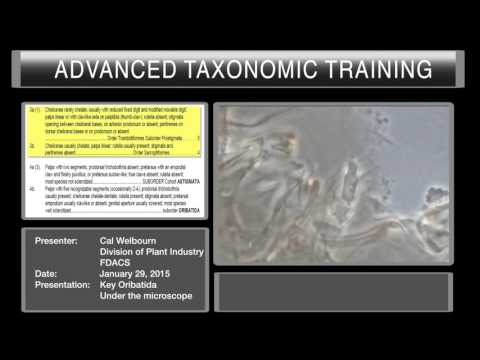
Using a dichotomous key to identify a mite specimen as Oribatida
Author: David E. Walter
Content last updated Sept. 2006, unless indicated otherwise
Lucid key player updated Sept. 2025
idtools.org