test
Sejida Kramer, 1885
Superorder Parasitiformes » Order Mesostigmata » Suborder Sejida
superfamilies: Sejoidea, Heterozerconoidea
sejines, sejids, uropodellids, ichthyostomatogasterids
low, most species are associated with treeholes, nests and other patchy habitats; most have deutonymphs that are phoretic on insects.
Low—as far as is known, all sejines are predators or scavengers.
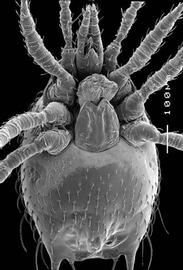
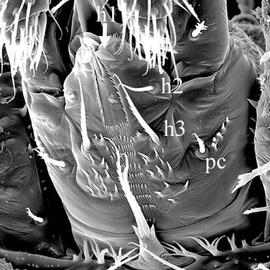
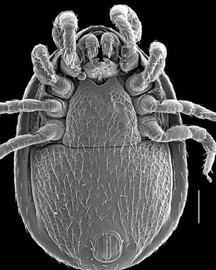
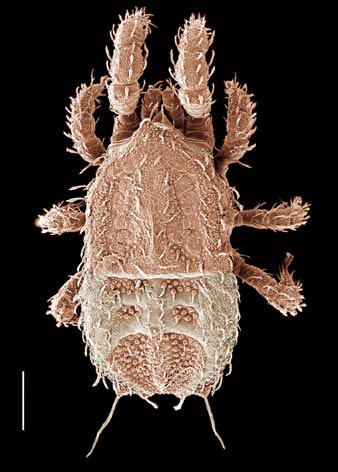
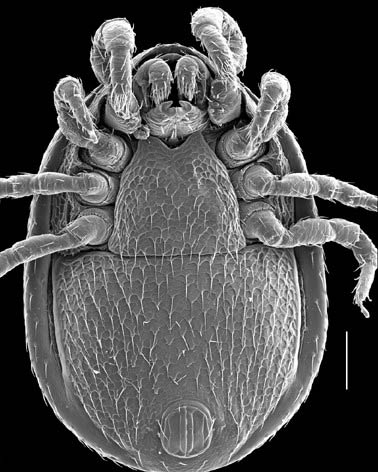
Mesostigmata with the female having a large genital shield usually bearing 6 to numerous setaeseta:
(pl. setae, from L. = bristle) cuticular process composed of a hollow shaft (sometimes filled with a refractive material) produced from a membranous socket (the alveolus); the hair-like, spine-like, branched or variously expanded structures on the surfaces of the legs and body. Most setae function as mechanoreceptors, but others (e.g., solenidia) are chemoreceptors or have unknown or ambiguous functions.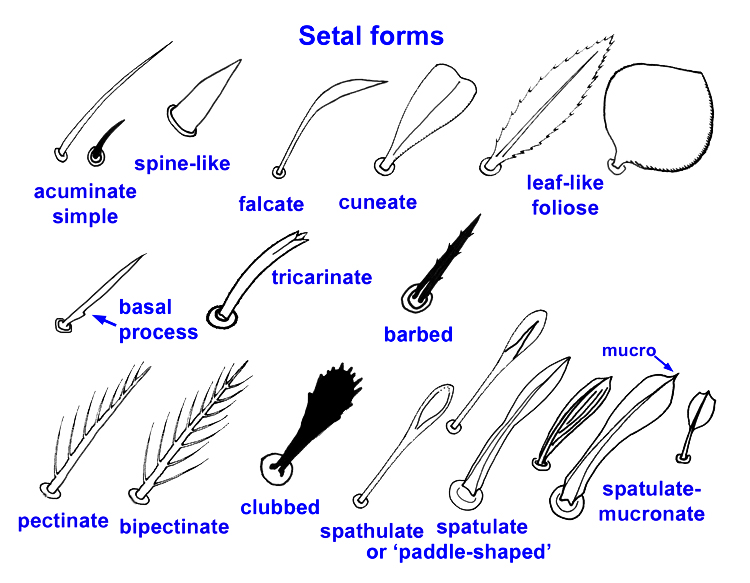 , often bifurcatebifurcate:
split into two distally or with two projections. 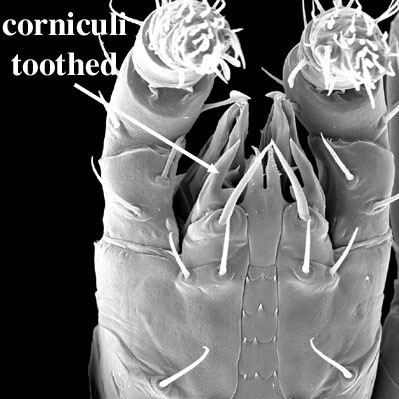 anteriorly, and covering the ovipore and an opening to a large, sac-like spermathecaspermatheca:
a structure in the female for storing sperm, typically sac-like.
; tarsustarsus:
(pl. tarsi) the subdistal leg segment between the tibia and the pretarsus (apotele).
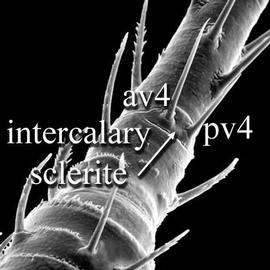
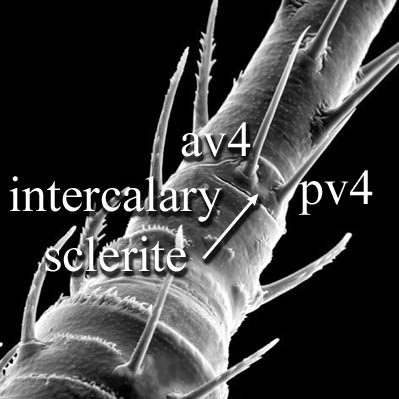
IV with well developed intercalary scleritesclerite:
A component section of an exoskeleton; a plate forming the skeleton of an arthropod.
bearing setaeseta:
(pl. setae, from L. = bristle) cuticular process composed of a hollow shaft (sometimes filled with a refractive material) produced from a membranous socket (the alveolus); the hair-like, spine-like, branched or variously expanded structures on the surfaces of the legs and body. Most setae function as mechanoreceptors, but others (e.g., solenidia) are chemoreceptors or have unknown or ambiguous functions. av4/ pv4.
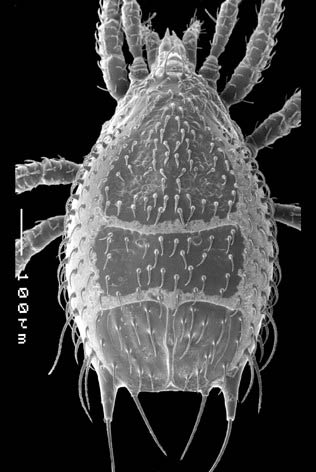
Body with moderate to extensive hypertrichy, numerous glandgland:
usually referring to a glandular opening in the cuticle such as the lateral opisthonotal glands in the Sarcoptiformes or the idionotal glands in the Mesostigmata (see gdj etc. above), including hypertrophied openings that produce defensive secretions.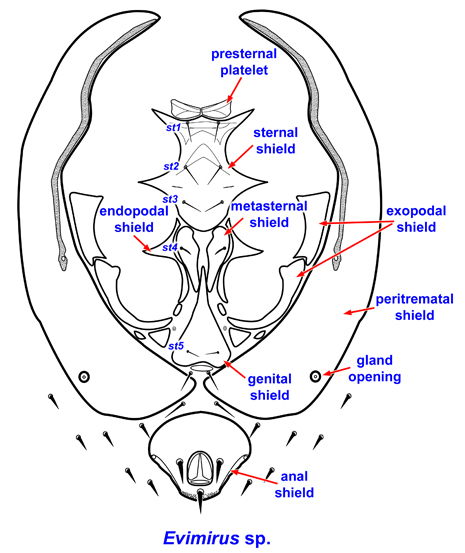 openings, and often densely tuberculatetuberculate:
ornamented with raised processes; covered with tubercles.
. Adult female dorsally with podonotalpodonotal:
relating to the dorsal podosoma, the region of the idiosoma over the legs.
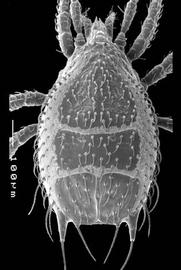
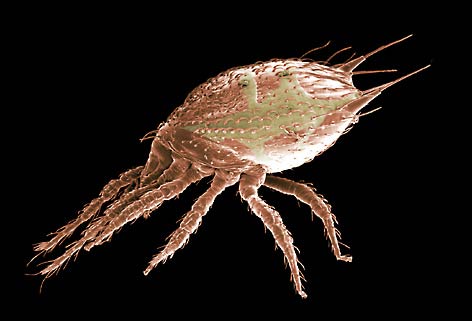
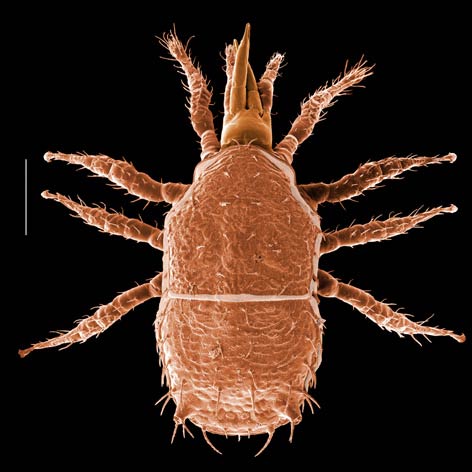
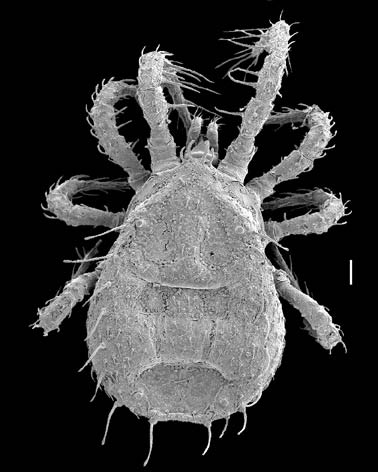
and pygidial shields (sometimes extensive) that may bear horns, and usually with mesonotal or mesolateral shields; secondary hardening of the cuticle often obscures the extent and number of these shields; with large ventrianal shieldventrianal shield:
in Mesostigmata, a ventral shield bearing the anal opening, circum anal setae, and one or more pairs of ventral setae or pores (lyrifissures) [see anal shield]; maybe rather narrow or very broad and covering most of the gaster.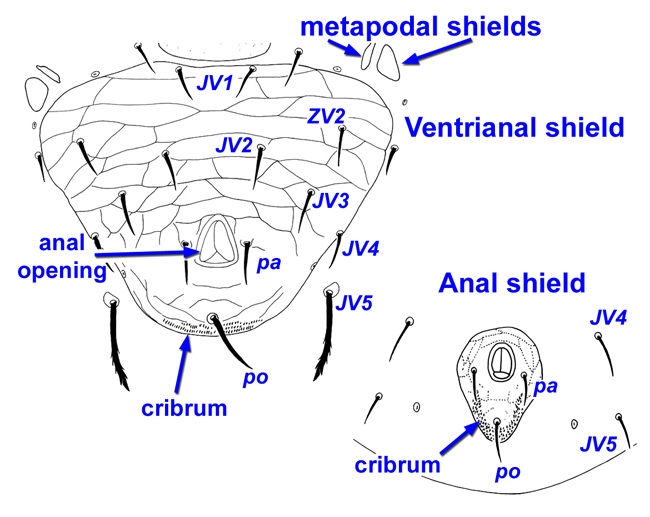 (sometimes developed dorso-laterally and fused to pygidial shieldpygidial shield:
(pygidial sclerite) in Mesostigmata, a shield at the back end of the idiosoma.
); usually large, free metapodal shieldsmetapodal shields:
(also metapodal plates, metapodal platelets, metapodal sclerites) in Mesostigmata, a pair (sometimes fused) of small sclerites posteriad coxae IV in the ventral region that probably reflect muscle attachments.. Peritremes and peritrematalperitrematal:
(peritrematic) of or referring to the peritreme; adjectival form of peritreme.
shields usually well developed, the latter fused anteriorly to podonotal shieldpodonotal shield:
the anterior shield in mesostigmatans with divided dorsal shields. 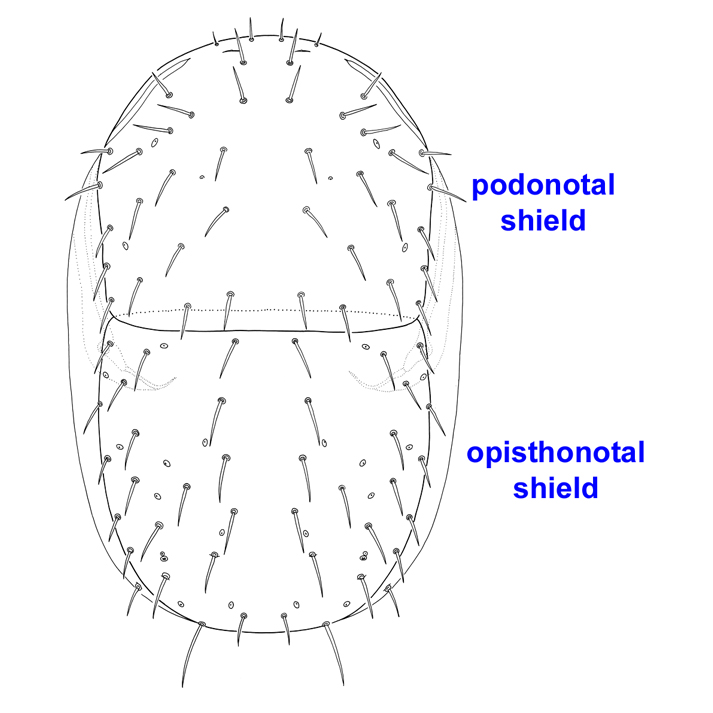 and sometimes producing a process over the gnathosomagnathosoma:
(= capitulum) the anteriormost part of a mite or ricinuleid, composed of the cheliceral and pedipalpal segments and separated from the body (idiosoma) by a ring of soft cuticle.
(vertexvertex:
an anterior extension of the idiosoma that covers the capitulum in many uropodid mites.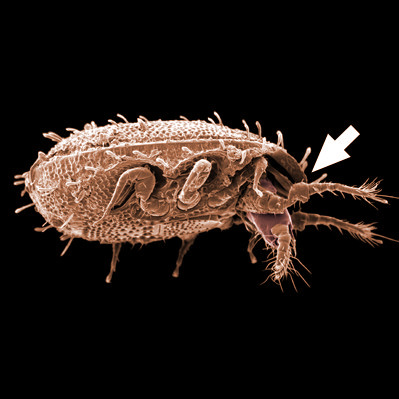 ); lateral setaeseta:
(pl. setae, from L. = bristle) cuticular process composed of a hollow shaft (sometimes filled with a refractive material) produced from a membranous socket (the alveolus); the hair-like, spine-like, branched or variously expanded structures on the surfaces of the legs and body. Most setae function as mechanoreceptors, but others (e.g., solenidia) are chemoreceptors or have unknown or ambiguous functions. often on small platelets. Sternal area not fully sclerotised, but with setaseta:
(pl. setae, from L. = bristle) cuticular process composed of a hollow shaft (sometimes filled with a refractive material) produced from a membranous socket (the alveolus); the hair-like, spine-like, branched or variously expanded structures on the surfaces of the legs and body. Most setae function as mechanoreceptors, but others (e.g., solenidia) are chemoreceptors or have unknown or ambiguous functions.-bearing platelets and often a shield bearing 2 pairs of setaeseta:
(pl. setae, from L. = bristle) cuticular process composed of a hollow shaft (sometimes filled with a refractive material) produced from a membranous socket (the alveolus); the hair-like, spine-like, branched or variously expanded structures on the surfaces of the legs and body. Most setae function as mechanoreceptors, but others (e.g., solenidia) are chemoreceptors or have unknown or ambiguous functions.. Males tend to have more consolidated bodybody:
the idiosoma of mites.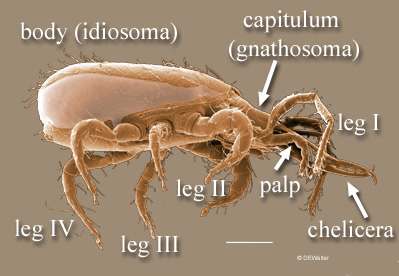 shields; the genital aperturegenital aperture:
the genital opening or acetabulum.
is on an intercoxal shield and is covered by a subcircular valve. Phoretic deutonymphs have a cylindrical anal process and 1–2 dorsaldorsal:
relating to the upper or back side; opposed to ventral.
shields. Tarsustarsus:
(pl. tarsi) the subdistal leg segment between the tibia and the pretarsus (apotele).
I sometimes with an apicotarsusapicotarsus:
(=acrotarsus) distal subdivision of the tarsus, usually of tarsus I
, with or without claws. Tarsustarsus:
(pl. tarsi) the subdistal leg segment between the tibia and the pretarsus (apotele).
IV with 20 or more setaeseta:
(pl. setae, from L. = bristle) cuticular process composed of a hollow shaft (sometimes filled with a refractive material) produced from a membranous socket (the alveolus); the hair-like, spine-like, branched or variously expanded structures on the surfaces of the legs and body. Most setae function as mechanoreceptors, but others (e.g., solenidia) are chemoreceptors or have unknown or ambiguous functions., including setaeseta:
(pl. setae, from L. = bristle) cuticular process composed of a hollow shaft (sometimes filled with a refractive material) produced from a membranous socket (the alveolus); the hair-like, spine-like, branched or variously expanded structures on the surfaces of the legs and body. Most setae function as mechanoreceptors, but others (e.g., solenidia) are chemoreceptors or have unknown or ambiguous functions. av4 and pv4 on a well defined intercalary scleritesclerite:
A component section of an exoskeleton; a plate forming the skeleton of an arthropod.
. Tritosternumtritosternum:
the sternum of the 3rd body segment (between legs I); produced as a biflagellate structure in Mesostigmata, although sometimes the flagellae (laciniae) are partially or completely fused. 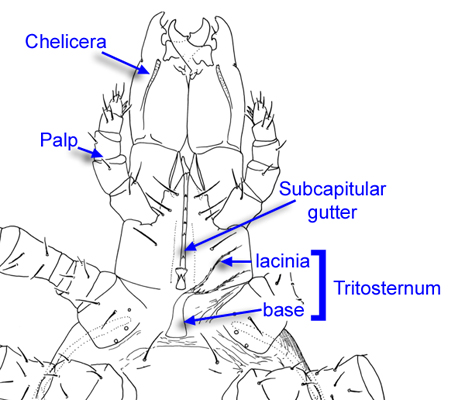 with well developed basebase:
the usually columnar basal part of the tritosternum; sometimes expanded and rectangular or otherwise modified; the most basal part of any structure.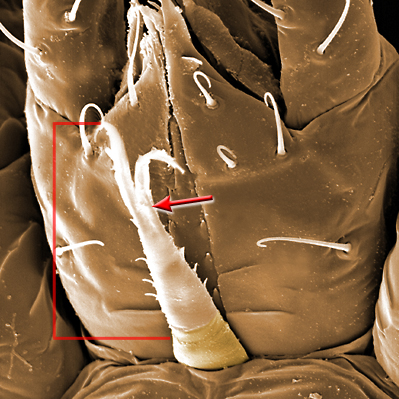 and separate laciniae. Hypostomal setaseta:
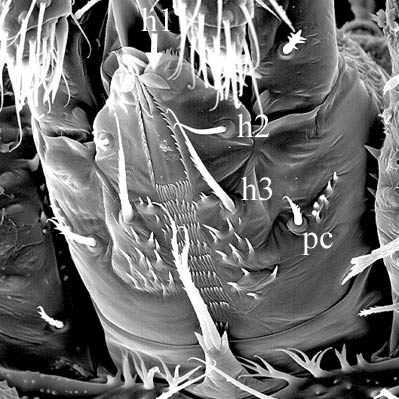
(pl. setae, from L. = bristle) cuticular process composed of a hollow shaft (sometimes filled with a refractive material) produced from a membranous socket (the alveolus); the hair-like, spine-like, branched or variously expanded structures on the surfaces of the legs and body. Most setae function as mechanoreceptors, but others (e.g., solenidia) are chemoreceptors or have unknown or ambiguous functions. h1 flattened, often scale-like; corniculicorniculus:
(pl. corniculi) (also, external malae) a usually horn-like process (sometimes toothed, bifurcate, trifurcate, spine-like, spatulate, or membranous) on the subcapitulum of parasitiform mites that usually supports the salivary styli. A toothed corniculus could be confused with a rutellum, a possibly homologous structure in Acariformes and Opilioacarida. Phytoseiid image is spatulate corniculus.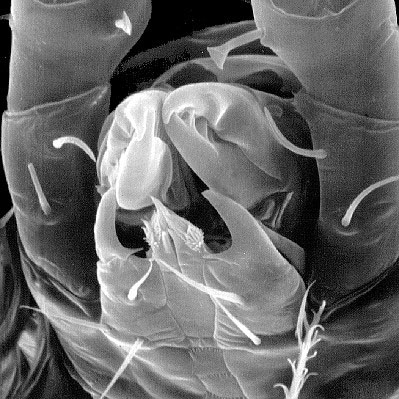 entire or bifid. Palp apotelepalptarsal apotele:
(= palp apotele, palptarsal claw) the most distal segment of the palp; absent in Acariformes, claw-like in Opilioacarida, and a subdistal, tined structure in the Mesostigmata.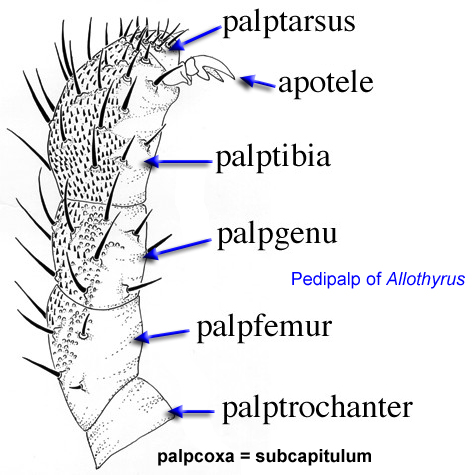 2-tined. Chelicerae chelate-dentatechelate-dentate:
pincer-like chelicerae with teeth.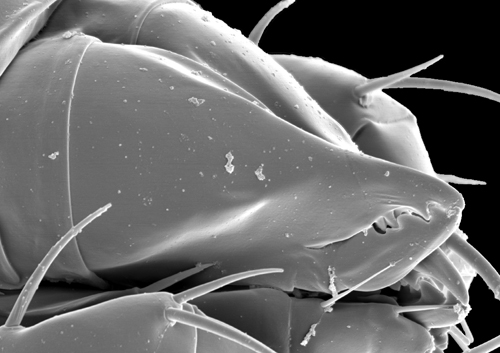 , slender with setiform pilus dentilispilus dentilis:
(pl. pili dentilis) a seta-like or membranous sensory organ inserted ventrolaterally on the fixed digit of the chelicera of many Mesostigmata.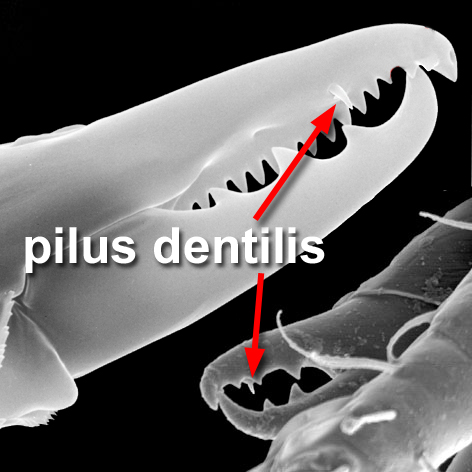 to massive without pilus dentilispilus dentilis:
(pl. pili dentilis) a seta-like or membranous sensory organ inserted ventrolaterally on the fixed digit of the chelicera of many Mesostigmata.; movable digit without arthrodial coronaarthrodial corona:
(arthrodial coronet) a crown-like array of fine processes from the arthrodial membrane at the juncture of the fixed and movable digits in Mesostigmata.
or excrescences.
Some Monogynaspida (e.g., Ascidae) have posteriorposterior:
the back part of the body or towards that region in comparison, e.g., 'posterior to'.
horns, but these species have entireentire:
a shield or sclerite with a continuous margin without incisions.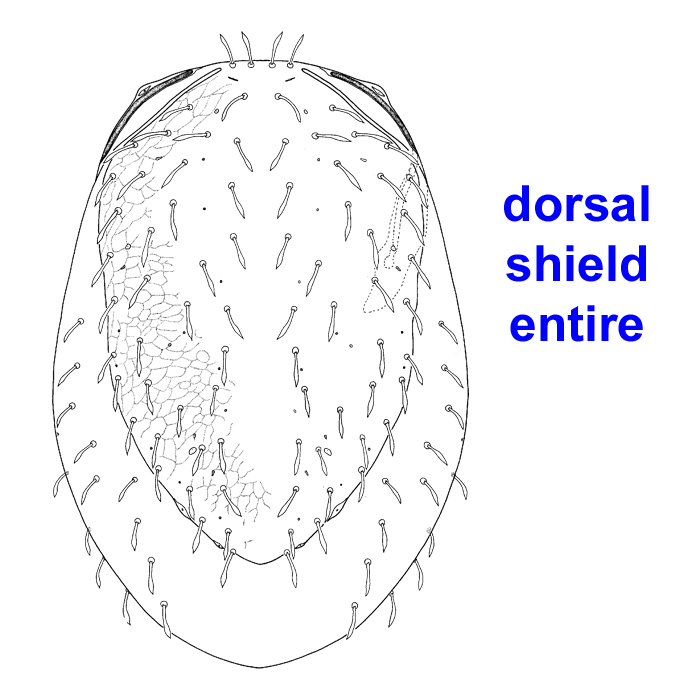 sternal shields and never more than 2 setaeseta:
(pl. setae, from L. = bristle) cuticular process composed of a hollow shaft (sometimes filled with a refractive material) produced from a membranous socket (the alveolus); the hair-like, spine-like, branched or variously expanded structures on the surfaces of the legs and body. Most setae function as mechanoreceptors, but others (e.g., solenidia) are chemoreceptors or have unknown or ambiguous functions. on the female genital shieldgenital shield:
a shield or shields covering the genital opening; in female mongynaspine Mesostigmata this shield is usually called the epigynal (epigynial) shield.
. Other monogynaspines (Microgyniina, some Uropodina, Heatherellina, and rare Dermayssina e.g., Halolaelapidae, Saprosecans) have fragmentedfragmented:
broken up, composed of several discrete parts rather than of a single unit.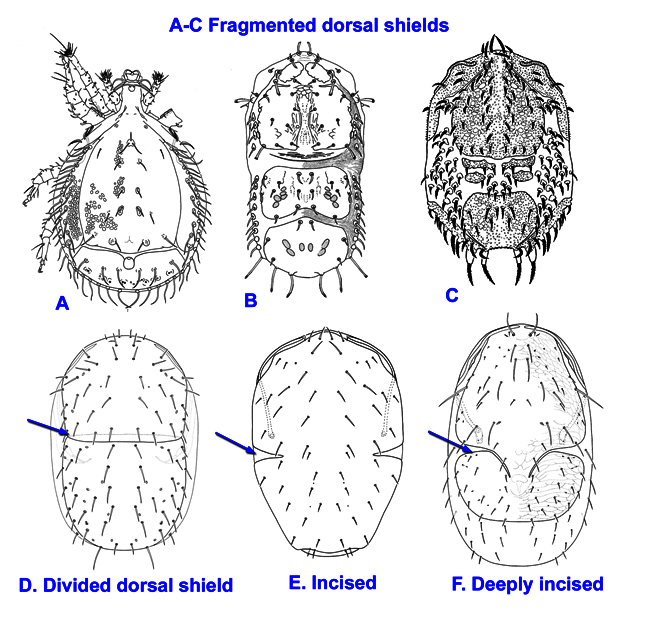 dorsal shields, but all have sclerotised sternal regions, 0–1 pairs of setaeseta:
(pl. setae, from L. = bristle) cuticular process composed of a hollow shaft (sometimes filled with a refractive material) produced from a membranous socket (the alveolus); the hair-like, spine-like, branched or variously expanded structures on the surfaces of the legs and body. Most setae function as mechanoreceptors, but others (e.g., solenidia) are chemoreceptors or have unknown or ambiguous functions. on the female's genital shieldgenital shield:
a shield or shields covering the genital opening; in female mongynaspine Mesostigmata this shield is usually called the epigynal (epigynial) shield.
, and lack setaeseta:
(pl. setae, from L. = bristle) cuticular process composed of a hollow shaft (sometimes filled with a refractive material) produced from a membranous socket (the alveolus); the hair-like, spine-like, branched or variously expanded structures on the surfaces of the legs and body. Most setae function as mechanoreceptors, but others (e.g., solenidia) are chemoreceptors or have unknown or ambiguous functions. av4/ pv4 and the intercalary scleritesclerite:
A component section of an exoskeleton; a plate forming the skeleton of an arthropod.
of tarsustarsus:
(pl. tarsi) the subdistal leg segment between the tibia and the pretarsus (apotele).
IV.
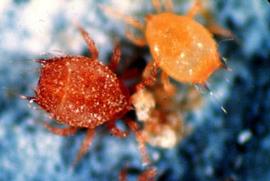
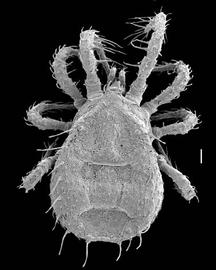
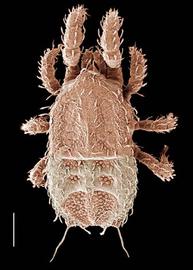
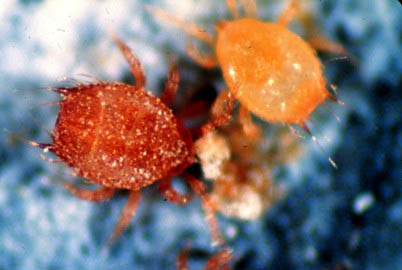
The Sejidae is the most diverse family in the Sejida with ~30 described species of Sejus and 16 of Epicroseius, as well as numerous undescribed species in both genera. Sejids are common litter inhabitants in moist forests in the subtropics and tropics, especially in association with rotting wood, but are much less common in the Holarctic Region. Species of Sejus and Epicroseius are predatory on small arthropods and nematodes and have been collected from decaying fungi on logs; wood mulch in gardens; litter around logs in rainforests and wet sclerophyll; and suspended soils in the canopy. The chelicerae have small, serrateserrate:
with closely set teeth that resemble the cutting edge of a saw.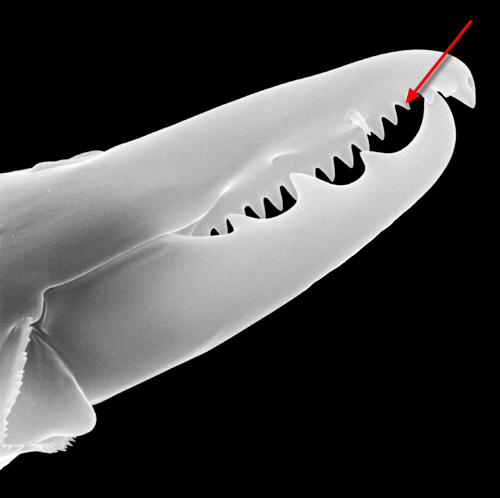 teeth and the anal opening is small. Only fluids of prey are ingested. Males use their chelicerae to transfer a flask-shaped spermatophorespermatophore:
any structure that carries a packet of sperm, including complex stalks deposited on substrate by male acariform mites and flask-like structures carried on the chelicerae of male mesostigmatans.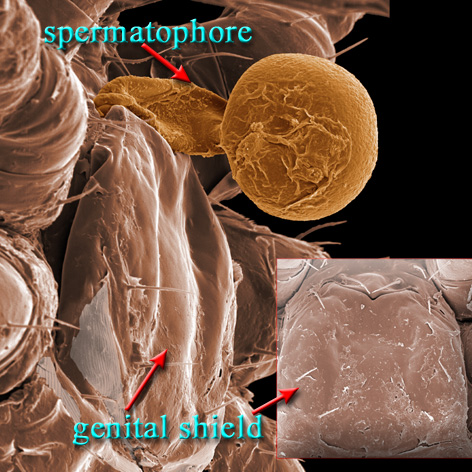 to the anterioranterior:
the front part of the body or towards that region in comparison, e.g., 'anterior to'.
cleft of the female’s genital shieldgenital shield:
a shield or shields covering the genital opening; in female mongynaspine Mesostigmata this shield is usually called the epigynal (epigynial) shield.
. One to four eggs are carried by gravid females. Deutonymphs of SejinaSejina:
older name for the suborder Sejida
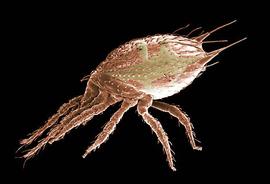
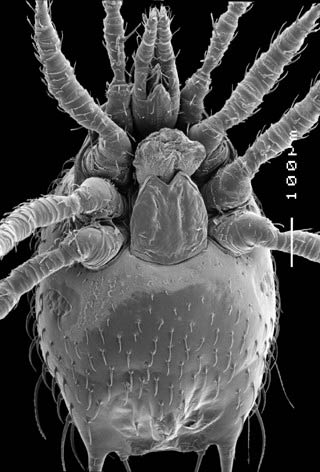
have been found as phoretics on beetles and flies and have a cylindrical extension of the anal opening that is used to attach to the carrier. Five species of Uropodella (Uropodellidae) have been described from the Americas and Africa, mostly associated with woody habitats. Species of Asternolaelaps (Ichthyostomatogasteridae), many undescribed, are known from Europe, North and South America, Australia and New Zealand. They have massive chelicerae and bifurcate corniculicorniculus:
(pl. corniculi) (also, external malae) a usually horn-like process (sometimes toothed, bifurcate, trifurcate, spine-like, spatulate, or membranous) on the subcapitulum of parasitiform mites that usually supports the salivary styli. A toothed corniculus could be confused with a rutellum, a possibly homologous structure in Acariformes and Opilioacarida. Phytoseiid image is spatulate corniculus. that are used to bite-off and swallow pieces of fungi and small mites, and enlarged anal openings for eliminating solid wastes.
Author: David E. Walter
Content last updated Sept. 2006, unless indicated otherwise
Lucid key player updated Sept. 2025
idtools.org