Mesostigmata
t
Taxonomy
updated 2025
Name
Dermanyssiae Evans and Till, 1979Evans and Till, 1979:
Evans EO and Till WM. 1979. Mesostigmatic mites of Britain and Ireland (Chelicerata: Acari-Parasitiformes): An introduction to their external morphology and classification. Transactions of the Zoological Society of London 35 (2): 145-270.
Children
Superfamilies: Veigaioidea, Rhodacaroidea, Eviphidoidea, Ascoidea, Phytoseioidea, Dermanyssoidea
Diagnostic characters
- Usually translucent or pale white due to little sclerotization
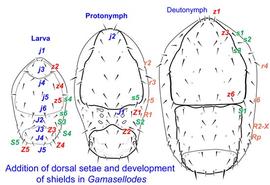
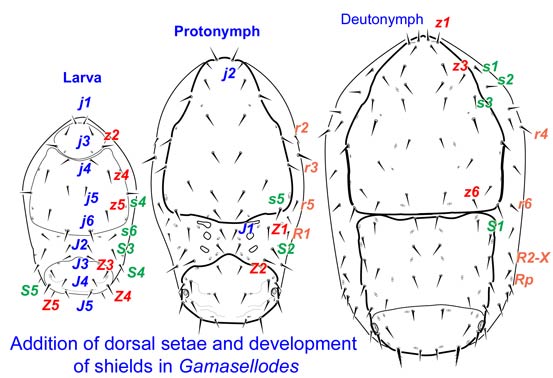
- In comparison to adults the dorsaldorsal:
relating to the upper or back side; opposed to ventral.
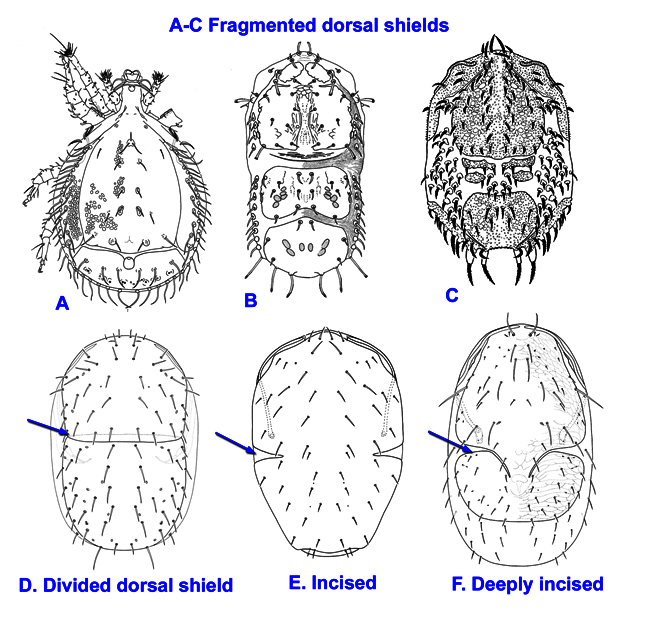
shields of the larvae and protonymphs are more fragmentedfragmented:
broken up, composed of several discrete parts rather than of a single unit.
 and the dorsaldorsal:
relating to the upper or back side; opposed to ventral.
and ventralventral:
relating to the lower or under side; opposed to dorsal.
setation is reduced (setaeseta:
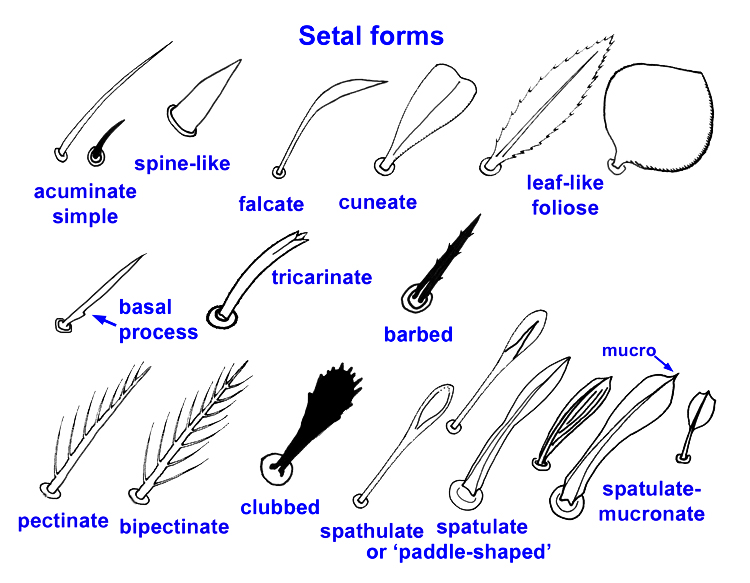
(pl. setae, from L. = bristle) cuticular process composed of a hollow shaft (sometimes filled with a refractive material) produced from a membranous socket (the alveolus); the hair-like, spine-like, branched or variously expanded structures on the surfaces of the legs and body. Most setae function as mechanoreceptors, but others (e.g., solenidia) are chemoreceptors or have unknown or ambiguous functions.
 are added at the protonymphal and at the deutonymphal molts)
- Deutonymphs have the full adult complement of setaeseta:
(pl. setae, from L. = bristle) cuticular process composed of a hollow shaft (sometimes filled with a refractive material) produced from a membranous socket (the alveolus); the hair-like, spine-like, branched or variously expanded structures on the surfaces of the legs and body. Most setae function as mechanoreceptors, but others (e.g., solenidia) are chemoreceptors or have unknown or ambiguous functions.
, but when adults have entireentire:
a shield or sclerite with a continuous margin without incisions.
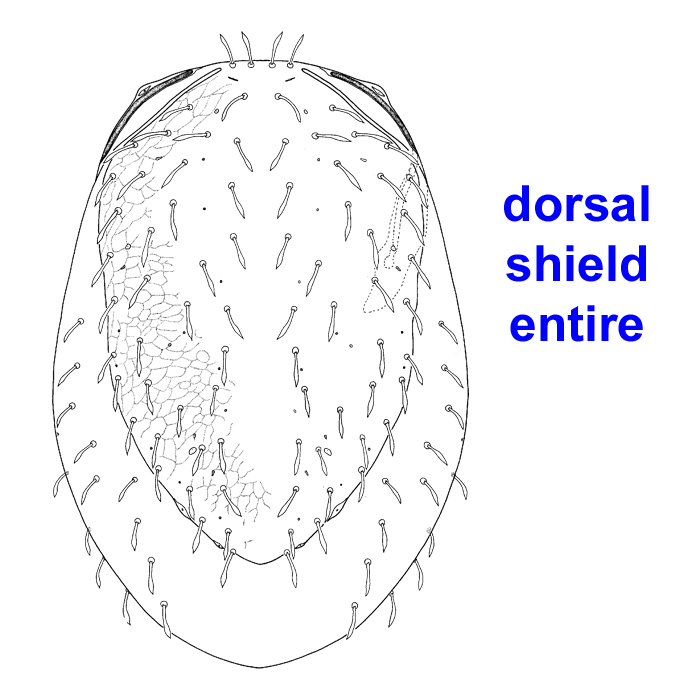 dorsal shields, the deutonymphs typically have divided or incised dorsaldorsal:
relating to the upper or back side; opposed to ventral.
shields
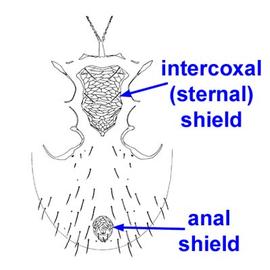
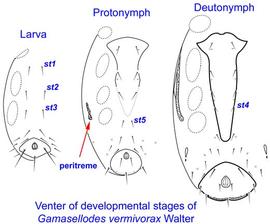
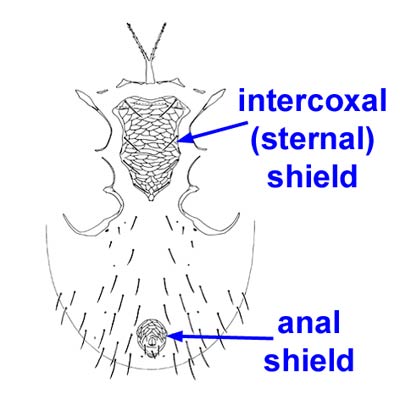
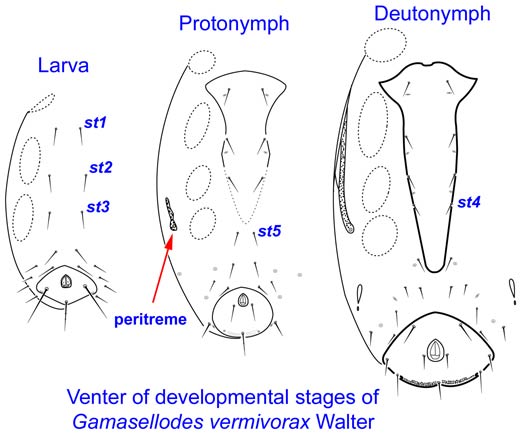
- The intercoxal shield is without valves in all immatures (the genital opening appears only at the adult molt), and the peritremeperitreme:
a groove or gutter on the surface connecting to a stigmatal opening. In Mesostigmata the peritremes are lateral and run above the coxae of the legs and usually run to near the anterior margin of the idiosoma, but they may be very short or vestigial. In Prostigmata peritremes are usually found on the anterior margin of the idiosoma, as short processes to either side of the capitulum (emergent peritremes), or as simple to complex lines or reticulations of short, connected chambers on the dorsal surface of the chelicerae or stylophore.
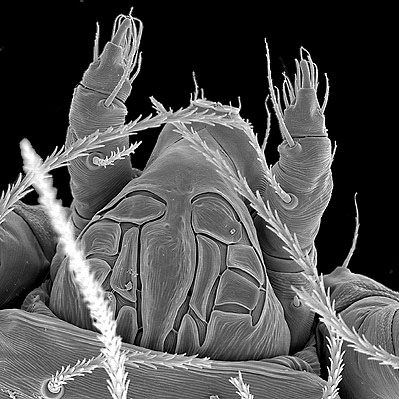 is reduced in the protonymphprotonymph:
the first nymphal stage or instar, usually octopod.
and absent in the larva
Similar taxa
Adult males always have a genital opening associated with the intercoxal area (except in the uropodid genus Metagynella where the opening is postcoxalpostcoxal:
posterior to the coxae.
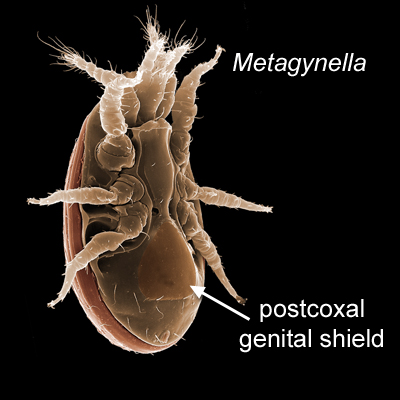 ).
).
Comments
In general, immature mites can only be identified if they can be associated with adult females. However, some of the bingo characters may work on immatures.
References
- Krantz 1986Krantz 1986:
Krantz GW. 1986. A manual of acarology [2nd ed., emended 1986]. Oregon State University Book Stores, Corvallis.