test
Sarcoptiformes Reuter, 1909
Superorder Acariformes » Order Sarcoptiformes
suborders: Endeostigmata, Oribatida
sarcoptiform mites, endeostigmatans, oribatids (including astigmatids)
high
High, but almost entirely because of the Astigmata, previously treated as the suborder Astigmata, but now recognized as a Hyporder in the Oribatida. Most endeostigmatans and oribatidsoribatidmites:
are a member of the sarcoptiform suborder Oribatida (=Cryptostigmata, Oribatei); some academics consider the use of 'oribatid' as a noun to be low class, but others consider that attitude pedantic.
are of little interest to quarantine since they are primarily soil/litter inhabitants that feed on fungi, other microbes, decaying organic matter and small invertebrates (e.g., nematodes, tardigrades, rotifers). Only a few sarcoptiform mites feed on living plant tissue and these are usually insignificant as pests. The Astigmata, however, includes important parasites of people, livestock, pets, wildlife and insects, as well as many fungivores and scavengers that are pests in stored products and homes.
Very small (0.15 mm long) to large (5 mm) mites without primary stigmatal openings or peritremes, sometimes with secondary respiratory systems (porose areas, brachytracheaebrachytracheae:
thick, elongated and porose tube-like invaginations in the cuticle of some oribatid mites.
); gnathosomagnathosoma:
(= capitulum) the anteriormost part of a mite or ricinuleid, composed of the cheliceral and pedipalpal segments and separated from the body (idiosoma) by a ring of soft cuticle.
exposed or withdrawn into camerostomecamerostome:
a recess under the rostral tectum that allows retraction of the chelicerae and palps of oribatid mites and that is sealed by the subcapitulum when retracted; a deep recess containing the gnathosoma in Uropodina.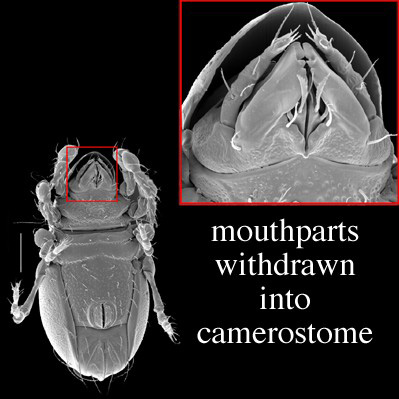 , cheliceralcheliceral:
of or pertaining to the chelicera.
bases not covered by sclerotized ring; palps with 1–5 free segments, without palp apotelepalptarsal apotele:
(= palp apotele, palptarsal claw) the most distal segment of the palp; absent in Acariformes, claw-like in Opilioacarida, and a subdistal, tined structure in the Mesostigmata.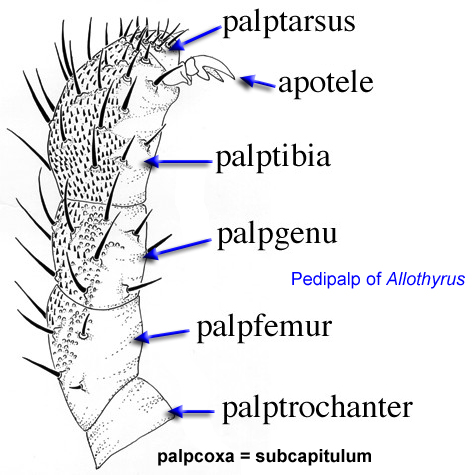 ; subcapitulumsubcapitulum:
(also infracapitulum) the venter of the capitulum; the ventral faces of the fused palpcoxae; apparently formed independently in the two superorders of mites.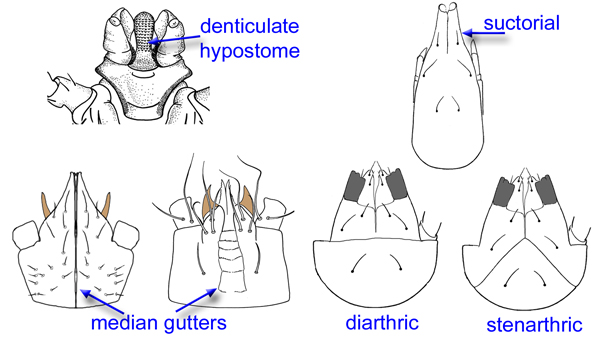 without median groove, rutellarutellum:
(pl. rutella) In Sarcoptiformes, the hypertrophied setae on the hypostome, often toothed; not to be confused with a corniculus (although possibly a homologue). In Astigmata, the rutellum may be referred to as a pseudorutellum, although it is the same structure. Various forms of rutella are recognized, including the atelebasic and pantelebasic.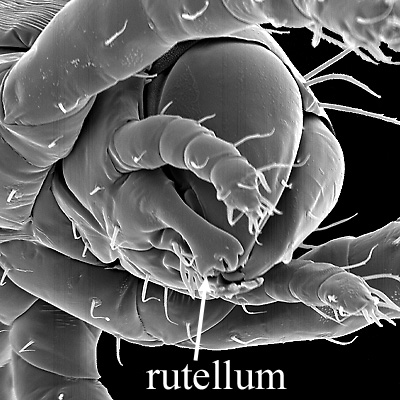 (pseudorutella) setiform, stalkedstalked:
raised up or otherwise produced on a stalk.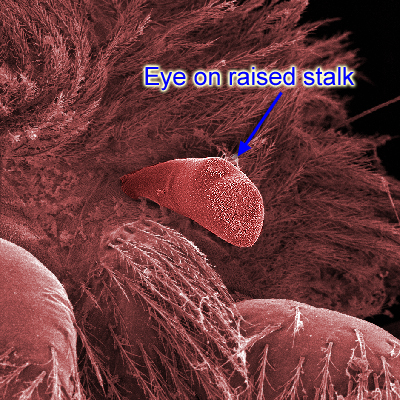 -dentate, to toothed, chisel-like or obscure (rarely lost); tritosternumtritosternum:
the sternum of the 3rd body segment (between legs I); produced as a biflagellate structure in Mesostigmata, although sometimes the flagellae (laciniae) are partially or completely fused. 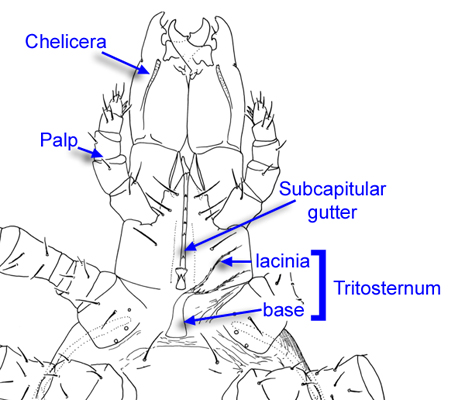 absent; coxae fused to bodybody:
the idiosoma of mites.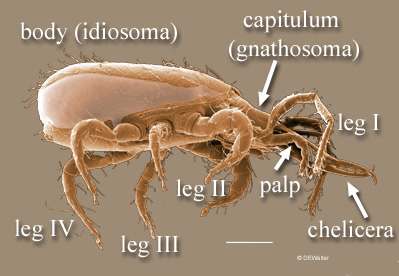 , forming epimeral fields or reduced to internal sclerotized elements (apodemes); chelicerae 2-segmented; with or without prodorsal trichobothriatrichobothrium:
(pl. trichobothria) (= bothridial sensillum) an often elaborately modified seta set in a cup-like base; forms include filiform, ciliate, pectinate or variously thickened or clubbed (bat-like to globose or capitate).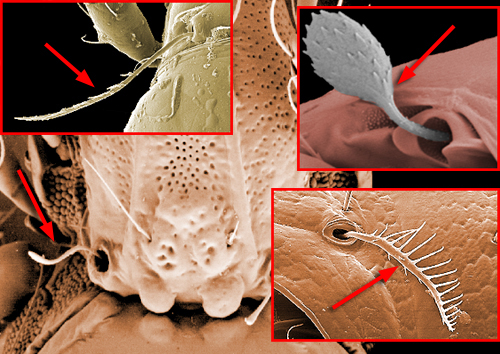 ; intercoxal region without sternal and genital shieldgenital shield:
a shield or shields covering the genital opening; in female mongynaspine Mesostigmata this shield is usually called the epigynal (epigynial) shield.
elements; development: +/- hexapod prelarvaprelarva:
(also deutovum, prolarva) the first instar in acariform mites having a complete ontogenetic sequence, but absent in derived Prostigmata and Parasitiformes (except Opilioacarida); incompletely formed, without functional mouthparts, often retained within the egg shell or just extruding from it, and usually inactive; hexapod or apodous.
, hexapodhexapod:
with three pairs of legs (i.e. 6 legs), as in the larvae of mites or the larviform stages of others.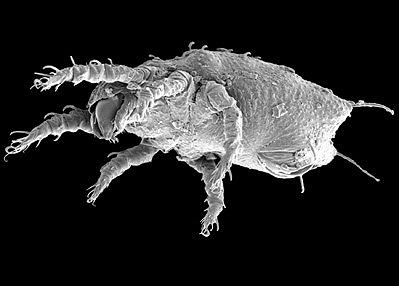 larva and 2–3 octopod nymphal stages (protonymphprotonymph:
the first nymphal stage or instar, usually octopod.
, +/- deutonymphdeutonymph:
(also deuteronymph) the second nymphal stage or instar.
, tritonymphtritonymph:
the third, and final, nymphal stage or instar present in Opilioacarida, Holothyrida, Argasidae, and many Acariformes.
); genital opening develops gradually with 1 pair of genital papillaegenital papillae:
1-3 pairs of extrusible finger-like to button-like projections, usually retracted into in the genital vestibule of acariform mites; sometimes formed as sessile disks around the genital opening; thought to be osmoregulatory structures; modified or multiplied and dispersed over the body in many freshwater mites. Genital papillae are absent in the larva, but may be added ontogenetically: protonymphs have one pair, deutonymphs two pairs, and tritonymphs (and adults) three pairs. The tritonymphal pair of papillae is often lost. The serially homologous Claparède's organ is usually present in the larvae (and prelarvae) of mites exhibiting genital papillae in nymphs and adults (Oudeman's Rule).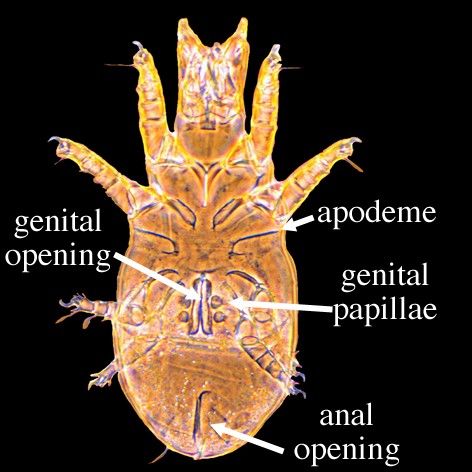 added in the protonymphprotonymph:
the first nymphal stage or instar, usually octopod.
, a second pair usually added in the deutonymphdeutonymph:
(also deuteronymph) the second nymphal stage or instar.
, and a third pair often added in the tritonymphtritonymph:
the third, and final, nymphal stage or instar present in Opilioacarida, Holothyrida, Argasidae, and many Acariformes.
; males with a spermatophoric organ or (Astigmata) an aedeagusaedeagus:
a male intromittent organ, especially when sclerotized (e.g., in Tetranycoidea, Raphignathoidea); a penis is a flexible, membranous intromittent organ, although 'penis' is often used for aedeagi (e.g., in Astigmata).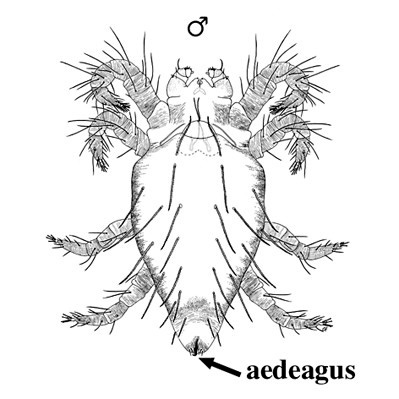 , chelicerae not modified for sperm transfer; female sperm receiving structure primary or secondary (Astigmata), with bursa copulatrixbursa copulatrix:
a secondary sperm system opening terminally in some Prostigmata and Astigmatina.
.
Uropodid mites (Mesostigmata: Monogynaspides) superficially resemble brachypylinebrachypyline:
having separate genital and anal plates surrounded by a large ventral plate (composed of aggenital and adanal elements); usage usually restricted to traditional oribatid mites (see macropyline).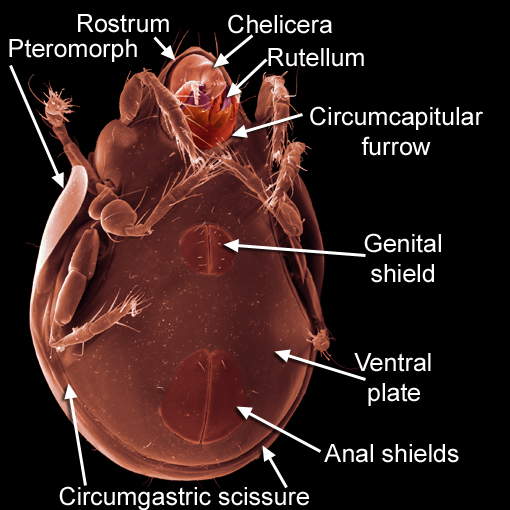 oribatid mites, but have tritosterna, intercoxal genital openings (except for Metagynella), lateral stigmata and peritremes. Heterostigmatina (Prostigmata: Eleutherengonides) have a gnathosomal capsulegnathosomal capsule:
a fusion of the gnathosomal elements (chelicerae and subcapitulum) into a single structure, as seen in protigmatans such as Heterostigmata, Myobiidae, and Cheyletoidea (also tegmen).
.
Sarcoptiformans are the dominant arthropods in soil/litter systems (including suspended soils, bogs, and cold and dry desserts). Most species feed on fungi, other microbes, decaying organic matter and small invertebrates (e.g., nematodes, tardigrades, rotifers). This is also true for most of those that inhabit vegetation and only a few species feed on health plant tissue. Astigmata are exceptional in that many species are pests of stored products or parasites of animals, and a few are predators of insects or graze on living plants.
Author: David E. Walter
Content last updated Sept. 2006, unless indicated otherwise
Lucid key player updated Sept. 2025
idtools.org