t
Alycidae Canestrini & Fanzago 1877
Pachygnathidae Kramer 1877, Bimichaeliidae Womersley 1944Womersley 1944:
Womersley H. 1944. Australian Acarina, families Alycidae and Nanorchestidae. Transactions of the Royal Society of South Australia 68: 133-143.
Superorder Acariformes » Order Sarcoptiformes » Suborder Endeostigmata » Infraorder Bimichaliida » Superfamily Alycoidea » Family Alycidae
Alycus Koch, 1841 (Alychus Canestrini & Fanzago, 1877: 168; also Alichus)
Type species: Alycus roseus CL Koch 1842 (=Pachygnathus dugesi Grandjean 1937)
Alycus occidentalis Womersley 1944—Australia; Alycus trichosus (Grandjean)—Europe; Alycus marinus (Schuster)—Europe; Alycus denasutus (Grandjean)—Europe.
Pachygnathus Dugês, 1836
Type species: Pachygnathus villosus Dugês [in Oken], 1836 (=P. ornithorhynchus Grandjean 1937)
Pachygnathus silvaticus de Alzuet & Delgado (selvaticus?)
Petralycus Grandjean, 1943Grandjean, 1943:
Grandjean F. 1943. Queques genres d’Acariens appartenant au groupe des Endeostigmata, 2e Série. Deuxiéme partie. Annales des Sciences Naturelles, Zoologie 11 (ser. 5): 1–59.: 1–59.
Type species: Petralycus unicornis Grandjean, 1943—Europe
Petralycus longicornis Theron, 1977—acacia soil in South Africa; Petralycus brevicornis Theron, 1977—pasture soil in South Africa; Petralycus caryapecaus McDaniel & Bolen; Petralycus celtisacinus McDaniel & Bolen
Bimichaelia Sig Thor, 1902, >17 spp.
Type species: Michaelia augustana Berlese 1884
Bimichaelia arbusculosa Grandjean; Bimichaelia augustana (Berlese 1884); Bimichaelia australica Womersley 1944Womersley 1944:
Womersley H. 1944. Australian Acarina, families Alycidae and Nanorchestidae. Transactions of the Royal Society of South Australia 68: 133–143.; Bimichaelia campylognatha Grandjean; Bimichaelia crassipalpis Halbert; Bimichaelia diadema Grandjean, 1939Grandjean, 1939:
Grandjean F. 1939. Quelques genres d’acariens appartenant au groupe des Endeostigmata. Annales des Sciences Naturelles, Zoologie 11 (ser. 2): 1–122.; Bimichaelia dimixsetosa McDaniel (Bimichaelia dimixsetosa texana); Bimichaelia disetosa McDaniel; Bimichaelia novazealandica Womersley; Bimichaelia pusilla Womersley 1944Womersley 1944:
Womersley H. 1944. Australian Acarina, families Alycidae and Nanorchestidae. Transactions of the Royal Society of South Australia 68: 133–143.; Bimichaelia ramosa Mihelčič; Bimichaelia rectangula Willman; Bimichaelia reticulata Shiba; Bimichaelia sarekensis (Trägårdh) Europe; Bimichaelia setigera (Berlese); Bimichaelia stellaris Womersley 1944Womersley 1944:
Womersley H. 1944. Australian Acarina, families Alycidae and Nanorchestidae. Transactions of the Royal Society of South Australia 68: 133–143.; Bimichaelia subnuda (Berlese)
Amphialycus penophthalmus Zachvatkin, 1949 Ukraine; A. leucogaster (Grandjean) Europe.
Orthacarus tremli Zachvatkin, 1949; O. oblongus (Halbert, 1920Halbert, 1920:
Halbert JN. 1920. The Acarina of the seashore. Proceedings of the Royal Irish Academy (Section B) 35 (7): 106–152.) Ireland.
Coccalicus clavatus Willmann 1952
Protacarus crani Hirst—Rhynie Chert fossil beds, Devonian
Prodorsumprodorsum:
the dorsal surface of the propodosoma.
with 2 pairs of trichobothriatrichobothrium:
(pl. trichobothria) (= bothridial sensillum) an often elaborately modified seta set in a cup-like base; forms include filiform, ciliate, pectinate or variously thickened or clubbed (bat-like to globose or capitate).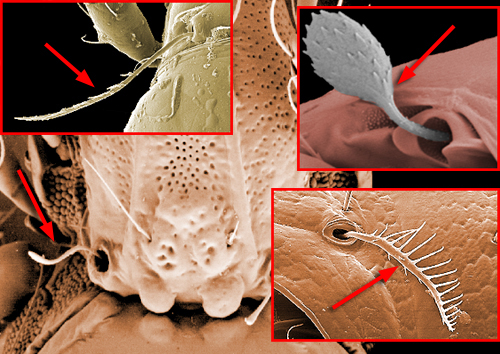 (sci, ve) and 2–4 pairs of setaeseta:
(pl. setae, from L. = bristle) cuticular process composed of a hollow shaft (sometimes filled with a refractive material) produced from a membranous socket (the alveolus); the hair-like, spine-like, branched or variously expanded structures on the surfaces of the legs and body. Most setae function as mechanoreceptors, but others (e.g., solenidia) are chemoreceptors or have unknown or ambiguous functions.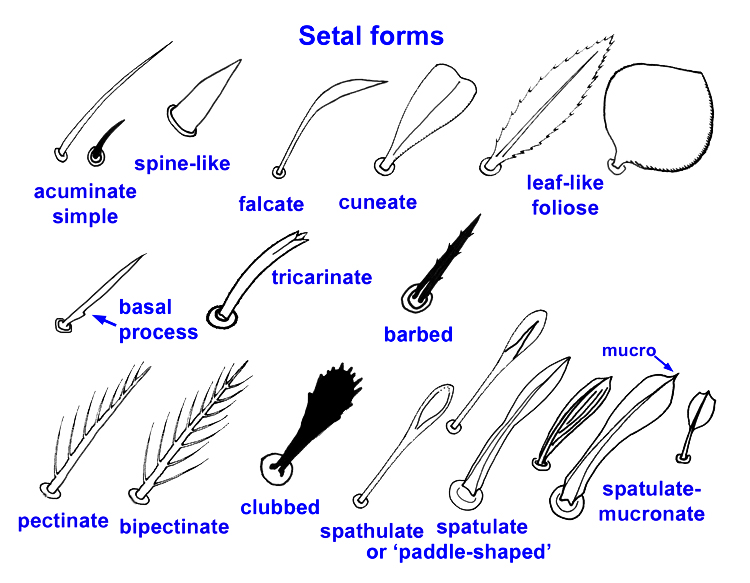 (in and/or exp may be absent); sci and ve either filiformfiliform:
thread-like; long and narrow.
or capitatecapitate:
with a terminal knob or head-like swelling; clavate; globose.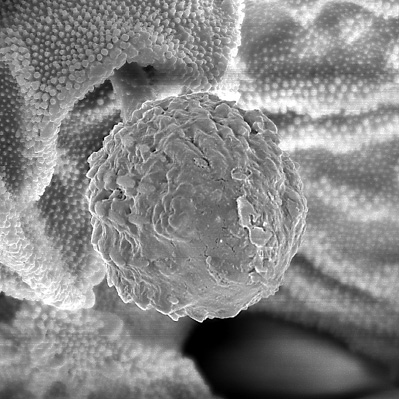 ; naso nude, reduced; lateral and median eyes present or absent. Rutellarutellum:
(pl. rutella) In Sarcoptiformes, the hypertrophied setae on the hypostome, often toothed; not to be confused with a corniculus (although possibly a homologue). In Astigmata, the rutellum may be referred to as a pseudorutellum, although it is the same structure. Various forms of rutella are recognized, including the atelebasic and pantelebasic.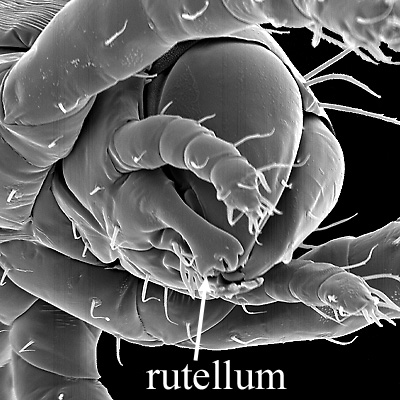 present or absent; chelicerae chelate-dentatechelate-dentate:
pincer-like chelicerae with teeth.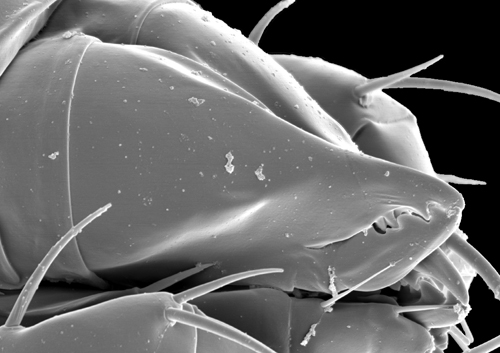 to attenuate-edentate, each with 0–2 setaeseta:
(pl. setae, from L. = bristle) cuticular process composed of a hollow shaft (sometimes filled with a refractive material) produced from a membranous socket (the alveolus); the hair-like, spine-like, branched or variously expanded structures on the surfaces of the legs and body. Most setae function as mechanoreceptors, but others (e.g., solenidia) are chemoreceptors or have unknown or ambiguous functions.. Opisthosomaopisthosoma:
(= abdomen) the posterior body division in arachnids; usually not distinct in mites because of the fusion of the opisthosoma with part of the prosoma to form the idiosoma.
usually hypertrichous; 3 pairs of genital papillaegenital papillae:
1-3 pairs of extrusible finger-like to button-like projections, usually retracted into in the genital vestibule of acariform mites; sometimes formed as sessile disks around the genital opening; thought to be osmoregulatory structures; modified or multiplied and dispersed over the body in many freshwater mites. Genital papillae are absent in the larva, but may be added ontogenetically: protonymphs have one pair, deutonymphs two pairs, and tritonymphs (and adults) three pairs. The tritonymphal pair of papillae is often lost. The serially homologous Claparède's organ is usually present in the larvae (and prelarvae) of mites exhibiting genital papillae in nymphs and adults (Oudeman's Rule).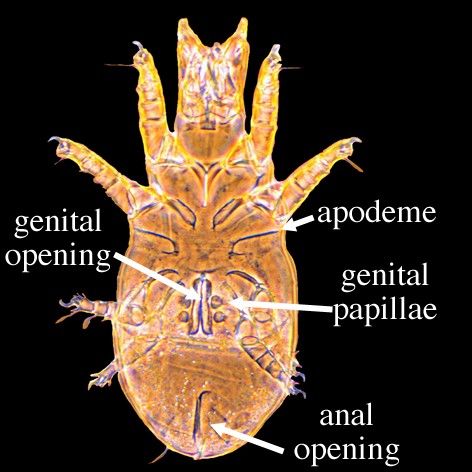 . Leg IV not modified for jumping.
This is the most difficult family of Endeostigmata to diagnose because of the remarkable variation in characters and it may not be a natural group. A fossil species is known from the Devonian Rhynie Chert and many extant species appear to be among the most plesiotypic Endeostigmata known. Some species of Alycus feed on nematodes (Walter 1988cWalter 1988c:
Walter DE. 1988c. Predation and mycophagy by endeostigmatid mites (Acariformes: Prostigmata). Experimental and Applied Acarology 4: 159-166.), which usually do not form visible gut contents, but others have gut boluses with fungal material. An unidentified species of 'Pachygnathus' from the intertidal is reported to have gut boluses with the cuticle of copepods and tardigrades (Schuster 1979Schuster 1979:
Schuster R. 1979. Soil mites in the marine environment. pp. 593-602. In: Rodríguez JG, ed. Recent advances in Acarology, Volume 1. Academic Press, New York.). Although probably the most commonly encountered genus of Endeostigmata in forest litter, and certainly the largest in bodybody:
the idiosoma of mites.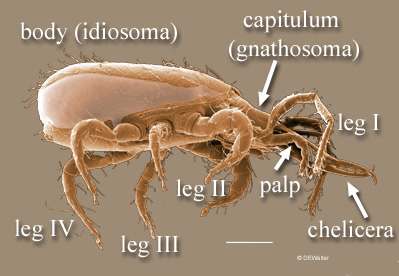 size, the feeding biology of Bimichaelia is unknown. These mites have elongate, needle-like chelicerae and, although an occasional specimen with a fungal spore impaled on the tips of the chelicerae has been found, no one has reported any feeding observations. Theron speculated that species of Bimichaelia might suck juices from plant roots (Theron 1979Theron 1979:
Theron PD. 1979. The functional morphology of the gnathosoma of some liquid and solid feeders in the Trombidiformes, Cryptostigmata and Astigmata (Acarina). pp. 575-579. In: Piffl E, ed. Proceedings of the 4th International Congress of Acarology. Akadémiai Kiadó, Budapest.), and Lindquist expanded on the possible evolution of phytophagy in the Bimichaeliidae and the similarity of their mouthparts to those in Eriophyoidea (Lindquist 1998Lindquist 1998:
Lindquist EE. 1998. Evolution of phytophagy in trombidiform mites. Experimental and Applied Acarology 22: 81-100.). Although an intriguing idea, perhaps feeding on ectomycorrhizae is more likely.
Author: David E. Walter
Content last updated Sept. 2006, unless indicated otherwise
Lucid key player updated Sept. 2025
idtools.org