Phytoseiulus
t
Taxonomy
Name
Phytoseiulus persimilis Athias-Henriot
Synonyms
P. riegli Dosse, Amblyseius tardi Lombardin
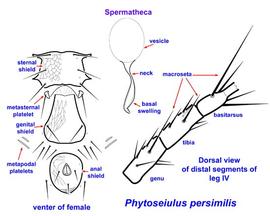
Diagnostic characters of adult female
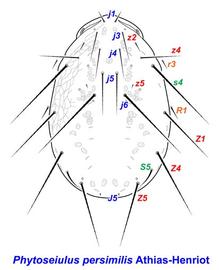
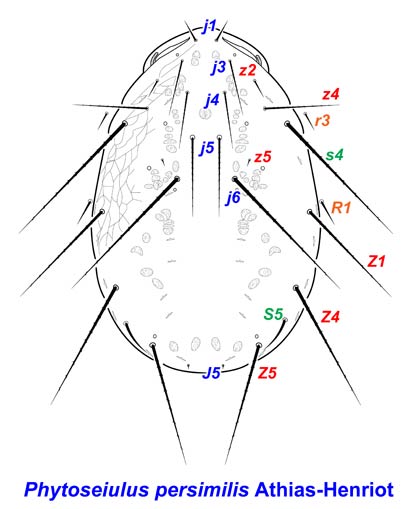
- Dorsal shield ca. 0.315–0.330 mm long
- Dorsaldorsal:
relating to the upper or back side; opposed to ventral.
shield setae j5 and S5 both present, j5 barbed and reaching insertion of j6; j6 barbed and as long or longer than Z1; R1 and r3 simplesimple:
unadorned; simple setae are needle-like and without hairs or pectins.
, similar in length.
- Peritrematalperitrematal:
(peritrematic) of or referring to the peritreme; adjectival form of peritreme.
shield fused to dorsaldorsal:
relating to the upper or back side; opposed to ventral.
shield anteriorly
- Fixed digitfixed digit:
the distal extension of the middle article of the chelicera; usually bearing teeth and a distal hook and opposed to the movable digit in chelate-dentate forms, but often regressed; in Mesostigmata the fixed digit may bear the pilus dentilis.
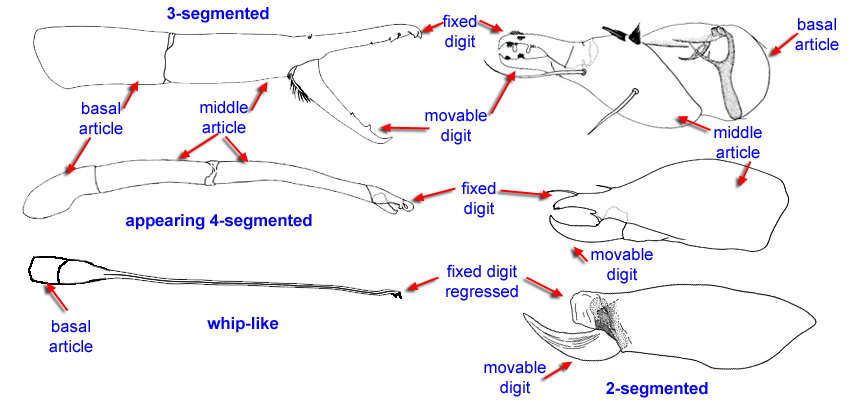 of chelicerachelicera:
a limb on the presumed first body segment in chelicerate arthropods, the primary mouthparts. In mites the chelicerae are primitively chelate-dentate, but may be modified into almost unrecognizable forms. In Acariformes, the chelicerae are usually 2-segmented, but in other mites and some basal acariforms they have three segments. Rarely, in some Uropodoidea (Mesostigmata), a subdivision makes them appear 4-segmented.
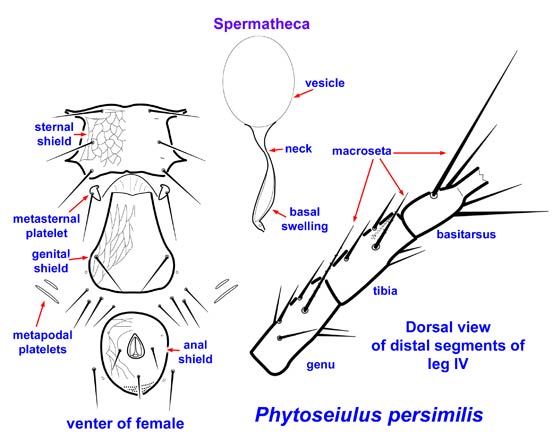
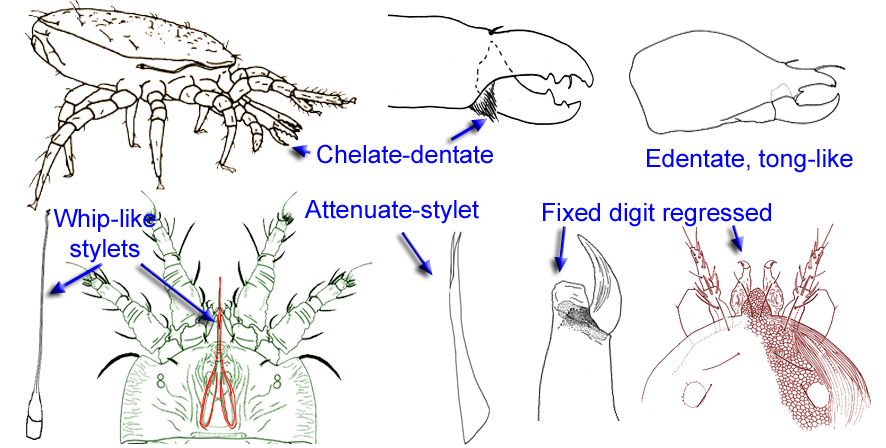 elongate and with row of 7–8 teeth
- Calyxcalyx:
(= cervix) in phytoseioid Mesostigmata (Phytoseiidae, Blattisociidae, Otopheidomenidae, Podocinidae), a collar-like structure of the sperm access system which surrounds the base of the vesicle.
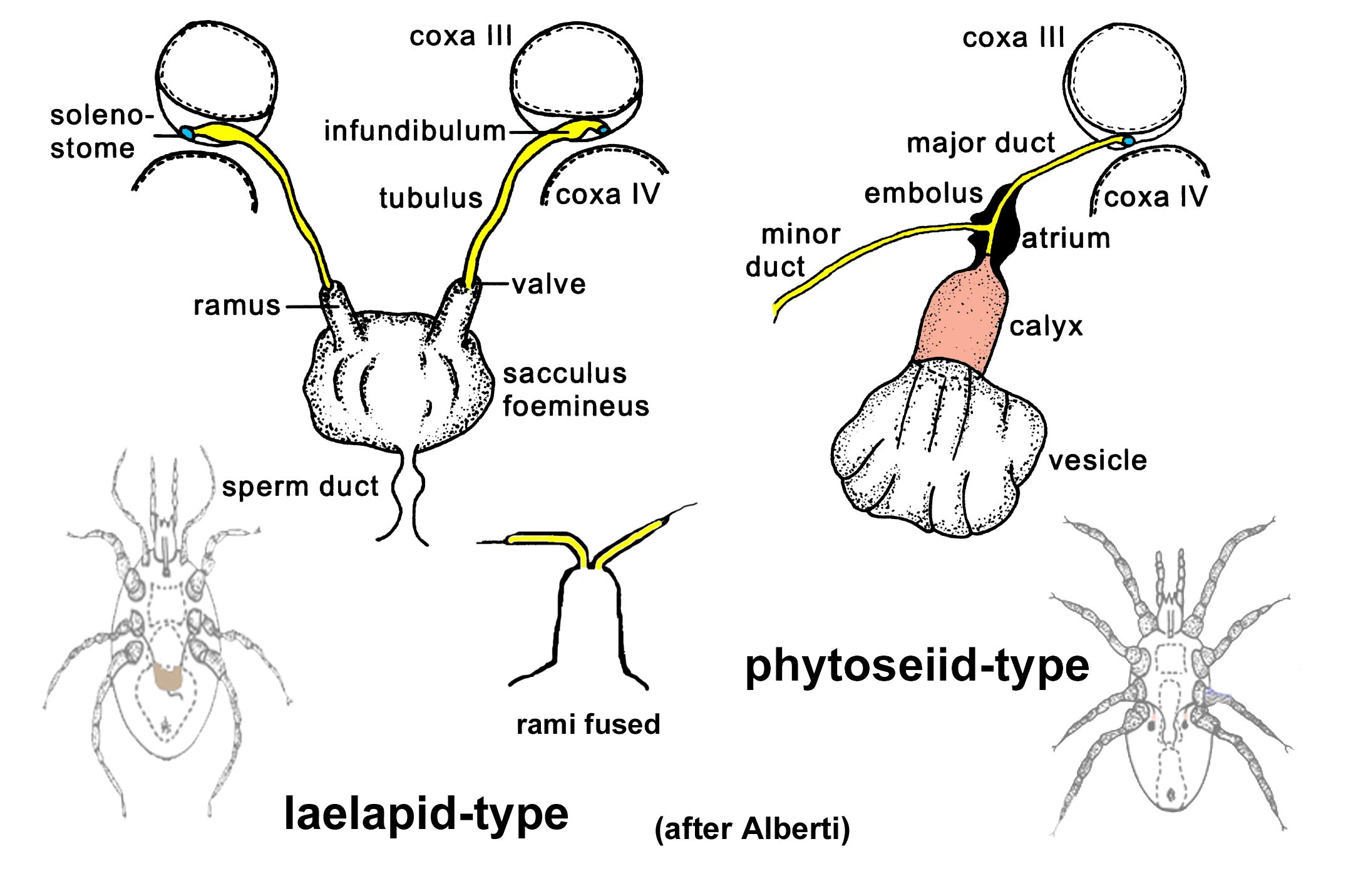 of spermathecaspermatheca:
a structure in the female for storing sperm, typically sac-like.
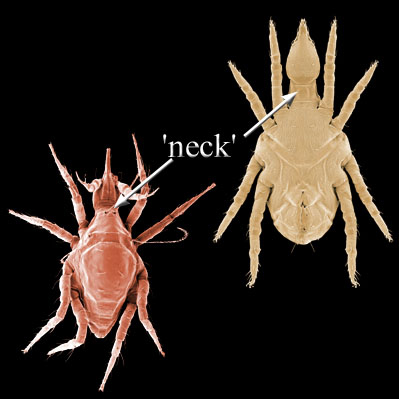
vase-shaped with neckneck:
(neck-like) a narrow constricted region joining the capitulum to the idiosoma.
- Sternal shieldsternal shield:
a shield in the anterior intercoxal region of parasitiform mites that bears one or more pairs of sternal setae.
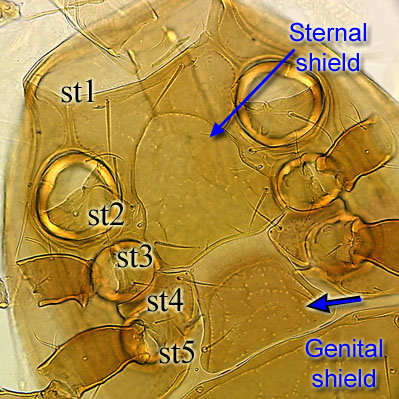 with 3 pairs of setae; st4 on small platelets.
- Anal opening on ianal shield with 3 setae; setae JV2 in the soft cuticle
- Ventralventral:
relating to the lower or under side; opposed to dorsal.
setae JV4 absent
- Genugenu:
(pl. genua) (= patella) the 4th leg segment, between the femur and tibia.
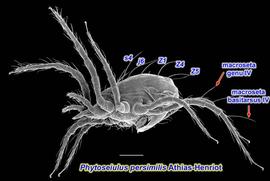
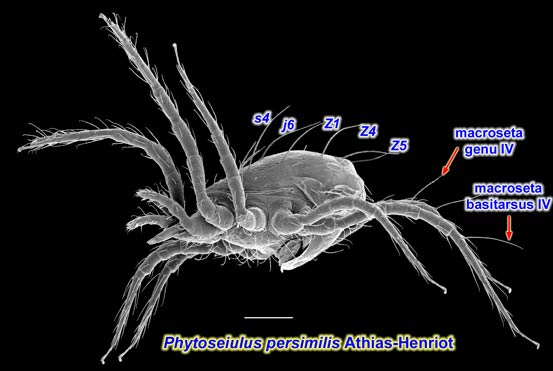
IV with barbed macroseta (ca. 0.085 mm long); macroseta on basitarsusbasitarsus:
a basal subdivision of the tarsus.
IV simplesimple:
unadorned; simple setae are needle-like and without hairs or pectins.
(ca. 0.125 mm long)
Similar species
Phytoseiulus longipes has a
sternal shieldsternal shield:
a shield in the anterior intercoxal region of parasitiform mites that bears one or more pairs of sternal setae.
with only 2 pairs of
setaeseta:
(pl. setae, from L. = bristle) cuticular process composed of a hollow shaft (sometimes filled with a refractive material) produced from a membranous socket (the alveolus); the hair-like, spine-like, branched or variously expanded structures on the surfaces of the legs and body. Most setae function as mechanoreceptors, but others (e.g., solenidia) are chemoreceptors or have unknown or ambiguous functions.
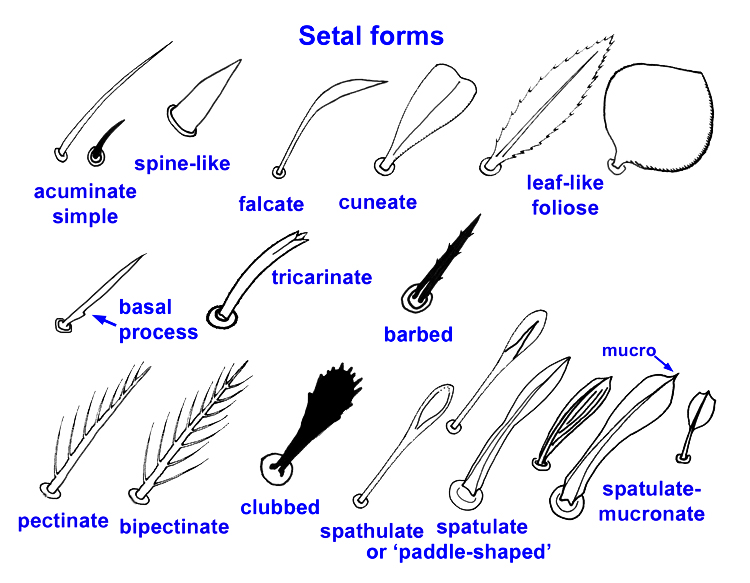
(
st1–
2) and lacks
dorsaldorsal:
relating to the upper or back side; opposed to ventral.
shield
setaeseta:
(pl. setae, from L. = bristle) cuticular process composed of a hollow shaft (sometimes filled with a refractive material) produced from a membranous socket (the alveolus); the hair-like, spine-like, branched or variously expanded structures on the surfaces of the legs and body. Most setae function as mechanoreceptors, but others (e.g., solenidia) are chemoreceptors or have unknown or ambiguous functions.
j5 and
S5.
Phytoseiulus fragariae has simple
setaeseta:
(pl. setae, from L. = bristle) cuticular process composed of a hollow shaft (sometimes filled with a refractive material) produced from a membranous socket (the alveolus); the hair-like, spine-like, branched or variously expanded structures on the surfaces of the legs and body. Most setae function as mechanoreceptors, but others (e.g., solenidia) are chemoreceptors or have unknown or ambiguous functions.
j6 shorter than
Z1 and
setaeseta:
(pl. setae, from L. = bristle) cuticular process composed of a hollow shaft (sometimes filled with a refractive material) produced from a membranous socket (the alveolus); the hair-like, spine-like, branched or variously expanded structures on the surfaces of the legs and body. Most setae function as mechanoreceptors, but others (e.g., solenidia) are chemoreceptors or have unknown or ambiguous functions.
JV4 present laterad the
ventrianal shieldventrianal shield:
in Mesostigmata, a ventral shield bearing the anal opening, circum anal setae, and one or more pairs of ventral setae or pores (lyrifissures) [see anal shield]; maybe rather narrow or very broad and covering most of the gaster.
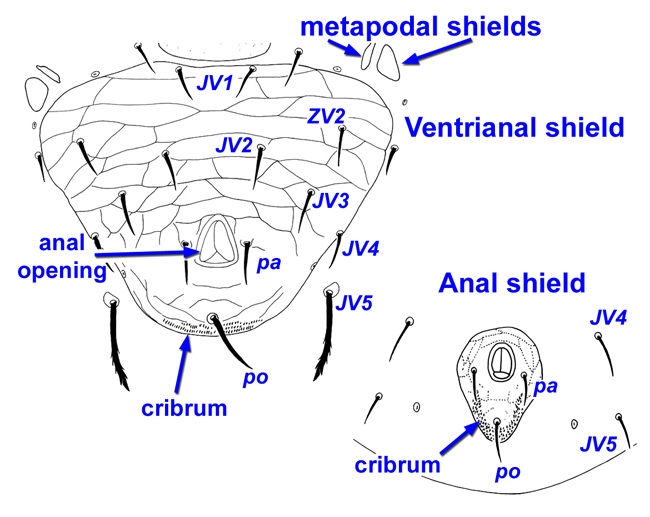
.
Phytoseiulus macropilis usually has a
ventrianal shieldventrianal shield:
in Mesostigmata, a ventral shield bearing the anal opening, circum anal setae, and one or more pairs of ventral setae or pores (lyrifissures) [see anal shield]; maybe rather narrow or very broad and covering most of the gaster.
with 4–5
setaeseta:
(pl. setae, from L. = bristle) cuticular process composed of a hollow shaft (sometimes filled with a refractive material) produced from a membranous socket (the alveolus); the hair-like, spine-like, branched or variously expanded structures on the surfaces of the legs and body. Most setae function as mechanoreceptors, but others (e.g., solenidia) are chemoreceptors or have unknown or ambiguous functions.
(rarely an
anal shieldanal shield:
in Mesostigmata, a ventral shield bearing the anal opening and circumanal setae (po, pa), but without any ventral setae or pores (lyrifissures) [see ventrianal shield].
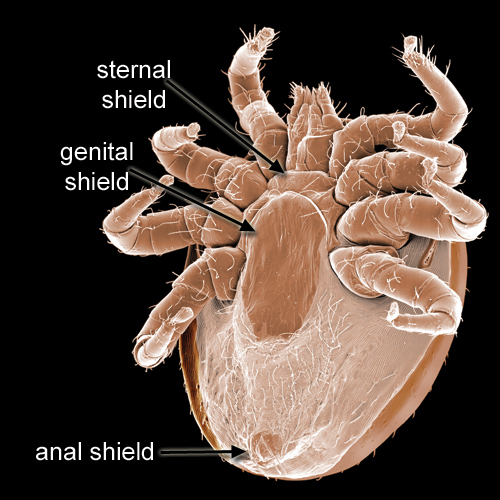
with 3
setaeseta:
(pl. setae, from L. = bristle) cuticular process composed of a hollow shaft (sometimes filled with a refractive material) produced from a membranous socket (the alveolus); the hair-like, spine-like, branched or variously expanded structures on the surfaces of the legs and body. Most setae function as mechanoreceptors, but others (e.g., solenidia) are chemoreceptors or have unknown or ambiguous functions.
) and a barbed macroseta on
basitarsusbasitarsus:
a basal subdivision of the tarsus.
IV.
Ecology and distribution
Phytoseiulus persimilis is perhaps the most successful and widely distributed biological control agent of the two-spotted spider mite
Tetranychus urticae and of other spider mites that form dense webbing.
References
- Athias-Henriot 1957Athias-Henriot 1957:
Athias-Henriot C. 1957. Phytoseiidae et Aceosejidae (Acarina: Gamasina) d'Algérie. I. Genres Blattisocius Keegan, Iphoseius Berlese, Amblyseius Berlese, Phytoseius Ribaga, Phytoseiulus Evans. Bulletin de la Société d'Histoire Naturelle de l'Afrique du Nord 48: 319–352.
- Schicha 1987Schicha 1987:
Schicha E. 1987. Phytoseiidae of Australia and neighbouring areas. Indira Publishing House, Oak Park, Michigan.
- Schuster and Pritchard 1963Schuster and Pritchard 1963:
Schuster RO and Pritchard EA. 1963. Phytoseiid mites of California. Hilgardia 43 (7): 191-285.
- Takahashi and Chant 1993Takahashi and Chant 1993:
Takahashi F and Chant DA. 1993. Phylogenetic relationships in the genus Phytoseiulus Evans (Acari: Phytoseiidae). II. Taxonomic Review. International Journal of Acarology 19: 23-37.
- Tseng 1976Tseng 1976:
Tseng YH. 1976. Systematics of the mite family Phytoseiidae from Taiwan, with a revised key to the genera of the world (II). Journal of the Agricultural Association of China 94: 86-128.
- Walter et al. 1998Walter et al. 1998:
Walter DE, Azam G, Waite G, and Hargreaves J. 1998. Risk assessment of an exotic biocontrol agent: Phytoseiulus persimilis (Acari: Phytoseiidae) does not establish in rainforest in south-east Queensland. Australian Journal of Ecology 23: 587-592.