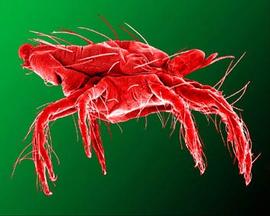
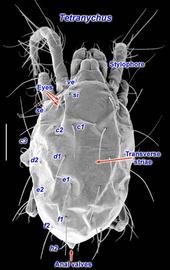
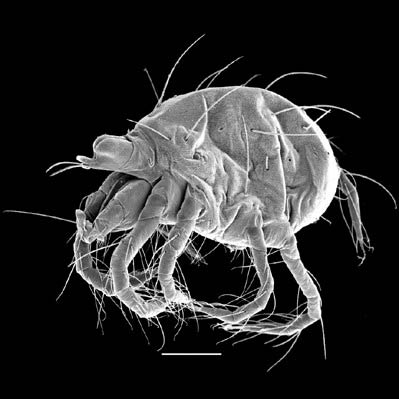
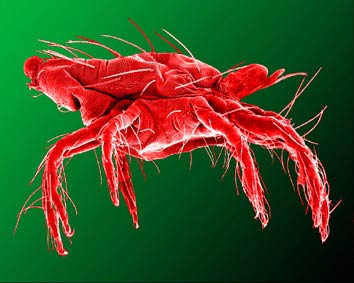
Tetranychinae
t
Taxonomy
Classification
updated 2025
Superorder Acariformes » Order Trombidiformes » Suborder Prostigmata » Infraorder EleutherengonaEleutherengona:
(also Eleutherengonida, Eleutherengonina, Eleutherengonides) an infraorderwithin the Prostigmata consisting of the two hyporders Raphignathina and Heterostigmata. Eleutherengona includes many of the most important plant-parasitic mites, e.g., spider mites, broad mite, cyclamen mite.
» Hyporder Raphignathina » Superfamily Tetranychoidea » Family Tetranychidae » Subfamily Tetranychinae » Tribe Tetranychini » Genus Tetranychus
Common names
two-spotted mite, fourspotted mite, carmine spider mitespider mite:
a member of the family Tetranychidae (Prostigmata).
, red bean spider mitespider mite:
a member of the family Tetranychidae (Prostigmata).
, desert spider mitespider mite:
a member of the family Tetranychidae (Prostigmata).
, McDaniel spider mitespider mite:
a member of the family Tetranychidae (Prostigmata).
, Pacific spider mitespider mite:
a member of the family Tetranychidae (Prostigmata).
, Schoene spider mitespider mite:
a member of the family Tetranychidae (Prostigmata).
, strawberry spider mitespider mite:
a member of the family Tetranychidae (Prostigmata).
, tumid spider mitespider mite:
a member of the family Tetranychidae (Prostigmata).
Probability of encounter
very high
Quarantine importance
Very high. Tetranychus is probably the most economically important genus of mites, with member of the two-spotted mite complex, such as T. urticae (Koch) and T. cinnabarinus (Boisduval), attacking an extraordinary diversity of economically important plants throughout the world. About 140 species of Tetranychus have been described and distributed across a variety of subgenera. Species identifications invariably require a good lateral mount of the male aedeagusaedeagus:
a male intromittent organ, especially when sclerotized (e.g., in Tetranycoidea, Raphignathoidea); a penis is a flexible, membranous intromittent organ, although 'penis' is often used for aedeagi (e.g., in Astigmata).
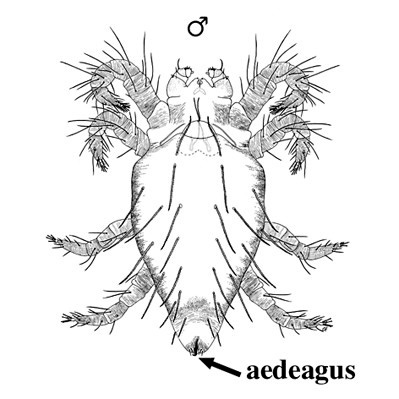 , and even then only a specialist with extensive experience is likely to feel confident of the identification. Exotic species that are a potential threat to US agriculture include:
- Tetranychus lombardinii Baker & Pritchard attacks banana, beans, cassava, cotton, cucumber, melons, papaya, passion fruit, potato, soybean, castor bean, sweet potato, tomato, tobacco, alfalfa, sorghum and a variety of other plants in Asia, Africa, Indonesia, and Australia.
- Tetranychus macfarlanei Baker & Pritchard attacks bananas, beans, cotton, cucumber, eggplant, melons, okra, papaya, peanut, watermelon, and ornamentals in India, Madagascar, Mauritius, and the Canary Islands.
- Tetranychus lambi Pritchard & BakerPritchard & Baker:
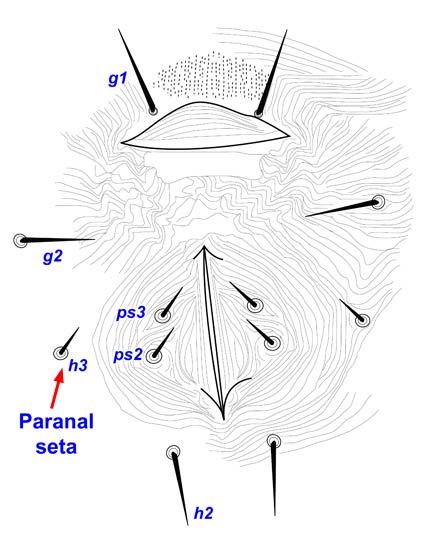
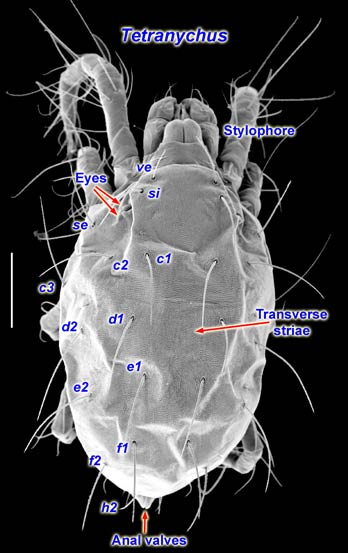
A system of setal designations of spider mites in Pritchard & Baker 1955 (A revision of the spider mite family Tetranychidae. Mem. Pac. Coast Entomol. Soc. 2: 1-472.). Dorsocentrals: D1 = c1; D2 = d1; D3 = e1; D4 = f1; D5 = h1; Dorsolaterals: L1 = c2; L2 = d2; L3 = e2; L4 = f2; Sublaterals: 1st sublaterals = c3; 2nd sublaterals = d3; 3rd sublaterals = e3; Humerals: H = c3; also Inner sacrals (or DC4) = f1; Outer sacrals (or L4) = f2; Clunals (or DC5) = h1 or f3; Postanals (or posterior para-anals) = h2; Anterior para-anals = h3; Anals = ps1-3; 1st genitals (or anteromedial genitals) = g1; 2nd genitals (or posterolateral genitals)= g2; Pregenitals = ag in the Grandjean system.
attacks banana, cassava, beans, clover, cotton, cucumber, eggplant, fruit trees, okra, peanut, soybean, squash, tobacco, grasses and ornamentals in Iran, Asia, and most Pacific islands including Australia and New Zealand.
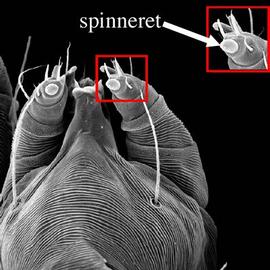
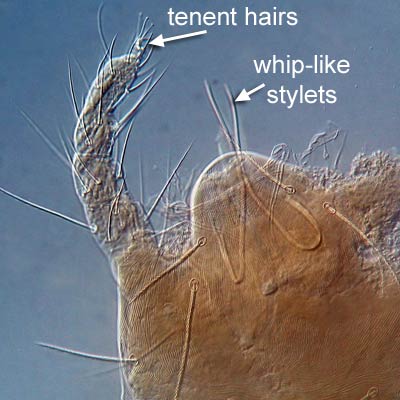
- Tetranychus fijiensis Hirst (the only species known with only 2 pairs of proximoventral hairsproximoventral hairs:
the hair-like processes on the empodia of some spider mites; apparently represents a finely divided empodium, and not tenent hairs.
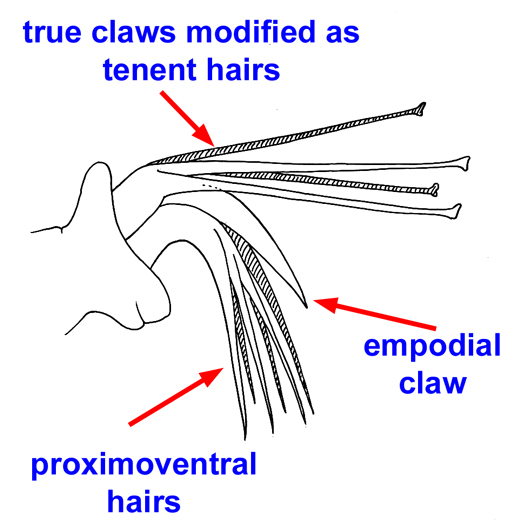 ) attacks citrus and other fruit trees and ornamentals in India, Southeast Asia, and many Pacific islands, including Australia.
- Tetranychus piercei McGergor is a pest of banana, beans, cassava, eggplant, mulberry, papaya, passion fruit, peach, sweet potato, and a diversity of ornamentals primarily in Asia and has recently been found in the US.
- Tetranychus truncatus Ehara attacks banana, cassava, beans, maize, cucumber, eggplant, fruit trees, okra, onions, orchids, rice, soybean, sweet potato, and a variety of ornamentals in Asia and on Pacific islands.
- Tetranychus amicus Meyer & Rodrigues attacks banana, cassava, beans, cotton, eggplant, peanut, soybean, sweet potato and ornamentals in South Africa and on Indian Ocean islands.
Diagnosis
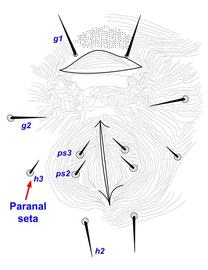
- With 1 pair of paranal setae (h3); setaeseta:
(pl. setae, from L. = bristle) cuticular process composed of a hollow shaft (sometimes filled with a refractive material) produced from a membranous socket (the alveolus); the hair-like, spine-like, branched or variously expanded structures on the surfaces of the legs and body. Most setae function as mechanoreceptors, but others (e.g., solenidia) are chemoreceptors or have unknown or ambiguous functions.
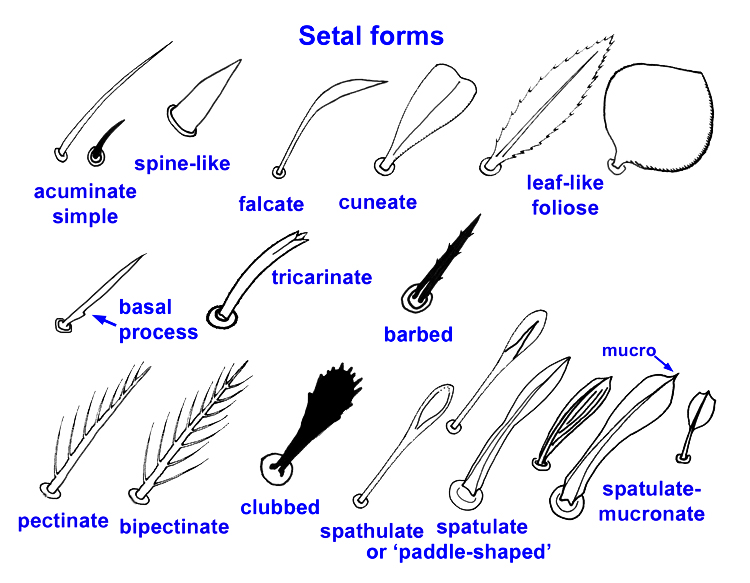 h2 terminal, not in paranal position; setaseta:
(pl. setae, from L. = bristle) cuticular process composed of a hollow shaft (sometimes filled with a refractive material) produced from a membranous socket (the alveolus); the hair-like, spine-like, branched or variously expanded structures on the surfaces of the legs and body. Most setae function as mechanoreceptors, but others (e.g., solenidia) are chemoreceptors or have unknown or ambiguous functions.
h1 absent.
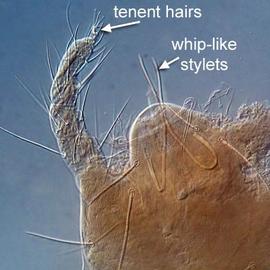
- Empodiumempodium:
(pl. empodia) an unpaired structure arising between the tarsal claws, ranging from pad-like to claw-like and often bearing structures such as tenent hairs, dense setulae, or taking the form of a featherclaw (Eriophyoidea)..
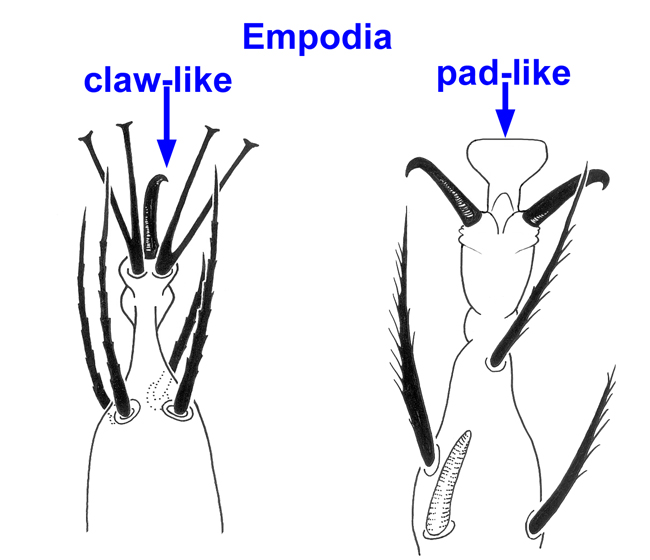 split into 2–3 pairs of proximoventral hairsproximoventral hairs:
the hair-like processes on the empodia of some spider mites; apparently represents a finely divided empodium, and not tenent hairs.
- Mediodorsal empodial spurspur:
a projection, usually tooth- or spine-like, from the body or limbs.
generally present, sometimes well developed
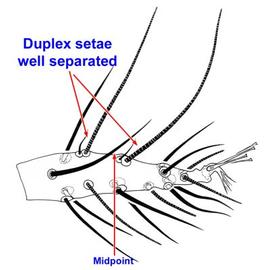
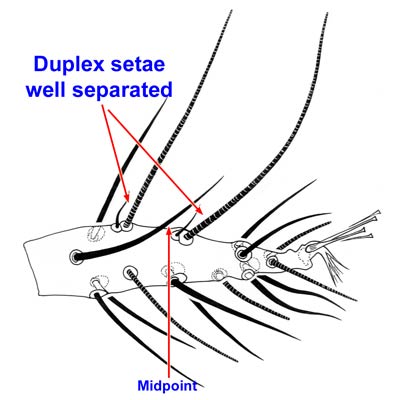
- Duplex setaeseta:
(pl. setae, from L. = bristle) cuticular process composed of a hollow shaft (sometimes filled with a refractive material) produced from a membranous socket (the alveolus); the hair-like, spine-like, branched or variously expanded structures on the surfaces of the legs and body. Most setae function as mechanoreceptors, but others (e.g., solenidia) are chemoreceptors or have unknown or ambiguous functions.
of tarsustarsus:
(pl. tarsi) the subdistal leg segment between the tibia and the pretarsus (apotele).
I well separated
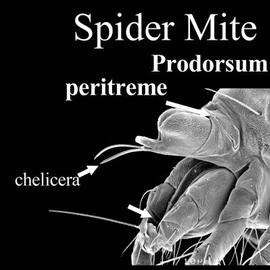
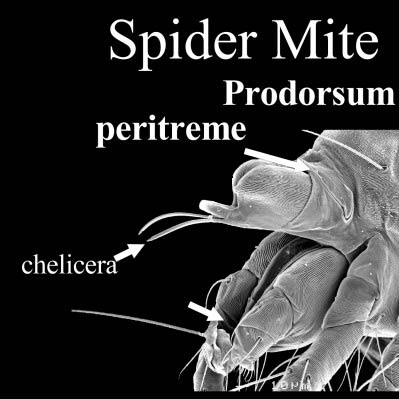
- Peritremes recurvedrecurved:
a curved suture or line of dehiscence that arches posteriorly; opposed to procurved.
distally, simplesimple:
unadorned; simple setae are needle-like and without hairs or pectins.
Similar taxa
The empodiaempodium:
(pl. empodia) an unpaired structure arising between the tarsal claws, ranging from pad-like to claw-like and often bearing structures such as tenent hairs, dense setulae, or taking the form of a featherclaw (Eriophyoidea)..
have tenent hairs in the Bryobiinae. Eutetranychini (e.g., species of Eutetranychus) have a clawclaw:
like - having a distal hook; resembling a claw.
-like or highly regressedregressed:
reduce from normal as, for example, the capitulum of astigmatan deutonymphs or the fixed digit of the chelicerae in varroa.
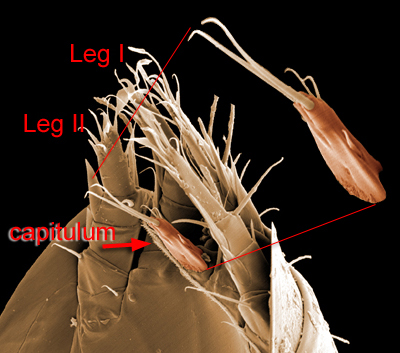 empodium. Other Tetranychini have either 2 pairs of paranal setaeseta:
(pl. setae, from L. = bristle) cuticular process composed of a hollow shaft (sometimes filled with a refractive material) produced from a membranous socket (the alveolus); the hair-like, spine-like, branched or variously expanded structures on the surfaces of the legs and body. Most setae function as mechanoreceptors, but others (e.g., solenidia) are chemoreceptors or have unknown or ambiguous functions.
(e.g., Allonychus, Panonychus ) or have hooked empodiaempodium:
(pl. empodia) an unpaired structure arising between the tarsal claws, ranging from pad-like to claw-like and often bearing structures such as tenent hairs, dense setulae, or taking the form of a featherclaw (Eriophyoidea)..
with proximoventral hairsproximoventral hairs:
the hair-like processes on the empodia of some spider mites; apparently represents a finely divided empodium, and not tenent hairs.
and the duplex setaeseta:
(pl. setae, from L. = bristle) cuticular process composed of a hollow shaft (sometimes filled with a refractive material) produced from a membranous socket (the alveolus); the hair-like, spine-like, branched or variously expanded structures on the surfaces of the legs and body. Most setae function as mechanoreceptors, but others (e.g., solenidia) are chemoreceptors or have unknown or ambiguous functions.
of tarsustarsus:
(pl. tarsi) the subdistal leg segment between the tibia and the pretarsus (apotele).
I distaldistal:
towards the free end of an appendage.
and adjacent (e.g., Oligonychus) or have an empodial spurspur:
a projection, usually tooth- or spine-like, from the body or limbs.
and have peritremes recurvedrecurved:
a curved suture or line of dehiscence that arches posteriorly; opposed to procurved.
distally (Tetranychus).
References
- Baker and Pritchard 1960Baker and Pritchard 1960:
Baker EW, Pritchard AE. 1960. The tetranychoid mites of Africa. Hilgardia 29 (11): 455–574.
- Baker and Tuttle 1994Baker and Tuttle 1994:
Baker EW, Tuttle DM. 1994. A guide to the spider mites (Tetranychidae) of the United States. Indira Publishing House, West Bloomfield, Michigan. 347 pp.
- Beard et al. 2003Beard et al. 2003:
Beard JJ, Walter DE, and Allsopp P. 2003. Spider mites of sugarcane in Australia: A review of grass-feeding Oligonychus Berlese (Acari: Prostigmata: Tetranychidae) with the description of four new species. Australian Journal of Entomology 42: 51-78.
- Bolland et al. 1998Bolland et al. 1998:
Bolland HR, Gutierrez J, Flechtmann CHW. 1998. World catalogue of the spider mite family (Acari: Tetranychidae). Brill, Leiden.
- Flechtmann and Knihinicki 2002Flechtmann and Knihinicki 2002:
Flechtmann CHW and Knihinicki DK. 2002. New species and new record of Tetranychus Dufour from Australia, with a key to the major groups in this genus based on adult females (Acari: Postigmata: Tetranychidae). Australian Journal of Entomology 41: 118-127.
- Helle and Sabelis 1985Helle and Sabelis 1985:
Helle W and Sabelis MW, eds. 1985. Spider mites: Their biology, natural enemies, and control. World Crop Pests, Vol. 1A. Elsevier, New York.
- Jeppson et al. 1975Jeppson et al. 1975:
Jeppson LR, Keifer HH, and Baker EW. 1975. Mites injurious to economic plants. University of California Press, Berkeley.
- Meyer 1974Meyer 1974:
Meyer MKPS. 1974. A revision of the Tetranychidae of Africa (Acari) with a key to the genera of the world. Republic of South Africa, Department of Agricultural Technical Services, Entomology Memoir No. 36: 291 pp.
- Meyer 1987Meyer 1987:
Meyer MKPS. 1987. African Tetranychidae (Acari: Prostigmata) - with reference to the world genera. Republic of South Africa, Department of Agriculture and Water Supply, Entomology Memoir No. 69: 175 pp.
- Migeon and Flechtmann 2004Migeon and Flechtmann 2004:
Migeon A and Flechtmann CHW. 2004. First additions and corrections to the World Catalogue of the Spider Mite Family (Acari: Tetranychidae). International Journal of Acarology 30 (2): 143-152.
- Navajas et al. 1997Navajas et al. 1997:
Navajas M, Gutierrez J, and Gotoh T. 1997. Convergence of molecular and morphological data reveals phylogenetic information in Tetranychus species and allows the restoration of the genus Amphitetranychus (Acari: Tetranychidae). Bulletin of Entomological Research 87: 283-288.
- Ochoa et al. 1994Ochoa et al. 1994:
Ochoa R, Aguilar H, and Vargas C. 1994. Phytophagous mites of Central America: An illustrated guide. CATIE, Turrialba, Costa Rica.
- Tseng 1990Tseng 1990:
Tseng Y-H. 1990. A monograph of the mite family Tetranychidae (Acarina: Trombidiformes) from Taiwan. Taiwan Museum Special Publication Series 9. 224 pp.
- Zhang 2003Zhang 2003:
Zhang Z-Q. 2003. Mites of greenhouses: Identification, biology and control. CABI Publishing, Wallingford. 244 pp.
- Zhang and Martin 2001Zhang and Martin 2001:
Zhang Z-Q and Martin NA. 2001. A review of Schizotetranychus-like mites from New Zealand. J. Roy. Soc. N.Z. 31: 307-325.
Videos
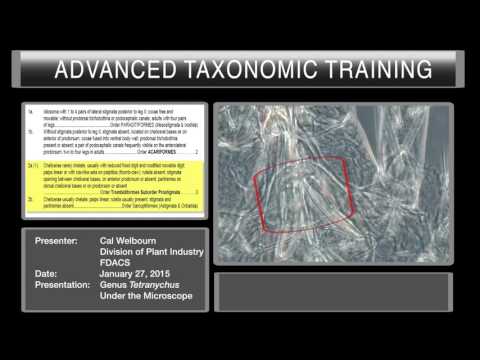
Tetranychus
Using a dichotomous key to identify a spider mitespider mite:
a member of the family Tetranychidae (Prostigmata).
(Tetranychidae) to genus