Tetranychinae
t
Taxonomy
Classification
updated 2025
Superorder Acariformes » Order Trombidiformes » Suborder Prostigmata » Infraorder EleutherengonaEleutherengona:
(also Eleutherengonida, Eleutherengonina, Eleutherengonides) an infraorderwithin the Prostigmata consisting of the two hyporders Raphignathina and Heterostigmata. Eleutherengona includes many of the most important plant-parasitic mites, e.g., spider mites, broad mite, cyclamen mite.
» Hyporder Raphignathina » Superfamily Tetranychoidea » Family Tetranychidae » Subfamily Tetranychinae » Tribe Tetranychini » Genus Eotetranychus
Common names
azalea white mite, pecan leaf scorch mite, sixspotted mite, yellow spider mitespider mite:
a member of the family Tetranychidae (Prostigmata).
, Yuma spider mitespider mite:
a member of the family Tetranychidae (Prostigmata).
, Willamette mite
Probability of encounter
high
Quarantine importance
High. About 180 species of Eotetranychus are described, including a number of moderately polyphagous pests such as the sixspotted mite E. sexmaculatus (Riley) that attacks grapes, cherry, figs, citrus, azalea, rhododendron, figs, strawberries, guava, and a variety of other trees and herbs in much of the world. Other pests are present in the US, e.g., the yellow mite E. carpini (Oudemans) and the Willamette mite E. willamettei (McGregor) attack grape, fruit trees and a variety of ornamental trees; the azalea white mite E. clitus Pritchard & Baker is a pest of azalea and attacks passionfruit, blackberry, and cherry; the Pecan leaf scorch mite E. hicoriae (McGregor) attacks pecans, other hickories, and a variety of ornamental trees. Several species are of concern to US quarantine at the moment, including:
- Eotetranychus cendanai Rimando on citrus, murraya, legumes, and a grass in Southeast Asia and the Philippines.
- Eotetranychus falcatus Meyer & Rodrigues on cassava, fig, cotton, jute, peanut, cashew, and ornamentals in much of Africa and the Cape Verde islands.
- Eotetranychus kankitus Ehara on citrus, grape, rose, and ornamental trees in China, India and Japan.
Diagnosis
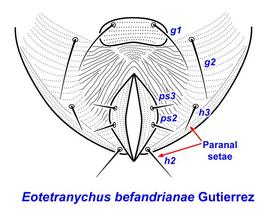
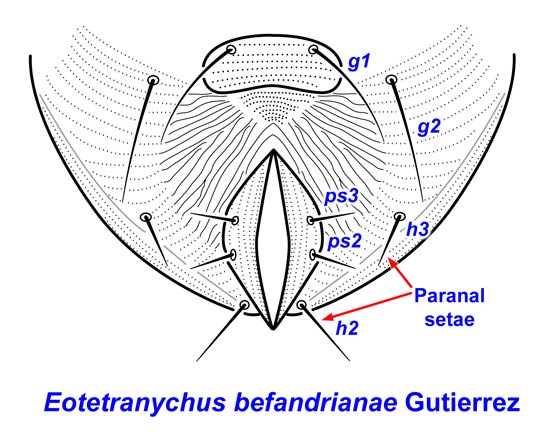
- With 2 pairs of anal setaeseta:
(pl. setae, from L. = bristle) cuticular process composed of a hollow shaft (sometimes filled with a refractive material) produced from a membranous socket (the alveolus); the hair-like, spine-like, branched or variously expanded structures on the surfaces of the legs and body. Most setae function as mechanoreceptors, but others (e.g., solenidia) are chemoreceptors or have unknown or ambiguous functions.
 and 2 pairs of paranal setae; setaeseta:
(pl. setae, from L. = bristle) cuticular process composed of a hollow shaft (sometimes filled with a refractive material) produced from a membranous socket (the alveolus); the hair-like, spine-like, branched or variously expanded structures on the surfaces of the legs and body. Most setae function as mechanoreceptors, but others (e.g., solenidia) are chemoreceptors or have unknown or ambiguous functions.
h1 terminal
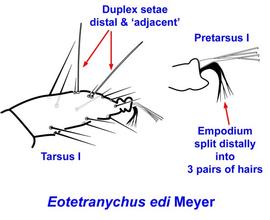
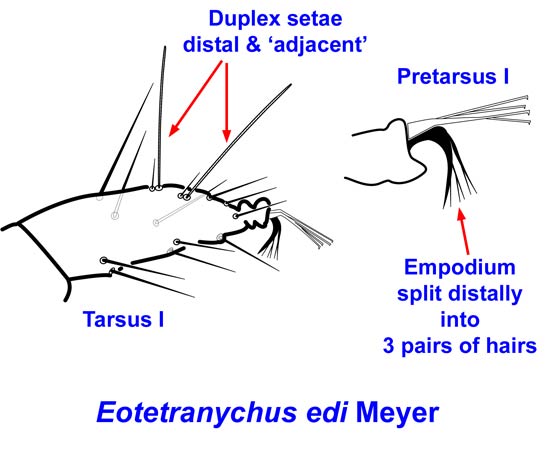
- Empodiumempodium:
(pl. empodia) an unpaired structure arising between the tarsal claws, ranging from pad-like to claw-like and often bearing structures such as tenent hairs, dense setulae, or taking the form of a featherclaw (Eriophyoidea)..
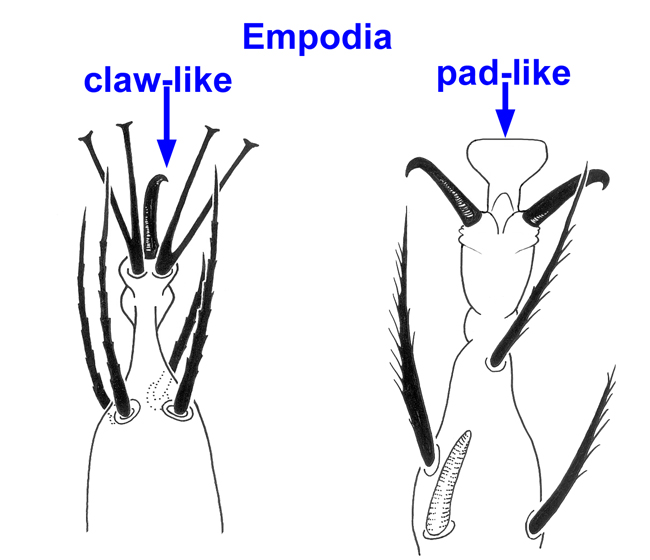 split distally into 3 pairs of hairs; no spurspur:
a projection, usually tooth- or spine-like, from the body or limbs.
.
- Tarsustarsus:
(pl. tarsi) the subdistal leg segment between the tibia and the pretarsus (apotele).
I duplex setae distaldistal:
towards the free end of an appendage.
and inserted near each other
- Transverse striaestriae:
the raised, narrowly aligned cuticular ridges, often like a fingerprint or plicate pattern; striations.
between setaeseta:
(pl. setae, from L. = bristle) cuticular process composed of a hollow shaft (sometimes filled with a refractive material) produced from a membranous socket (the alveolus); the hair-like, spine-like, branched or variously expanded structures on the surfaces of the legs and body. Most setae function as mechanoreceptors, but others (e.g., solenidia) are chemoreceptors or have unknown or ambiguous functions.
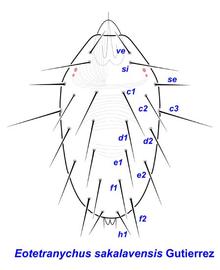
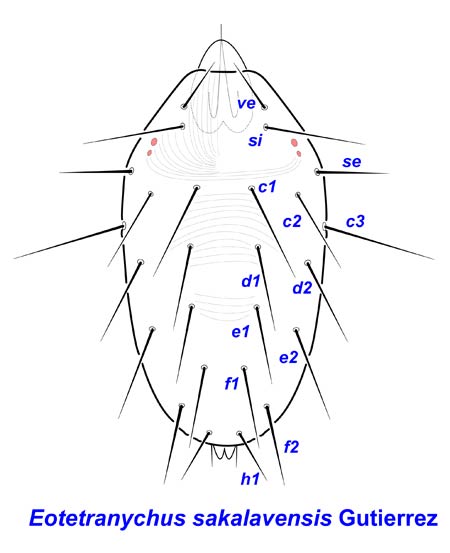
e1
- Dorsal setaeseta:
(pl. setae, from L. = bristle) cuticular process composed of a hollow shaft (sometimes filled with a refractive material) produced from a membranous socket (the alveolus); the hair-like, spine-like, branched or variously expanded structures on the surfaces of the legs and body. Most setae function as mechanoreceptors, but others (e.g., solenidia) are chemoreceptors or have unknown or ambiguous functions.
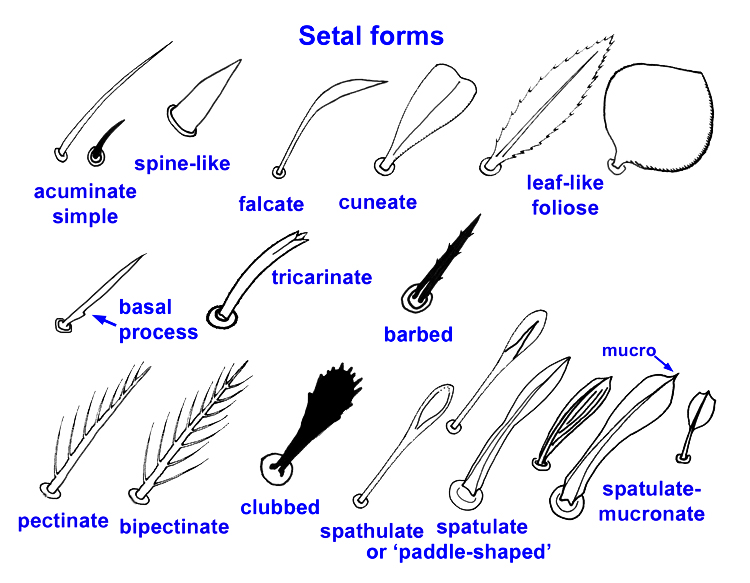
sessile, simplesimple:
unadorned; simple setae are needle-like and without hairs or pectins.
, and longer than the distance between their insertions
Similar taxa
Monoychellus has longitudinal striaestriae:
the raised, narrowly aligned cuticular ridges, often like a fingerprint or plicate pattern; striations.
between setae e1. Platytetranychus has setaeseta:
(pl. setae, from L. = bristle) cuticular process composed of a hollow shaft (sometimes filled with a refractive material) produced from a membranous socket (the alveolus); the hair-like, spine-like, branched or variously expanded structures on the surfaces of the legs and body. Most setae function as mechanoreceptors, but others (e.g., solenidia) are chemoreceptors or have unknown or ambiguous functions.
shorter than the distance between their insertions. Palmanychus has only 1 pair of anal setaeseta:
(pl. setae, from L. = bristle) cuticular process composed of a hollow shaft (sometimes filled with a refractive material) produced from a membranous socket (the alveolus); the hair-like, spine-like, branched or variously expanded structures on the surfaces of the legs and body. Most setae function as mechanoreceptors, but others (e.g., solenidia) are chemoreceptors or have unknown or ambiguous functions.
. Other Tetranychini have either setaeseta:
(pl. setae, from L. = bristle) cuticular process composed of a hollow shaft (sometimes filled with a refractive material) produced from a membranous socket (the alveolus); the hair-like, spine-like, branched or variously expanded structures on the surfaces of the legs and body. Most setae function as mechanoreceptors, but others (e.g., solenidia) are chemoreceptors or have unknown or ambiguous functions.
on tubercles or 1 pair of paranal setaeseta:
(pl. setae, from L. = bristle) cuticular process composed of a hollow shaft (sometimes filled with a refractive material) produced from a membranous socket (the alveolus); the hair-like, spine-like, branched or variously expanded structures on the surfaces of the legs and body. Most setae function as mechanoreceptors, but others (e.g., solenidia) are chemoreceptors or have unknown or ambiguous functions.
or have hooked empodiaempodium:
(pl. empodia) an unpaired structure arising between the tarsal claws, ranging from pad-like to claw-like and often bearing structures such as tenent hairs, dense setulae, or taking the form of a featherclaw (Eriophyoidea)..
with proximoventral hairsproximoventral hairs:
the hair-like processes on the empodia of some spider mites; apparently represents a finely divided empodium, and not tenent hairs.
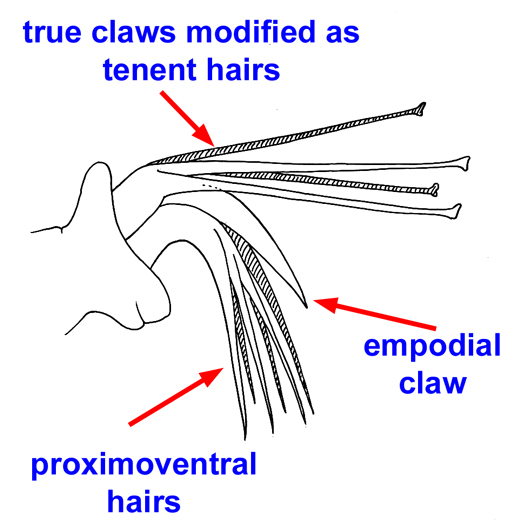 or bifurcate empodiaempodium:
(pl. empodia) an unpaired structure arising between the tarsal claws, ranging from pad-like to claw-like and often bearing structures such as tenent hairs, dense setulae, or taking the form of a featherclaw (Eriophyoidea)..
.
References
- Baker and Pritchard 1960Baker and Pritchard 1960:
Baker EW, Pritchard AE. 1960. The tetranychoid mites of Africa. Hilgardia 29 (11): 455–574.
- Baker and Tuttle 1994Baker and Tuttle 1994:
Baker EW, Tuttle DM. 1994. A guide to the spider mites (Tetranychidae) of the United States. Indira Publishing House, West Bloomfield, Michigan. 347 pp.
- Bolland et al. 1998Bolland et al. 1998:
Bolland HR, Gutierrez J, Flechtmann CHW. 1998. World catalogue of the spider mite family (Acari: Tetranychidae). Brill, Leiden.
- Helle and Sabelis 1985Helle and Sabelis 1985:
Helle W and Sabelis MW, eds. 1985. Spider mites: Their biology, natural enemies, and control. World Crop Pests, Vol. 1A. Elsevier, New York.
- Jeppson et al. 1975Jeppson et al. 1975:
Jeppson LR, Keifer HH, and Baker EW. 1975. Mites injurious to economic plants. University of California Press, Berkeley.
- Meyer 1974Meyer 1974:
Meyer MKPS. 1974. A revision of the Tetranychidae of Africa (Acari) with a key to the genera of the world. Republic of South Africa, Department of Agricultural Technical Services, Entomology Memoir No. 36: 291 pp.
- Meyer 1987Meyer 1987:
Meyer MKPS. 1987. African Tetranychidae (Acari: Prostigmata) - with reference to the world genera. Republic of South Africa, Department of Agriculture and Water Supply, Entomology Memoir No. 69: 175 pp.
- Migeon and Flechtmann 2004Migeon and Flechtmann 2004:
Migeon A and Flechtmann CHW. 2004. First additions and corrections to the World Catalogue of the Spider Mite Family (Acari: Tetranychidae). International Journal of Acarology 30 (2): 143-152.
- Ochoa et al. 1994Ochoa et al. 1994:
Ochoa R, Aguilar H, and Vargas C. 1994. Phytophagous mites of Central America: An illustrated guide. CATIE, Turrialba, Costa Rica.
- Tseng 1990Tseng 1990:
Tseng Y-H. 1990. A monograph of the mite family Tetranychidae (Acarina: Trombidiformes) from Taiwan. Taiwan Museum Special Publication Series 9. 224 pp.
- Zhang 2003Zhang 2003:
Zhang Z-Q. 2003. Mites of greenhouses: Identification, biology and control. CABI Publishing, Wallingford. 244 pp.