Bryobiinae
t
Taxonomy
Synonyms
B. repensi Manson 1967Manson 1967:
Manson DCM. 1967. The spider mite family Tetranychidae in New Zealand L.: The genus Bryobia. Acarologia 9: 76-123.
Probability of encounter
unknown
Quarantine importance
high
- Bryobia vasiljevi Reck is a member of the praetiosa-complex and may be a damaging pest of apple, passion fruit, asparagus, wheat and other grasses, and some flowers in Europe, Australia, and New Zealand. Males are not present.
Diagnosis
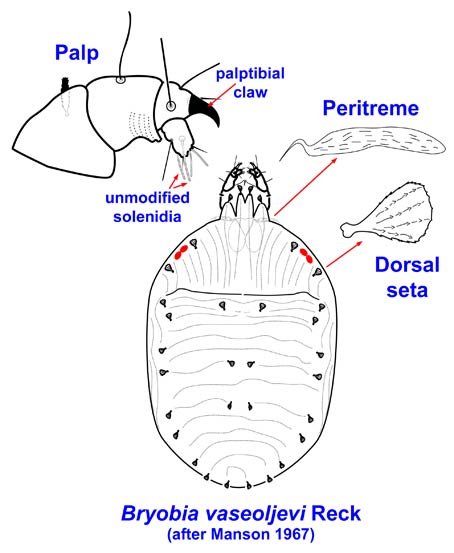
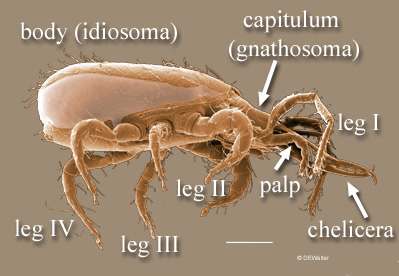
- Dorsally flattened mites with red cuticle; dark bodybody:
the idiosoma of mites.
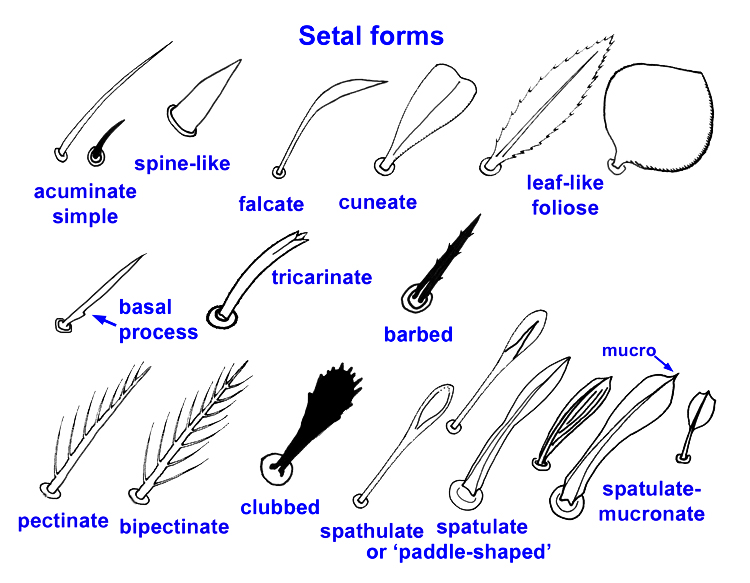
 contents; short, flattened, white setaeseta:
(pl. setae, from L. = bristle) cuticular process composed of a hollow shaft (sometimes filled with a refractive material) produced from a membranous socket (the alveolus); the hair-like, spine-like, branched or variously expanded structures on the surfaces of the legs and body. Most setae function as mechanoreceptors, but others (e.g., solenidia) are chemoreceptors or have unknown or ambiguous functions.
 ; and very long legs I.
- Claws hooked; empodium pad-likepad-like:
in Prostigmata, used to refer to empodia that do not have a distal hook (claw-like); when tenent hairs are present a 'pad-like' empodium may look more like a pincushion; in other Acari, usually a simple, pad-like empodium.
and with more than 1 pair of tenent hairs.
- Prodorsumprodorsum:
the dorsal surface of the propodosoma.
with 4 pairs of setaeseta:
(pl. setae, from L. = bristle) cuticular process composed of a hollow shaft (sometimes filled with a refractive material) produced from a membranous socket (the alveolus); the hair-like, spine-like, branched or variously expanded structures on the surfaces of the legs and body. Most setae function as mechanoreceptors, but others (e.g., solenidia) are chemoreceptors or have unknown or ambiguous functions.
(vi, ve, sci, sce), vi and ve borne on prominent lobes over gnathosomagnathosoma:
(= capitulum) the anteriormost part of a mite or ricinuleid, composed of the cheliceral and pedipalpal segments and separated from the body (idiosoma) by a ring of soft cuticle.
- Median lobes longest and partially fused medially; outer lobes well developed and mound-like.
- Femurfemur:
(pl. femora) major leg segment between trochanter and genu; often subdivided into a basifemur and a telofemur.
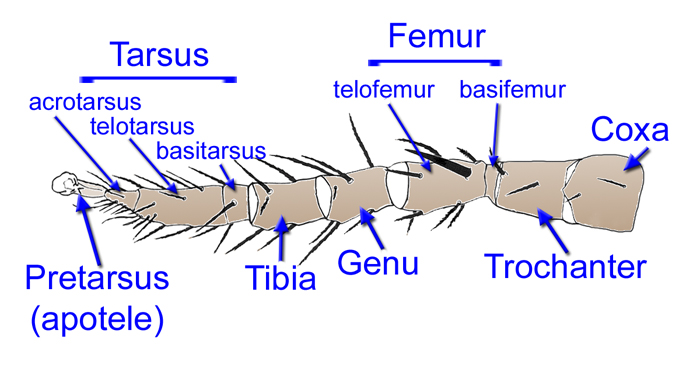 I with 24–26 setaeseta:
(pl. setae, from L. = bristle) cuticular process composed of a hollow shaft (sometimes filled with a refractive material) produced from a membranous socket (the alveolus); the hair-like, spine-like, branched or variously expanded structures on the surfaces of the legs and body. Most setae function as mechanoreceptors, but others (e.g., solenidia) are chemoreceptors or have unknown or ambiguous functions.
- Opisthosomaopisthosoma:
(= abdomen) the posterior body division in arachnids; usually not distinct in mites because of the fusion of the opisthosoma with part of the prosoma to form the idiosoma.
with 12 pairs of setaeseta:
(pl. setae, from L. = bristle) cuticular process composed of a hollow shaft (sometimes filled with a refractive material) produced from a membranous socket (the alveolus); the hair-like, spine-like, branched or variously expanded structures on the surfaces of the legs and body. Most setae function as mechanoreceptors, but others (e.g., solenidia) are chemoreceptors or have unknown or ambiguous functions.
(c1–3, d1–3, e1–3, f1–2, h1), typically club-shaped
Similar taxa
Differentiating this species from other members of the praetiosa-complex is difficult and best done by a specialist.
References
- Bolland et al. 1998Bolland et al. 1998:
Bolland HR, Gutierrez J, Flechtmann CHW. 1998. World catalogue of the spider mite family (Acari: Tetranychidae). Brill, Leiden.
- Manson 1967Manson 1967:
Manson DCM. 1967. The spider mite family Tetranychidae in New Zealand L.: The genus Bryobia. Acarologia 9: 76-123.
- Zhang 2003Zhang 2003:
Zhang Z-Q. 2003. Mites of greenhouses: Identification, biology and control. CABI Publishing, Wallingford. 244 pp.