Bryobiinae
t
Taxonomy
Taxonomic position
Superfamily Tetranychoidea » Family Tetranychidae » Subfamily Bryobiinae » Tribe Petrobiini » Genus Petrobia
Common names
brown wheat mite, legume mite, oxalis spider mite
Probability of encounter
high
Quarantine importance
High. The genus Petrobia contains more than 30 species often grouped into 3 subgenera of which several polyphagous species are important pests.
- The brown wheat mite (also large brown wheat mite, garlic mite) P. (Petrobia) latens (Müller) attacks onion, galic, asparagus, strawberries, cucumber, spice crops, clover and other legumes, and a variety of grains. P. latens is one of the few spider mites that is a proven vector, of barley yellow streak mosaic virus and probably carries the virus transovarially.
- P. (Mesotetranychus) tunisiae Manson feeds on grains and chrysanthemum in the Mediterranean region and Iran.
- The legume mite P. (Tetranychina) apicalis (Banks) attacks onions, peas, clover, vetch and other legumes in Europe and the USA.
- P. (Tetranychina) harti (Ewing) feeds on a variety of weeds, especially certain species of Oxalis, but also attacks citrus, tea, strawberry, apple, grape, sugarcane, clover and a variety of ornamentals and has been dispersed to most of the world.
Diagnosis
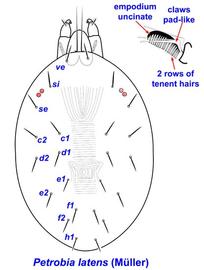
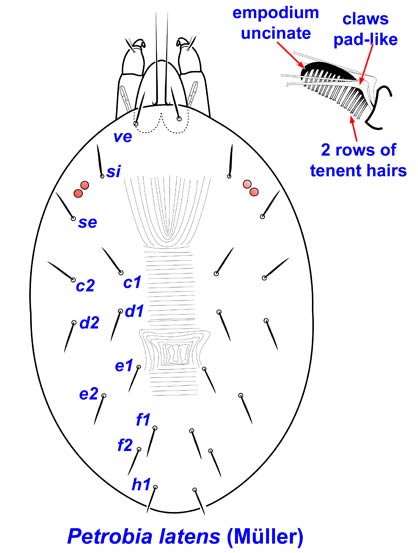
- With reddish brown cuticle, dark bodybody:
the idiosoma of mites.
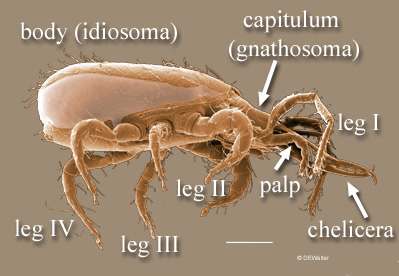 contents, and very long legs I.
- Claws pad-likepad-like:
in Prostigmata, used to refer to empodia that do not have a distal hook (claw-like); when tenent hairs are present a 'pad-like' empodium may look more like a pincushion; in other Acari, usually a simple, pad-like empodium.
; empodiumempodium:
(pl. empodia) an unpaired structure arising between the tarsal claws, ranging from pad-like to claw-like and often bearing structures such as tenent hairs, dense setulae, or taking the form of a featherclaw (Eriophyoidea)..
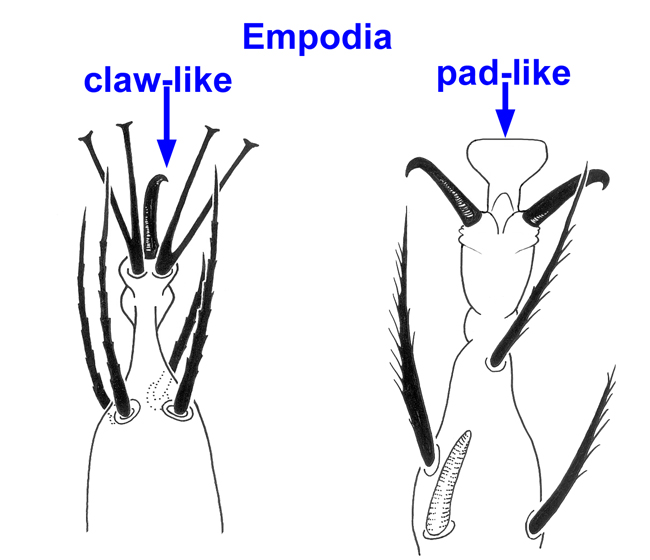 hooked and with more than 1 pair of tenent hairs.
- Prodorsumprodorsum:
the dorsal surface of the propodosoma.
with 3 pairs of setaeseta:
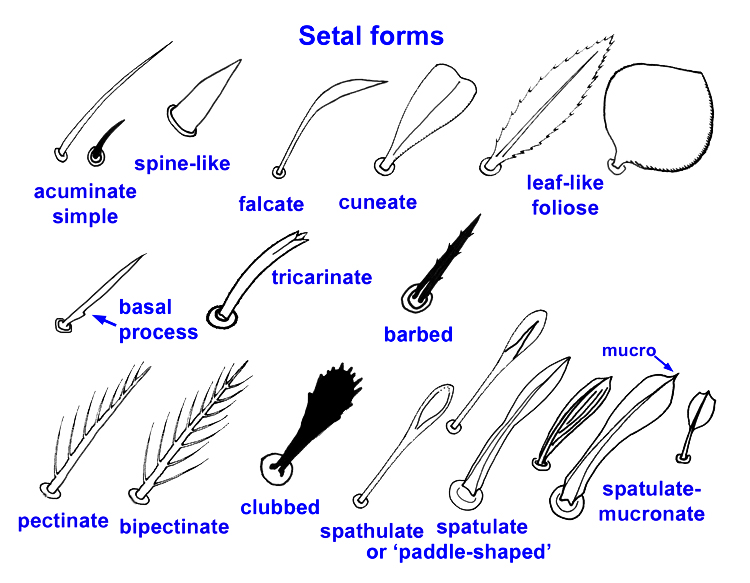
(pl. setae, from L. = bristle) cuticular process composed of a hollow shaft (sometimes filled with a refractive material) produced from a membranous socket (the alveolus); the hair-like, spine-like, branched or variously expanded structures on the surfaces of the legs and body. Most setae function as mechanoreceptors, but others (e.g., solenidia) are chemoreceptors or have unknown or ambiguous functions.
 (ve, sci, sce), without prominent lobes over gnathosomagnathosoma:
(= capitulum) the anteriormost part of a mite or ricinuleid, composed of the cheliceral and pedipalpal segments and separated from the body (idiosoma) by a ring of soft cuticle.
.
- Paranal setaeseta:
(pl. setae, from L. = bristle) cuticular process composed of a hollow shaft (sometimes filled with a refractive material) produced from a membranous socket (the alveolus); the hair-like, spine-like, branched or variously expanded structures on the surfaces of the legs and body. Most setae function as mechanoreceptors, but others (e.g., solenidia) are chemoreceptors or have unknown or ambiguous functions.
(h2–3) in a ventralventral:
relating to the lower or under side; opposed to dorsal.
position.
Similar taxa
The true spider mites in the Tetranychinae do not have empodiaempodium:
(pl. empodia) an unpaired structure arising between the tarsal claws, ranging from pad-like to claw-like and often bearing structures such as tenent hairs, dense setulae, or taking the form of a featherclaw (Eriophyoidea)..
with tenent hairs. The claws are pad-likepad-like:
in Prostigmata, used to refer to empodia that do not have a distal hook (claw-like); when tenent hairs are present a 'pad-like' empodium may look more like a pincushion; in other Acari, usually a simple, pad-like empodium.
in other tribes of Bryobiinae.
References
- Baker and Pritchard 1960Baker and Pritchard 1960:
Baker EW, Pritchard AE. 1960. The tetranychoid mites of Africa. Hilgardia 29 (11): 455–574.
- Baker and Tuttle 1994Baker and Tuttle 1994:
Baker EW, Tuttle DM. 1994. A guide to the spider mites (Tetranychidae) of the United States. Indira Publishing House, West Bloomfield, Michigan. 347 pp.
- Bolland et al. 1998Bolland et al. 1998:
Bolland HR, Gutierrez J, Flechtmann CHW. 1998. World catalogue of the spider mite family (Acari: Tetranychidae). Brill, Leiden.
- Helle and Sabelis 1985Helle and Sabelis 1985:
Helle W and Sabelis MW, eds. 1985. Spider mites: Their biology, natural enemies, and control. World Crop Pests, Vol. 1A. Elsevier, New York.
- Jeppson et al. 1975Jeppson et al. 1975:
Jeppson LR, Keifer HH, and Baker EW. 1975. Mites injurious to economic plants. University of California Press, Berkeley.
- Meyer 1974Meyer 1974:
Meyer MKPS. 1974. A revision of the Tetranychidae of Africa (Acari) with a key to the genera of the world. Republic of South Africa, Department of Agricultural Technical Services, Entomology Memoir No. 36: 291 pp.
- Meyer 1987Meyer 1987:
Meyer MKPS. 1987. African Tetranychidae (Acari: Prostigmata) - with reference to the world genera. Republic of South Africa, Department of Agriculture and Water Supply, Entomology Memoir No. 69: 175 pp.
- Robertson and Carroll 1988Robertson and Carroll 1988:
Robertson NL and Carroll TW. 1988. Virus-like particles and a spider mite intimately associated with a new disease of barley. Science 240: 1188-1190.
- Smidansky and Carroll 1996Smidansky and Carroll 1996:
Smidansky ED and Carroll TW. 1996. Factors influencing the outcome of barley yellow streak mosaic virus-brown wheat mite-barley interactions. Plant Disease 80 (2): 186-193.