Bryobiinae
t
Taxonomy
Taxonomic position
Superfamily Tetranychoidea » Family Tetranychidae » Subfamily Bryobiinae » Tribe Bryobiini » Genus Bryobia
Common names
clover mites, brown mites
Probability of encounter
high
Quarantine importance
High. The genus Bryobia contains a number of economically important pests, including several that are not yet reported from the U.S. Most of the economically important species are highly polyphagous and thelytokousthelytokous:
exhibiting all female parthenogenesis (thelytoky).
(i.e., without males). Some well known and widely distributed pests include the brown clover mite Bryobia praetiosa (Koch), a pest of over 250 kinds of plants. Most of the important pests are similar to B. praetiosa in appearance and difficult to distinguish. Some of current quarantine interest include:
- Bryobia graminum (Schrank) is an important pest of apple, pear, citrus, cole crops, clover and grasses in many European countries including the United Kingdom, North Africa, Asia including Japan, Chile, Australia, and New Zealand.
- Bryobia kissophila Van Eyndhoven, the ivy mite, attacks potato and ivy and can be a pest in greenhouses on ivy. It is currently known from Europe, Costa Rica, Chile, New Zealand, and parts of Australia.
- Bryobia lagodechiana Reck is a pest of beans, cucumber, currants, eggplant, grasses, clover and some flowers in Europe, Japan, New Zealand, and Canada. It can be a pest in greenhouses.
- Bryobia vasiljevi Reck is a pest of apple, passion fruit, asparagus, wheat and other grasses, and some flowers in Europe, Australia, and New Zealand.
Diagnosis
- Dorsally flattened mites with red cuticle; dark bodybody:
the idiosoma of mites.
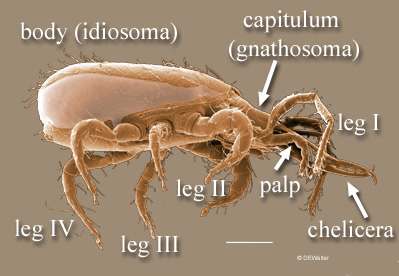 contents; short, flattened, white setaeseta:
(pl. setae, from L. = bristle) cuticular process composed of a hollow shaft (sometimes filled with a refractive material) produced from a membranous socket (the alveolus); the hair-like, spine-like, branched or variously expanded structures on the surfaces of the legs and body. Most setae function as mechanoreceptors, but others (e.g., solenidia) are chemoreceptors or have unknown or ambiguous functions.
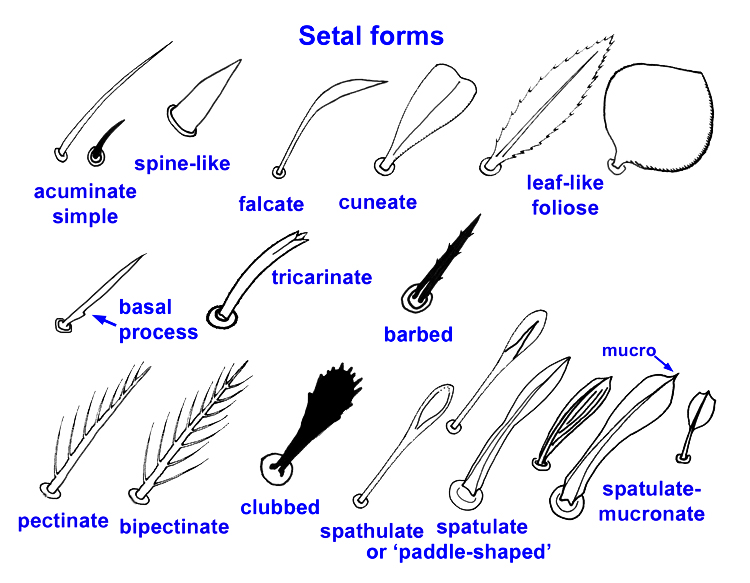 ; and very long legs I.
- Claws hooked; empodium pad-likepad-like:
in Prostigmata, used to refer to empodia that do not have a distal hook (claw-like); when tenent hairs are present a 'pad-like' empodium may look more like a pincushion; in other Acari, usually a simple, pad-like empodium.
and with more than 1 pair of tenent hairs.
- Prodorsumprodorsum:
the dorsal surface of the propodosoma.
with 4 pairs of setaeseta:
(pl. setae, from L. = bristle) cuticular process composed of a hollow shaft (sometimes filled with a refractive material) produced from a membranous socket (the alveolus); the hair-like, spine-like, branched or variously expanded structures on the surfaces of the legs and body. Most setae function as mechanoreceptors, but others (e.g., solenidia) are chemoreceptors or have unknown or ambiguous functions.
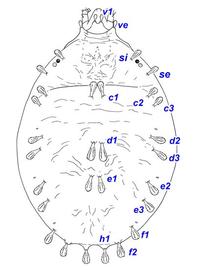
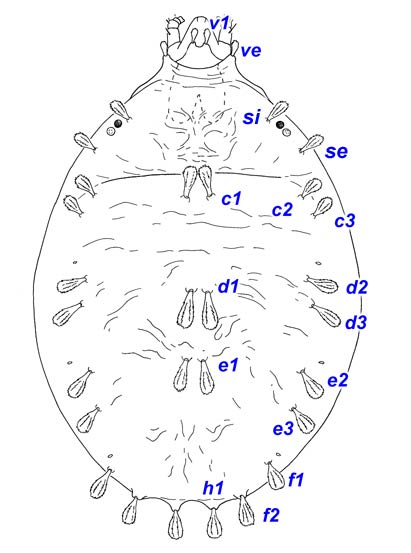
(vi, ve, sci, sce), vi and ve borne on prominent lobes over gnathosomagnathosoma:
(= capitulum) the anteriormost part of a mite or ricinuleid, composed of the cheliceral and pedipalpal segments and separated from the body (idiosoma) by a ring of soft cuticle.
- Adult female with 3 pairs of anal setaeseta:
(pl. setae, from L. = bristle) cuticular process composed of a hollow shaft (sometimes filled with a refractive material) produced from a membranous socket (the alveolus); the hair-like, spine-like, branched or variously expanded structures on the surfaces of the legs and body. Most setae function as mechanoreceptors, but others (e.g., solenidia) are chemoreceptors or have unknown or ambiguous functions.
(ps1–3) and 2 pairs of paranal setaeseta:
(pl. setae, from L. = bristle) cuticular process composed of a hollow shaft (sometimes filled with a refractive material) produced from a membranous socket (the alveolus); the hair-like, spine-like, branched or variously expanded structures on the surfaces of the legs and body. Most setae function as mechanoreceptors, but others (e.g., solenidia) are chemoreceptors or have unknown or ambiguous functions.
(h2–3)
- Opisthosomaopisthosoma:
(= abdomen) the posterior body division in arachnids; usually not distinct in mites because of the fusion of the opisthosoma with part of the prosoma to form the idiosoma.
with 12 pairs of setaeseta:
(pl. setae, from L. = bristle) cuticular process composed of a hollow shaft (sometimes filled with a refractive material) produced from a membranous socket (the alveolus); the hair-like, spine-like, branched or variously expanded structures on the surfaces of the legs and body. Most setae function as mechanoreceptors, but others (e.g., solenidia) are chemoreceptors or have unknown or ambiguous functions.
(c1–3, d1–3, e1–3, f1–2, h1), typically club-shaped
Similar taxa
The true spider mites (e.g., species of Eutetranychus) in the Tetranychinae do not have empodiaempodium:
(pl. empodia) an unpaired structure arising between the tarsal claws, ranging from pad-like to claw-like and often bearing structures such as tenent hairs, dense setulae, or taking the form of a featherclaw (Eriophyoidea)..
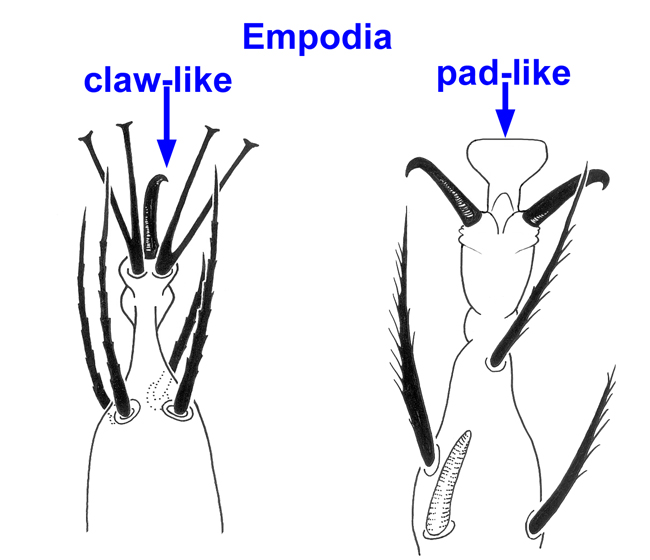 with tenent hairs. The claws are pad-likepad-like:
in Prostigmata, used to refer to empodia that do not have a distal hook (claw-like); when tenent hairs are present a 'pad-like' empodium may look more like a pincushion; in other Acari, usually a simple, pad-like empodium.
in other tribes of Bryobiinae.
References
- Baker and Pritchard 1960Baker and Pritchard 1960:
Baker EW, Pritchard AE. 1960. The tetranychoid mites of Africa. Hilgardia 29 (11): 455–574.
- Baker and Tuttle 1994Baker and Tuttle 1994:
Baker EW, Tuttle DM. 1994. A guide to the spider mites (Tetranychidae) of the United States. Indira Publishing House, West Bloomfield, Michigan. 347 pp.
- Bolland et al. 1998Bolland et al. 1998:
Bolland HR, Gutierrez J, Flechtmann CHW. 1998. World catalogue of the spider mite family (Acari: Tetranychidae). Brill, Leiden.
- Helle and Sabelis 1985Helle and Sabelis 1985:
Helle W and Sabelis MW, eds. 1985. Spider mites: Their biology, natural enemies, and control. World Crop Pests, Vol. 1A. Elsevier, New York.
- Jeppson et al. 1975Jeppson et al. 1975:
Jeppson LR, Keifer HH, and Baker EW. 1975. Mites injurious to economic plants. University of California Press, Berkeley.
- Manson 1967Manson 1967:
Manson DCM. 1967. The spider mite family Tetranychidae in New Zealand L.: The genus Bryobia. Acarologia 9: 76-123.
- Meyer 1974Meyer 1974:
Meyer MKPS. 1974. A revision of the Tetranychidae of Africa (Acari) with a key to the genera of the world. Republic of South Africa, Department of Agricultural Technical Services, Entomology Memoir No. 36: 291 pp.
- Meyer 1987Meyer 1987:
Meyer MKPS. 1987. African Tetranychidae (Acari: Prostigmata) - with reference to the world genera. Republic of South Africa, Department of Agriculture and Water Supply, Entomology Memoir No. 69: 175 pp.
- Morgan 1960aMorgan 1960a:
Morgan CVG. 1960a. Anatomical characters distinguishing Bryobia arborea M. and A. and B. praetiosa Koch (Acarina: Tetranychidae) from various areas of the world. The Canadian Entomologist 92: 595-604.
- Morgan 1960bMorgan 1960b:
Morgan CVG. 1960b. Notes on the occurrence and morphology of Bryobia lagodechiana Reck in British Columbia (Acarina: Tetranychidae). The Canadian Entomologist 92: 634-636.
- Zhang 2003Zhang 2003:
Zhang Z-Q. 2003. Mites of greenhouses: Identification, biology and control. CABI Publishing, Wallingford. 244 pp.