This website seeks to provide information facilitating the identification of Noctuidae in Hawaiʻi, with an emphasis on the non-native species. Thirty-seven fact sheets are available, each one covering a different species (or genus in the case of endemic radiations). Click on the "Fact Sheets" tab at the top of the website to browse these. Fact sheets contain information on taxonomy, adult recognition, larval morphology, similar species, distribution, and biology. Genus fact sheets contain information on taxonomy, a general overview of the group, a list of species, adult recognition, larval morphology, similar species, distribution, and biology (when known). On all of the pages, hover your mouse over a reference for a full citation.
Most noctuid pests are broadly oligophagous or polyphagous. It is rare to find specialist pests that feed only on one particular host. No attempt was made to catalog all species recorded from all hosts worldwide. The website emphasizes the most common and relevant hosts for Hawaiʻi. A few doubtful records are discussed as necessary. The literature on polyphagous pests like Spodoptera or Helicoverpa is enormous; only the most relevant references are listed. Species can be variable and the photographs included here do not always encompass the full range of variation. Photographs of the adults or larvae of most pests are found readily online.
Taxa are listed in one of three categories on each fact sheet: "adventive," "deliberately introduced," and "native." In a few instances where the status of a taxon is unclear, I provide a best guess (e.g., "questionably native").
The current valid scientific name, its author(s), and its current higher taxonomy (Family: Subfamily: Tribe), as well as common name(s), if any, is listed. As many species are cosmopolitan species with dozens of synonyms, full synonymic lists are omitted except in instances where the majority of the literature of the species in Hawaiʻi uses a different name now in synonymy and hence invalid.
The size of species in terms of forewing lengthforewing length:
the distance of the forewing in a straight line from the base to the tip of the apex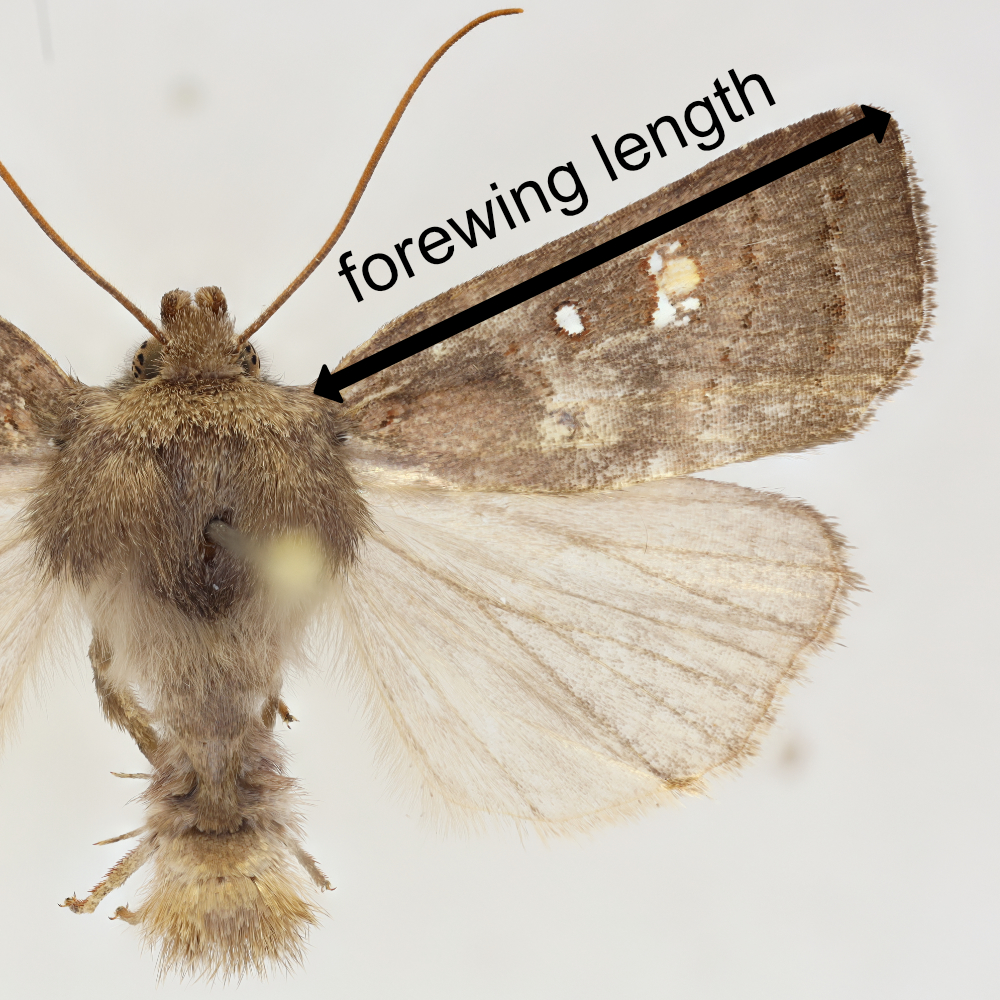 (FWLforewing length:
the distance of the forewing in a straight line from the base to the tip of the apex) in mm, a general description of the adult moth, and useful diagnostic features are provided. When available, photos of adult moths and genitalia are provided.
Generalized descriptions of the mature larva, including size, color, and remarks on the chaetotaxy, which is useful in making many larval identifications are provided. In this tool, the term "abdominal prolegs" refers only to the prolegs on the abdominal segments and does not include the anal prolegs. Some external resources combine these differently, so users should be aware of this distinction.
Here we list other species that could be easily confused with the treated species, either because of similar adult morphology or larval feeding biology. Links are included to other species with Noctuidae of Hawaiʻi fact sheets.
The full geographic range of the species is described, including both in Hawaiʻi, and for introduced species, globally.
The life cycle of the species is described, including phenology, ovipositional preferences, known host plants, and mating behavior (when known).
A series of thumbnail photos are provided under the Gallery tab. Thumbnail photos can be sorted by subfamily, tribe, and genus, as well as sex, life stage, and view/structure (dorsal/ventral, genitalia, etc.). Clicking on an image will enlarge it. Clicking on the species name beneath the image will take you to the fact sheet for that species.
PLEASE NOTE: The identification thumbnail gallery contains photos of adults for EVERY species listed in the fact sheets. This includes both native species and introduced species. The purpose of the thumbnail ID gallery is to provide the user with a broad overview of the variation within each particular subfamily, tribe, and genus, and to provide a quick pictorial overview of the taxa covered in Noctuidae of Hawaiʻi. Keep in mind that many similar-looking moths in Hawaiʻi may now belong to different families, including Erebidae.
Figures on the fact sheets were photographed by the author of Noctuidae of Hawaiʻi unless otherwise credited.
Information in the text as well as host plant information was obtained from the references provided on each fact sheet (hover or click on reference for full citation).
Taxonomic information for Noctuidae follows Keegan et al. (2021)Keegan et al. (2021):
Keegan KL, Rota J, Zahiri R, Zilli A, Wahlberg N, Schmidt BC et al. 2021. Toward a stable global Noctuidae (Lepidoptera) taxonomy. Insect Systematics and Diversity. 5:1–24. and Nedumpally et al. (2025)Nedumpally et al. (2025):
Nedumpally V, Zilli A, Yapar E, Tammaru T, Lemmon AR, Õunap E. 2025. Elaborating the phylogeny of Noctuidae by focusing on relationships between northern European taxa. Systematic Entomology. e70010. except where otherwise noted. Plant taxonomy follows the Plants of the World Online database (https://powo.science.kew.org/). POWO. 2024. Plants of the World Online (https://powo.science.kew.org/). Facilitated by the Royal Botanic Gardens, Kew. [Accessed May 2026]
Author: Kyhl A. Austin
Content last updated May 2026
idtools.org