Agricultural
guineagrass
FloretFloret:
A small flower in a clustered inflorescence (e.g., sunflower, grasses). In grasses, a floret consists of the lemma, palea, stamens, and pistil.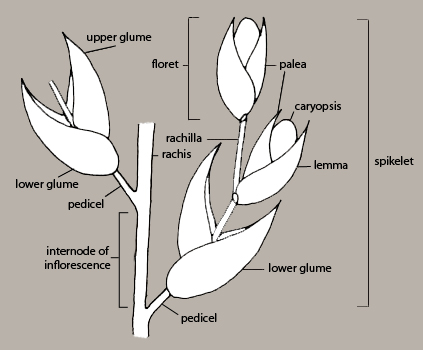
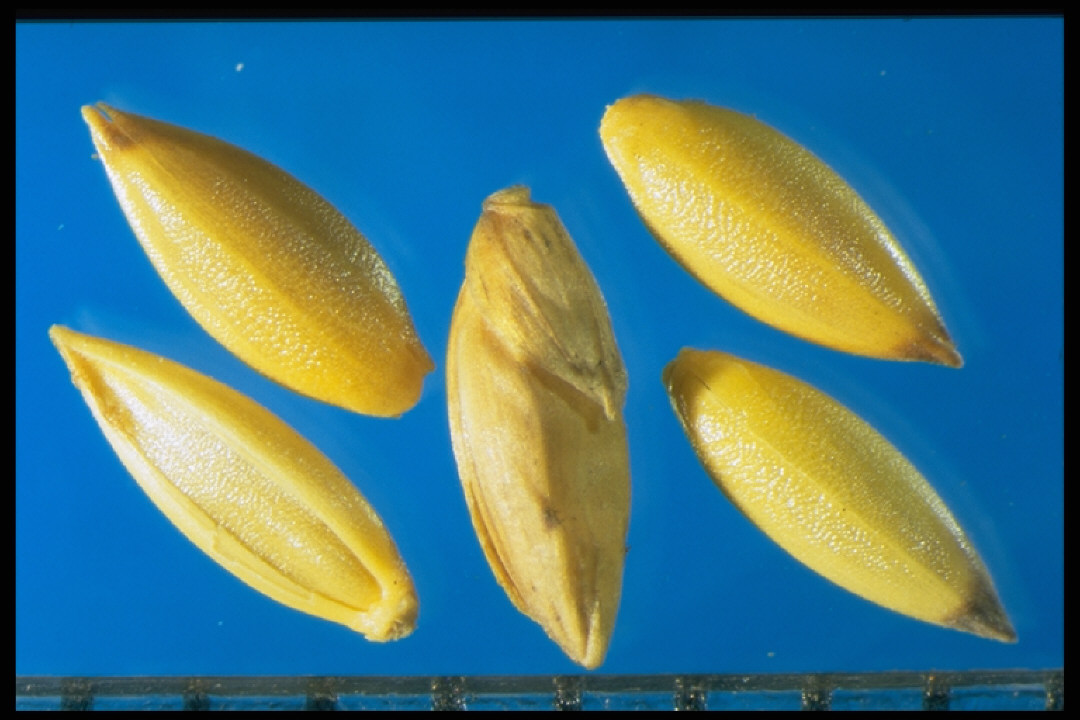
Elliptic
Yellow with tip of floretFloret:
A small flower in a clustered inflorescence (e.g., sunflower, grasses). In grasses, a floret consists of the lemma, palea, stamens, and pistil. dark brown
Tubercles on lemmaLemma:
One of two bracts of the grass floret; it is located on the side nearest the embryo and opposite the rachilla.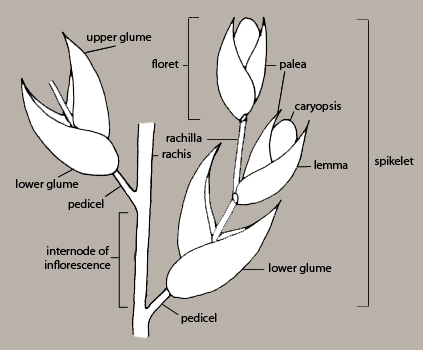 form faint transverseTransverse:
Set crosswise, crossing or at right angles.
ridges
Hard; basalBasal:
The base of the fruit or seed opposite the apical end.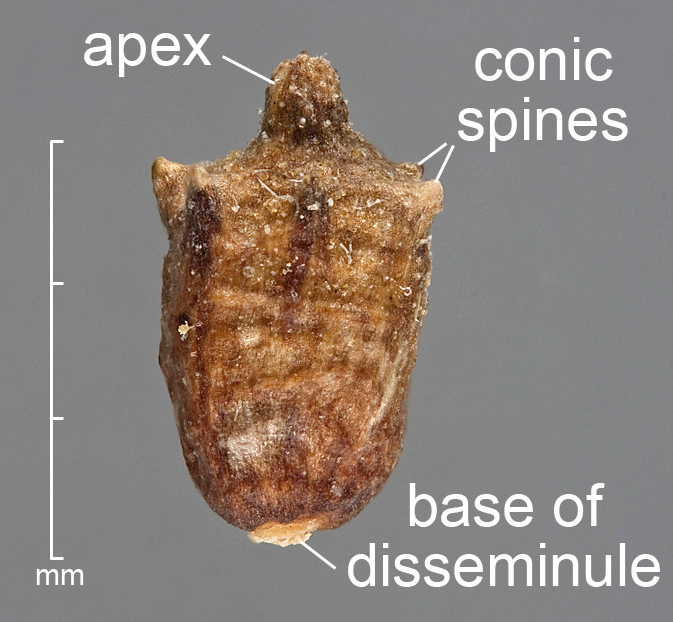 half broadest; no awnAwn:
A narrow, bristle-like organ, as on the glumes or lemmas of grasses (Poaceae).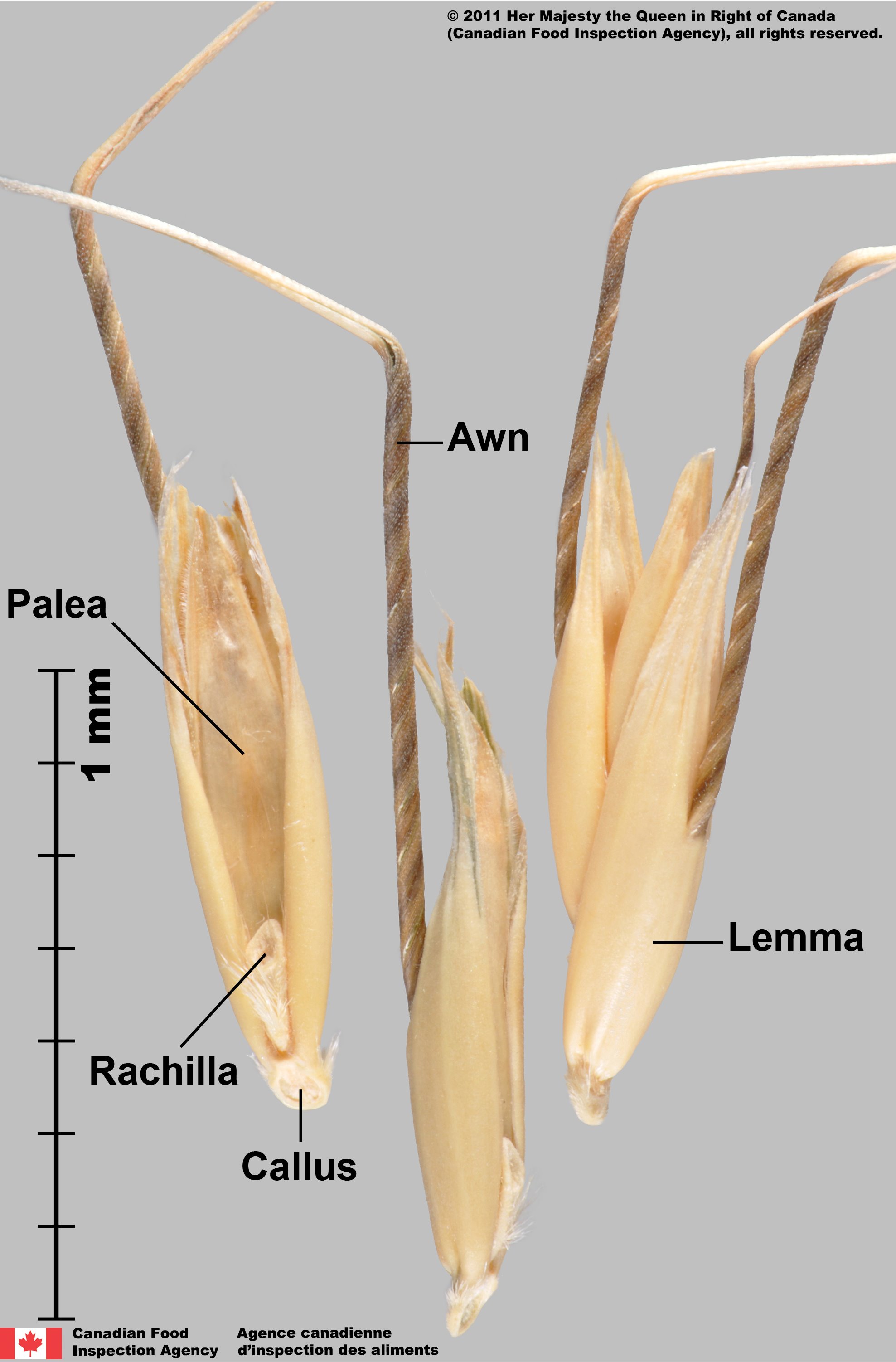 ; slightly arched; nerves obscure.
Hard and slightly arched
Small scar
Unit is mostly found as a floretFloret:
A small flower in a clustered inflorescence (e.g., sunflower, grasses). In grasses, a floret consists of the lemma, palea, stamens, and pistil.; however, spikeletsSpikelet:
One or more florets that are subtended by a pair of bracts called glumes. Spikelets are pedicellate if located on a pedicle and sessile if attached directly to the rachis. Often spikelets with single florets have remnants of a second floret, usually a lemma.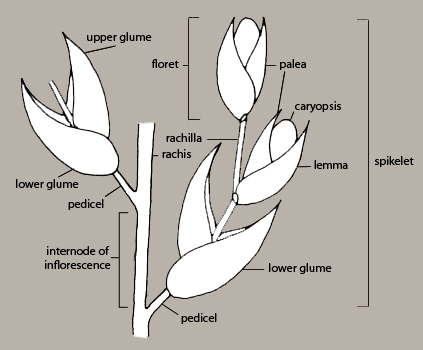 are found. SpikeletsSpikelet:
One or more florets that are subtended by a pair of bracts called glumes. Spikelets are pedicellate if located on a pedicle and sessile if attached directly to the rachis. Often spikelets with single florets have remnants of a second floret, usually a lemma. consist of a basalBasal:
The base of the fruit or seed opposite the apical end. first glumeGlume:
The pair of chaffy bracts that occur at the base of a grass spikelet, often completely enclosing it.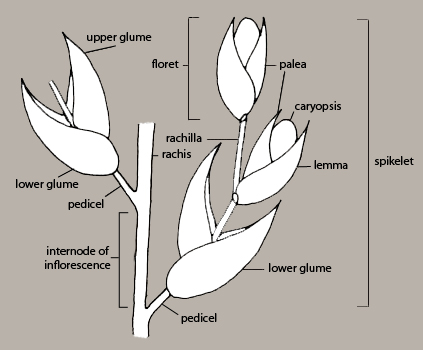 , then equal second glumeGlume:
The pair of chaffy bracts that occur at the base of a grass spikelet, often completely enclosing it. and sterile lemmaLemma:
One of two bracts of the grass floret; it is located on the side nearest the embryo and opposite the rachilla., and finally the floretFloret:
A small flower in a clustered inflorescence (e.g., sunflower, grasses). In grasses, a floret consists of the lemma, palea, stamens, and pistil..
Not listed
Not included
For more information, see ISMA fact sheet.
Poaceae
Megathyrsus maximus (Jacq.) B.K. Simon & S.W.L. Jacobs
Panicum gongylodes Jacq.
Panicum hirsutissimum Steud.
Panicum jumentorum Pers.
Panicum laeve Lam.
Panicum maximum Jacq.
Panicum maximum var. gongylodes (Jacq.) Döll
Panicum maximum var. maximum Jacq.
Panicum maximum var. pubiglume K. Schum.
Panicum maximum var. trichoglume Robyns
Panicum maximum f. pubiglume (K. Schum.) K. Schum. ex Peter
Panicum polygamum Sw.
Panicum polygamum var. gongylodes (Jacq.) E. Fourn.
Panicum praticola Salzm. ex Döll
Panicum scaberrimum Lag.
Panicum trichocondylum Steud.
Urochloa maxima (Jacq.) R.D. Webster
Urochloa maxima var. trichoglumis (Robyns) R.D. Webster