Family name: Doryanthaceae R. Dahlgren & Clifford
Synonym(s): [none]
Common name(s): doryanthes family
*Number of genera & species: 1/2
List of genera records in GRIN-Global
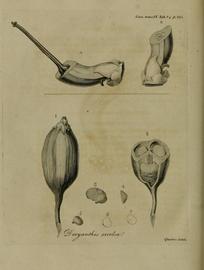
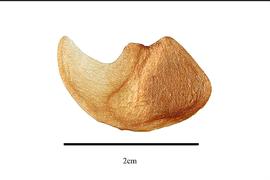
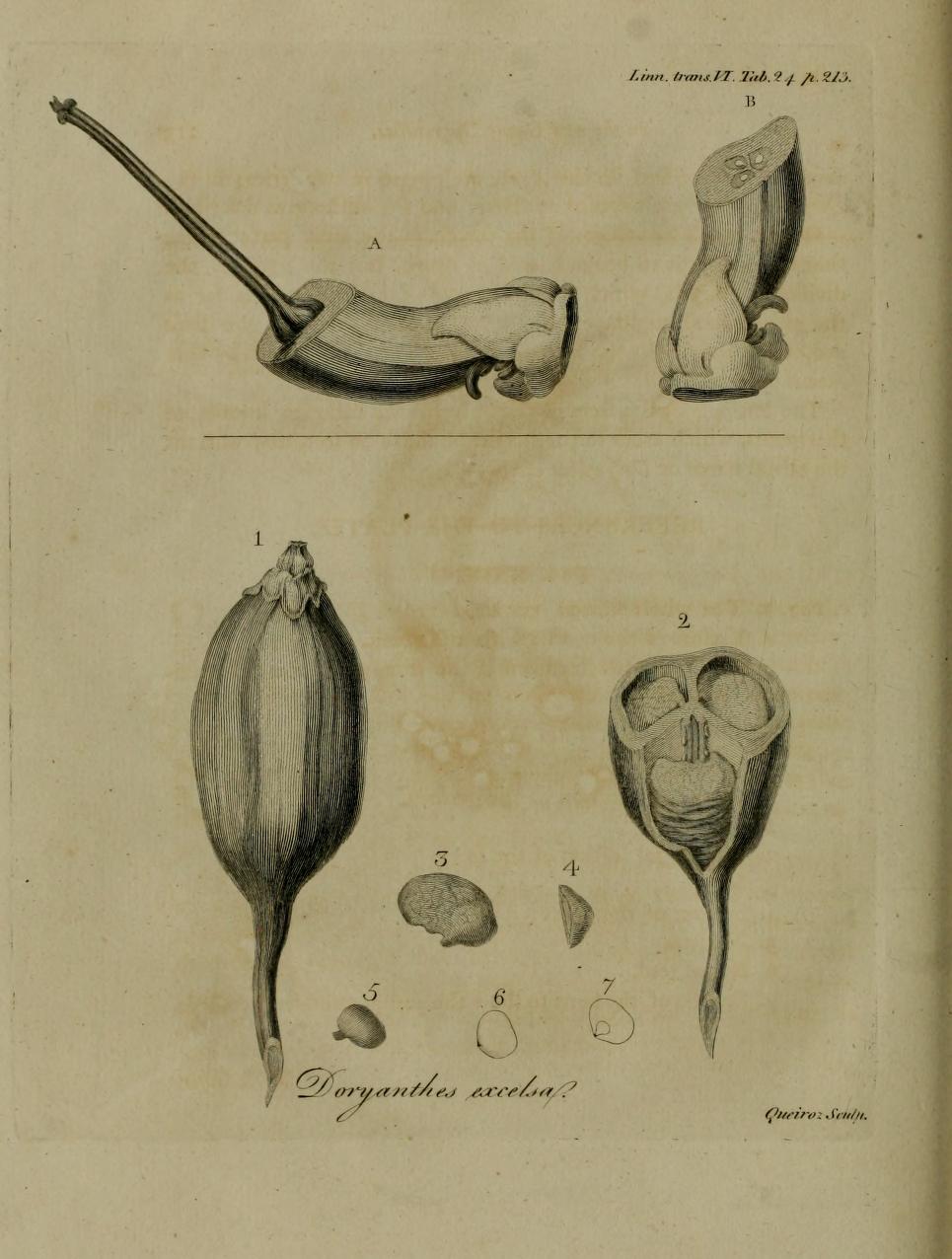
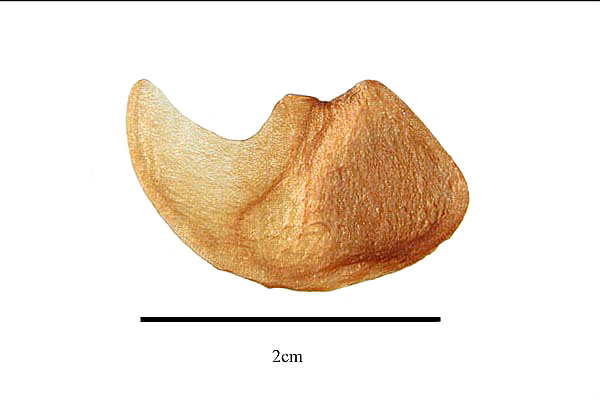
seed
Fruit a loculicidalloculicidal:
type of capsular dehiscence, opening longitudinally through the locules (compare septicidal)
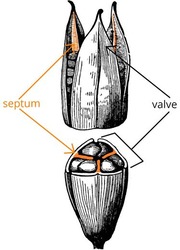 capsulecapsule:
a dry, dehiscent fruit derived from a compound ovary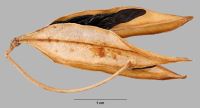 , 90–100 mm long, oblongoblong:
2D shape—much longer than broad with nearly parallel sides, corners are rounded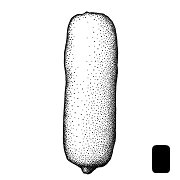 or ovoidovoid:
3D shape—ovate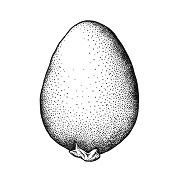 , tereteterete:
approximately circular in cross section; width and thickness approximately equal
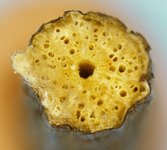 in transection, beakedbeak:
a usually firm, terminal appendage, sometimes tapered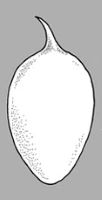 (persistent stylestyle:
in a flower, the narrow and elongated part of the pistil between the stigma and the ovary; sometimes persisting in fruit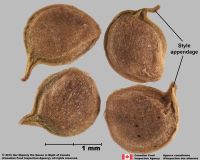 and stigmastigma:
the portion of the pistil receptive to pollen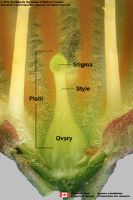 ), with many seeds. Pericarppericarp:
fruit wall or fruit coat
brown or red, dulldull:
reflecting only a low proportion of incident light, with no apparent sheen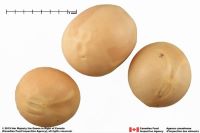 , woodywoody:
texture—consisting mainly of indurate lignified tissues, characteristic of or resembling wood
, smooth or ridgedridged:
surface relief—raised, thick ridges, sharp edged or rounded, usually in a series that may cover the entire surface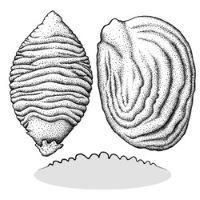 .
.
Seeds conicalconical:
3D shape—cone-shaped, with the point of attachment at the broad end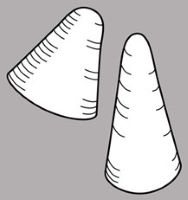 , flattened or triangulartriangular:
2D shape—three relatively straight sides with distinct corners; more angular than teardrop-shaped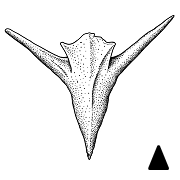 in transection, usually with a broad, paperypapery:
texture—papyraceous, chartaceous; very thin, pliable, and readily torn; like paper
, laterallateral:
(of embryo) embryo lies along the side of the seed, generally towards one end; of, at, or from the side; in grasses, can refer to the sides adjacent to the dorsal and ventral sides
wing. Seed coat reddish brown or yellow, dulldull:
reflecting only a low proportion of incident light, with no apparent sheen, thin, wrinkledwrinkled:
surface relief—shallow, irregular folds and furrows covering the surface; appearing overall though crumpled and then spread out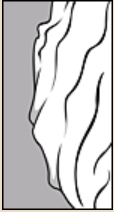 .
.
Embryo capitatecapitate:
head-shaped; abruptly enlarged on one end to a relatively short, terminal portion
with obtriangularobtriangular:
2D shape—inversely triangular, with point of attachment at narrow end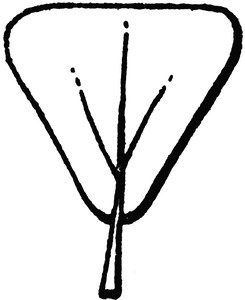 cotyledoncotyledon:
a primary leaf of the embryo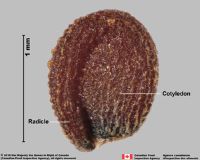 , straight, 1/3 to nearly as long as seed, partially filling seed coat.
Endosperm oily.
| Fruit | |
| Type | loculicidalloculicidal: type of capsular dehiscence, opening longitudinally through the locules (compare septicidal) capsulecapsule:a dry, dehiscent fruit derived from a compound ovary |
| Size range | 90–100 mm long |
| Shape(s) | oblongoblong: 2D shape—much longer than broad with nearly parallel sides, corners are rounded , ovoidovoid:3D shape—ovate |
| Texture | woodywoody: texture—consisting mainly of indurate lignified tissues, characteristic of or resembling wood |
| Surface relief | smooth or ridgedridged: surface relief—raised, thick ridges, sharp edged or rounded, usually in a series that may cover the entire surface |
| Color(s) | brown, red |
| Unique features | Woodywoody: texture—consisting mainly of indurate lignified tissues, characteristic of or resembling wood , beakedbeak: a usually firm, terminal appendage, sometimes tapered many-seeded capsulescapsule:a dry, dehiscent fruit derived from a compound ovary usually laterally winged. |
| Seed | |
| Size range | 20 mm |
| Shape(s) | conicalconical: 3D shape—cone-shaped, with the point of attachment at the broad end |
| Surface relief | wrinkledwrinkled: surface relief—shallow, irregular folds and furrows covering the surface; appearing overall though crumpled and then spread out |
| Color(s) | reddish brown, yellow |
| Unique features | Wrinkledwrinkled: surface relief—shallow, irregular folds and furrows covering the surface; appearing overall though crumpled and then spread out , conical-shaped seeds with broad, paperypapery:texture—papyraceous, chartaceous; very thin, pliable, and readily torn; like paper , laterallateral: (of embryo) embryo lies along the side of the seed, generally towards one end; of, at, or from the side; in grasses, can refer to the sides adjacent to the dorsal and ventral sides wings. |
| Other | |
| Embryo | capitatecapitate: head-shaped; abruptly enlarged on one end to a relatively short, terminal portion with obtriangularobtriangular: 2D shape—inversely triangular, with point of attachment at narrow end cotyledoncotyledon:a primary leaf of the embryo , straight, 1/3 to nearly as long as seed, partially filling seed coat |
| Nutritive tissue | endosperm oily |
Eastern Australia.
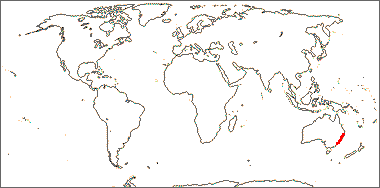
Distribution map courtesy of Angiosperm Phylogeny Website.
Baskin and Baskin 2021Baskin and Baskin 2021:
Baskin C and Baskin J. 2021. Relationship of the lateral embryo (in grasses) to other monocot embryos: A status up-grade. Seed Science Research 31 (3): 199-210. doi:10.1017/S0960258521000209; Dahlgren et al. 1985Dahlgren et al. 1985:
Dahlgren RMT, Clifford HT, and Yeo PF. 1985. The families of the monocotyledons: structure, evolution, and taxonomy. Springer-Verlag, Berlin. 520 pp.; Flora of Australia 2021+Flora of Australia 2021+:
Flora of Australia. Australian Biological Resources Study, Canberra. Accessed January 2021–March 2024. URL: http://www.ausflora.org.au; Kirkbride et al. 2006Kirkbride et al. 2006:
Kirkbride JH, Jr, Gunn CR, and Dallwitz MJ. 2006. Family guide for fruits and seeds, vers. 1.0. Accessed September 2020-January 2022. URL: https://nt.ars-grin.gov/seedsfruits/keys/frsdfam/index.cfm .; Kubitzki et al. 1990+Kubitzki et al. 1990+:
Kubitzki K et al., eds. 1990+. The families and genera of vascular plants. 7+ vols. Berlin etc.; Stevenson and Loconte 1995Stevenson and Loconte 1995:
Stevenson DW and Loconte H. 1995. A cladistic analysis of monocot families. In: Rudall PJ, Cribb PJ, Cutler DF, and Humphries CJ, eds. Monocotyledons: Systematics and Evolution. Royal Botanic Gardens, Kew.; Watson and Dallwitz 1992+Watson and Dallwitz 1992+:
Watson L and Dallwitz MJ. 1992+. The families of flowering plants: descriptions, illustrations, identification, and information retrieval. Version: 6th Accessed September 2020-September 2022. URL: delta-intkey.com
*The number of genera and species is based on Christenhusz and Byng 2016Christenhusz and Byng 2016:
Christenhusz MJM and Byng JW. 2016. The number of known plant species in the world and its annual increase. Phytotaxa 261 (3): 201-217. https://doi.org/10.11646/phytotaxa.261.3.1, which may differ from the number of genera in GRIN-Global.
Authors: M. Islam, A. Gottlieb, M. Maher, J. Scher, A. Redford
Content last updated August 2024
idtools.org