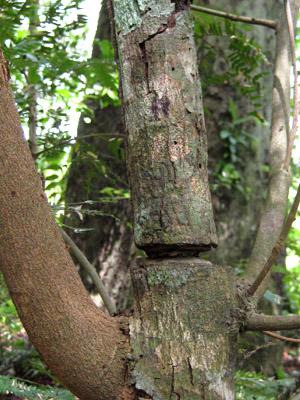
Known as the "twig girdlers" in the USA and as the "corta palo" [cuts wood] (Bosq 1950Bosq 1950:
Bosq JM. 1950. Los "Corta Palo" Oncideres spp. (Coleoptera: Cerambycidae: Lamiinae). Almanaque del Miniserio de Agricultura y Ganaderia. 25:405–409.), "serrador" [one who saws], or "serruchador" [sawyer] (Delgado and Couturier 2004Delgado and Couturier 2004:
Delgado C, Couturier G. 2004. Manejo de insectos plagas en la Amazonía: su aplicacion en camu camu. Lima, IIAP/IRD. 147 pp.) in Latin America, adult females of several genera in the tribe Onciderini (e.g., Ecthoea, Lochmaeocles, Oncideres including species formally placed in Psyllotoxus) girdle branches of various host trees. Unfortunately, bionomic data is unavailable for most genera in the tribe. However, based on morphological similarities, it is likely that additional genera within the tribe will also be discovered to exhibit girdling behavior.
In the USA, the biology of the "hickory girdler," Oncideres c. cingulata, has been studied extensively by several authors. Adults of this species emerge from late August to early October (Solomon 1995Solomon 1995:
Solomon JD. 1995. Guide to insect borers in North American broadleaf trees and shrubs. Washington, D.C., USDA, Forest Service. 735 pp.). Adult females girdle living branches by chewing a V-shaped groove with their mandibles completely around the branch, through the bark and phloem. Females then oviposit into the newly cut host material which usually falls to the forest floor. The life cycle is usually completed in one year (Linsley 1940Linsley 1940:
Linsley EG. 1940. Notes on Oncideres twig girdlers. Journal of Economic Entomology. 33(3):561–563., Linsley and Chemsak 1984Linsley and Chemsak 1984:
Linsley EG, Chemsak JA. 1984. The Cerambycidae of North America. Part VII, No. 1. Taxonomy and classification of the subfamily Lamiinae, tribes Parmenini through Acanthoderini. Berkeley and Los Angeles, University of California Press. 258 pp.). By girdling a living branch, females weaken a part of the healthy host tree, circumventing plant defense mechanisms and ensuring that valuable nutrients such as nitrogen remain trapped within the branch for the benefit of their larvae (Dillon and Dillon 1945Dillon and Dillon 1945:
Dillon LS, Dillon ES. 1945. The tribe Onciderini (Coleoptera: Cerambycidae) Part I. Reading, Scientific Publications, Reading Public Museum and Art Gallery, Number 5. 186 pp., Forcella 1981Forcella 1981:
Forcella F. 1981. Twig nitrogen content and larval survival of twig-girdling beetles, Oncideres cingulata (Say) (Coleoptera: Cerambycidae). The Coleopterists Bulletin. 35(2):211–212., Forcella 1984Forcella 1984:
Forcella F. 1984. Tree size and density affect twig-girdling intensity of Oncideres cingulata (Say) (Coleoptera: Cerambycidae). The Coleopterists Bulletin. 38(1):37–42., Rice 1995Rice 1995:
Rice ME. 1995. Branch girdling by Oncideres cingulata (Coleoptera: Cerambycidae) and relative quality of persimmon, hickory, and elm. Annals of the Entomological Society of America. 88(4):451–454., Rogers 1977Rogers 1977:
Rogers CE. 1977. Bionomics of Oncideres cingulata (Coleoptera: Cerambycidae) on mesquite. Journal of the Kansas Entomological Society. 50(2):222–229.).
Several authors have also studied the biology of another North American species, the "huisache girdler," Oncideres pustulata (e.g., High 1915High 1915:
High MM. 1915. The huisache girdler. Bulletin of the U.S. Department of Agriculture. 184:1–9., Hovore and Penrose 1982Hovore and Penrose 1982:
Hovore FT, Penrose RL. 1982. Notes on Cerambycidae co-inhabiting girdles of Oncideres pustulata Leconte (Coleoptera: Cerambycidae). The Southwestern Naturalist. 27(1):23–27., Rice 1986Rice 1986:
Rice ME. 1986. Winter mortality of Oncideres pustulatus LeConte (Coleoptera: Cerambycidae) larvae induced by freezing temperatures. Journal of the Kansas Entomological Society. 59(3):423–427., Rice 1989Rice 1989:
Rice ME. 1989. Branch girdling and oviposition biology of Oncideres pustulatus (Coleoptera: Cerambycidae) on Acacia farnesiana. Annals of the Entomological Society of America. 82(2):181–186.). Additional studies on the biology of Oncideres were conducted by Duffy (1960)Duffy (1960):
Duffy EAJ. 1960. A monograph of the immature stages of Neotropical timber beetles (Cerambycidae). London, British Museum (Natural History). 327 pp. and Linsley (1961)Linsley (1961):
Linsley EG. 1961. The Cerambycidae of North America. Part I. Introduction. University of California Publications in Entomology. 18:1–97, 35 pls., as well as on the effects of O. humeralis on the number and size structure of its host plants in Brazil (Romero et al. 2005Romero et al. 2005:
Romero GQ, Vasconcellos-Neto J, Neto HFP. 2005. The effects of the wood-boring Oncideres humeralis (Coleoptera, Cerambycidae) on the number and size structure of its host-plants in south-east Brazil. Journal of Tropical Ecology. 21:233–236.). Hovore and Penrose (1982)Hovore and Penrose (1982):
Hovore FT, Penrose RL. 1982. Notes on Cerambycidae co-inhabiting girdles of Oncideres pustulata Leconte (Coleoptera: Cerambycidae). The Southwestern Naturalist. 27(1):23–27. and Touroult (2004)Touroult (2004):
Touroult J. 2004. Les longicornes associés aux rameaux coupés par Oncideres amputator en Guadeloupe. (Coleoptera, Cerambycidae). Le Coléoptériste, 7(2):129–134. recorded Cerambycidae species which emerged from branches girdled by Oncideres.