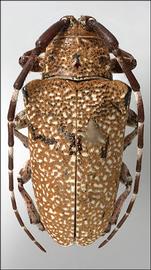
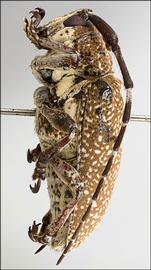
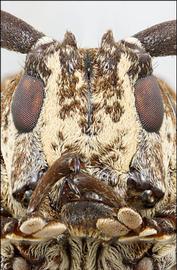
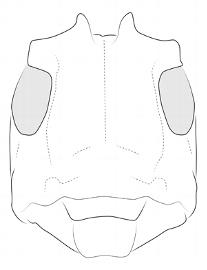
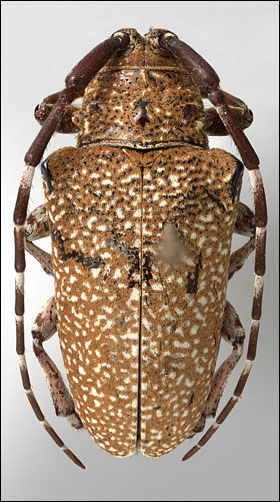
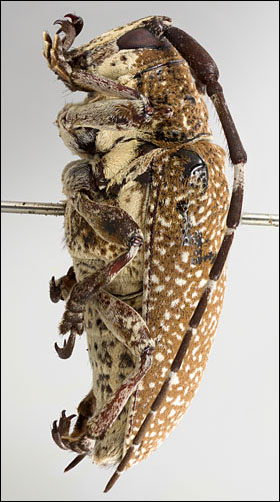
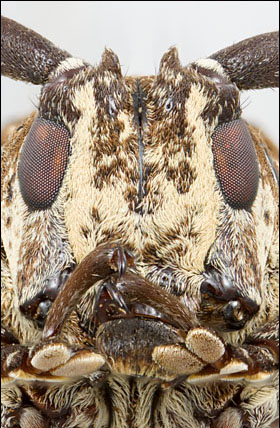
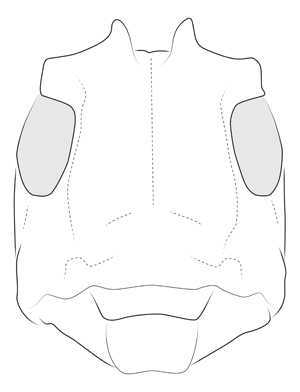
Elongate-ovate, robust, small to moderate-sized, ranging from about 10–18 mm in length. Integument generally dark brown or black with whitish, brown, and ochraceous pubescence. Head with frons elongate, about as wide as width of 2 1/2 lower eye lobes. Eyes with lower lobes ovate-oblong. Genae elongate, about as tall as lower eye lobes. Antennal tubercles prominent, narrowly separated, contiguous at base; tubercles armed at apex with a small projection, or with a short, blunt horn. Antennae about as long as overall body length, or as much as twice as long; scape gradually expanded to apex, longer than antennomere IV; antennomere III nearly straight, about as long as scape and longer than antennomere IV. Pronotum transverse, roughly conical, wider at base, with lateral tubercles. Elytra with sides attenuate; elytral apices individually rounded; elytra generally uniform in coloration or speckled; base of elytra with two prominent tubercles at humeri. Basal 1/3 of elytra with dense punctation, surface granulate-punctate. Procoxae without projection (females) or with small acute projection (males). Mesosternal process with apex deeply emarginate. Metafemora moderate in length, about 1/3 as long as elytra.
The combination of the following characters will help to distinguish this genus: narrowly separated antennal tubercles, contiguous at base; scape gradually expanded to apex; roughly conical pronotum, with distinct lateral tubercles; and base of elytra with two prominent tubercles at humeri.
South America (Argentina, Bolivia, Brazil, Ecuador, Paraguay, Uruguay)
Asteraceae (Baccharis dracunculifolia, B. dracunculifolia subsp. tandilensis, Grindelia buphthalmoides, Tessaria absinthioides); Fabaceae (Vachellia caven); Solanaceae (Cestrum parqui); Malvaceae (Callianthe pauciflora, Sphaeralcea bonariensis)
Unknown
The genus Neodillonia currently contains two species: N. albisparsa (Germar, 1824Germar, 1824:
Germar EF. 1824. Insectorum species novae aut minus cognitae, descriptionibus illustratae. Halae, xxiv + 624 pp., 2 pls.); N. waltersi Nearns and Swift, 2011Nearns and Swift, 2011:
Nearns EH, Swift IP. 2011. New taxa and combinations in Onciderini Thomson, 1860 (Coleoptera: Cerambycidae: Lamiinae). Insecta Mundi. 0192:1–27..
More species images are available in the Gallery.
NeodilloniaMonné & Fragoso, 1984
subtribe: Hypsiomina
type species: Trachysomus adspersus Castelnau, 1840 [synonym of Lamia albisparsa Germar, 1824]
generic synonymies: Dillonia Lane, 1855, preoccupied by Dillonia Haeckel, 1847 [Pisces]
Bezark and Monné (2013)Bezark and Monné (2013):
Bezark LG, Monné MA. 2013. Checklist of the Oxypeltidae, Vesperidae, Disteniidae and Cerambycidae, (Coleoptera) of the Western Hemisphere., Dillon and Dillon (1945)Dillon and Dillon (1945):
Dillon LS, Dillon ES. 1945. The tribe Onciderini (Coleoptera: Cerambycidae) Part I. Reading, Scientific Publications, Reading Public Museum and Art Gallery, Number 5. 186 pp., Germar (1824)Germar (1824):
Germar EF. 1824. Insectorum species novae aut minus cognitae, descriptionibus illustratae. Halae, xxiv + 624 pp., 2 pls., Monné (2005)Monné (2005):
Monné MA. 2005. Catalogue of the Cerambycidae (Coleoptera) of the Neotropical Region. Part II. Subfamily Lamiinae. Zootaxa. 1023:1–759., Nearns and Swift (2011)Nearns and Swift (2011):
Nearns EH, Swift IP. 2011. New taxa and combinations in Onciderini Thomson, 1860 (Coleoptera: Cerambycidae: Lamiinae). Insecta Mundi. 0192:1–27.