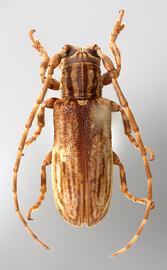
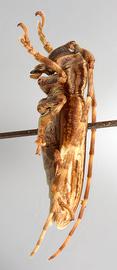
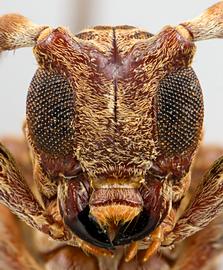
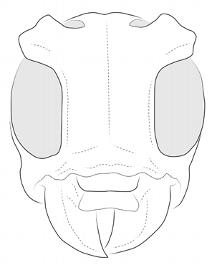
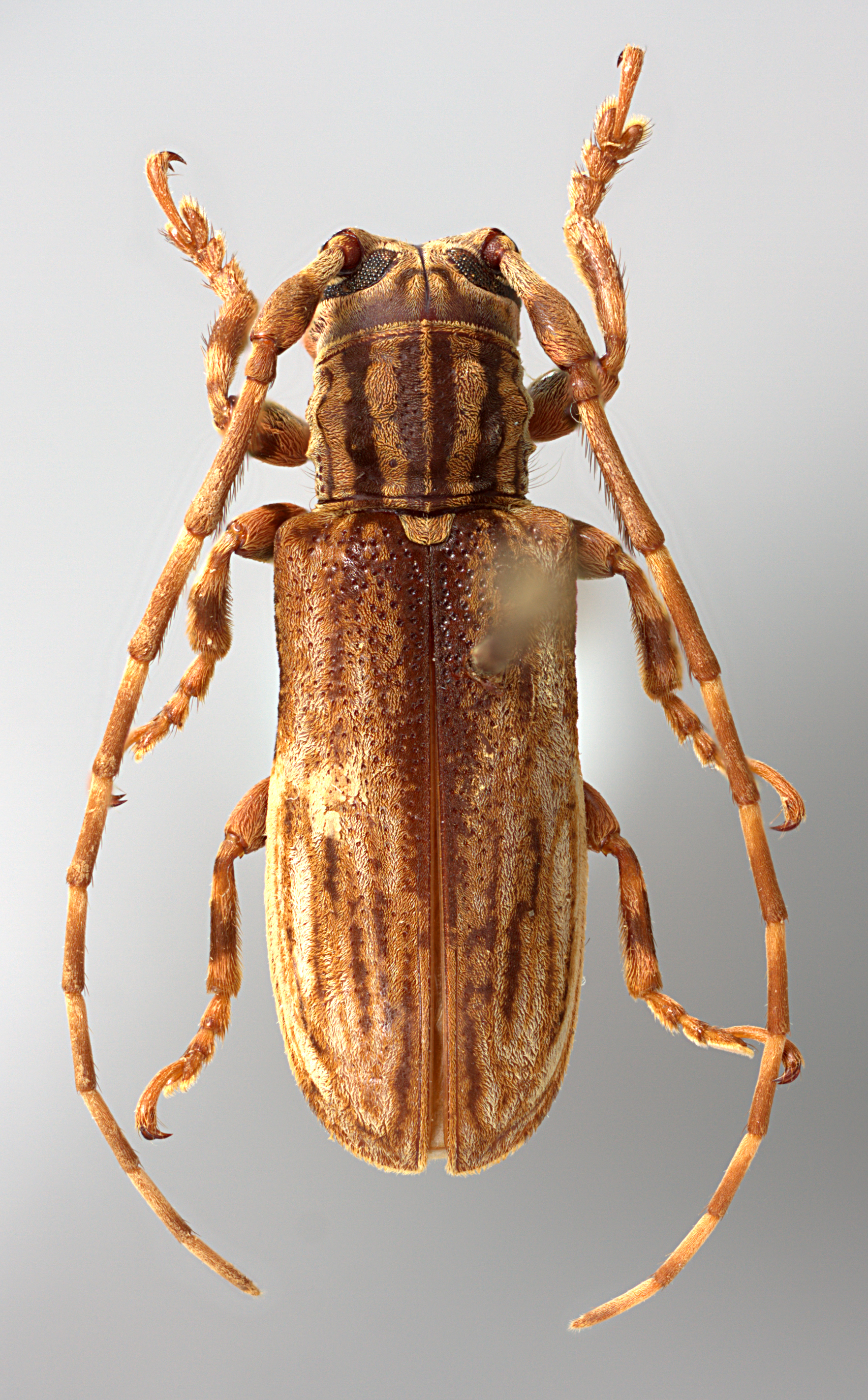
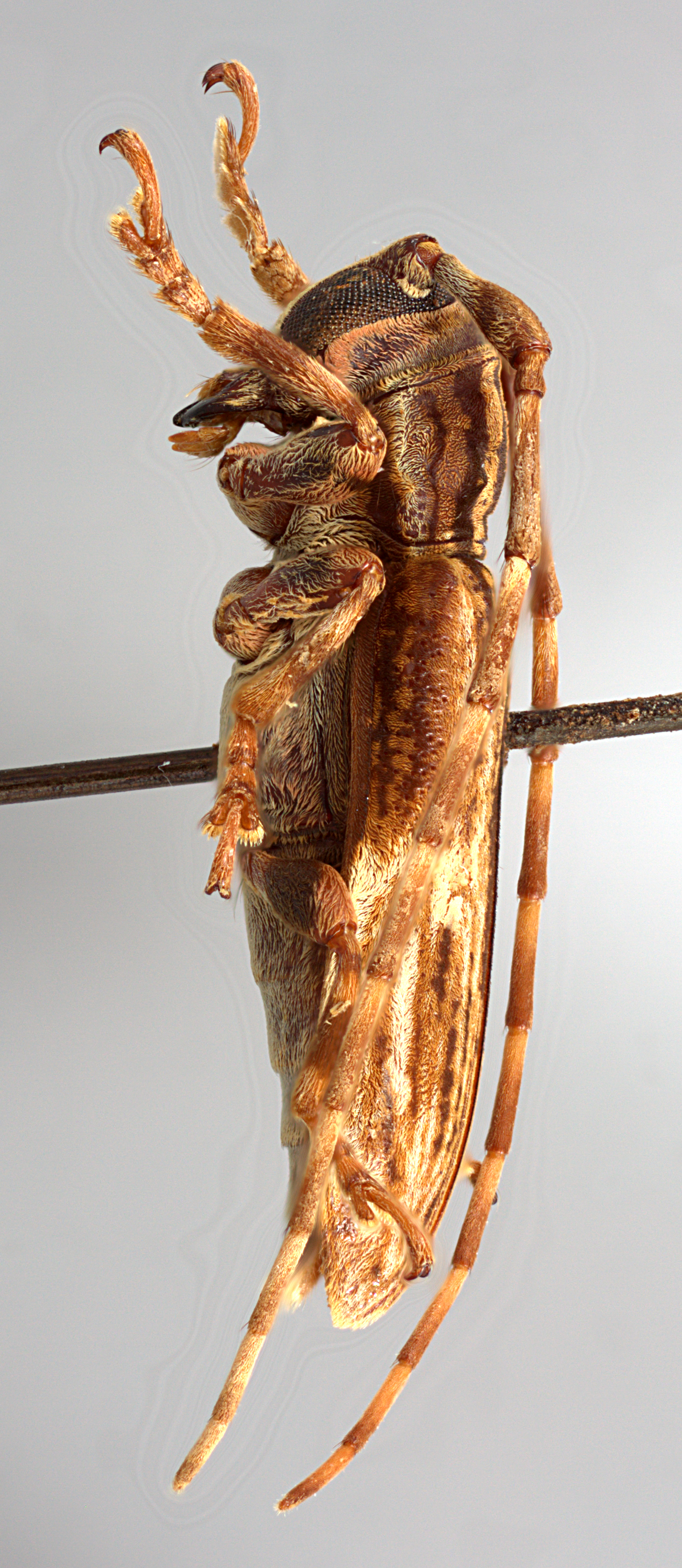
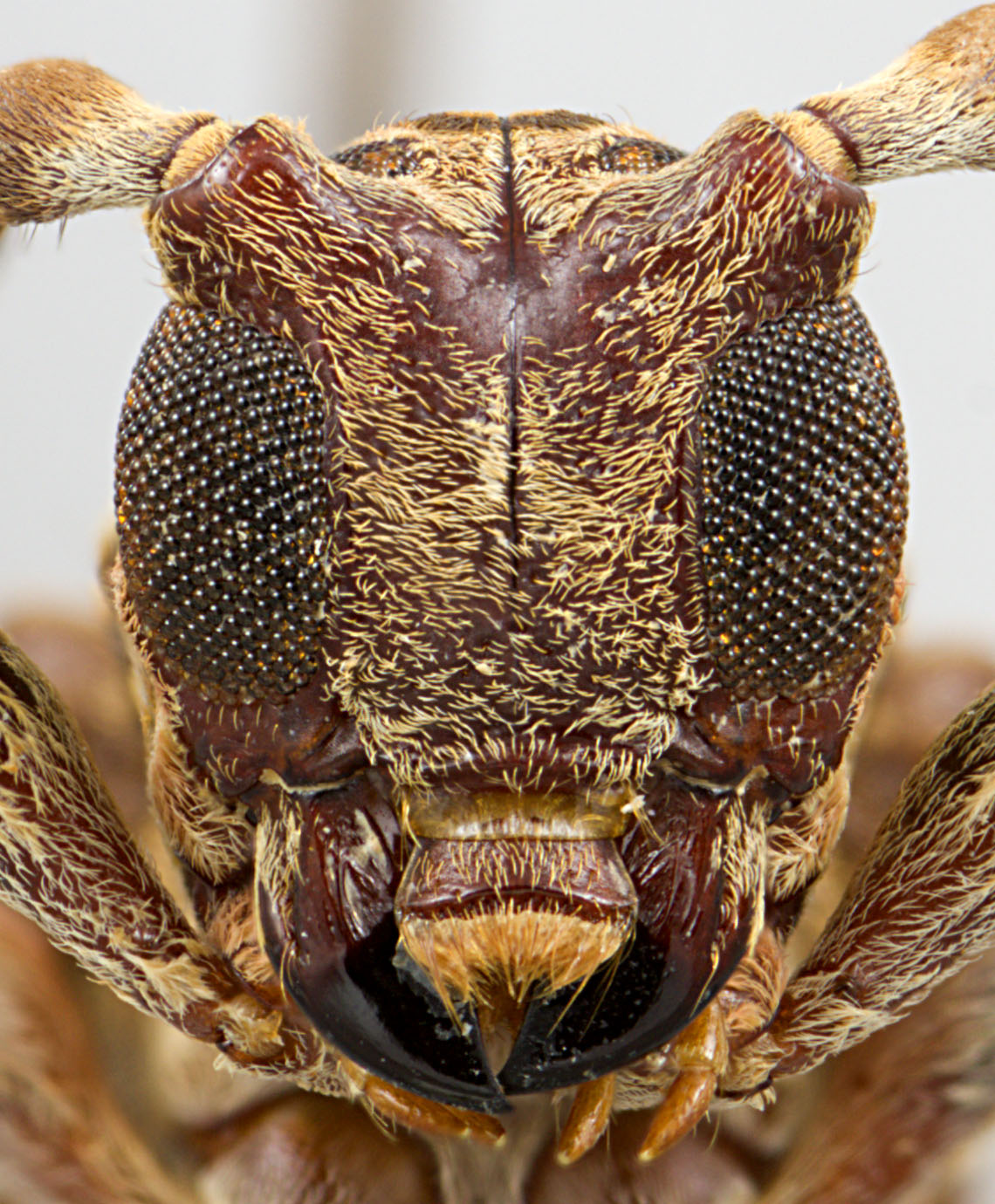
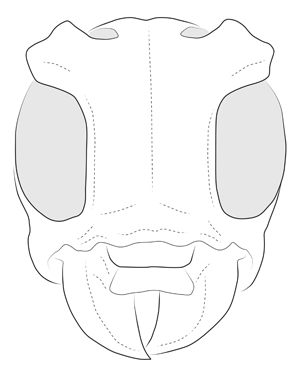
Elongate-oblong, moderate-sized, ranging from about 12–19 mm in length. Integument generally ferrugineous with whitish and ochraceous pubescence. Head with frons subquadrate to slightly elongate, about as wide as width of 1–2 lower eye lobes; frons distinctly convex. Eyes with lower lobes distinctly large, oblong. Genae strongly transverse, distinctly shorter than lower eye lobes. Antennal tubercles prominent, widely separated; tubercles unarmed at apex or armed with small projection (males). Antennae about as long (females) to about 1 1/2 times as long (males) as overall body length; scape clavate, about as long or slightly longer than antennomere IV; antennomere III feebly curved or feebly sinuate, distinctly longer than scape and IV; antennae annulate. Pronotum transverse, roughly cylindrical, slightly wider at apex, with lateral tubercles; pronotum with distinct, dark vitae. Elytra with sides distinctly wider towards apical 1/2; elytral apices individually rounded; elytra with vague vittae; base of elytra without prominent tubercles at humeri. Basal 1/3 of elytra with moderate to dense punctation, surface coarsely punctate to granulate-punctate. Procoxae without projection. Mesosternal process with apex subtruncate to feebly emarginate. Metafemora distinctly short, about 1/5 as long as elytra.
The combination of the following characters will help to distinguish this genus: integument generally ferrugineous; distinctly large eyes; pronotum roughly cylindrical, with distinct vitae; and elytra with sides distinctly wider towards apices.
Superficially resembles Cherentes.
Central America (Costa Rica, Panama); South America (Brazil, French Guiana, Peru)
Unknown
Unknown
The genus Bacuris currently contains one species: B. sexvittatus (Bates, 1865Bates, 1865:
Bates HW. 1865. Contributions to an insect fauna of the Amazon Valley. Coleoptera: Longicornes. The Annals and Magazine of Natural History 3(15):213–225, 382–394; 3(16):101–113, 167–182, 308–314.).
More species images are available in the Gallery.
Bacuris Gounelle, 1906Gounelle, 1906:
Gounelle E. 1906. Note sur deux lamiaires américains placés avec doute dans le genre Eudesmus et description de deux genres nouveaux. Bulletin de la Societe Entomologique de France. 1906:272–275.
subtribe: Onciderina
type species: Eudesmus sexvittatusi Bates, 1865Bates, 1865:
Bates HW. 1865. Contributions to an insect fauna of the Amazon Valley. Coleoptera: Longicornes. The Annals and Magazine of Natural History 3(15):213–225, 382–394; 3(16):101–113, 167–182, 308–314.
Bates (1865)Bates (1865):
Bates HW. 1865. Contributions to an insect fauna of the Amazon Valley. Coleoptera: Longicornes. The Annals and Magazine of Natural History 3(15):213–225, 382–394; 3(16):101–113, 167–182, 308–314., Bezark and Monné (2013)Bezark and Monné (2013):
Bezark LG, Monné MA. 2013. Checklist of the Oxypeltidae, Vesperidae, Disteniidae and Cerambycidae, (Coleoptera) of the Western Hemisphere., Dillon and Dillon (1946)Dillon and Dillon (1946):
Dillon LS, Dillon ES. 1946. The tribe Onciderini (Coleoptera: Cerambycidae) Part II. Reading, Scientific Publications, Reading Public Museum and Art Gallery, Number 6. 189–413 pp., Gounelle (1906)Gounelle (1906):
Gounelle E. 1906. Note sur deux lamiaires américains placés avec doute dans le genre Eudesmus et description de deux genres nouveaux. Bulletin de la Societe Entomologique de France. 1906:272–275., Monné (2005)Monné (2005):
Monné MA. 2005. Catalogue of the Cerambycidae (Coleoptera) of the Neotropical Region. Part II. Subfamily Lamiinae. Zootaxa. 1023:1–759.