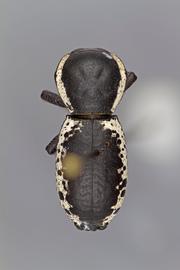
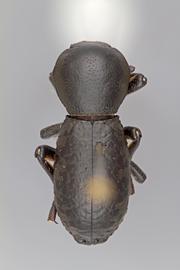
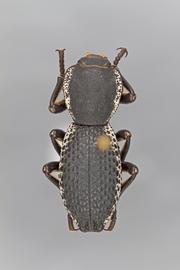
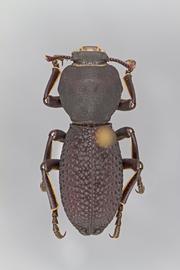
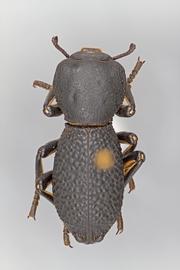
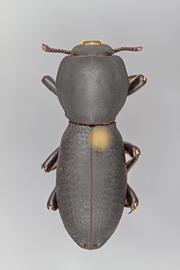
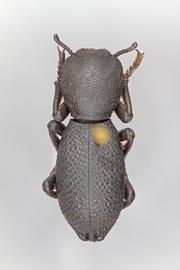
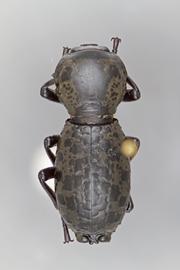
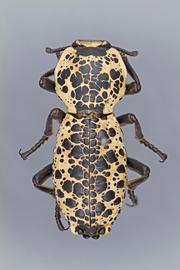
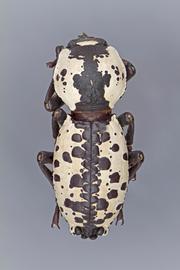
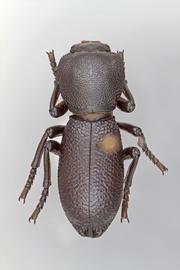
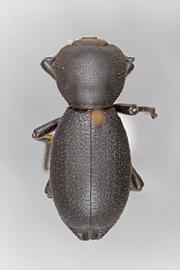
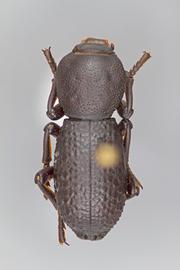
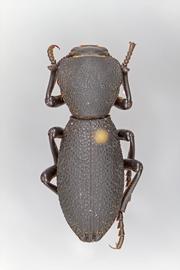
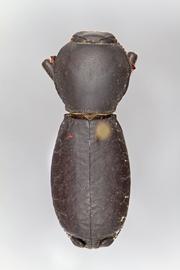
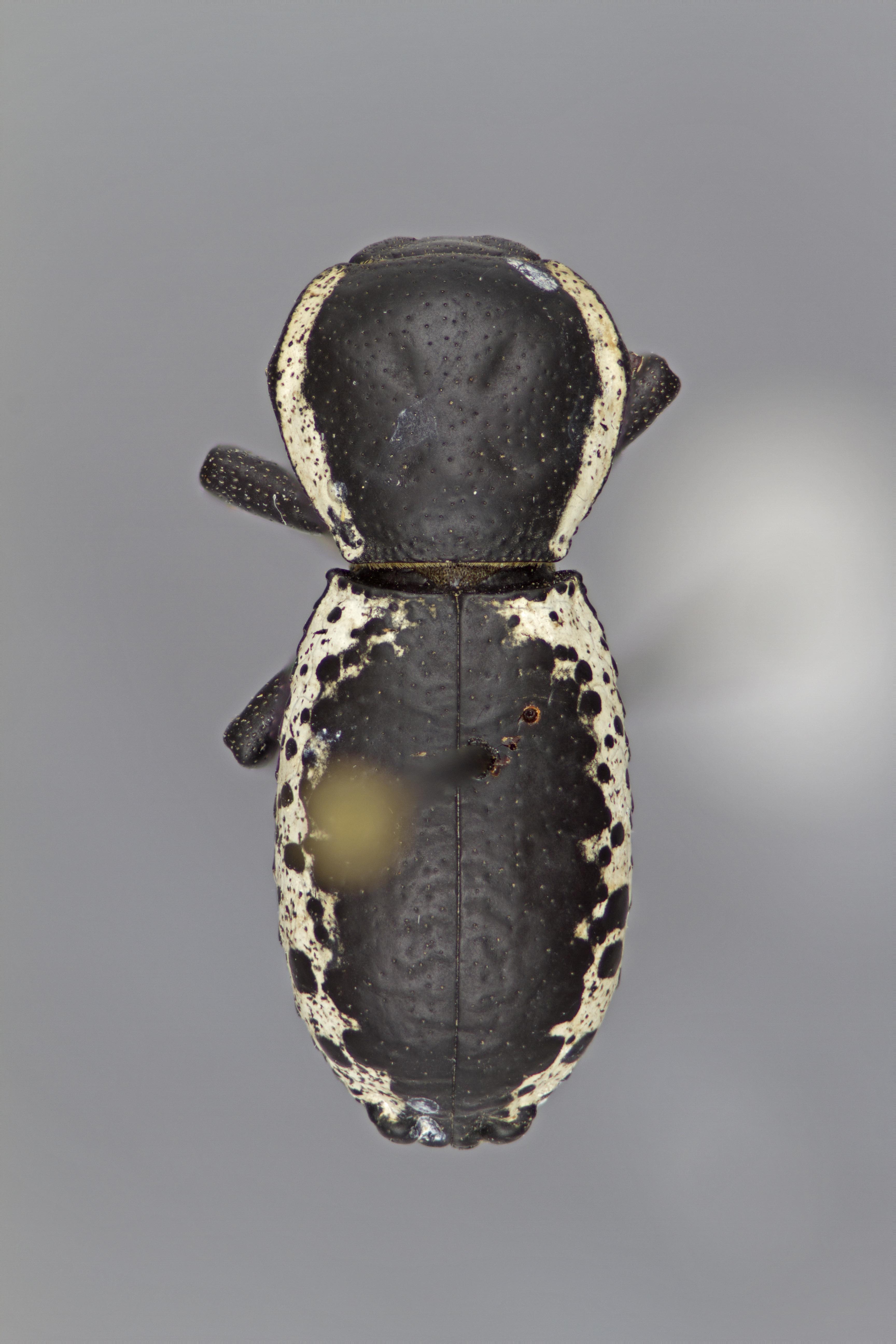
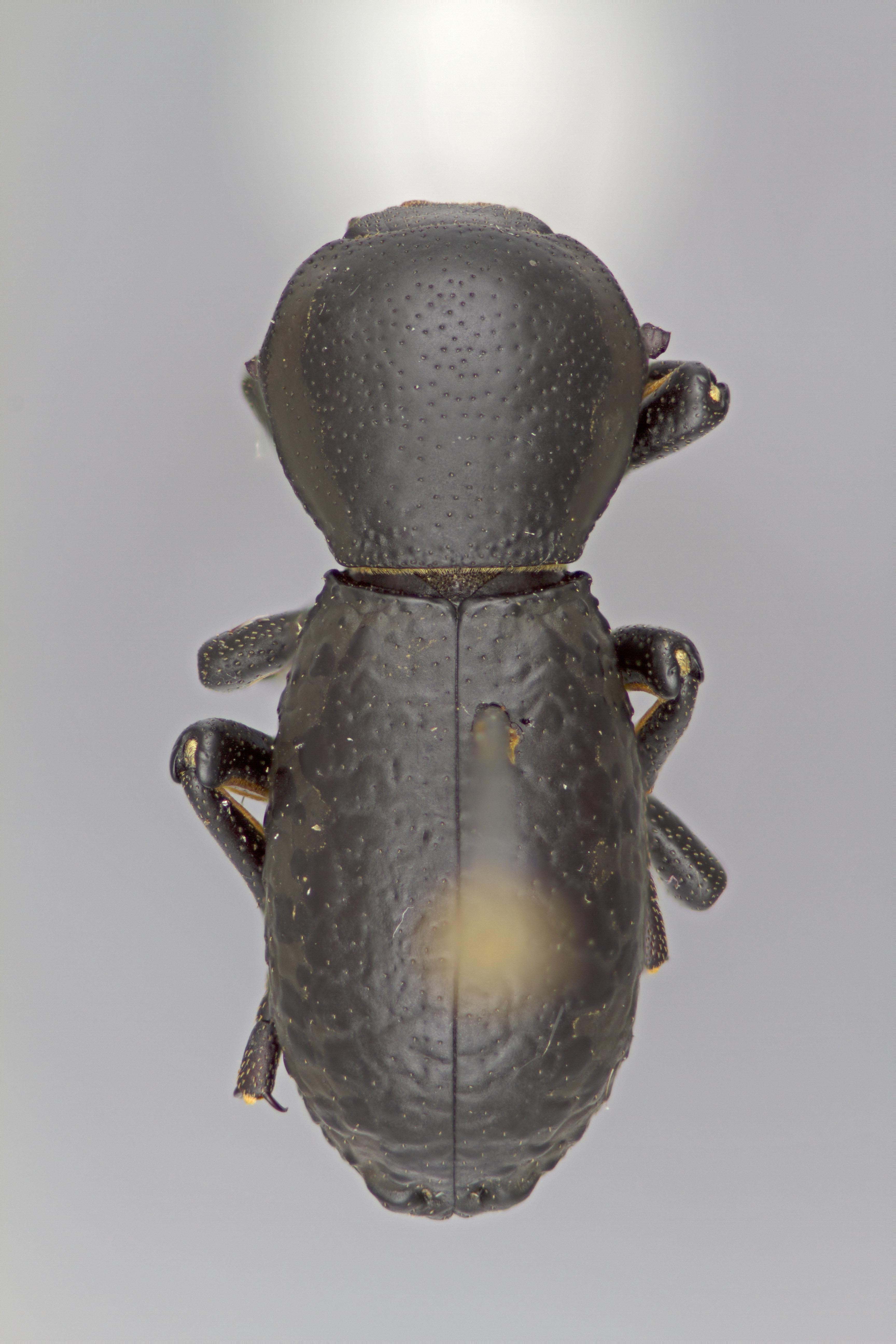
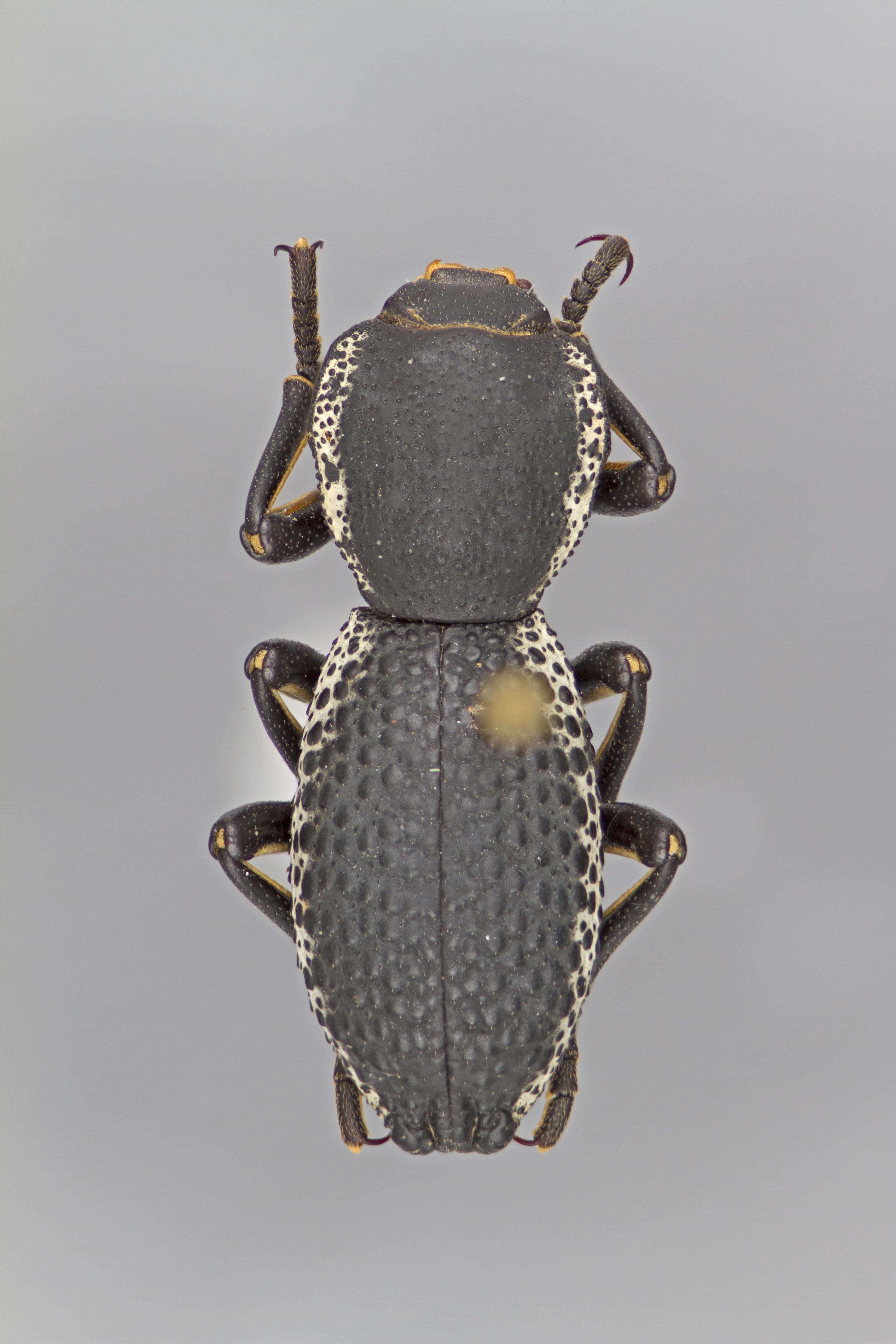
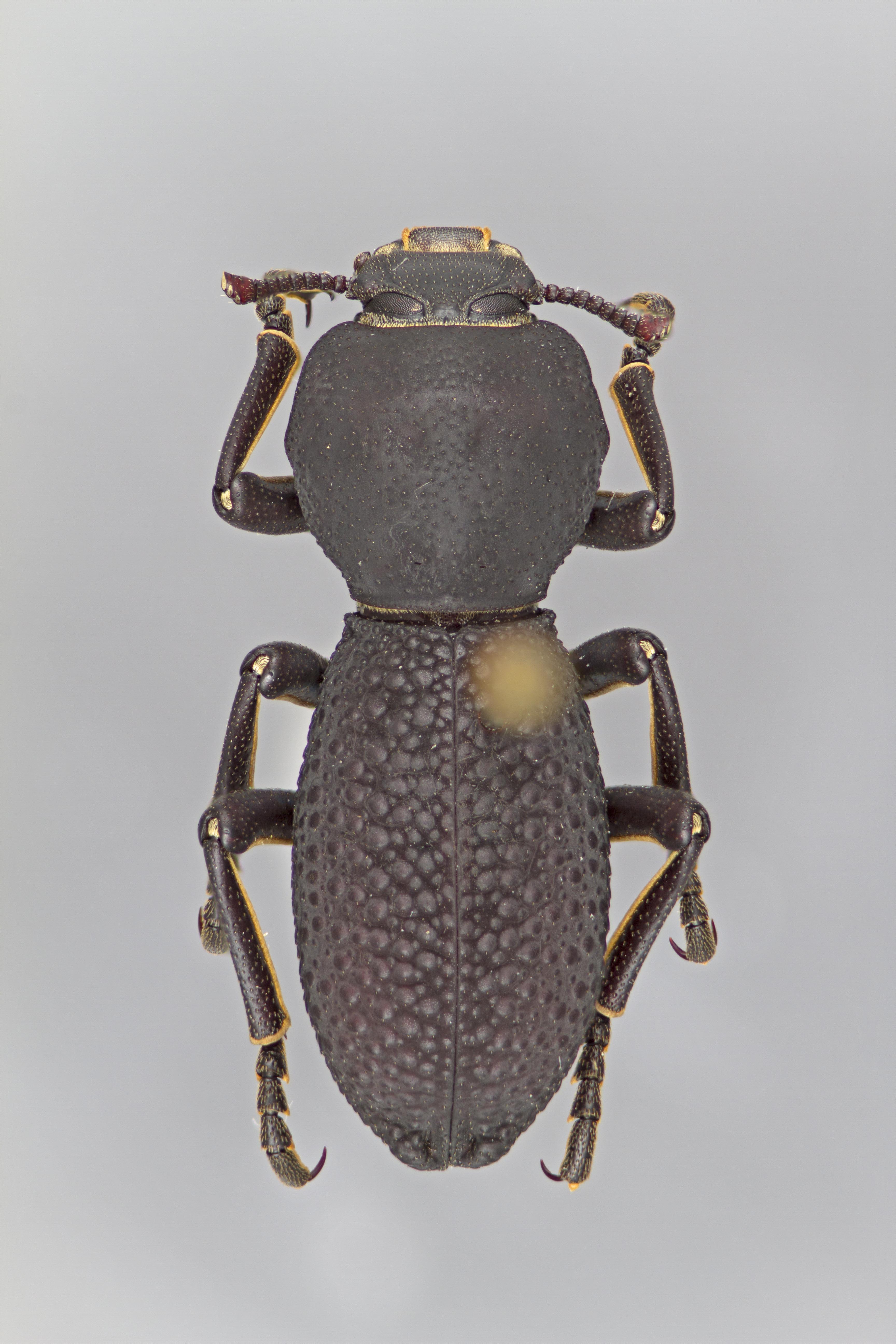
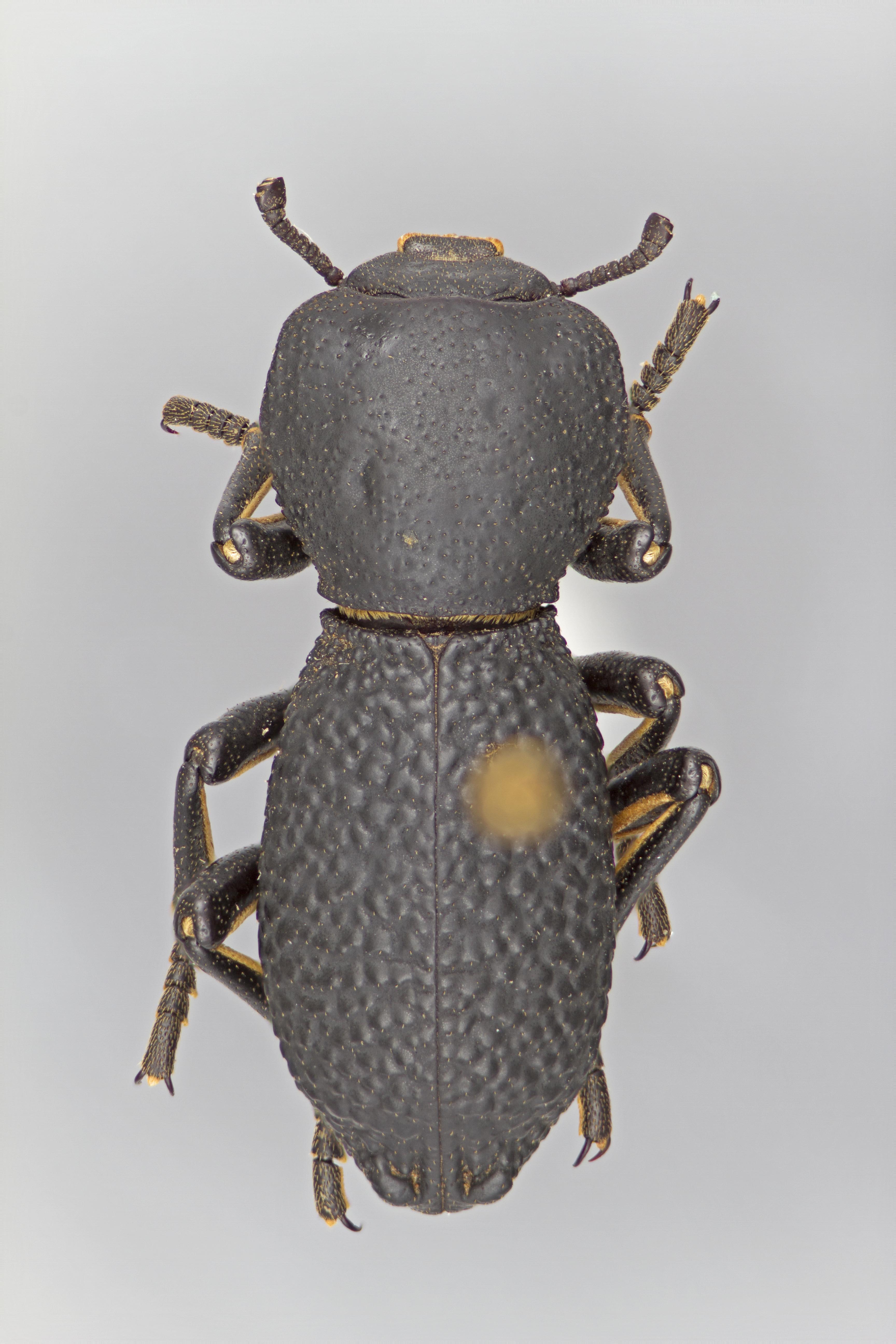
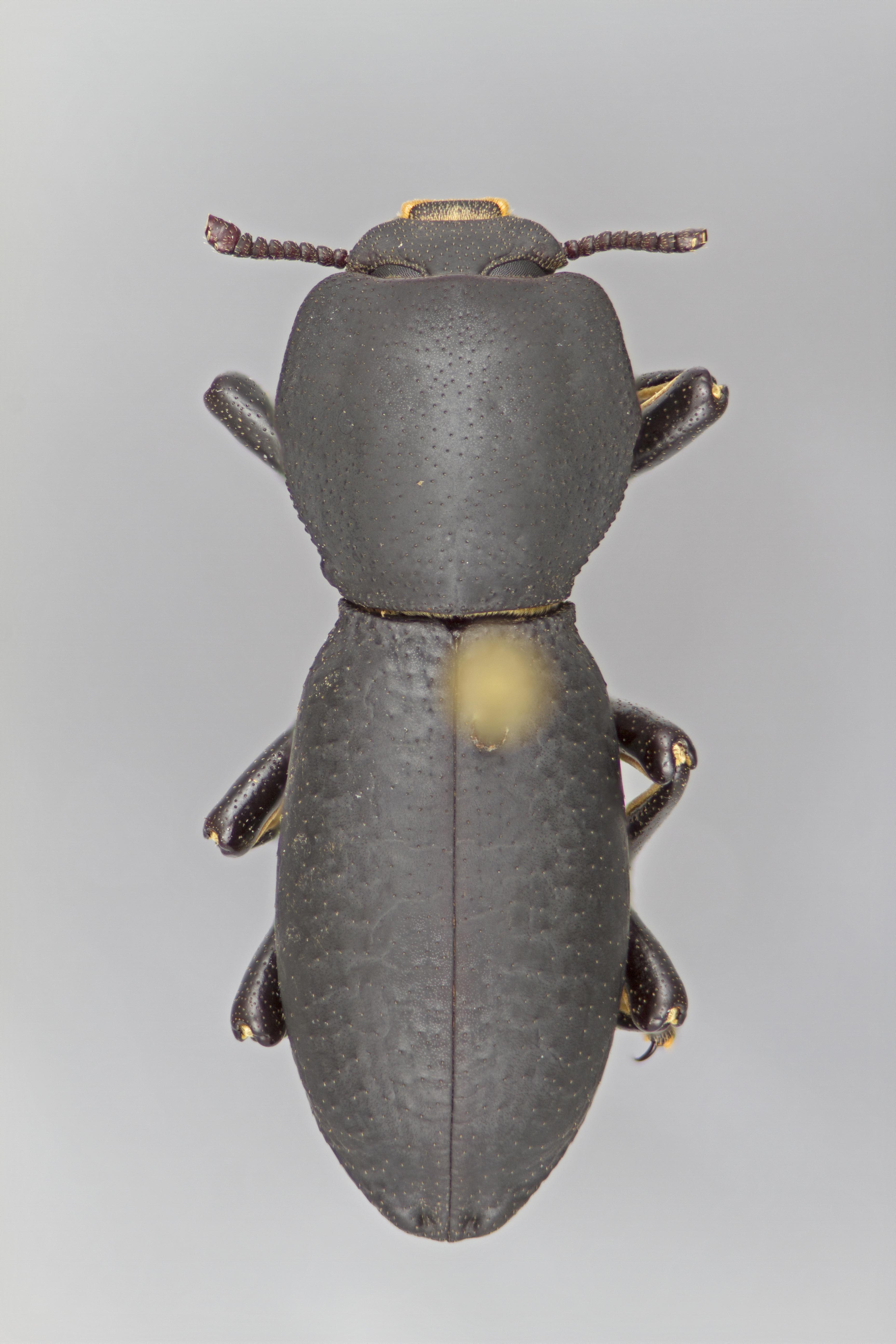
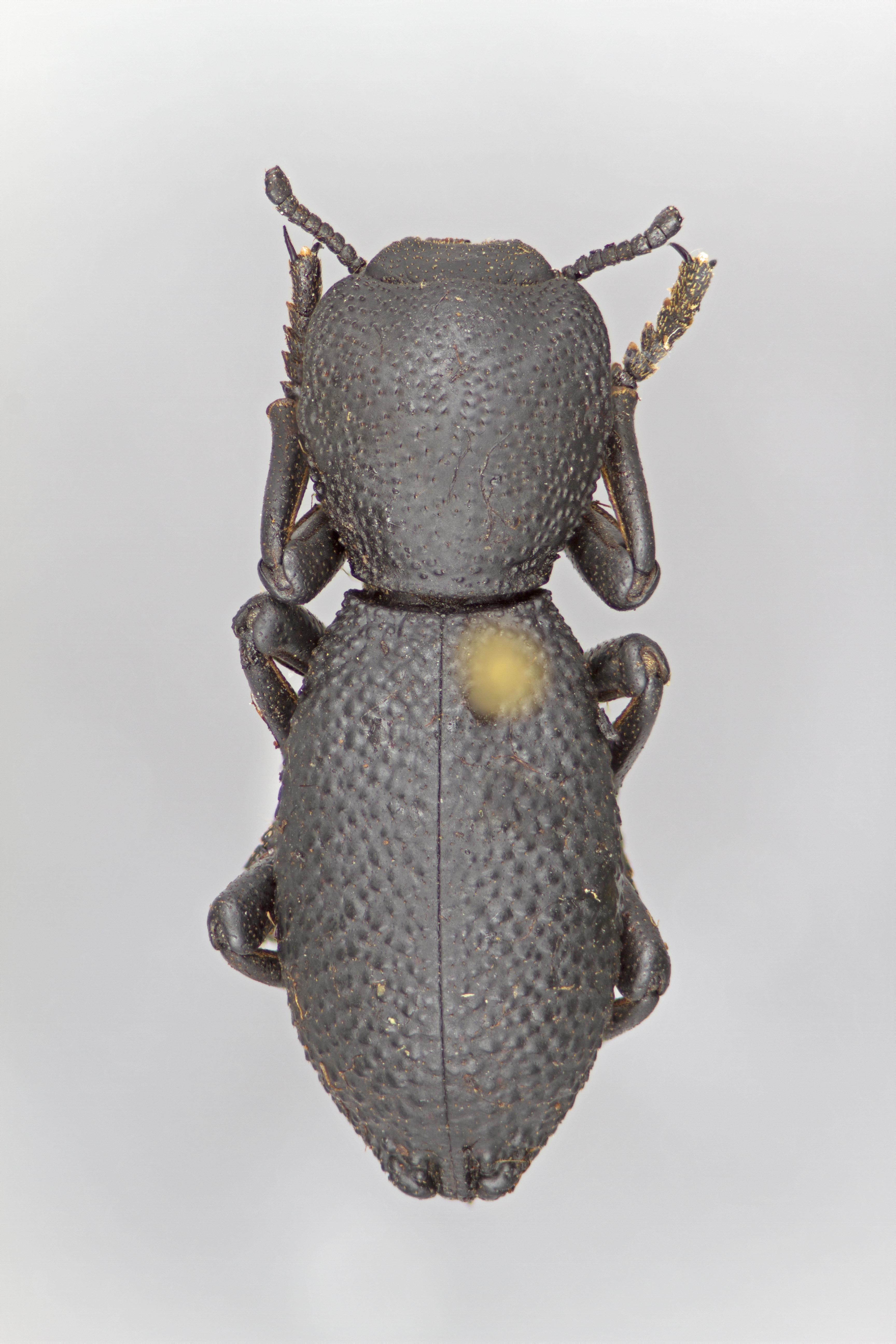
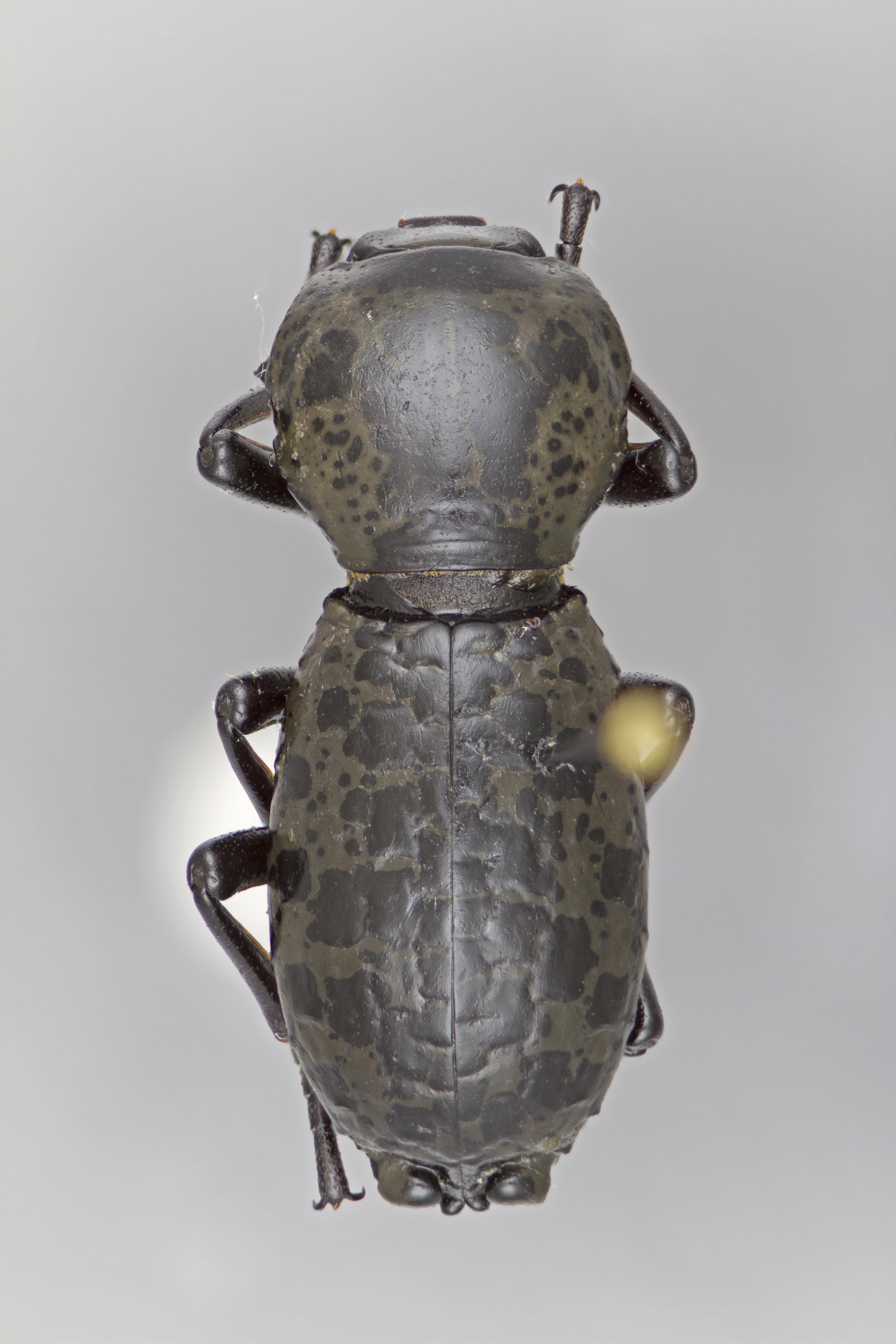
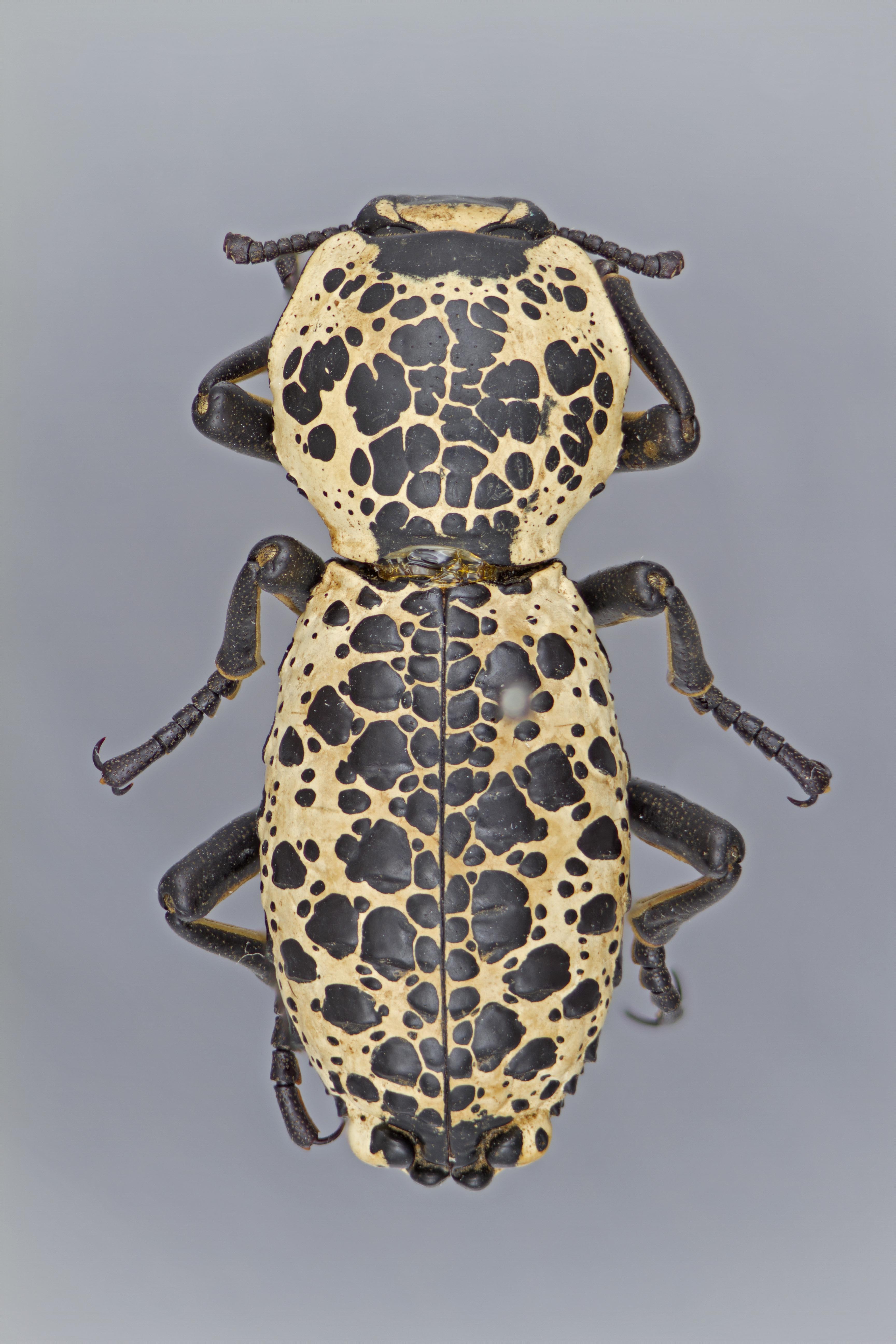
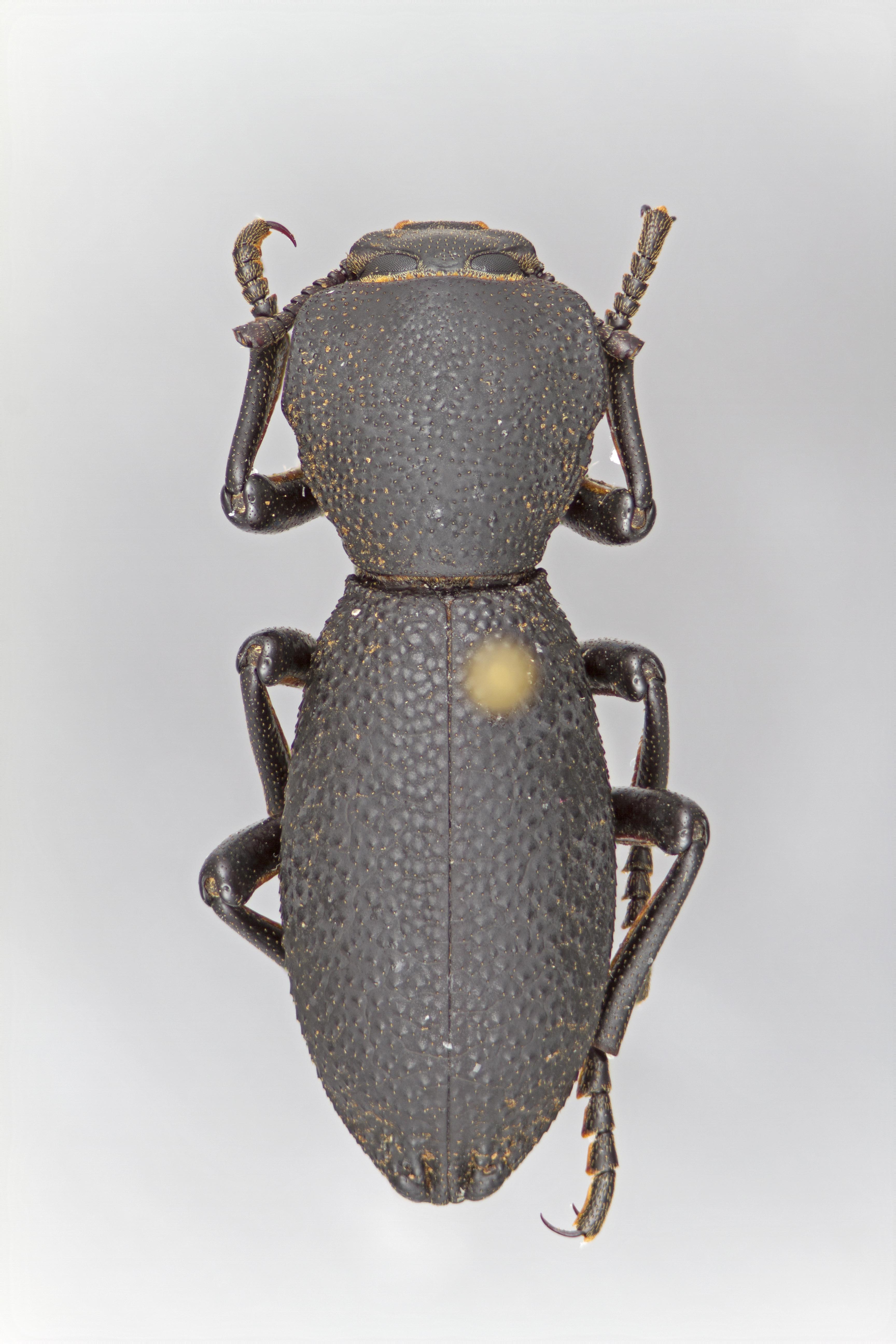
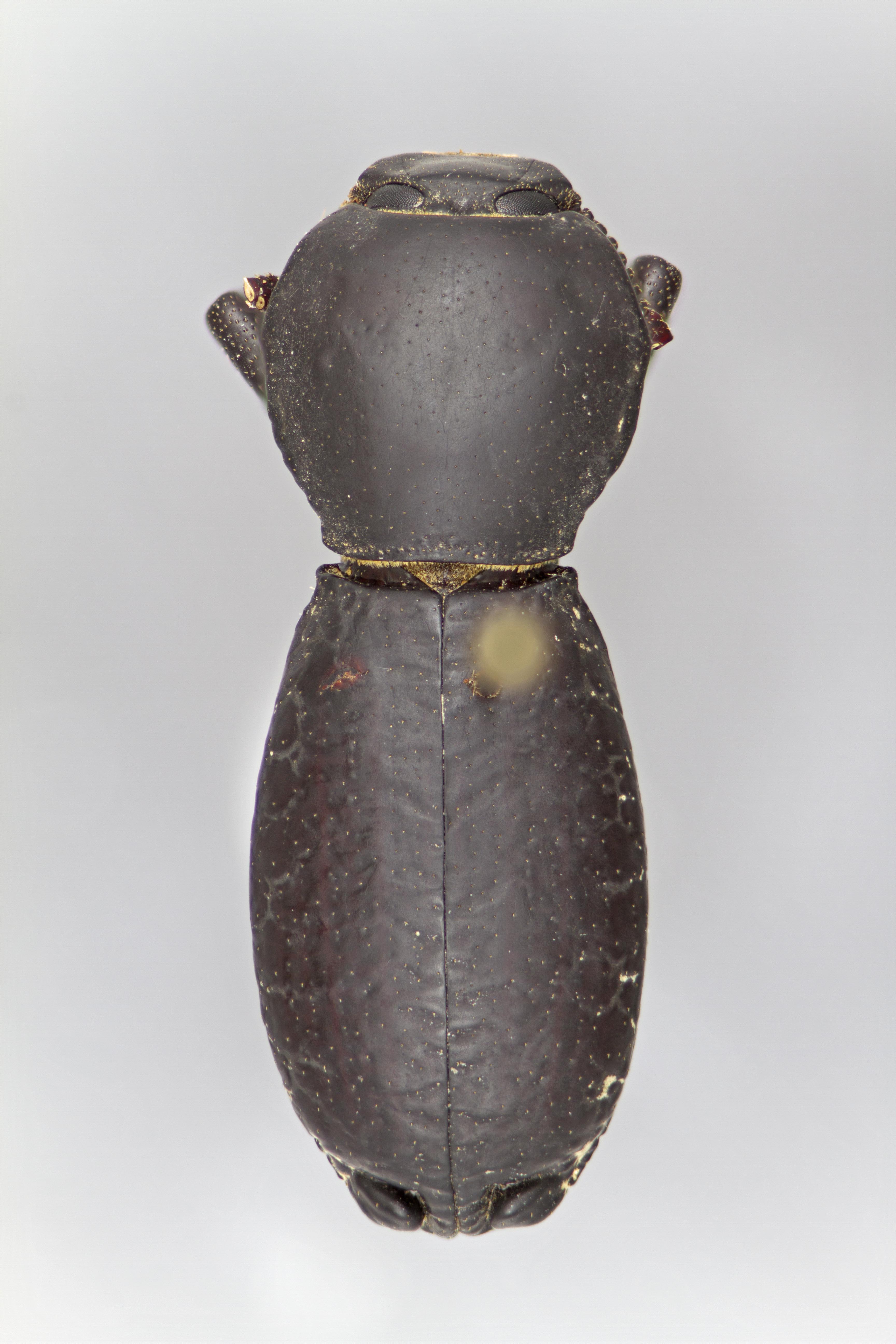
Antennaeantennae:
paired, segmental appendages, borne one on each side of head, functioning as sense organs and bearing a large number of sensilla.
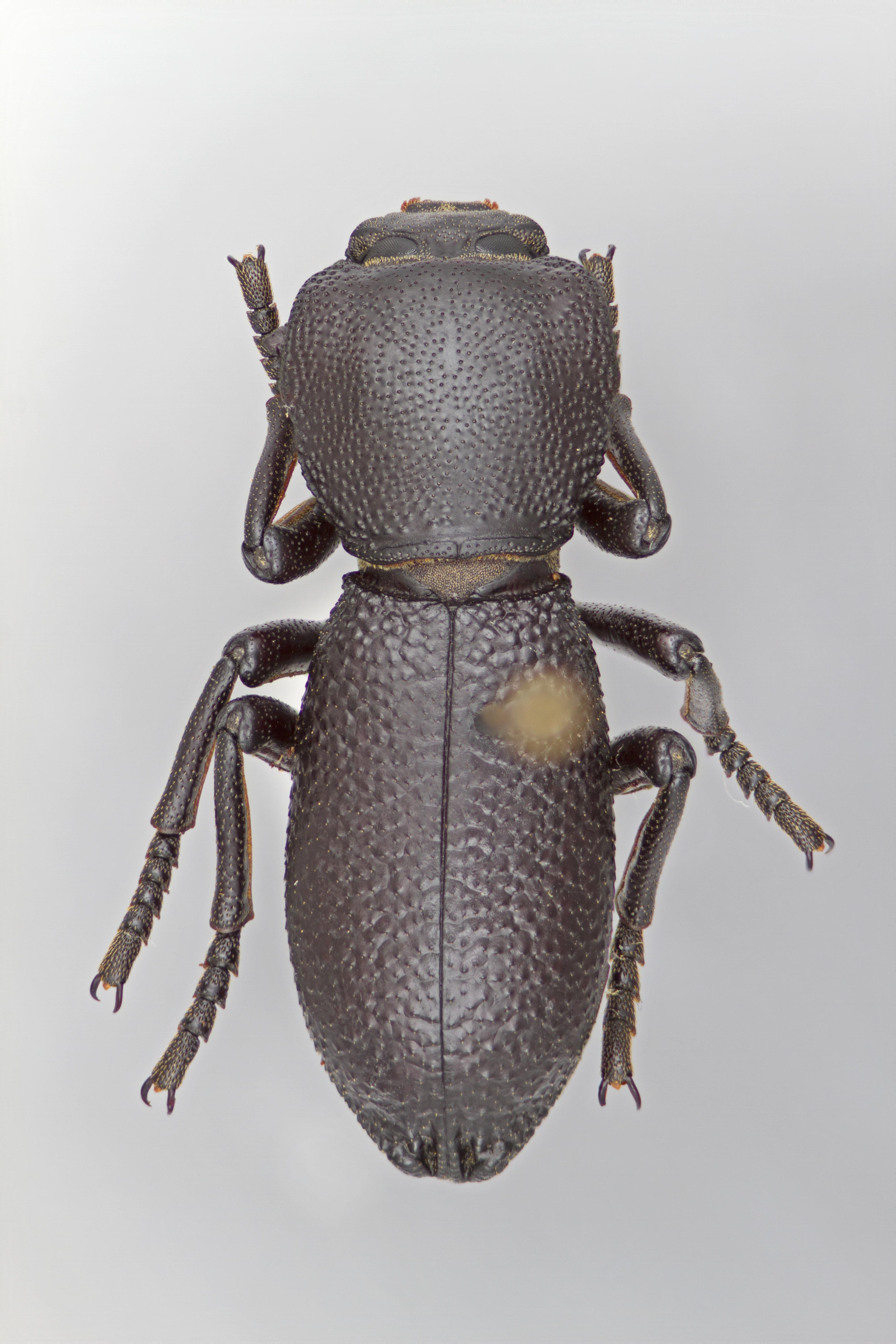
9-segmented with a 1-segmented club composed of 3 fused segments. Antennal setation sparse. Eyes well-developed, elongate-oval, somewhat reniformreniform:
kidney-shaped.
, coarsely faceted, extending well onto dorsal portion of head. Males without setose pit on submentum. Lateral margins of pronotumpronotum:
dorsal portion of the pronotum, lying above the lateral pronotal carinae when these are present.
arcuate to sinuatesinuate:
wavy, applying specifically to edges and margins.
, without distinct lobes, narrowed posteriorly. Hypomeronhypomeron:
that portion of the pronotum which is visible from the ventral side; when there is a lateral pronotal carina, this is the portion below that carina (the pronotal disc being above it).
with deep antennal cavitiesantennal cavity:
a prothoracic cavity for housing the whole antenna or a portion of the antenna (usually the club).
. ProsternumProsternum:
used for the entire ventral plate lying in front of and between the procoxae and between the notosternal or pleurosternal sutures.
with or without distinct transverse groove. Procoxal cavitiesprocoxal cavities:
external closure: Externally closed when the postcoxal processes of the hypomera meet the prosternal process or meet one another.
closed. Metacoxaemetacoxae:
the coxae of the metathorax.
moderately separated, separation slightly narrower than metacoxal length. Scutellumscutellum:
posterior portion of mesotergum. Often referring only to that portion of the scutellum which is visible between the bases of the elytra (see Scutellar Shield).
small, visible to indistinct. Abdominal ventriteabdominal ventrite:
visible ventral abdominal sclerite. Ventrite number does not correspond to true sternite number except in rare cases where sternite 1 is visible. Also called ventrite.
5 with an undivided preapical groove. Femorafemur:
the third and usually the stoutest segment of the beetle leg, articulated proximally with trochanter (or if the latter is absent, then the coxa) and distally with the tibia.
and tibiatibia:
the fourth and often the longest segment of the beetle leg, articulated proximally with the femur and distally with the first tarsomere.
with paired rows of golden setaeseta:
a sclerotized, hairlike (or scalelike) projection of cuticula arising from a single trichogen cell and surrounded at the base by a small cuticular ring.
on inner face. Tarsal formulatarsal formula:
the number of tarsomeres on the fore, mid, and hind tarsi, respectively.
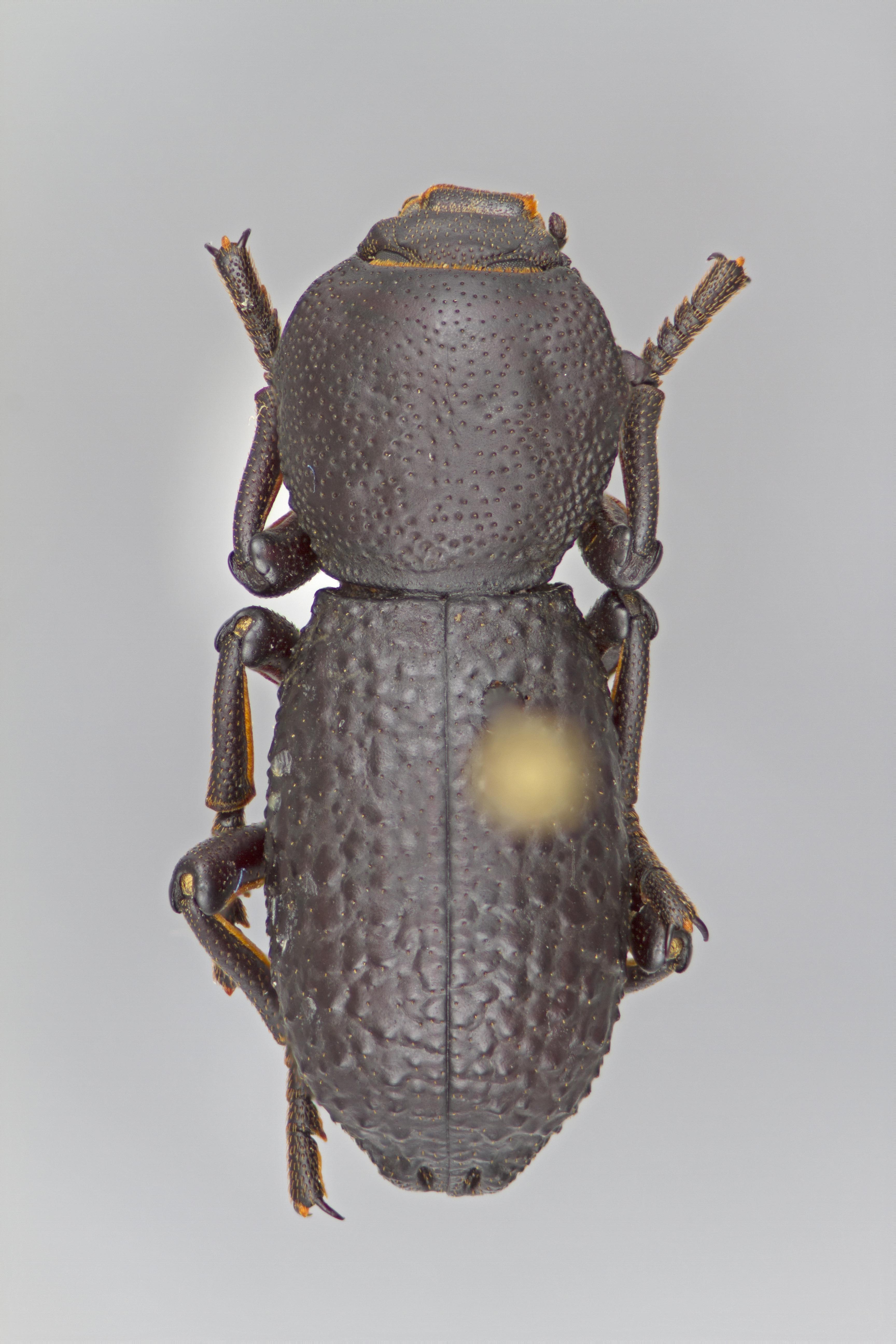
5–5–4. Dorsal surface glabrousglabrous:
without hairs (setae).
, piceuspiceus:
black.
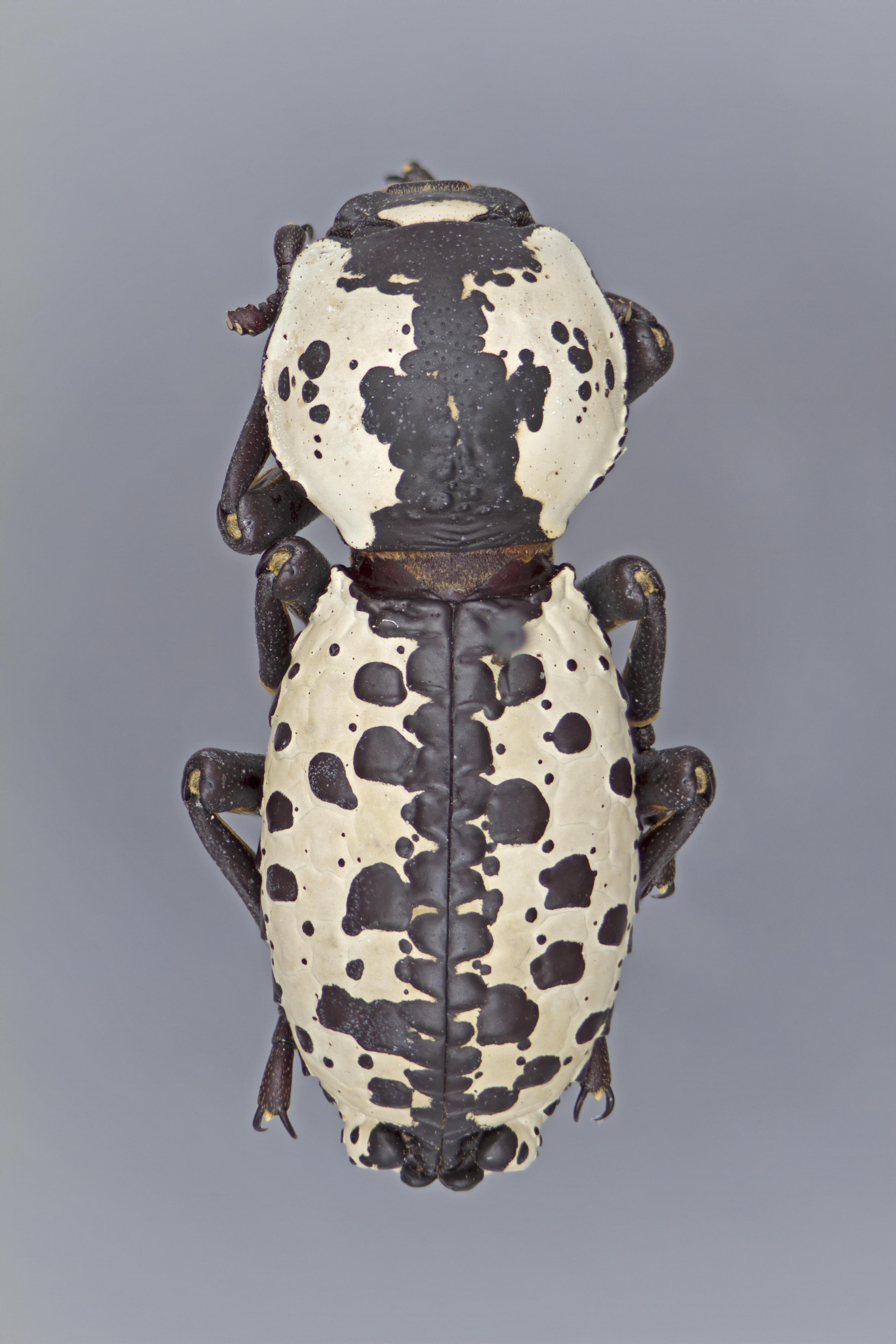
to bicolored with white and black.
The genus Zopherus is similar to the genera Sesaspis, Phloeodes, and Phellopsis but can immediately be distinguished by the 9-segmented antennaeantennae:
paired, segmental appendages, borne one on each side of head, functioning as sense organs and bearing a large number of sensilla.
with a 1-segmented club composed of 3 fused segments, the deep antennal cavitiesantennal cavity:
a prothoracic cavity for housing the whole antenna or a portion of the antenna (usually the club).
on the prothoracic hypomerahypomeron:
that portion of the pronotum which is visible from the ventral side; when there is a lateral pronotal carina, this is the portion below that carina (the pronotal disc being above it).
, and the paired rows of fine golden setaeseta:
a sclerotized, hairlike (or scalelike) projection of cuticula arising from a single trichogen cell and surrounded at the base by a small cuticular ring.
on all femorafemur:
the third and usually the stoutest segment of the beetle leg, articulated proximally with trochanter (or if the latter is absent, then the coxa) and distally with the tibia.
and tibiaetibia:
the fourth and often the longest segment of the beetle leg, articulated proximally with the femur and distally with the first tarsomere.
.
Zopherus championi Triplehorn, 1972Triplehorn, 1972:
Triplehorn, C.A. 1972. A review of the genus Zopherus of the world (Coleoptera: Tenebrionidae). Smithsonian Contributions to Zoology, 108: 1-24., Z. concolor LeConte, 1851LeConte, 1851:
LeConte, J.L. 1851. Descriptions of New Species of Coleoptera, from California. Annals of the Lyceum of Natural History of New York, 5: 125-184., Z. elegans Horn, 1870Horn, 1870:
Horn, G.H. 1870. Revision of the Tenebrionidae of America, North of Mexico. Transactions of the American Philosophical Society, series 2, 14: 253-404, illustrated., Z. gracilis Horn, 1867Horn, 1867:
Horn, G.H. 1867. Notes on the Zopheri of the United States. Transactions of the American Entomological Society, 1: 159-162., Z. granicollis Horn, 1885Horn, 1885:
Horn, G.H. 1885. Contributions to the coleopterology of the United States. No.4. Transactions of the American Entomological Society, 12: 128-162, illus., Z. nodulosus nodulosus Solier, 1841Solier, 1841:
Solier, A.J.J. 1841. Essai sur les Collapterides (suite). Annales de la Societe Entomologique de France, 10: 29-51, illustrated., Z. nodulosus haldemani Horn, 1870Horn, 1870:
Horn, G.H. 1870. Revision of the Tenebrionidae of America, North of Mexico. Transactions of the American Philosophical Society, series 2, 14: 253-404, illustrated.. Z. opacus Horn, 1867Horn, 1867:
Horn, G.H. 1867. Notes on the Zopheri of the United States. Transactions of the American Entomological Society, 1: 159-162., Z. sanctaehelenae (Blaisdell, 1931Blaisdell, 1931:
Blaisdell FE. 1931. A New Species of Zopherodes from Central California (Coleoptera: Tenebrionidae). Pan-Pacific Entomologist 7(3): 111-114.), Z. tristis LeConte, 1851LeConte, 1851:
LeConte, J.L. 1851. Descriptions of New Species of Coleoptera, from California. Annals of the Lyceum of Natural History of New York, 5: 125-184., Z. uteanus (Casey, 1907), Z. xestus Triplehorn, 1972Triplehorn, 1972:
Triplehorn, C.A. 1972. A review of the genus Zopherus of the world (Coleoptera: Tenebrionidae). Smithsonian Contributions to Zoology, 108: 1-24.
Southwest (AZ, CA, CO, NM, NV, UT), Southcentral (TX) USA; Mexico.
Zopherus occurs in rotting wood and plant matter. It is speculated that some members may be morphologically adapted (as larvae) for boring into sound wood (Doyen and Lawrence 1979Doyen and Lawrence 1979:
Doyen JT, Lawrence JF. 1979. Relationships and higher classification of some Tenebrionidae and Zopheridae (Coleoptera). Systematic Entomology. 4:333–377., Ślipiński and Lawrence 1999Ślipiński and Lawrence 1999:
Ślipiński SA, Lawrence JF. 1999. Phylogeny and classification of Zopheridae sensu novo (Coleoptera: Tenebrionoidea) with a review of the genera of Zopherinae (excluding Monommatini). Annales Zoologici (Warszawa). 49:1–53.). Larvae of Z. nodulosus has been found in pecan timber (Carya sp.) and larvae of Z. granicollis have been collected from the root crown of Pinus monophylla (Doyen and Lawrence 1979Doyen and Lawrence 1979:
Doyen JT, Lawrence JF. 1979. Relationships and higher classification of some Tenebrionidae and Zopheridae (Coleoptera). Systematic Entomology. 4:333–377.).
Abundance: Some species are locally common.
Zopherus championi: This species can be readily distinguished by the elytral apexapex:
end of any structure distad to the base.
bearing 2 swollen, obliqueoblique:
slanting; any direction between perpendicular and horizontal.
ridges on each side and the lateral margins of the elytraelytron:
the fore wing in Coleoptera, which is more or less uniformly sclerotized and in resting position is longitudinally oriented, usually meeting the opposite elytron along the midline.
and pronotumpronotum:
dorsal portion of the pronotum, lying above the lateral pronotal carinae when these are present.
bordered in white (some specimens lack white lateral margins). This species is most similar to Z. elegans, and can be distinguished by pronotal surface consisting of simple puncturespuncture:
a small impression on the cuticle, like that made by a needle.
(compared to small, scabrousscabrous:
irregularly and roughly rugose; possessing short, sharp projections or wrinkles.
bumps or tuberclestubercle:
a small knoblike or rounded protuberance.
in Z. elegans) and the prosternumProsternum:
used for the entire ventral plate lying in front of and between the procoxae and between the notosternal or pleurosternal sutures.
anterad of procoxaeprocoxae:
the coxae of the prothorax.
with punctured but lacking distinct tuberclestubercle:
a small knoblike or rounded protuberance.
. This species may sometimes be covered in a greasy exudate, rendering the specimen almost entirely black in color. If this is the case, Z. championi will greatly resemble Z. gracilis, but can be separated by the distribution, more convex pronotal discpronotal disc:
the area of the pronotum which is visible dorsally and usually delimited laterally by the two lateral carinae. Contrasted with the paired pronotal hypomera, which extend onto the ventral surface.
, puncturespuncture:
a small impression on the cuticle, like that made by a needle.
on pronotal discpronotal disc:
the area of the pronotum which is visible dorsally and usually delimited laterally by the two lateral carinae. Contrasted with the paired pronotal hypomera, which extend onto the ventral surface.
deeper, and a hint of coloration on the elytraelytron:
the fore wing in Coleoptera, which is more or less uniformly sclerotized and in resting position is longitudinally oriented, usually meeting the opposite elytron along the midline.
. Distribution: Texas, USA; Mexico.
Zopherus concolor: This species can be readily distinguished by the elytral apexapex:
end of any structure distad to the base.
bearing 2 swollen, obliqueoblique:
slanting; any direction between perpendicular and horizontal.
ridges on each side, solid black body, pronotumpronotum:
dorsal portion of the pronotum, lying above the lateral pronotal carinae when these are present.
with small, deep, moderately sparse puncturespuncture:
a small impression on the cuticle, like that made by a needle.
, and distinctly scabrousscabrous:
irregularly and roughly rugose; possessing short, sharp projections or wrinkles.
, irregularly tuberculate elytral sculpture (as opposed to vermiculate in other species). Zopherus concolor is most similar to Z. tristis but can be distinguished by the shallower and more sparse pronotal puncturespuncture:
a small impression on the cuticle, like that made by a needle.
and the elytral scabrousscabrous:
irregularly and roughly rugose; possessing short, sharp projections or wrinkles.
tublercles more distinctly raised and prominent. Distribution: New Mexico, Texas, USA.
Zopherus elegans: This species can be readily distinguished by the elytral apexapex:
end of any structure distad to the base.
bearing 2 swollen, obliqueoblique:
slanting; any direction between perpendicular and horizontal.
ridges on each side and the lateral margins of the elytraelytron:
the fore wing in Coleoptera, which is more or less uniformly sclerotized and in resting position is longitudinally oriented, usually meeting the opposite elytron along the midline.
and pronotumpronotum:
dorsal portion of the pronotum, lying above the lateral pronotal carinae when these are present.
bordered in white (some specimens lack white lateral margins). This species is most similar to Z. championi and can be distinguished by pronotal surface consisting of small, scabrousscabrous:
irregularly and roughly rugose; possessing short, sharp projections or wrinkles.
bumps or tuberclestubercle:
a small knoblike or rounded protuberance.
(compared to simple puncturespuncture:
a small impression on the cuticle, like that made by a needle.
in Z. championi) and the prosternumProsternum:
used for the entire ventral plate lying in front of and between the procoxae and between the notosternal or pleurosternal sutures.
anterad of procoxaeprocoxae:
the coxae of the prothorax.
with distinct tuberclestubercle:
a small knoblike or rounded protuberance.
, not puncturespuncture:
a small impression on the cuticle, like that made by a needle.
. This species may sometimes lack the whitish lateral pronotal and elytral margins, rendering the specimen almost entirely black in color. If this is the case, Z. elegans will greatly resemble Z. granicollis and Z. uteanus, but can be separated by the evenly curved anterioranterior:
in front; before.
margin of the pronoum (when viewed anteriorly), as opposed to bisinuatebisinuate:
with 2 sinuations or incisions.
in Z. granicollis and Z. uteanus. Distribution: Arizona, New Mexico, Utah, USA.
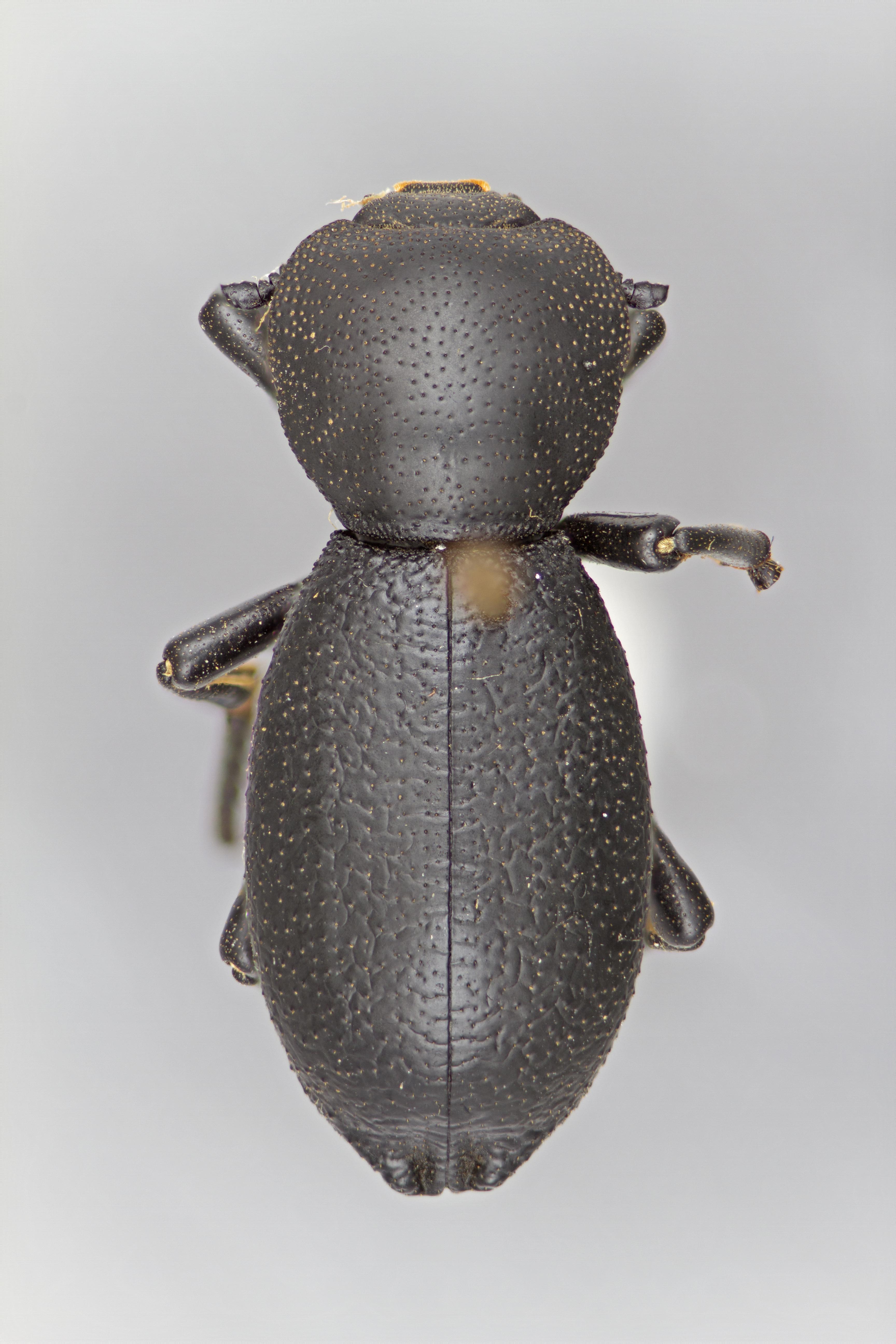
Zopherus gracilis: This species can be readily distinguished by the elytral apexapex:
end of any structure distad to the base.
bearing 2 swollen, obliqueoblique:
slanting; any direction between perpendicular and horizontal.
ridges on each side and the pronotumpronotum:
dorsal portion of the pronotum, lying above the lateral pronotal carinae when these are present.
smooth, impunctate, the elytraelytron:
the fore wing in Coleoptera, which is more or less uniformly sclerotized and in resting position is longitudinally oriented, usually meeting the opposite elytron along the midline.
impunctate, smooth to slightly wrinkled, and the solid black dorsum. Zopherus gracilis is most similar to Z. xestus but can immediately be distinguished by the 2 slightly swollen obliqueoblique:
slanting; any direction between perpendicular and horizontal.
ridges at the elytral apexapex:
end of any structure distad to the base.
, whereas in Z. xestus the elytral apexapex:
end of any structure distad to the base.
bears 2 large, swollen, oval tuberclestubercle:
a small knoblike or rounded protuberance.
. Distribution: Arizona, New Mexico, USA; Mexico.
Zopherus granicollis: This species can be readily distinguished by the elytral apexapex:
end of any structure distad to the base.
bearing 2 swollen, obliqueoblique:
slanting; any direction between perpendicular and horizontal.
ridges on each side, solid black body, pronotumpronotum:
dorsal portion of the pronotum, lying above the lateral pronotal carinae when these are present.
and elytraelytron:
the fore wing in Coleoptera, which is more or less uniformly sclerotized and in resting position is longitudinally oriented, usually meeting the opposite elytron along the midline.
bearing small, regular scabrous tuberclestubercle:
a small knoblike or rounded protuberance.
subequal in size and more or less evenly distributed. Zopherus granicollis is most similar to Z. uteanus but differs in the prosternal processprosternal process:
Posterior projection of the mesal portion of the prosternum which extends between the procoxae and may overlap the mesoventrite or fit into the mesoventral cavity.
between the coxaecoxa:
the basal segment of the leg, by means of which it is articulated to the body.
more densely punctate (as opposed to sparsely punctate in Z. uteanus), coarser clypeal puncturespuncture:
a small impression on the cuticle, like that made by a needle.
, and pronotumpronotum:
dorsal portion of the pronotum, lying above the lateral pronotal carinae when these are present.
usually narrower than elytraelytron:
the fore wing in Coleoptera, which is more or less uniformly sclerotized and in resting position is longitudinally oriented, usually meeting the opposite elytron along the midline.
. NOTE: This species has two subspecies, Z. granicollis granicollis and Z. granicollis ventriosus. Zopherus granicollis granicollis can be separated from Z. granicollis ventriosus in the overall larger size of the elytral tuberclestubercle:
a small knoblike or rounded protuberance.
and lateral tuberclestubercle:
a small knoblike or rounded protuberance.
of the elytraelytron:
the fore wing in Coleoptera, which is more or less uniformly sclerotized and in resting position is longitudinally oriented, usually meeting the opposite elytron along the midline.
similar in size and shape to those on rest of elytraelytron:
the fore wing in Coleoptera, which is more or less uniformly sclerotized and in resting position is longitudinally oriented, usually meeting the opposite elytron along the midline.
, whereas in Z. granicollis ventriosus, the elytral tuberclestubercle:
a small knoblike or rounded protuberance.
are overall smaller in size and the lateral tuberclestubercle:
a small knoblike or rounded protuberance.
of the elytraelytron:
the fore wing in Coleoptera, which is more or less uniformly sclerotized and in resting position is longitudinally oriented, usually meeting the opposite elytron along the midline.
are transversely elongate. Distribution: Arizona, California, Nevada, USA; Mexico.
Zopherus opacus: This species can be readily distinguished by the elytral apexapex:
end of any structure distad to the base.
bearing 2 swollen, obliqueoblique:
slanting; any direction between perpendicular and horizontal.
ridges on each side, solid black body, pronotumpronotum:
dorsal portion of the pronotum, lying above the lateral pronotal carinae when these are present.
with small, moderately dense puncturespuncture:
a small impression on the cuticle, like that made by a needle.
, and distinctly vermiculate and minutely tuberculate or bumpy elytral sculpture (as opposed to with scabrousscabrous:
irregularly and roughly rugose; possessing short, sharp projections or wrinkles.
, flattened tuberclestubercle:
a small knoblike or rounded protuberance.
in other species) The similar size and density of the small bumps/tubercles of the pronotumpronotum:
dorsal portion of the pronotum, lying above the lateral pronotal carinae when these are present.
and elytraelytron:
the fore wing in Coleoptera, which is more or less uniformly sclerotized and in resting position is longitudinally oriented, usually meeting the opposite elytron along the midline.
serve to separate this species. Distribution: California, Nevada, Utah, USA.
Zopherus nodulosus: This species can be readily distinguished by the elytral apexapex:
end of any structure distad to the base.
bearing 4 distinct tuberclestubercle:
a small knoblike or rounded protuberance.
, the inner pair being smaller than the outer, and the bicolorous, black and white dorsum. NOTE: This species has two subspecies, Z. nodulosus nodulosus and Z. nodulosus haldemani. Z. nodulosus nodulosus can be separated from Z. nodulosus haldemani in the pronotumpronotum:
dorsal portion of the pronotum, lying above the lateral pronotal carinae when these are present.
and elytraelytron:
the fore wing in Coleoptera, which is more or less uniformly sclerotized and in resting position is longitudinally oriented, usually meeting the opposite elytron along the midline.
mostly white with black coloration mostly restricted to midline, whereas in Z. nodulosus haldemani, the black coloration is more widespread. There can also be darker color morphs (nearly all black) of both subspecies. Zopherus nodulosus nodulosus occurs in Mexico whereas Z. nodulosus haldemani occurs in Texas and Mexico. Distribution: Texas, USA; Mexico.
Zopherus sanctaehelenae: This species can be readily distinguished by the elytral apexapex:
end of any structure distad to the base.
bearing 2 swollen, obliqueoblique:
slanting; any direction between perpendicular and horizontal.
ridges on each side, solid black body, pronotumpronotum:
dorsal portion of the pronotum, lying above the lateral pronotal carinae when these are present.
with small, moderately sparse puncturespuncture:
a small impression on the cuticle, like that made by a needle.
, and distinctly vermiculate and minutely punctate elytral sculpture (as opposed to with scabrousscabrous:
irregularly and roughly rugose; possessing short, sharp projections or wrinkles.
, flattened tuberclestubercle:
a small knoblike or rounded protuberance.
in other species). Distribution: California, USA.
Zopherus tristis: This species can be readily distinguished by the elytral apexapex:
end of any structure distad to the base.
bearing 2 swollen, obliqueoblique:
slanting; any direction between perpendicular and horizontal.
ridges on each side, solid black body, pronotumpronotum:
dorsal portion of the pronotum, lying above the lateral pronotal carinae when these are present.
with small, deep, moderately sparse puncturespuncture:
a small impression on the cuticle, like that made by a needle.
, and distinctly scabrousscabrous:
irregularly and roughly rugose; possessing short, sharp projections or wrinkles.
, irregularly tuberculate elytral sculpture (as opposed to vermiculate in other species). Zopherus tristis is most similar to Z. concolor but can be distinguished by the deeper and more dense pronotal puncturespuncture:
a small impression on the cuticle, like that made by a needle.
and the elytral scabrousscabrous:
irregularly and roughly rugose; possessing short, sharp projections or wrinkles.
tublercles less distinctly raised. Distribution: Arizona, California, Colorado, Texas, USA; Mexico.
Zopherus uteanus: This species can be readily distinguished by the elytral apexapex:
end of any structure distad to the base.
bearing 2 swollen, obliqueoblique:
slanting; any direction between perpendicular and horizontal.
ridges on each side, solid black body, pronotumpronotum:
dorsal portion of the pronotum, lying above the lateral pronotal carinae when these are present.
and elytraelytron:
the fore wing in Coleoptera, which is more or less uniformly sclerotized and in resting position is longitudinally oriented, usually meeting the opposite elytron along the midline.
bearing small, regular scabrous tuberclestubercle:
a small knoblike or rounded protuberance.
subequal in size and more or less evenly distributed. Z. uteanus is most similar to Z. granicollis but differs in the prosternal processprosternal process:
Posterior projection of the mesal portion of the prosternum which extends between the procoxae and may overlap the mesoventrite or fit into the mesoventral cavity.
between the coxaecoxa:
the basal segment of the leg, by means of which it is articulated to the body.
sparsely punctate (as opposed to more densely punctate in Z. granicollis), clypeal puncturespuncture:
a small impression on the cuticle, like that made by a needle.
smaller and sparser, and pronotumpronotum:
dorsal portion of the pronotum, lying above the lateral pronotal carinae when these are present.
usually as wide or wider than elytraelytron:
the fore wing in Coleoptera, which is more or less uniformly sclerotized and in resting position is longitudinally oriented, usually meeting the opposite elytron along the midline.
. Distribution: Arizona, California, Nevada, Utah, USA.
Zopherus xestus: This species can be readily distinguished by the elytral apexapex:
end of any structure distad to the base.
bearing 2 distinct tuberclestubercle:
a small knoblike or rounded protuberance.
, the pronotumpronotum:
dorsal portion of the pronotum, lying above the lateral pronotal carinae when these are present.
smooth, impunctate, the elytraelytron:
the fore wing in Coleoptera, which is more or less uniformly sclerotized and in resting position is longitudinally oriented, usually meeting the opposite elytron along the midline.
impunctate, smooth to slightly wrinkled, and the solid black dorsum. Zopherus xestus is most similar to Z. gracilis but can immediately be distinguished by the 2 tuberclestubercle:
a small knoblike or rounded protuberance.
at the elytral apexapex:
end of any structure distad to the base.
large, swollen, and oval in shape, whereas in Z. gracilis the elytral apexapex:
end of any structure distad to the base.
bears a slightly swollen obliqueoblique:
slanting; any direction between perpendicular and horizontal.
ridge. Distribution: Texas, USA.
Many of the North American members of this genus are quite similar in general appearance and can be difficult to accurately identify. The species which exhibit patterns of black and white coloration also have black forms, which greatly hinder identification. This black coloration is caused by a greasy exudate, which conceals the white coloration and many of the surface sculpture. The exudate can be removed by soaking the specimen in a grease solvent.
Casey (1907a)Casey (1907a):
Casey TL. 1907a. Notes on Chalcolepidius and the Zopherini. Canadian Entomologist 39: 29-46., Blaisdell (1931)Blaisdell (1931):
Blaisdell FE. 1931. A New Species of Zopherodes from Central California (Coleoptera: Tenebrionidae). Pan-Pacific Entomologist 7(3): 111-114., Doyen and Lawrence (1979)Doyen and Lawrence (1979):
Doyen JT and Lawrence JF. 1979. Relationships and higher classification of some Tenebrionidae and Zopheridae (Coleoptera). Systematic Entomology 4: 333-377., Foley and Ivie (2008b)Foley and Ivie (2008b):
Foley IA and Ivie MA. 2008b. A phylogenetic analysis of the tribe Zopherini with a review of the species and generic classification (Coleoptera: Zopheridae). Zootaxa 1928: 1-72., Horn (1867)Horn (1867):
Horn, G.H. 1867. Notes on the Zopheri of the United States. Transactions of the American Entomological Society, 1: 159-162., Horn (1870)Horn (1870):
Horn, G.H. 1870. Revision of the Tenebrionidae of America, North of Mexico. Transactions of the American Philosophical Society, series 2, 14: 253-404, illustrated., Horn (1885)Horn (1885):
Horn, G.H. 1885. Contributions to the coleopterology of the United States. No.4. Transactions of the American Entomological Society, 12: 128-162, illus., Ivie (2002c)Ivie (2002c):
Ivie, M.A. 2002c. 129. Zopheridae, pp. 457-462 In: R. H. Arnett, Jr., Jr. and M. C. Thomas (eds.), American Beetles. CRC Press, Gainesville, Florida., LeConte (1851)LeConte (1851):
LeConte, J.L. 1851. Descriptions of New Species of Coleoptera, from California. Annals of the Lyceum of Natural History of New York, 5: 125-184., Ślipiński and Lawrence (1999)Ślipiński and Lawrence (1999):
Ślipiński, S.A. and J.F. Lawrence. 1999. Phylogeny and classification of Zopheridae sensu novo (Coleoptera: Tenebrionoidea) with a review of the genera of Zopherinae (excluding Monommatini). Annales Zoologici (Warszawa), 49: 1-53., Solier (1841)Solier (1841):
Solier, A.J.J. 1841. Essai sur les Collapterides (suite). Annales de la Societe Entomologique de France, 10: 29-51, illustrated., Triplehorn (1972)Triplehorn (1972):
Triplehorn, C.A. 1972. A review of the genus Zopherus of the world (Coleoptera: Tenebrionidae). Smithsonian Contributions to Zoology, 108: 1-24.
Authors: Lord NP, Nearns EH, Miller KB. 2011–2015.
Content updated Apr 2015; taxonomy updated Feb 2026
idtools.org