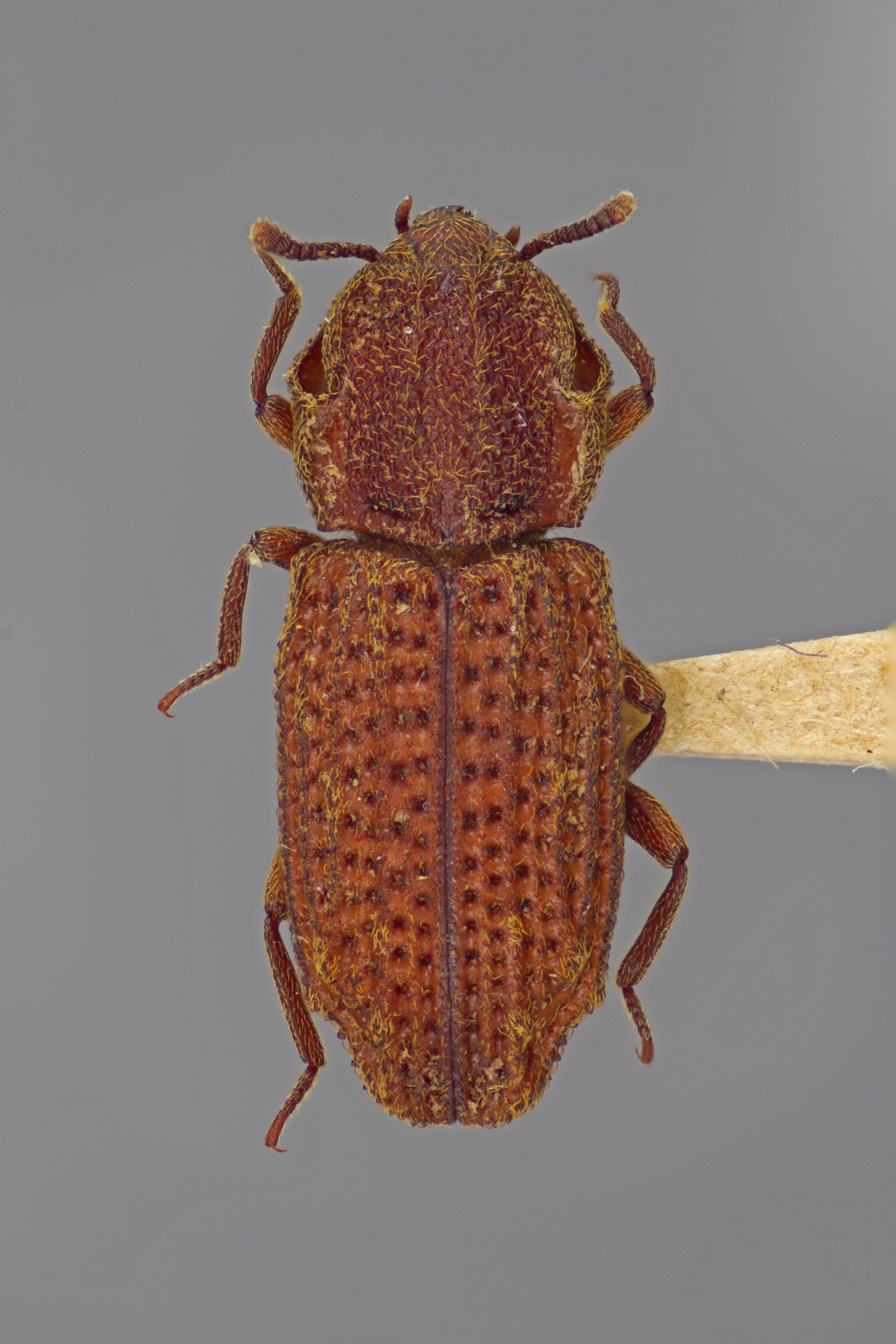
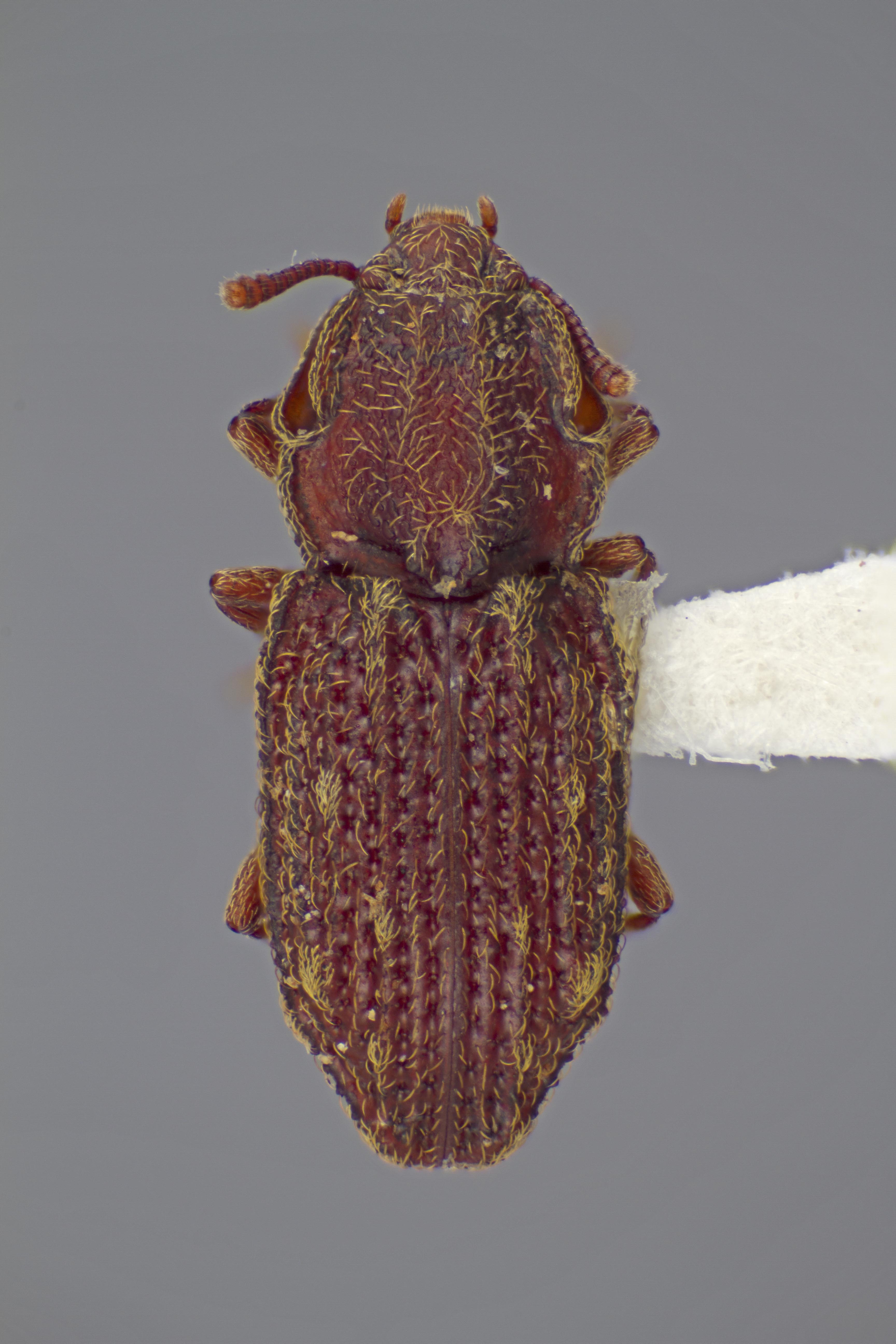
Antennaeantennae:
paired, segmental appendages, borne one on each side of head, functioning as sense organs and bearing a large number of sensilla.
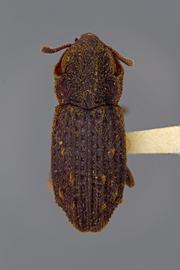
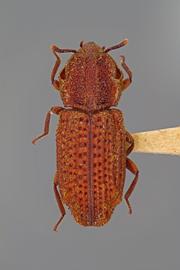
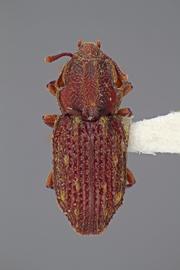
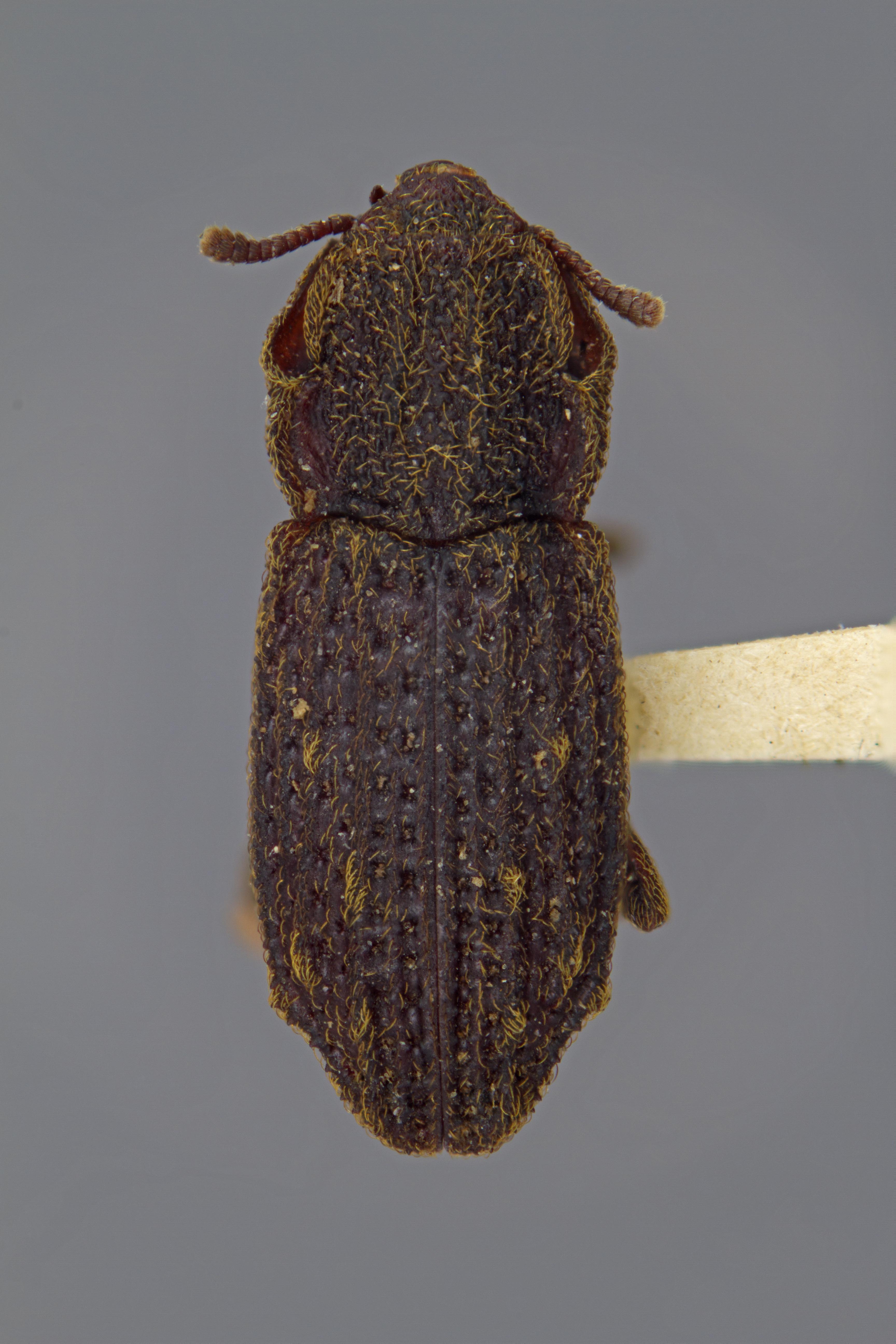
11-segmented with a 3-segmented club. Antennal setation sparse. Subantennal groovessubantennal groove:
groove or concavity lying below the antennal insertion and housing the base of the antenna. Placed between the eye (if present) and the mandibular articulation, and sometimes extends below or behind the eye.
absent. Eyes well-developed, elongate-oval, somewhat reniformreniform:
kidney-shaped.
, coarsely faceted, extending well onto dorsal portion of head. Submentum in male with a setose pit. Pronotumpronotum:
dorsal portion of the pronotum, lying above the lateral pronotal carinae when these are present.
with anterolateral antennal cavities/grooves located above lateral margin, clearly visible from above. Pronotumpronotum:
dorsal portion of the pronotum, lying above the lateral pronotal carinae when these are present.
narrowed anteriorly, distinctly margined laterally. Pronotal discpronotal disc:
the area of the pronotum which is visible dorsally and usually delimited laterally by the two lateral carinae. Contrasted with the paired pronotal hypomera, which extend onto the ventral surface.
distinctly setose. Procoxal cavitiesprocoxal cavities:
external closure: Externally closed when the postcoxal processes of the hypomera meet the prosternal process or meet one another.
closed. Metacoxaemetacoxae:
the coxae of the metathorax.
widely separated, separation as wide as metacoxal length. Abdominal ventriteabdominal ventrite:
visible ventral abdominal sclerite. Ventrite number does not correspond to true sternite number except in rare cases where sternite 1 is visible. Also called ventrite.
5 with a thin preapical groove. Tarsal formulatarsal formula:
the number of tarsomeres on the fore, mid, and hind tarsi, respectively.
5–5–4. Dorsal surface with patches of short, thick, pale setaeseta:
a sclerotized, hairlike (or scalelike) projection of cuticula arising from a single trichogen cell and surrounded at the base by a small cuticular ring.
. Dorsal and ventral surfaces commonly encrusted with dirt and debris.
The genus Usechus is similar to the genus Usechimorpha. Usechus can be readily distinguished by the less compact antennal clubantennal club:
an enlarged portion of the antennal apex, consisting of a variable number of antennomeres (often 3). In an incrassate, antenna the antennomeres gradually enlarge towards to apex, but if there is an abrupt change in length or width at some point, then the antennomeres beyond this are considered to be part of the club.
, closed procoxal cavities, distinctly widened apexapex:
end of any structure distad to the base.
of the prosternal process, and posterolateral depressions of pronotum not connected by a transverse groove at base. In Usechimorpha, the antennal clubantennal club:
an enlarged portion of the antennal apex, consisting of a variable number of antennomeres (often 3). In an incrassate, antenna the antennomeres gradually enlarge towards to apex, but if there is an abrupt change in length or width at some point, then the antennomeres beyond this are considered to be part of the club.
is more abrupt and compact, procoxal cavities are open, the apexapex:
end of any structure distad to the base.
of the prosternal process is truncate, and the posterolateral depressions of pronotum are connected by a transverse groove at base.
Usechus lacerta Motschulsky, 1845, U. nucleatus Casey, 1889Casey, 1889:
Casey TL. 1889. Coleopterological Notices. I. Annals of the New York Academy of Sciences 5: 39-198, illus.
Northwest (OR, WA), Southwest (CA) USA.
Usechus has been collected sifting leaf litter and detritus of oaks, maples and conifers. Usechus lacerta larvae and pupae have been collected in Quercus and associated with fungus under bark of dead maple (Acer macrophyllum) (Doyen and Lawrence 1979Doyen and Lawrence 1979:
Doyen JT and Lawrence JF. 1979. Relationships and higher classification of some Tenebrionidae and Zopheridae (Coleoptera). Systematic Entomology 4: 333-377.).
Abundance: Moderately rare.
Usechus lacerta: Elytral intervals 1, 3, and 5 merge at elytral base to form a transverse carina that does not project forward. Pronotum more uniformly setose except for glabrous posterolateral depressions. Distribution: California, USA.
Usechus nucleatus: Elytral intervals 1, 3, and 5 merge at elytral base to form an abruptly raised tubercle that projects forward. Pronotum less uniformly setose, with larger glabrous posterolateral depressions and a glabrous mediobasal depression. Distribution: California, Oregon, Washington, USA.
Blaisdell (1929)Blaisdell (1929):
Blaisdell FE. 1929. A revision of the beetles of the tenebrionid tribe Usechini, with descriptions of a new genus and new species. Proceedings of the United States National Museum 75 (19): 1-14. divided the genus Usechus into two species, U. nucleatus and U. lacerta. He further divided U. lacerta into 4 varieties (U. lacerta lacerta, U. l. santaclarae, U. l. horni, and U. l. trinitatis). For the purposes of this work, all Usechus lacerta varieties will be treated under one species.
Members of this genus are frequently encrusted with dirt and other debris which may conceal the diagnostic characters.
Blaisdell (1929), Boddy (1965)Boddy (1965):
Boddy, D.W. 1965. Zopheridae. Pp. 77-79. In: M. H. Hatch, ed. The beetles of the Pacific Northwest. Part IV: Macrodactyles, Palpicornes and Heteromera. University of Washington Publications in Biology, 16 (4): 1-268., Casey (1889)Casey (1889):
Casey TL. 1889. Coleopterological Notices. I. Annals of the New York Academy of Sciences 5: 39-198, illus., Doyen and Lawrence (1979)Doyen and Lawrence (1979):
Doyen JT and Lawrence JF. 1979. Relationships and higher classification of some Tenebrionidae and Zopheridae (Coleoptera). Systematic Entomology 4: 333-377., Ivie (2002c)Ivie (2002c):
Ivie, M.A. 2002c. 129. Zopheridae, pp. 457-462 In: R. H. Arnett, Jr., Jr. and M. C. Thomas (eds.), American Beetles. CRC Press, Gainesville, Florida., Motschulsky (1845)Motschulsky (1845):
Motschulsky, V. von. 1845. Remarques sur la collection de Coleopteres russes de Motschulsky. Article 1. Bulletin de la Societe Imperiale des Naturalistes de Moscou, 18: 1-127., Ślipiński and Lawrence (1999)Ślipiński and Lawrence (1999):
Ślipiński, S.A. and J.F. Lawrence. 1999. Phylogeny and classification of Zopheridae sensu novo (Coleoptera: Tenebrionoidea) with a review of the genera of Zopherinae (excluding Monommatini). Annales Zoologici (Warszawa), 49: 1-53.
Authors: Lord NP, Nearns EH, Miller KB. 2011–2015.
Content updated Apr 2015; taxonomy updated Feb 2026
idtools.org