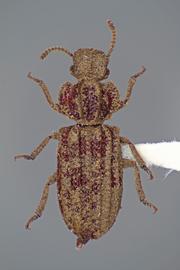
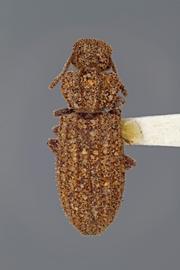
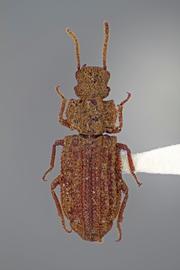
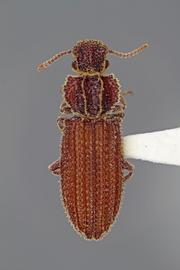
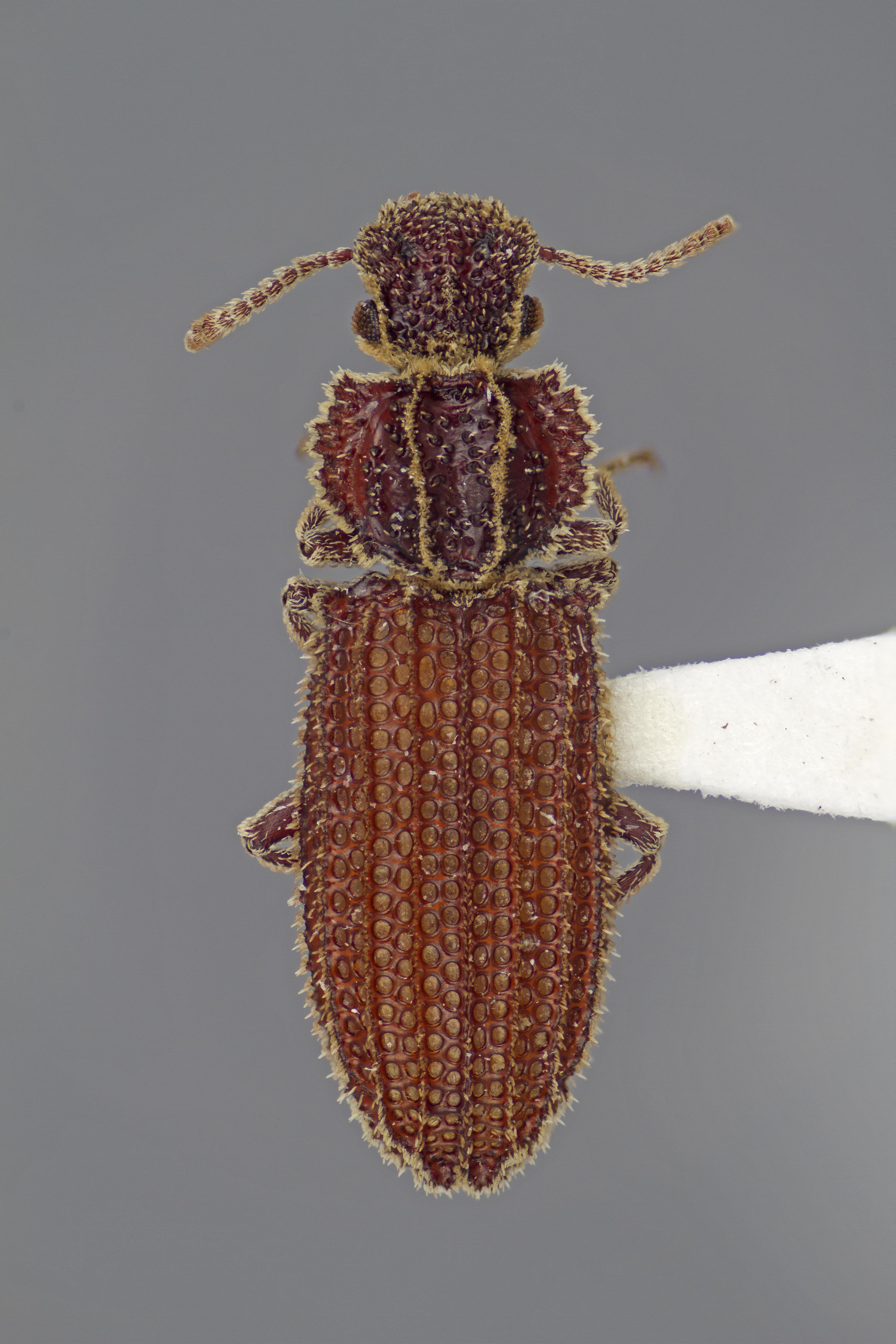
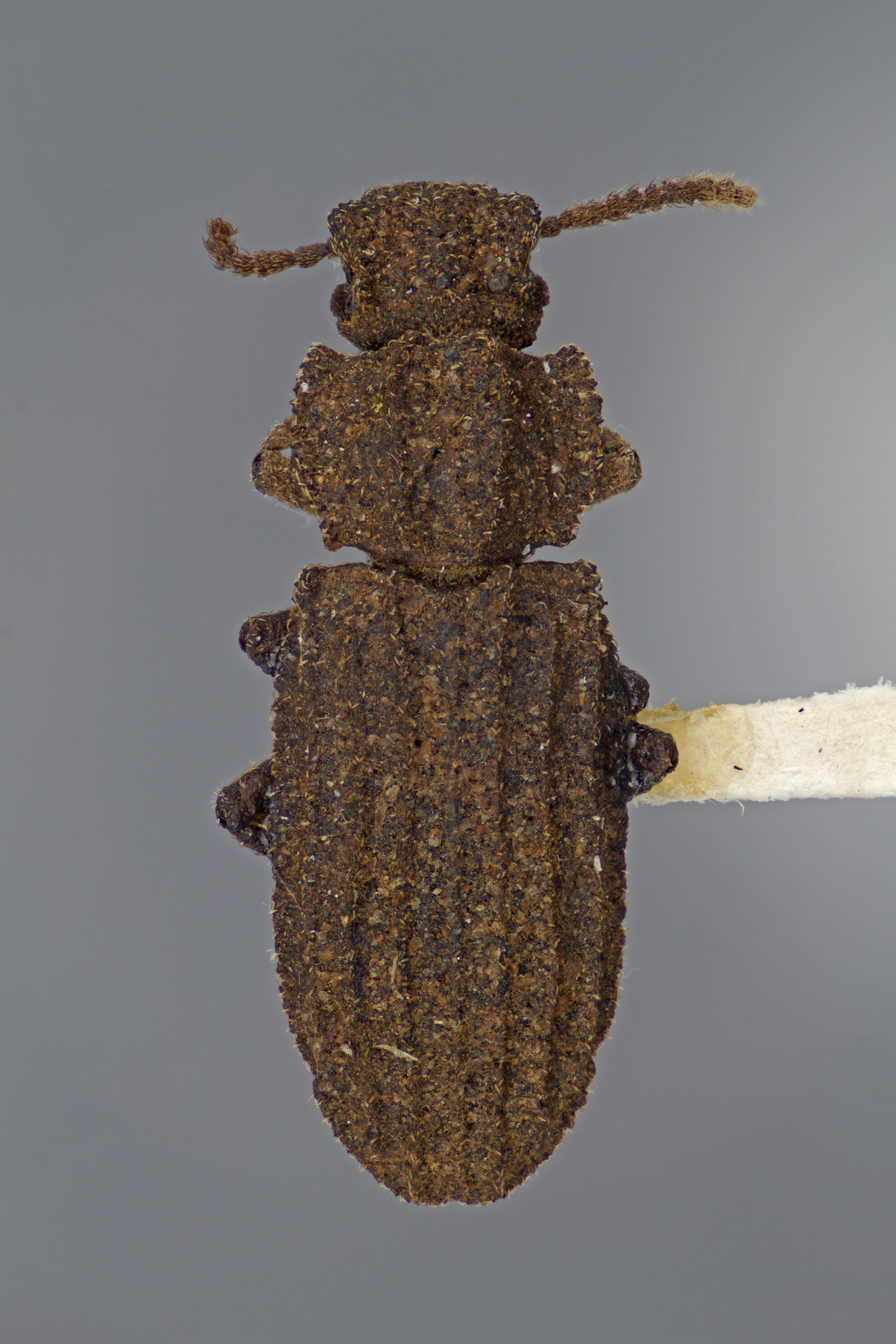
Antennaeantennae:
paired, segmental appendages, borne one on each side of head, functioning as sense organs and bearing a large number of sensilla.
11-segmented with an indistinct, 3-segmented club. Antennal setation dense, scaly. Subantennal grooves/depressions present or absent. Eyes small, coarsely faceted, with scale-like interfacetal setaeseta:
a sclerotized, hairlike (or scalelike) projection of cuticula arising from a single trichogen cell and surrounded at the base by a small cuticular ring.
. Pronotal discpronotal disc:
the area of the pronotum which is visible dorsally and usually delimited laterally by the two lateral carinae. Contrasted with the paired pronotal hypomera, which extend onto the ventral surface.
with a pair of costae. Lateral margin of pronotum serrateserrate:
sawlike, i.e., with notched edges like the teeth of a saw.
, appearing curved or sinuatesinuate:
wavy, applying specifically to edges and margins.
when teeth are filled with debris. Procoxal cavitiesprocoxal cavities:
external closure: Externally closed when the postcoxal processes of the hypomera meet the prosternal process or meet one another.
narrowly open. Metacoxaemetacoxae:
the coxae of the metathorax.
narrowly separated, separation less than metacoxal length. Elytraelytron:
the fore wing in Coleoptera, which is more or less uniformly sclerotized and in resting position is longitudinally oriented, usually meeting the opposite elytron along the midline.
fused. Each elytronelytron:
the fore wing in Coleoptera, which is more or less uniformly sclerotized and in resting position is longitudinally oriented, usually meeting the opposite elytron along the midline.
with 3 costae. Tarsal formulatarsal formula:
the number of tarsomeres on the fore, mid, and hind tarsi, respectively.
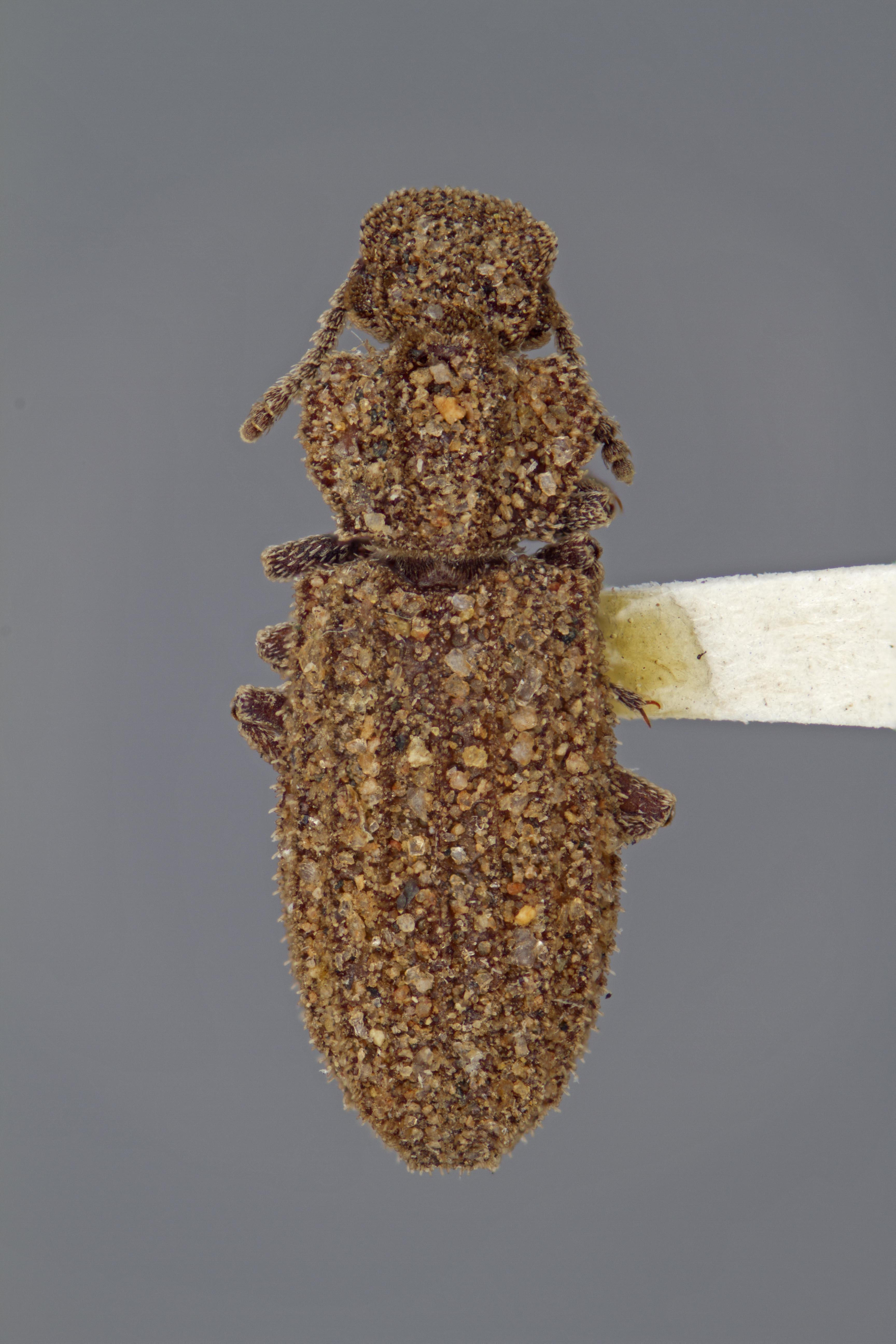
4–4–4. Body usually encrusted with sand, dirt, or debris.
The genus Rhagodera is superficially similar to the genus Pseudocorticus. The lack of elytral carinae and 1-segmented antennal clubantennal club:
an enlarged portion of the antennal apex, consisting of a variable number of antennomeres (often 3). In an incrassate, antenna the antennomeres gradually enlarge towards to apex, but if there is an abrupt change in length or width at some point, then the antennomeres beyond this are considered to be part of the club.
serve to distinguish Pseudocorticus.
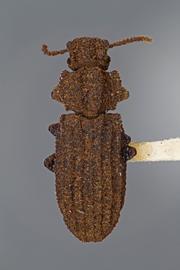
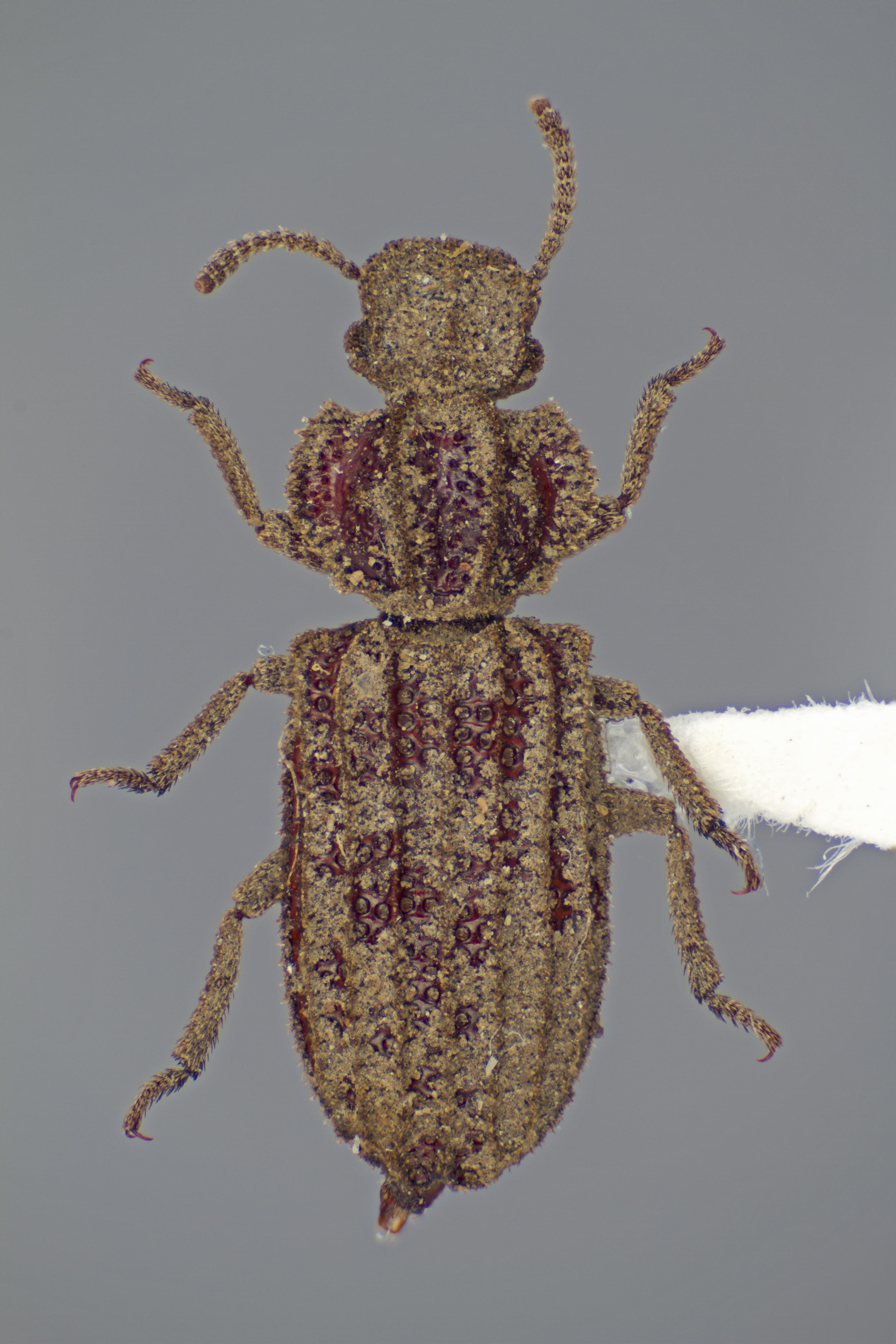
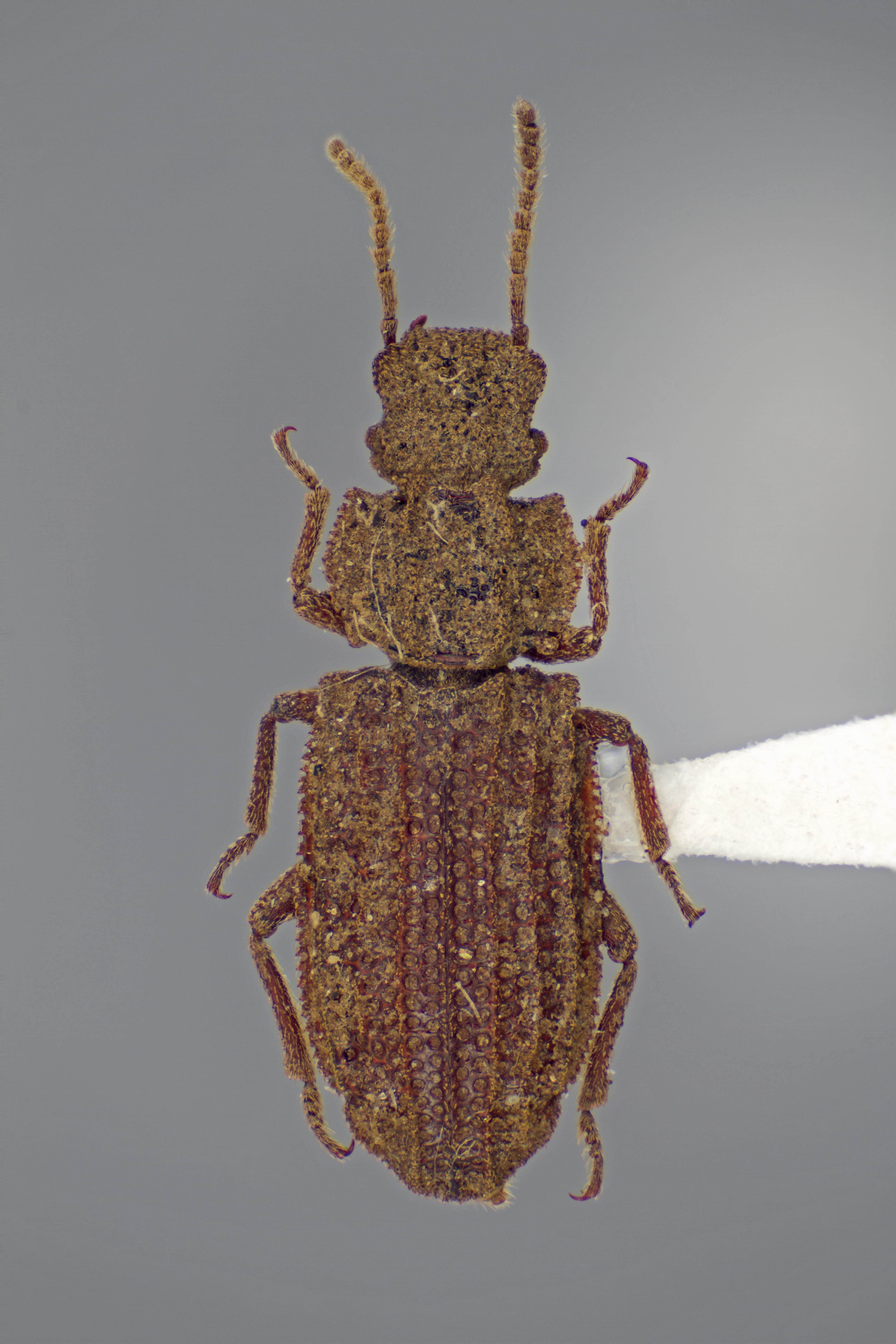
Rhagodera costata Horn, 1867, R. interrupta Stephan, 1989, R. texana Stephan, 1989, R. tuberculata Mannerheim, 1843
Southwestern (AZ, CA, TX) USA; Mexico.
Likely occurs in Southwestern (NM) USA.
Members of this genus are flightless and ground-dwelling. They inhabit arid, deserted regions. The larvae are unknown. Little is known about the biology of this group.
Abundance: Rarely encountered.
Rhagodera tuberculata: Subantennal groove/depression present. Antennal segment 3 not greatly elongate. No elytral costae join near apexapex:
end of any structure distad to the base.
. Second elytral costa not interrupted before apexapex:
end of any structure distad to the base.
. Epipleural foldepipleural fold:
a fold in the elytron which separates the elytral disc from the epipleuron.
does not reach apexapex:
end of any structure distad to the base.
of elytraelytron:
the fore wing in Coleoptera, which is more or less uniformly sclerotized and in resting position is longitudinally oriented, usually meeting the opposite elytron along the midline.
. Distribution: Arizona and California, USA.
Rhagodera interrupta: Subantennal groove/depression absent. Antennal segment 3 greatly elongate. No elytral costae join near apexapex:
end of any structure distad to the base.
. Second elytral costa interrupted before apexapex:
end of any structure distad to the base.
. Epipleural foldepipleural fold:
a fold in the elytron which separates the elytral disc from the epipleuron.
does not reach apexapex:
end of any structure distad to the base.
of elytraelytron:
the fore wing in Coleoptera, which is more or less uniformly sclerotized and in resting position is longitudinally oriented, usually meeting the opposite elytron along the midline.
. Distribution: California, USA.
Rhagodera costata: Subantennal groove/depression present. Antennal segment 3 not greatly elongate. Lateral margin of pronotumpronotum:
dorsal portion of the pronotum, lying above the lateral pronotal carinae when these are present.
appearing sinuatesinuate:
wavy, applying specifically to edges and margins.
when filled with debris. Elytral costae 1 and 2 joined near apexapex:
end of any structure distad to the base.
. Epipleural foldepipleural fold:
a fold in the elytron which separates the elytral disc from the epipleuron.
reaches apexapex:
end of any structure distad to the base.
of elytraelytron:
the fore wing in Coleoptera, which is more or less uniformly sclerotized and in resting position is longitudinally oriented, usually meeting the opposite elytron along the midline.
. Distribution: Southern Arizona, USA.
Rhagodera texana: Subantennal groove/depression present. Antennal segment 3 not greatly elongate. Lateral margin of pronotumpronotum:
dorsal portion of the pronotum, lying above the lateral pronotal carinae when these are present.
appearing evenly curved when filled with debris. Elytral costae 1 and 2 joined near apexapex:
end of any structure distad to the base.
. Epipleural foldepipleural fold:
a fold in the elytron which separates the elytral disc from the epipleuron.
reaches apexapex:
end of any structure distad to the base.
of elytraelytron:
the fore wing in Coleoptera, which is more or less uniformly sclerotized and in resting position is longitudinally oriented, usually meeting the opposite elytron along the midline.
. Distribution: Texas, USA.
Members of this genus are quite distinct from all other members of the subfamily Colydiinae, with a number of characters separating it as a distinct group. The specific placement of this genus in the overall classification of the family is uncertain.
Members of this genus are frequently encrusted with sand and other debris, which may conceal the pronotal and elytral characters. Rhagodera costata and R. texana are very similar. Although unsatisfactory, their distribution serves as the best diagnosis.
Horn (1867)Horn (1867):
Horn, G.H. 1867. Notes on the Zopheri of the United States. Transactions of the American Entomological Society, 1: 159-162., Mannerheim (1843)Mannerheim (1843):
Mannerheim, C.G. von. 1843. Beitrag zur Kaeferfauna der Aleutischen Inseln, der Insel Sitka und Neu-Californiens. Bulletin de la Societe Imperiale des Naturalistes de Moscou, 16(2): 175-314., Stephan (1989)Stephan (1989):
Stephan, K.H. 1989. The Bothrideridae and Colydiidae of America north of Mexico (Coleoptera: Clavicornia and Heteromera). Occasional Papers of the Florida State Collection of Arthropods, 6: xii + 65 pp.
Authors: Lord NP, Nearns EH, Miller KB. 2011–2015.
Content updated Apr 2015; taxonomy updated Feb 2026
idtools.org