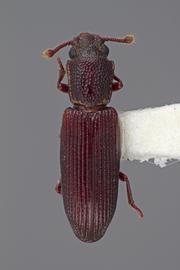
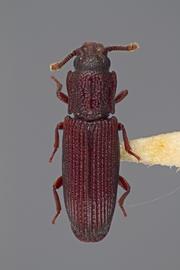
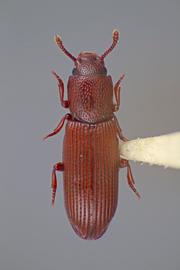
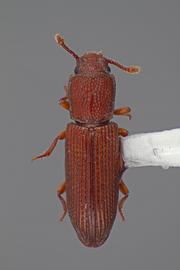
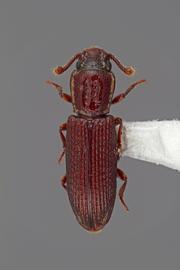
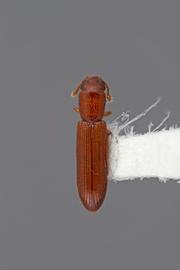
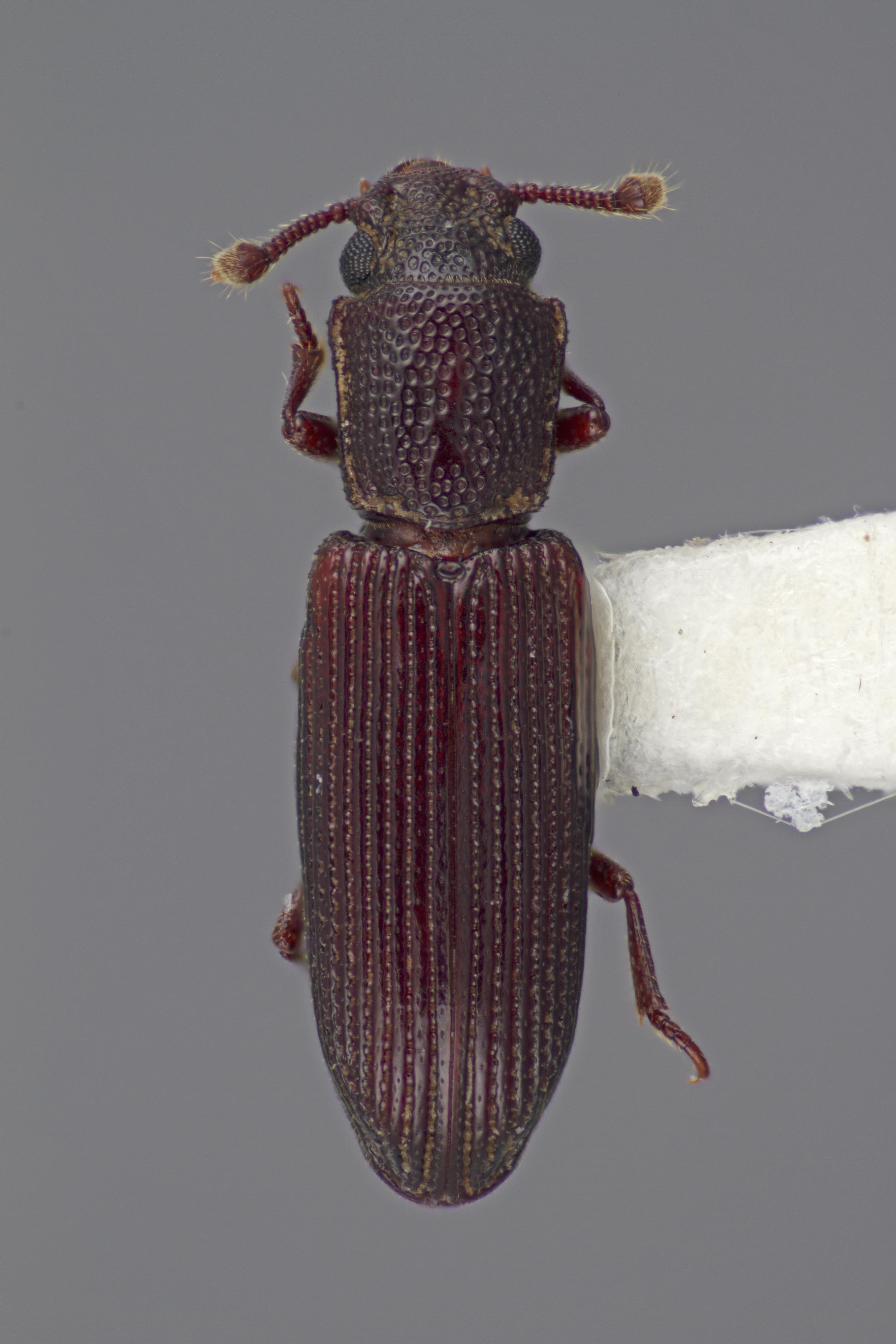
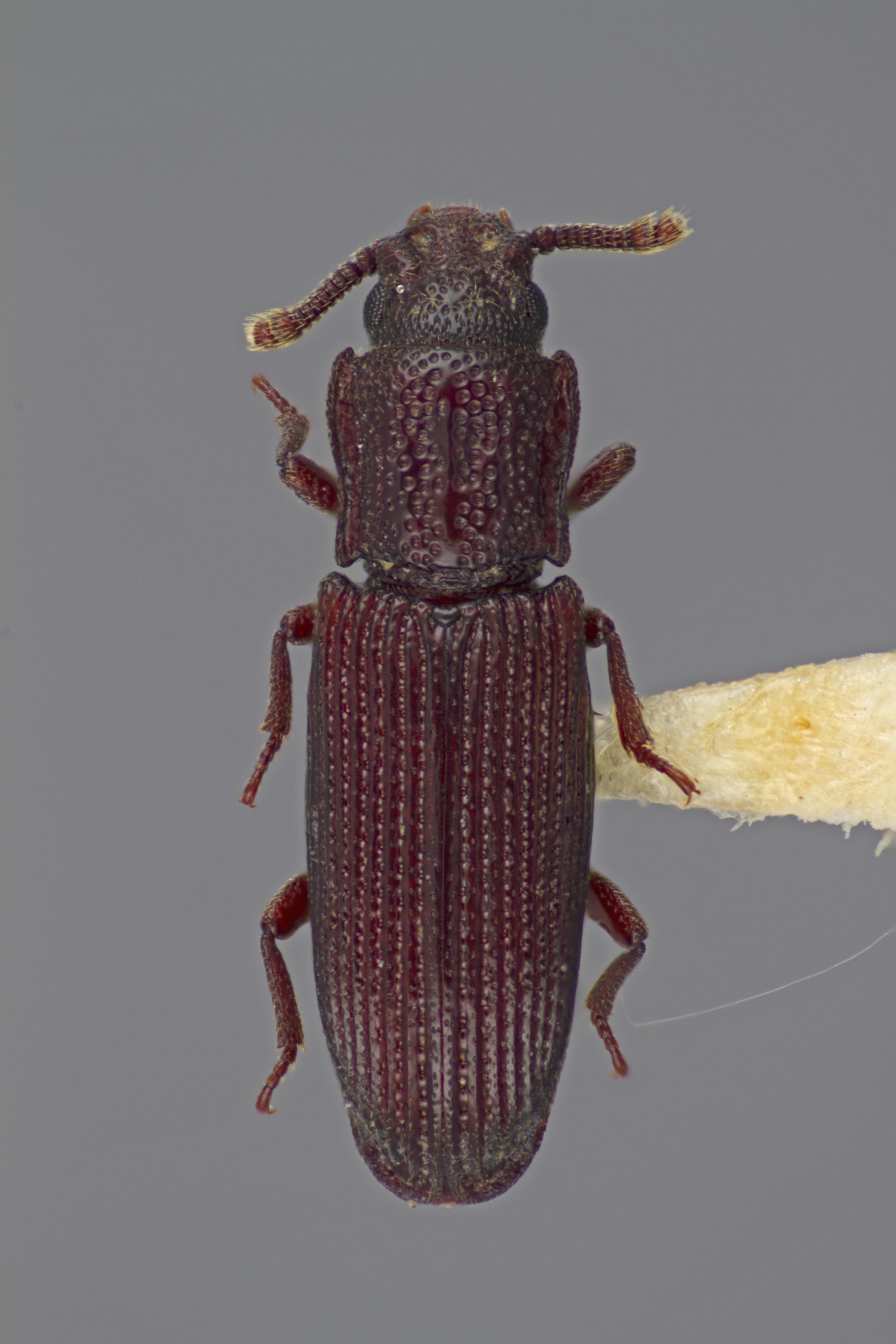
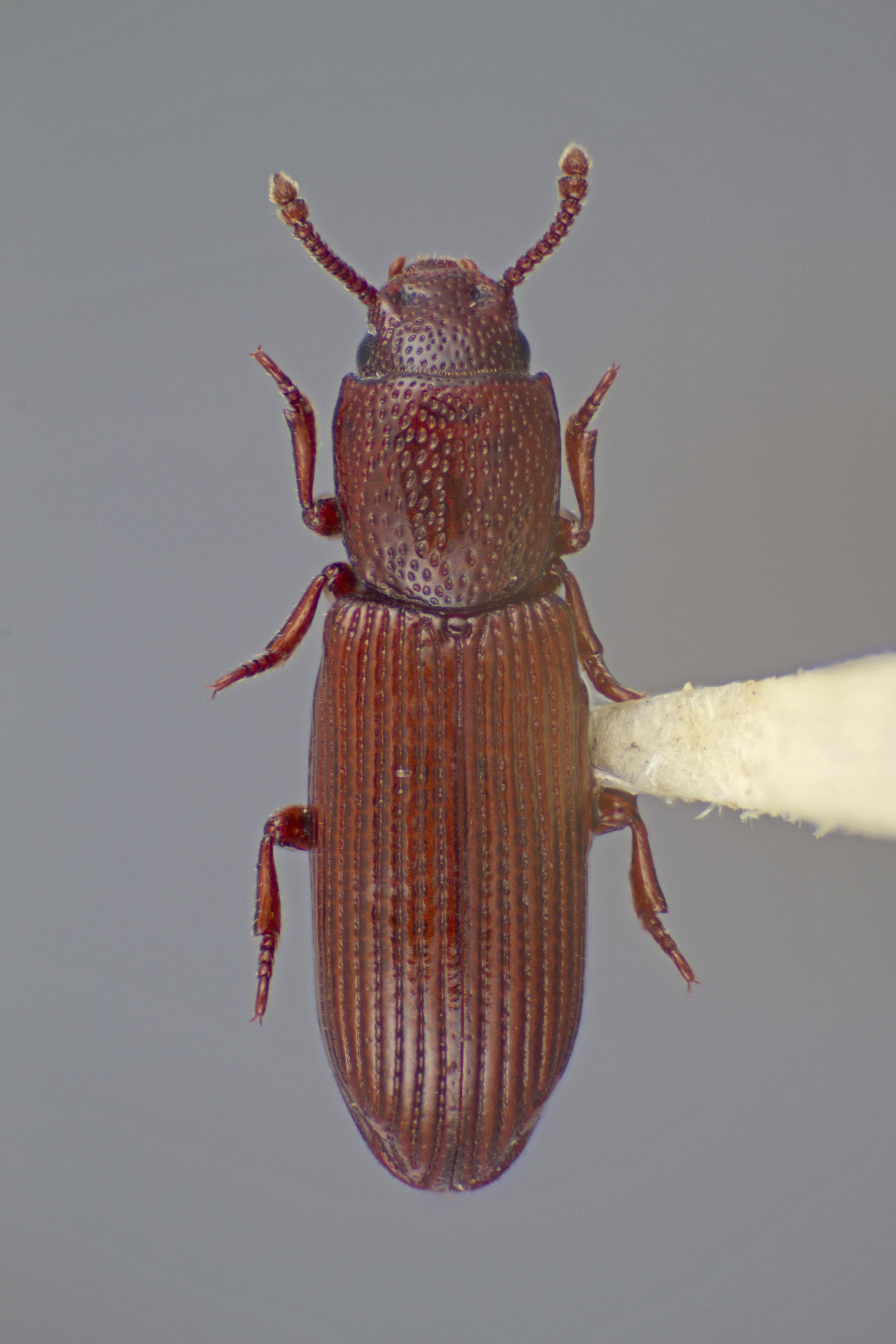
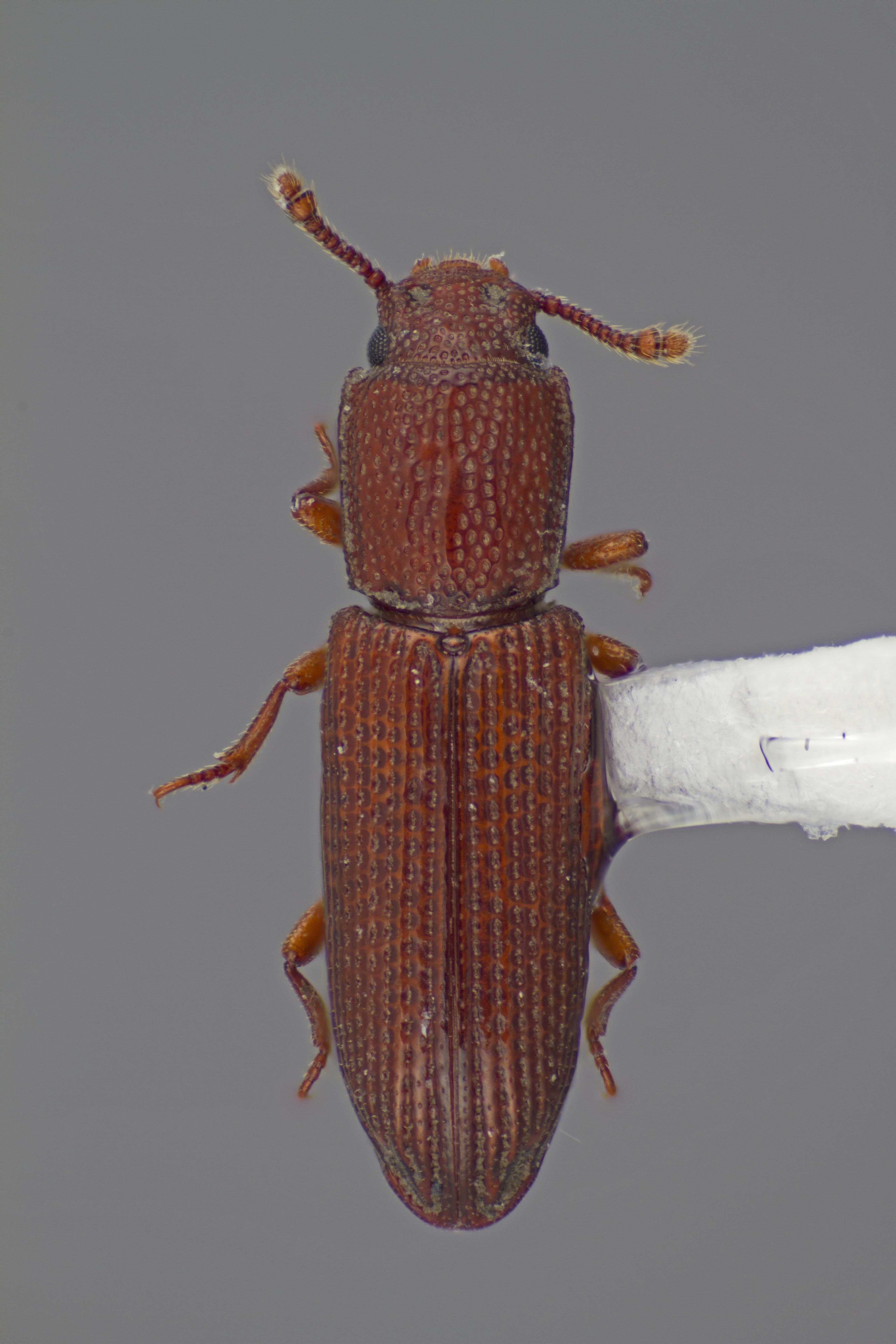
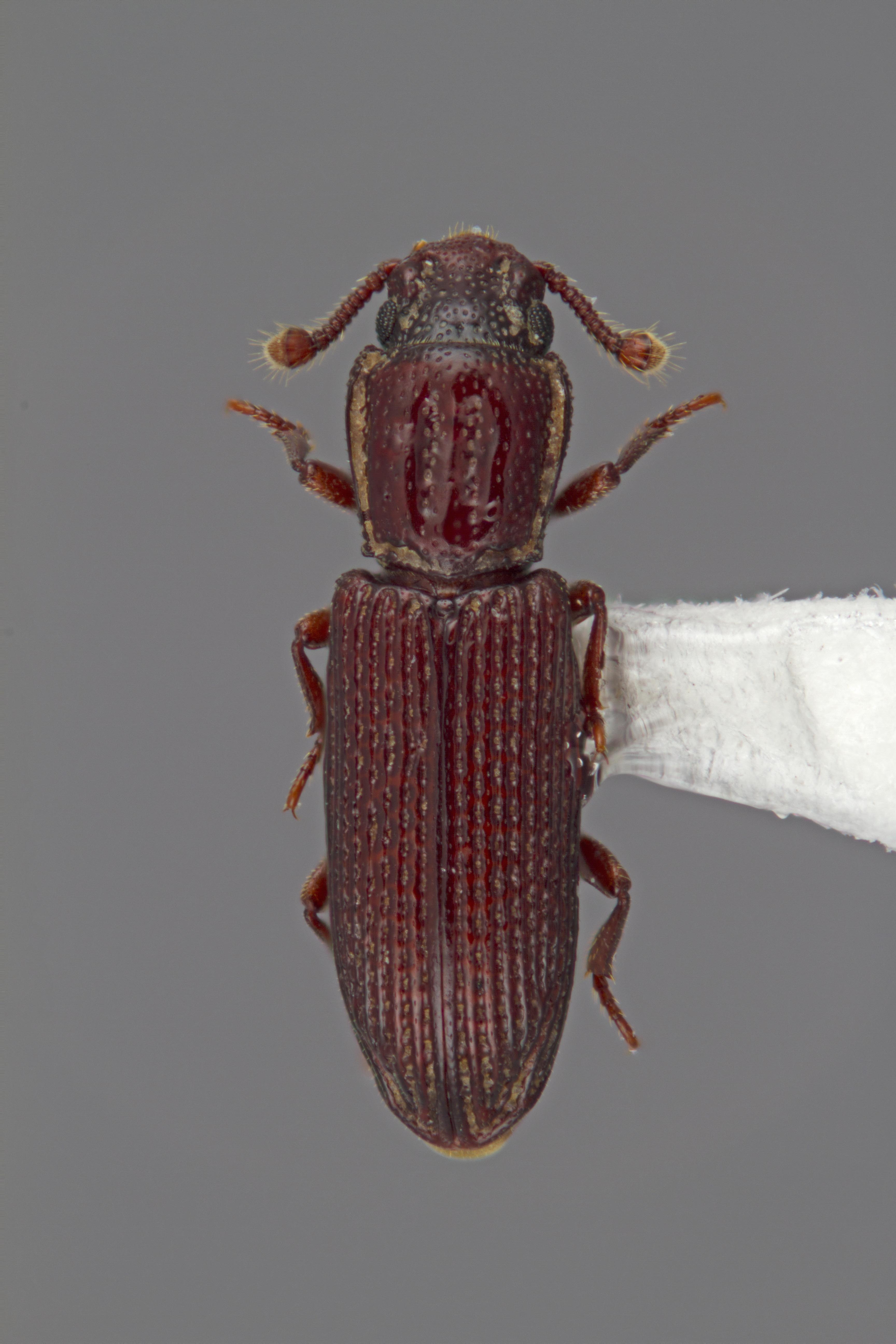
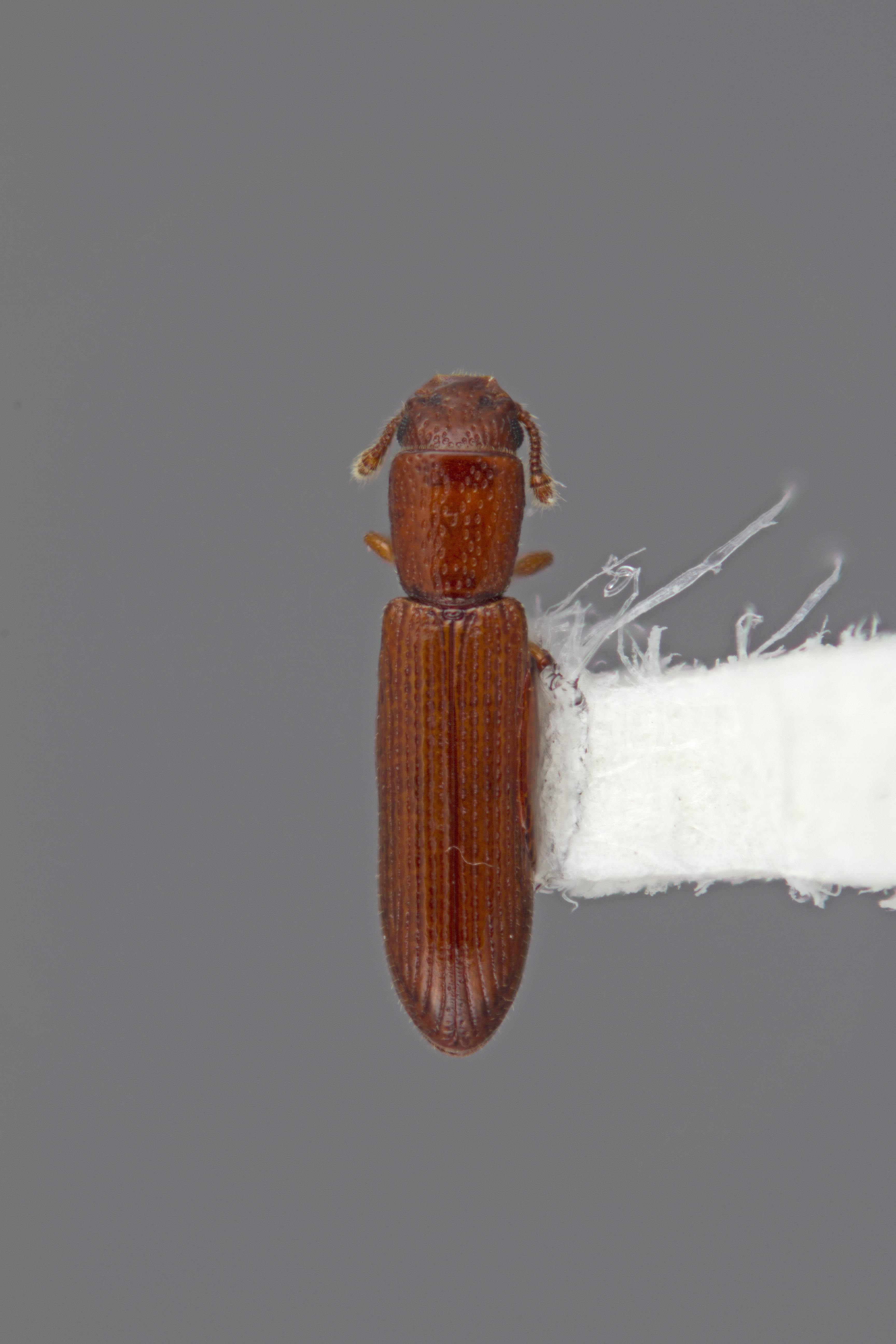
Body elongate, subdepressed. Antennaeantennae:
paired, segmental appendages, borne one on each side of head, functioning as sense organs and bearing a large number of sensilla.
10- or 11-segmented with distinct, 1- or 2-segmented club. Antennal setation sparse. Subantennal groovessubantennal groove:
groove or concavity lying below the antennal insertion and housing the base of the antenna. Placed between the eye (if present) and the mandibular articulation, and sometimes extends below or behind the eye.
absent. Eyes large, well-developed, finely faceted. Submentum in male with a setose pit. Pronotal discpronotal disc:
the area of the pronotum which is visible dorsally and usually delimited laterally by the two lateral carinae. Contrasted with the paired pronotal hypomera, which extend onto the ventral surface.
convex, simple, sometimes with medial depressions. Procoxal cavitiesprocoxal cavities:
external closure: Externally closed when the postcoxal processes of the hypomera meet the prosternal process or meet one another.
broadly closed. Metacoxaemetacoxae:
the coxae of the metathorax.
widely separated, separation as wide as or greater than metacoxal length. Tibiatibia:
the fourth and often the longest segment of the beetle leg, articulated proximally with the femur and distally with the first tarsomere.
with outer angle expanded and produced into a tooth. Tarsal formulatarsal formula:
the number of tarsomeres on the fore, mid, and hind tarsi, respectively.
4–4–4. Abdomen with ventrites 1–3 connateconnate:
united at base, or along the entire length; fused.
. Elytronelytron:
the fore wing in Coleoptera, which is more or less uniformly sclerotized and in resting position is longitudinally oriented, usually meeting the opposite elytron along the midline.
with 10 distinct striae. Dorsal surface glabrousglabrous:
without hairs (setae).
, shiny.
The genus Pycnomerus is distinct among the genera of North America zopherids in having 4–4–4 tarsitarsus:
the fifth segment of the beetle leg, which is articulated proximally with the tibia and distally with the pretarsus; almost always subdivided into two to five tarsomeres.
, widely separated metacoxaemetacoxae:
the coxae of the metathorax.
, sparse antennal setation, and a shiny, glabrousglabrous:
without hairs (setae).
body.
Pycnomerus arizonicus Stephan, 1989, P. haematodes (Fabricius, 1801Fabricius, 1801:
Fabricius JC. 1801. Systema eleutheratorum. Secundum. Ordines, genera, species: adiectis synonymis, locis, observationibus, descriptionibus. Tomus II. Impensis Bibliopolii Adcademici Novi, Kiliae, i-xxiv + 506pp.), P. quercus Stephan, 1989, P. reflexus (Say, 1826), P. sulcicollis LeConte, 1863, P. thrinax Ivie and Ślipiński, 2001
Northeast (DE, MD, NJ, NY, PA, VA), North Central (IL, IN, OH), Southeast (AL, FL, GA, NC, SC, TN), South Central (AR, LA, MS, OK, TX), Northwest (ID, OR), Southwest (AZ) USA; Ontario, Canada
Pycnomerus is commonly collected under the bark of dead, rotting wood (both hardwoods and pines), on rotting palm fronds, and at MV/UV lights at night.
Abundance: Very common.
Pycnomerus arizonicus: Western species. Antennal clubantennal club:
an enlarged portion of the antennal apex, consisting of a variable number of antennomeres (often 3). In an incrassate, antenna the antennomeres gradually enlarge towards to apex, but if there is an abrupt change in length or width at some point, then the antennomeres beyond this are considered to be part of the club.
1-segmented. Pronotumpronotum:
dorsal portion of the pronotum, lying above the lateral pronotal carinae when these are present.
convex, without medianmedian:
on the midline.
, longitudinal depressions. Puncturespuncture:
a small impression on the cuticle, like that made by a needle.
of pronotumpronotum:
dorsal portion of the pronotum, lying above the lateral pronotal carinae when these are present.
more or less uniform in size. Lateral margins of pronotumpronotum:
dorsal portion of the pronotum, lying above the lateral pronotal carinae when these are present.
straight to slightly sinuatesinuate:
wavy, applying specifically to edges and margins.
. Pronotal discpronotal disc:
the area of the pronotum which is visible dorsally and usually delimited laterally by the two lateral carinae. Contrasted with the paired pronotal hypomera, which extend onto the ventral surface.
evenly convexconvex:
the outer curved surface of a segment of a sphere, as opposed to concave.
to lateral margins. Anterioranterior:
in front; before.
angles of pronotumpronotum:
dorsal portion of the pronotum, lying above the lateral pronotal carinae when these are present.
angulate, distinct, posteriorposterior:
hinder or hindmost, opposed to anterior; hind or rear.
angles rounded. Distribution: Arizona, USA.
Pycnomerus haematodes: Eastern species. Antennal clubantennal club:
an enlarged portion of the antennal apex, consisting of a variable number of antennomeres (often 3). In an incrassate, antenna the antennomeres gradually enlarge towards to apex, but if there is an abrupt change in length or width at some point, then the antennomeres beyond this are considered to be part of the club.
2-segmented. Pronotumpronotum:
dorsal portion of the pronotum, lying above the lateral pronotal carinae when these are present.
with 2 medianmedian:
on the midline.
, longitudinal depressions. Puncturespuncture:
a small impression on the cuticle, like that made by a needle.
of pronotumpronotum:
dorsal portion of the pronotum, lying above the lateral pronotal carinae when these are present.
more or less uniform in size. Lateral margins of pronotum sinuatesinuate:
wavy, applying specifically to edges and margins.
. Pronotal discpronotal disc:
the area of the pronotum which is visible dorsally and usually delimited laterally by the two lateral carinae. Contrasted with the paired pronotal hypomera, which extend onto the ventral surface.
with central area flattened or subdepressed. Anterioranterior:
in front; before.
and posteriorposterior:
hinder or hindmost, opposed to anterior; hind or rear.
angles of pronotumpronotum:
dorsal portion of the pronotum, lying above the lateral pronotal carinae when these are present.
angulate, distinct. Distribution: Alabama, Florida, Georgia, Indiana, Maryland, Mississippi, New Jersey, New York, Ohio, Oklahoma, Pennsylvania, South Carolina, Texas, Virginia, USA.
Pycnomerus quercus: Western species. Antennal clubantennal club:
an enlarged portion of the antennal apex, consisting of a variable number of antennomeres (often 3). In an incrassate, antenna the antennomeres gradually enlarge towards to apex, but if there is an abrupt change in length or width at some point, then the antennomeres beyond this are considered to be part of the club.
2-segmented. Pronotumpronotum:
dorsal portion of the pronotum, lying above the lateral pronotal carinae when these are present.
convex, without medianmedian:
on the midline.
, longitudinal depressions. Puncturespuncture:
a small impression on the cuticle, like that made by a needle.
of pronotumpronotum:
dorsal portion of the pronotum, lying above the lateral pronotal carinae when these are present.
more or less uniform in size. Lateral margins of pronotumpronotum:
dorsal portion of the pronotum, lying above the lateral pronotal carinae when these are present.
arcuate. Pronotal discpronotal disc:
the area of the pronotum which is visible dorsally and usually delimited laterally by the two lateral carinae. Contrasted with the paired pronotal hypomera, which extend onto the ventral surface.
evenly convexconvex:
the outer curved surface of a segment of a sphere, as opposed to concave.
to lateral margins. Anterioranterior:
in front; before.
angles of pronotumpronotum:
dorsal portion of the pronotum, lying above the lateral pronotal carinae when these are present.
angulate, distinct, posteriorposterior:
hinder or hindmost, opposed to anterior; hind or rear.
angles rounded. Distribution: Arizona, USA.
Pycnomerus reflexus: Eastern species. Antennal clubantennal club:
an enlarged portion of the antennal apex, consisting of a variable number of antennomeres (often 3). In an incrassate, antenna the antennomeres gradually enlarge towards to apex, but if there is an abrupt change in length or width at some point, then the antennomeres beyond this are considered to be part of the club.
2-segmented. Pronotumpronotum:
dorsal portion of the pronotum, lying above the lateral pronotal carinae when these are present.
convex, without medianmedian:
on the midline.
, longitudinal depressions. Puncturespuncture:
a small impression on the cuticle, like that made by a needle.
of pronotumpronotum:
dorsal portion of the pronotum, lying above the lateral pronotal carinae when these are present.
more or less uniform in size. Lateral margins of pronotumpronotum:
dorsal portion of the pronotum, lying above the lateral pronotal carinae when these are present.
arcuate. Pronotal discpronotal disc:
the area of the pronotum which is visible dorsally and usually delimited laterally by the two lateral carinae. Contrasted with the paired pronotal hypomera, which extend onto the ventral surface.
evenly convexconvex:
the outer curved surface of a segment of a sphere, as opposed to concave.
to lateral margins. Anterioranterior:
in front; before.
and posteriorposterior:
hinder or hindmost, opposed to anterior; hind or rear.
angles of pronotumpronotum:
dorsal portion of the pronotum, lying above the lateral pronotal carinae when these are present.
angulate, distinct. Distribution: Georgia, Illinois, Indiana, Louisiana, Maryland, Mississippi, New Jersey, North Carolina, Ohio, Pennsylvania, South Carolina, Tennessee, Virginia, USA; Ontario, Canada.
Pycnomerus sulcicollis: Eastern species. Antennal clubantennal club:
an enlarged portion of the antennal apex, consisting of a variable number of antennomeres (often 3). In an incrassate, antenna the antennomeres gradually enlarge towards to apex, but if there is an abrupt change in length or width at some point, then the antennomeres beyond this are considered to be part of the club.
1-segmented. Pronotumpronotum:
dorsal portion of the pronotum, lying above the lateral pronotal carinae when these are present.
with 2 medianmedian:
on the midline.
, longitudinal depressions. Puncturespuncture:
a small impression on the cuticle, like that made by a needle.
of pronotumpronotum:
dorsal portion of the pronotum, lying above the lateral pronotal carinae when these are present.
variable in size, puncturespuncture:
a small impression on the cuticle, like that made by a needle.
in central portion of disc larger than surrounding puncturespuncture:
a small impression on the cuticle, like that made by a needle.
. Lateral margins of pronotumpronotum:
dorsal portion of the pronotum, lying above the lateral pronotal carinae when these are present.
arcuate. Pronotal discpronotal disc:
the area of the pronotum which is visible dorsally and usually delimited laterally by the two lateral carinae. Contrasted with the paired pronotal hypomera, which extend onto the ventral surface.
with central area flattened or subdepressed. Anterioranterior:
in front; before.
and posteriorposterior:
hinder or hindmost, opposed to anterior; hind or rear.
angles of pronotumpronotum:
dorsal portion of the pronotum, lying above the lateral pronotal carinae when these are present.
angulate, distinct. Distribution: Alabama, Arkansas, Delaware, Florida, Georgia, Indiana, Mississippi, New Jersey, North Carolina, Oklahoma, South Carolina, Tennessee, Virginia, USA.
Pycnomerus thrinax: Eastern species. Antennal clubantennal club:
an enlarged portion of the antennal apex, consisting of a variable number of antennomeres (often 3). In an incrassate, antenna the antennomeres gradually enlarge towards to apex, but if there is an abrupt change in length or width at some point, then the antennomeres beyond this are considered to be part of the club.
2-segmented. Pronotumpronotum:
dorsal portion of the pronotum, lying above the lateral pronotal carinae when these are present.
convex, without medianmedian:
on the midline.
, longitudinal depressions. Puncturespuncture:
a small impression on the cuticle, like that made by a needle.
of pronotumpronotum:
dorsal portion of the pronotum, lying above the lateral pronotal carinae when these are present.
more or less uniform in size. Lateral margins of pronotumpronotum:
dorsal portion of the pronotum, lying above the lateral pronotal carinae when these are present.
arcuate. Pronotal discpronotal disc:
the area of the pronotum which is visible dorsally and usually delimited laterally by the two lateral carinae. Contrasted with the paired pronotal hypomera, which extend onto the ventral surface.
with central area flattened or subdepressed. Anterioranterior:
in front; before.
and posteriorposterior:
hinder or hindmost, opposed to anterior; hind or rear.
angles of pronotumpronotum:
dorsal portion of the pronotum, lying above the lateral pronotal carinae when these are present.
rounded. Distribution: Known only from the Florida Keys, Florida, USA.
Fabricius (1801)Fabricius (1801):
Fabricius JC. 1801. Systema eleutheratorum. Secundum. Ordines, genera, species: adiectis synonymis, locis, observationibus, descriptionibus. Tomus II. Impensis Bibliopolii Adcademici Novi, Kiliae, i-xxiv + 506pp., Ivie (2002a)Ivie (2002a):
Ivie, M.A. 2002a. 127. Colydiidae, pp. 445-453 In: R. H. Arnett, Jr., Jr. and M. C. Thomas (eds.), American Beetles. CRC Press, Gainesville, Florida., Ivie and Ślipiński (2001a)Ivie and Ślipiński (2001a):
Ivie, M.A. and S.A. Ślipiński. 2001a. Pycnomerus thrinax, a new North American zopherid. Insecta Mundi, [2000] 14: 225-227., LeConte (1863)LeConte (1863):
LeConte, J.L. 1863. New species of North American Coleoptera. Part I. Smithsonian Miscellaneous Collections, 167: 1-92., Say (1826)Say (1826):
Say, T. 1826. Descriptions of new species of coleopterous insects inhabiting the United States. Journal of the Academy of Natural Sciences of Philadelphia, 5(2): 237-284., Ślipiński and Lawrence (1999)Ślipiński and Lawrence (1999):
Ślipiński, S.A. and J.F. Lawrence. 1999. Phylogeny and classification of Zopheridae sensu novo (Coleoptera: Tenebrionoidea) with a review of the genera of Zopherinae (excluding Monommatini). Annales Zoologici (Warszawa), 49: 1-53., Stephan (1989)Stephan (1989):
Stephan, K.H. 1989. The Bothrideridae and Colydiidae of America north of Mexico (Coleoptera: Clavicornia and Heteromera). Occasional Papers of the Florida State Collection of Arthropods, 6: xii + 65 pp.
Authors: Lord NP, Nearns EH, Miller KB. 2011–2015.
Content updated Apr 2015; taxonomy updated Feb 2026
idtools.org