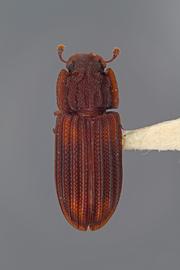
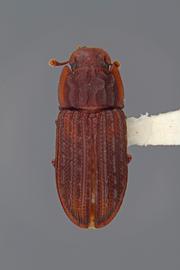
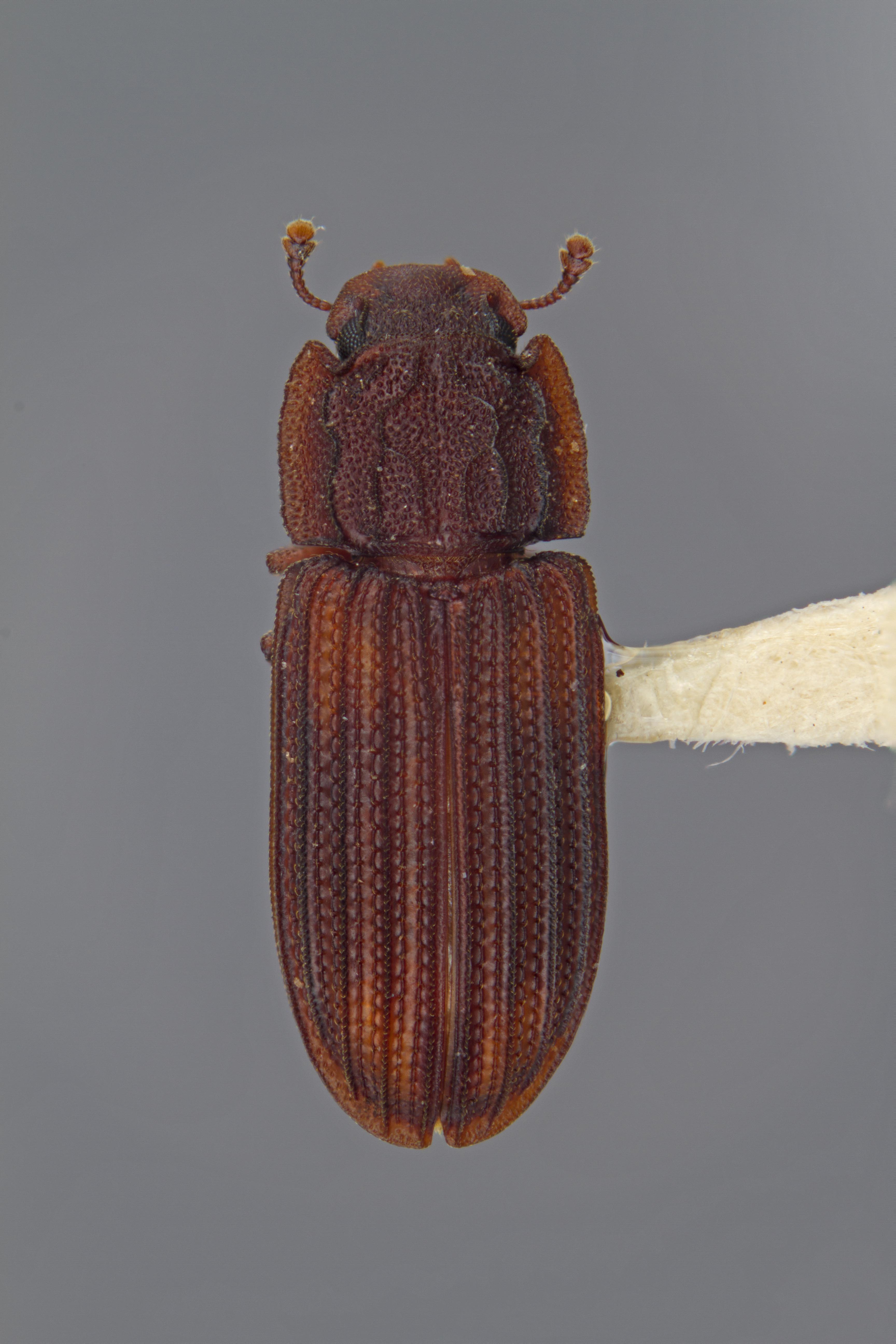
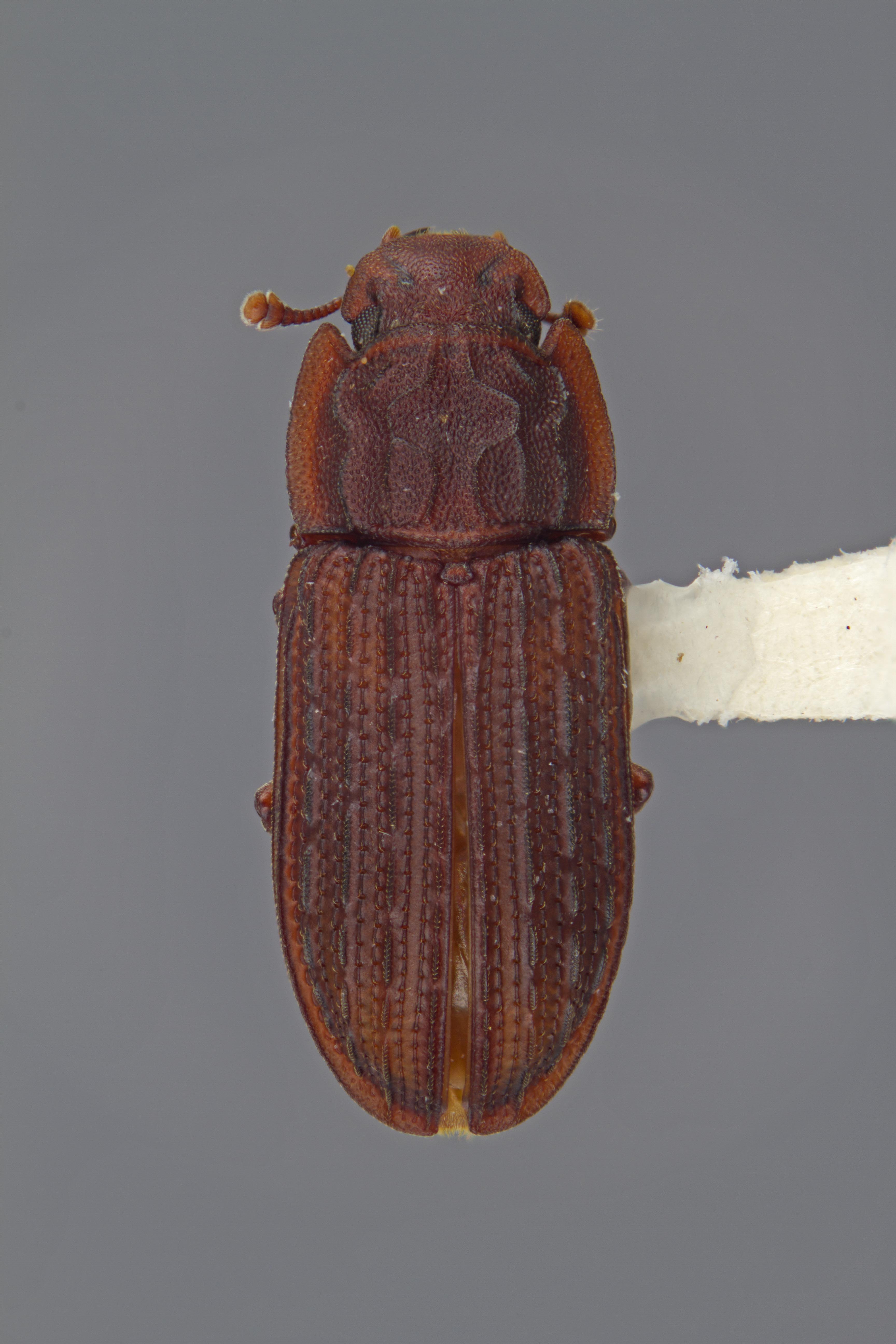
Antennaeantennae:
paired, segmental appendages, borne one on each side of head, functioning as sense organs and bearing a large number of sensilla.
11-segmented with a 2-segmented club (club may appear 3-segmented due to slightly enlarged antennomereantennomere:
antennal segment; including scape, pedicel and flagellomeres. NOTE: the flagellum is composed of all antennal segments proceeding the scape and pedicel. Any individual antennal segment is commonly called an antennomere.
9). Antennal setation sparse. Subantennal groovessubantennal groove:
groove or concavity lying below the antennal insertion and housing the base of the antenna. Placed between the eye (if present) and the mandibular articulation, and sometimes extends below or behind the eye.
present, as long as eyes. Eyes large, well-developed, finely faceted. Eyes deeply emarginateemarginate:
notched at the margin.
anteriorly by projection of fronsfrons:
the area between the eyes and just behind the frontoclypeal suture. In Coleoptera it is not or only rarely separated from the vertex posteriorly.
, forming a distinct canthuscanthus:
a sclerotized bar encroaching on the eye.
. Pronotal discpronotal disc:
the area of the pronotum which is visible dorsally and usually delimited laterally by the two lateral carinae. Contrasted with the paired pronotal hypomera, which extend onto the ventral surface.
convex, with a pattern of sinuate carinaecarina:
an elevated ridge or keel, not necessarily high or acute.
. Procoxal cavitiesprocoxal cavities:
external closure: Externally closed when the postcoxal processes of the hypomera meet the prosternal process or meet one another.
open. Metacoxaemetacoxae:
the coxae of the metathorax.
narrowly separated, separation less than metacoxal length. Elytraelytron:
the fore wing in Coleoptera, which is more or less uniformly sclerotized and in resting position is longitudinally oriented, usually meeting the opposite elytron along the midline.
carinate, with two rows of puncturespuncture:
a small impression on the cuticle, like that made by a needle.
between carinaecarina:
an elevated ridge or keel, not necessarily high or acute.
. Tarsal formulatarsal formula:
the number of tarsomeres on the fore, mid, and hind tarsi, respectively.
4–4–4. Dorsal surface glabrousglabrous:
without hairs (setae).
.
The genus Phloeonemus is superficially similar in general appearance to Denophoelus and Acolobicus but is immediately distinguished by the deeply emarginateemarginate:
notched at the margin.
eyes.
Phloeonemus catenulatus Horn, 1878, P. interruptus Reitter, 1877
South Central (TX), Southwest (AZ, CA) USA.
Likely to occur in Southwestern (NM) USA.
Phloeonemus has been collected at MV/UV lights and from under the bark of mesquite.
Abundance: Moderately common.
Phloeonemus catenulatus: Elytral carinaecarina:
an elevated ridge or keel, not necessarily high or acute.
uniterrupted, solid. Distribution: Arizona, California, Texas, USA.
Phloeonemus interruptus: Elytral carinaecarina:
an elevated ridge or keel, not necessarily high or acute.
numerously interrupted. Distribution: Extreme South Texas, USA.
Horn (1878)Horn (1878):
Horn, G.H. 1878. Synopsis of the Colydiidae of the United States. Proceedings of the American Philosophical Society, 17: 555-592., Ivie (2002a)Ivie (2002a):
Ivie, M.A. 2002a. 127. Colydiidae, pp. 445-453 In: R. H. Arnett, Jr., Jr. and M. C. Thomas (eds.), American Beetles. CRC Press, Gainesville, Florida., Reitter (1877a)Reitter (1877a):
Reitter, E. 1877a. Beitrag zur Kenntniss der Colydier. Stettiner Entomologische Zeitung, 38: 323-356., Stephan (1989)Stephan (1989):
Stephan, K.H. 1989. The Bothrideridae and Colydiidae of America north of Mexico (Coleoptera: Clavicornia and Heteromera). Occasional Papers of the Florida State Collection of Arthropods, 6: xii + 65 pp.
Authors: Lord NP, Nearns EH, Miller KB. 2011–2015.
Content updated Apr 2015; taxonomy updated Feb 2026
idtools.org