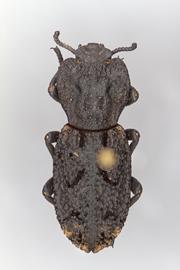
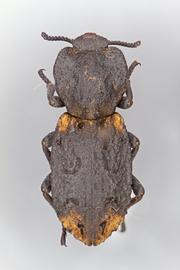
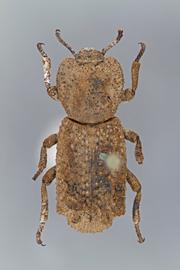
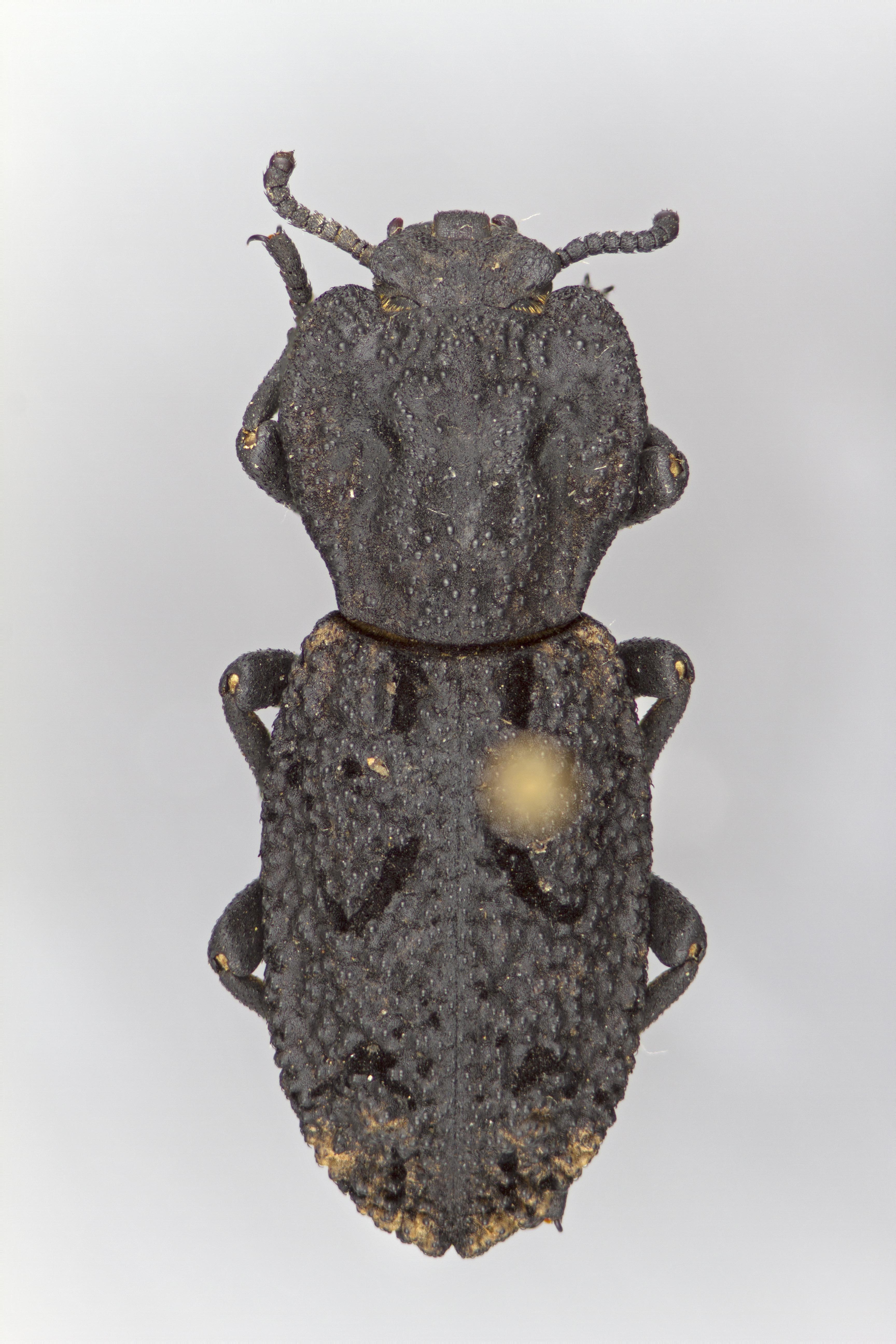
Antennaeantennae:
paired, segmental appendages, borne one on each side of head, functioning as sense organs and bearing a large number of sensilla.
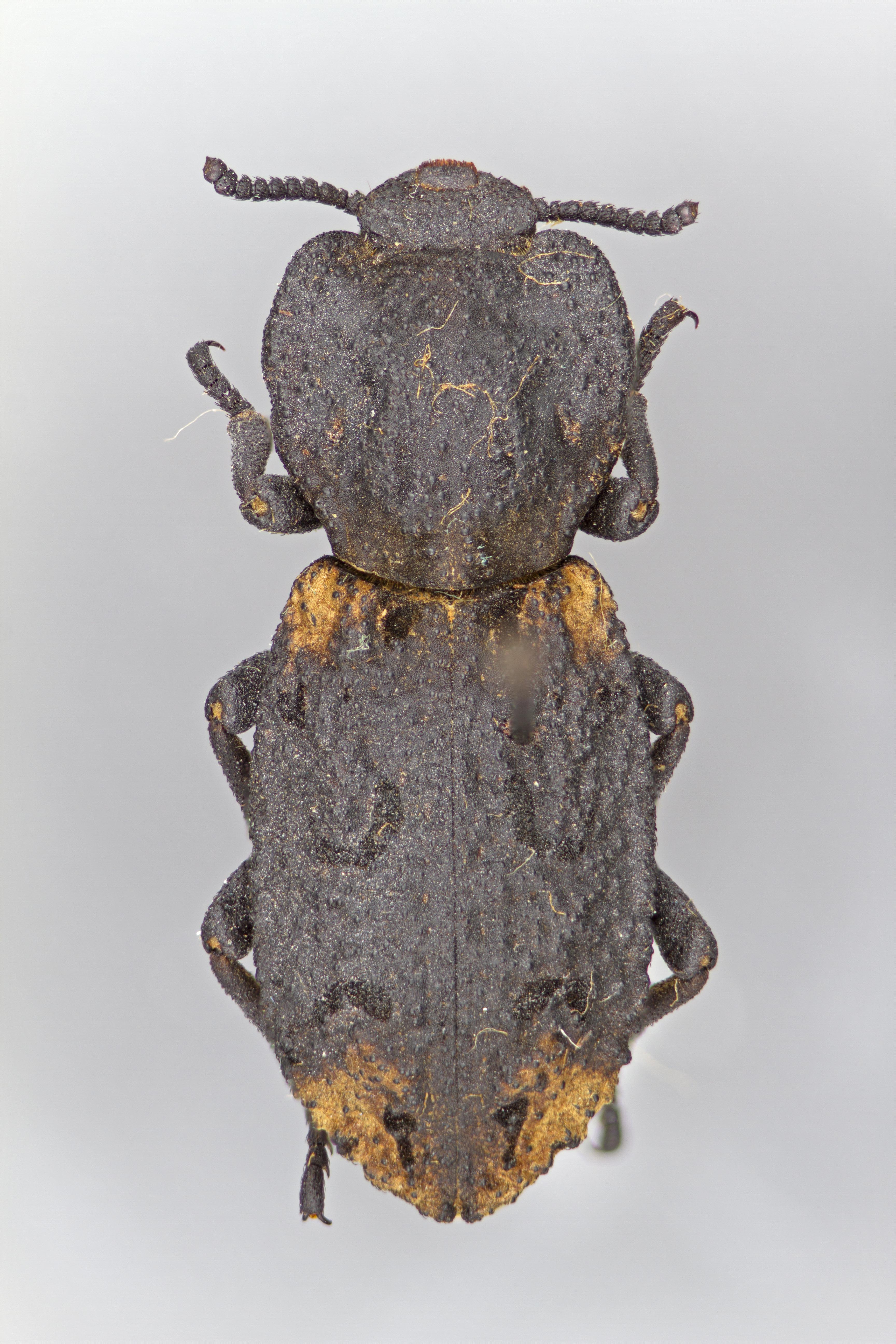
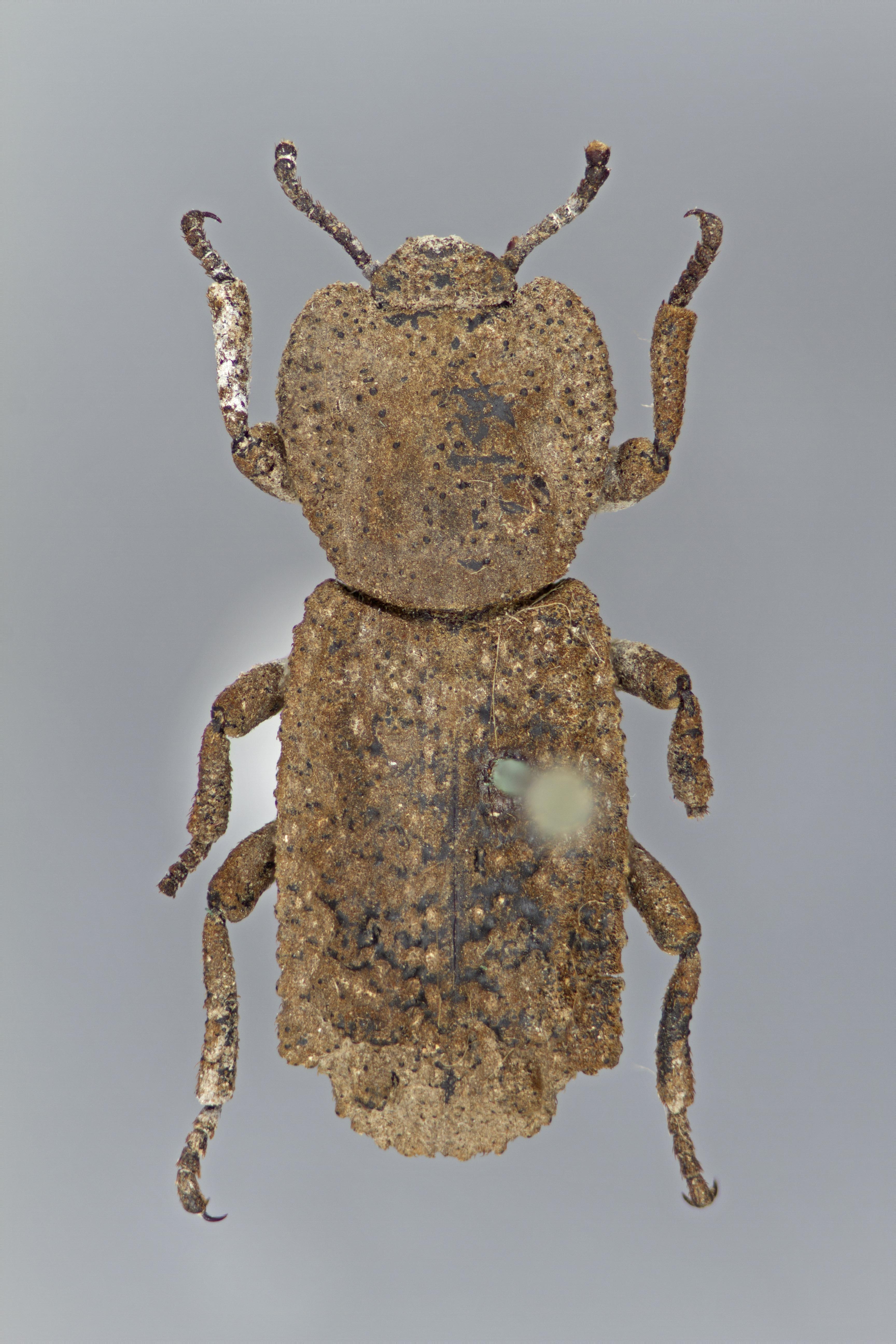
10-segmented with a 2-segmented club. Antennal setation sparse. Eyes well-developed, elongate-oval, somewhat reniformreniform:
kidney-shaped.
, coarsely faceted, extending well onto dorsal portion of head. Lateral margins of pronotumpronotum:
dorsal portion of the pronotum, lying above the lateral pronotal carinae when these are present.
arcuate to sinuatesinuate:
wavy, applying specifically to edges and margins.
, without distinct lobes. Pronotal discpronotal disc:
the area of the pronotum which is visible dorsally and usually delimited laterally by the two lateral carinae. Contrasted with the paired pronotal hypomera, which extend onto the ventral surface.
with several depressions and numerous small, round tuberclestubercle:
a small knoblike or rounded protuberance.
. Apicalapical:
an adjective (or adverb) denoting position near or movement toward the apex of a body part. The apex of the head or pronotum is at the anterior end while that of the abdomen or an elytron is at the posterior end; on the legs or antennae, apical and distal are synonymous.
margin of hypomeronhypomeron:
that portion of the pronotum which is visible from the ventral side; when there is a lateral pronotal carina, this is the portion below that carina (the pronotal disc being above it).
variable, with weak depression to complete antennal cavityantennal cavity:
a prothoracic cavity for housing the whole antenna or a portion of the antenna (usually the club).
. ProsternumProsternum:
used for the entire ventral plate lying in front of and between the procoxae and between the notosternal or pleurosternal sutures.
without distinct transverse groove. Procoxal cavitiesprocoxal cavities:
external closure: Externally closed when the postcoxal processes of the hypomera meet the prosternal process or meet one another.
closed. Metacoxaemetacoxae:
the coxae of the metathorax.
widely separated, separation as wide or wider than metacoxal length. Scutellumscutellum:
posterior portion of mesotergum. Often referring only to that portion of the scutellum which is visible between the bases of the elytra (see Scutellar Shield).
greatly reduced or absent from view. Abdominal ventriteabdominal ventrite:
visible ventral abdominal sclerite. Ventrite number does not correspond to true sternite number except in rare cases where sternite 1 is visible. Also called ventrite.
5 with an irregular preapical groove. Tarsal formulatarsal formula:
the number of tarsomeres on the fore, mid, and hind tarsi, respectively.
5–5–4. Dorsal surface granulose. Dorsal and ventral surfaces commonly encrusted with dirt and debris.
The genus Phloeodes is similar to the genera Sesaspis, Phellopsis, and Zopherus. Phloeodes is most similar to Sesaspis but can be distinguished by antennomereantennomere:
antennal segment; including scape, pedicel and flagellomeres. NOTE: the flagellum is composed of all antennal segments proceeding the scape and pedicel. Any individual antennal segment is commonly called an antennomere.
3 distinctly longer than 4 (in Sesaspis, antennomereantennomere:
antennal segment; including scape, pedicel and flagellomeres. NOTE: the flagellum is composed of all antennal segments proceeding the scape and pedicel. Any individual antennal segment is commonly called an antennomere.
3 only slightly longer than 4) and the pronotal discpronotal disc:
the area of the pronotum which is visible dorsally and usually delimited laterally by the two lateral carinae. Contrasted with the paired pronotal hypomera, which extend onto the ventral surface.
mostly flat, bearing small, round tuberclestubercle:
a small knoblike or rounded protuberance.
(in Sesaspis, with more well-defined raised ridges). Phellopsis can immediately be distinguished by the 11-segmented antennaeantennae:
paired, segmental appendages, borne one on each side of head, functioning as sense organs and bearing a large number of sensilla.
with a 3-segmented club, narrowly open procoxal cavitiesprocoxal cavities:
external closure: Externally closed when the postcoxal processes of the hypomera meet the prosternal process or meet one another.
, hypomeronhypomeron:
that portion of the pronotum which is visible from the ventral side; when there is a lateral pronotal carina, this is the portion below that carina (the pronotal disc being above it).
with lack of depression/antennal cavity, and a small but visible scutellumscutellum:
posterior portion of mesotergum. Often referring only to that portion of the scutellum which is visible between the bases of the elytra (see Scutellar Shield).
. The genus Zopherus can immediately be distinguished by the 9-segmented antennaeantennae:
paired, segmental appendages, borne one on each side of head, functioning as sense organs and bearing a large number of sensilla.
with a 1-segmented club composed of 3 fused segments, the deep antennal cavitiesantennal cavity:
a prothoracic cavity for housing the whole antenna or a portion of the antenna (usually the club).
on the prothoracic hypomerahypomeron:
that portion of the pronotum which is visible from the ventral side; when there is a lateral pronotal carina, this is the portion below that carina (the pronotal disc being above it).
, and the paired rows of fine golden setaeseta:
a sclerotized, hairlike (or scalelike) projection of cuticula arising from a single trichogen cell and surrounded at the base by a small cuticular ring.
on all femorafemur:
the third and usually the stoutest segment of the beetle leg, articulated proximally with trochanter (or if the latter is absent, then the coxa) and distally with the tibia.
and tibiaetibia:
the fourth and often the longest segment of the beetle leg, articulated proximally with the femur and distally with the first tarsomere.
.
Phloeodes diabolicus (LeConte, 1851), P. plicatus (LeConte, 1859)
Southwest (AZ, CA), Northwest (OR) USA.
It is speculated that some members may be morphologically adapted (as larvae) for boring into sound wood (Doyen and Lawrence 1979Doyen and Lawrence 1979:
Doyen JT and Lawrence JF. 1979. Relationships and higher classification of some Tenebrionidae and Zopheridae (Coleoptera). Systematic Entomology 4: 333-377., Ślipiński and Lawrence 1999Ślipiński and Lawrence 1999:
Ślipiński, S.A. and J.F. Lawrence. 1999. Phylogeny and classification of Zopheridae sensu novo (Coleoptera: Tenebrionoidea) with a review of the genera of Zopherinae (excluding Monommatini). Annales Zoologici (Warszawa), 49: 1-53.).
Abundance: Moderately rare.
Phloeodes diabolicus: Antennal cavitiesantennal cavity:
a prothoracic cavity for housing the whole antenna or a portion of the antenna (usually the club).
of prothoracic hypomeronhypomeron:
that portion of the pronotum which is visible from the ventral side; when there is a lateral pronotal carina, this is the portion below that carina (the pronotal disc being above it).
complete, clearly limited (enclosed) posteriorly. Elytral apicalapical:
an adjective (or adverb) denoting position near or movement toward the apex of a body part. The apex of the head or pronotum is at the anterior end while that of the abdomen or an elytron is at the posterior end; on the legs or antennae, apical and distal are synonymous.
declivity with several small, round tuberclestubercle:
a small knoblike or rounded protuberance.
and one larger raised area. Body generally dark black, elytraelytron:
the fore wing in Coleoptera, which is more or less uniformly sclerotized and in resting position is longitudinally oriented, usually meeting the opposite elytron along the midline.
often with pale velvety patches of setaeseta:
a sclerotized, hairlike (or scalelike) projection of cuticula arising from a single trichogen cell and surrounded at the base by a small cuticular ring.
at humeral angles and apexapex:
end of any structure distad to the base.
. Distribution: Arizona, California, Oregon, USA.
Phloeodes plicatus: Antennal cavitiesantennal cavity:
a prothoracic cavity for housing the whole antenna or a portion of the antenna (usually the club).
of prothoracic hypomeronhypomeron:
that portion of the pronotum which is visible from the ventral side; when there is a lateral pronotal carina, this is the portion below that carina (the pronotal disc being above it).
incomplete, not limited (enclosed) posteriorly. Elytral apicalapical:
an adjective (or adverb) denoting position near or movement toward the apex of a body part. The apex of the head or pronotum is at the anterior end while that of the abdomen or an elytron is at the posterior end; on the legs or antennae, apical and distal are synonymous.
declivity with several large, irregular tubercles/raised areas, each elytronelytron:
the fore wing in Coleoptera, which is more or less uniformly sclerotized and in resting position is longitudinally oriented, usually meeting the opposite elytron along the midline.
with three main nodulesnodule:
a small knot or swelling.
. Dorsal vestiturevestiture:
the general surface covering comprised of cuticular projections, e.g., setae, scales, or spicules.
even throughout, generally clothed in lighter colored setaeseta:
a sclerotized, hairlike (or scalelike) projection of cuticula arising from a single trichogen cell and surrounded at the base by a small cuticular ring.
. Distribution: Arizona, California, USA.
Other specimens of Phloeodes have been seen bearing locality data from Alaska, Oklahoma, Pennsylvania, Texas, Washington, and Wisconsin, but these records are questionable. It is doubtful natural populations occur there.
Members of this genus are frequently encrusted with dirt and other debris which may conceal the diagnostic characters.
Foley and Ivie (2008b)Foley and Ivie (2008b):
Foley IA and Ivie MA. 2008b. A phylogenetic analysis of the tribe Zopherini with a review of the species and generic classification (Coleoptera: Zopheridae). Zootaxa 1928: 1-72., Ivie (2002c)Ivie (2002c):
Ivie, M.A. 2002c. 129. Zopheridae, pp. 457-462 In: R. H. Arnett, Jr., Jr. and M. C. Thomas (eds.), American Beetles. CRC Press, Gainesville, Florida., LeConte (1851)LeConte (1851):
LeConte, J.L. 1851. Descriptions of New Species of Coleoptera, from California. Annals of the Lyceum of Natural History of New York, 5: 125-184., LeConte (1859b)LeConte (1859b):
LeConte, J.L. 1859b. Additions to the coleopterous fauna of northern California and Oregon. Proceedings of the Academy of National Science of Philadelphia, 11: 281-282., Ślipiński and Lawrence (1999)Ślipiński and Lawrence (1999):
Ślipiński, S.A. and J.F. Lawrence. 1999. Phylogeny and classification of Zopheridae sensu novo (Coleoptera: Tenebrionoidea) with a review of the genera of Zopherinae (excluding Monommatini). Annales Zoologici (Warszawa), 49: 1-53.
Authors: Lord NP, Nearns EH, Miller KB. 2011–2015.
Content updated Apr 2015; taxonomy updated Feb 2026
idtools.org